By David Chernitzky, CEO & Co-Founder, Armour Cybersecurity · Toronto-based, serving organizations across North America · Last updated July 28, 2026
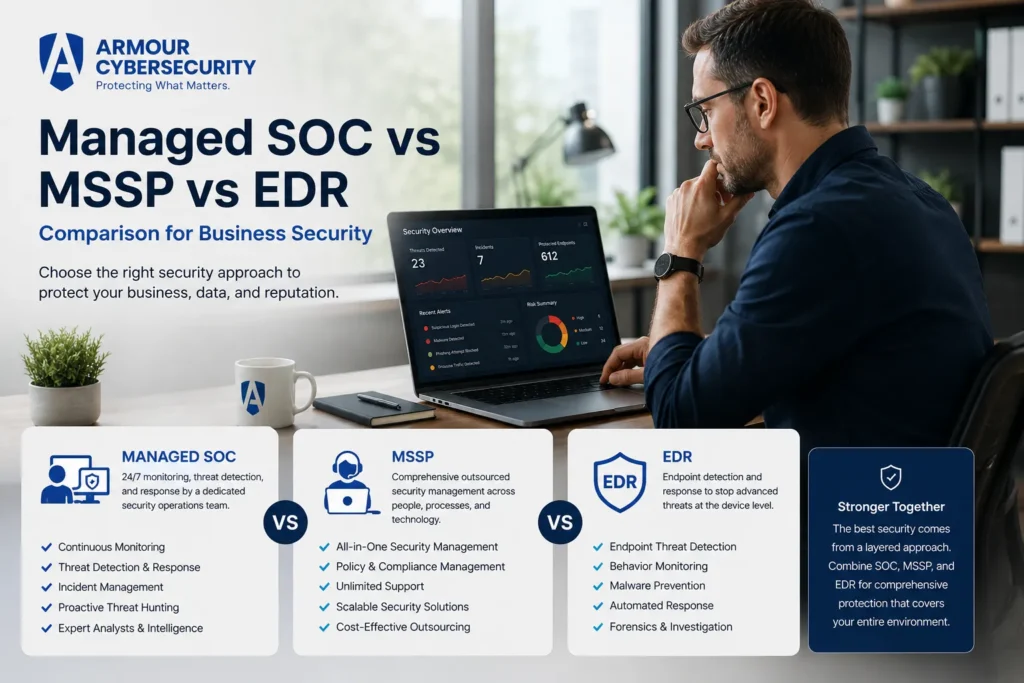
Quick answer: The managed SOC vs MSSP vs EDR question really comes down to one thing: how much of the work the provider actually does. EDR protects individual endpoints. An MSSP manages your security tools and alerts you when something happens. A managed SOC monitors your entire environment, investigates every alert through multiple analyst tiers, and contains threats on your behalf around the clock. For a business that needs real protection rather than alert forwarding, that difference is the whole game.
Key Takeaways
- EDR is a tool, not a service. Someone at your organization still has to watch it and act on what it finds.
- An MSSP manages devices and tools and typically notifies you of alerts. Active investigation and response usually stay with your team.
- A managed SOC delivers 24/7 monitoring, investigation, threat hunting, and incident response as one integrated service from the same team.
- MDR is a service category that overlaps with managed SOC. What matters is analyst depth, response integration, and whether threat hunting is included.
- Most SMBs need more than an MSSP but cannot afford an internal SOC. A managed SOC bridges that gap at a cost built for mid-market budgets.
Why Are These Terms So Confusing?
The vendor market uses this terminology loosely, and the cost of choosing on a wrong assumption is high. A business owner who believes their MSSP provides active threat response, when it really only forwards alerts, is making security decisions on a gap that stays invisible until an incident exposes it.
The cleanest way to cut through the labels is to ask one question of any security service: when a threat is confirmed in my environment at 2 a.m. on a Saturday, what does this provider do, and what does my team have to do? That single answer separates tool vendors from alert services from genuine managed detection and response.
Managed SOC vs MSSP vs EDR, Side by Side
Here is the managed detection and response comparison at a glance, before the detail below.
| Option | What it is | Who acts on threats | Coverage |
|---|---|---|---|
| EDR | Endpoint detection and response software | Your team | Endpoints only |
| MSSP | Managed security tools plus alerting | Mostly your team | Tools and devices, alert-level |
| MDR | Managed detection and response service | The provider, depth varies | Broad, response included |
| Managed SOC | Outsourced 24/7 Tier 1-4 SOC | The provider, end to end | Full environment plus integrated IR |
The rows below unpack what each of these actually means when a real threat shows up.
What Is EDR and What Does It Not Do?
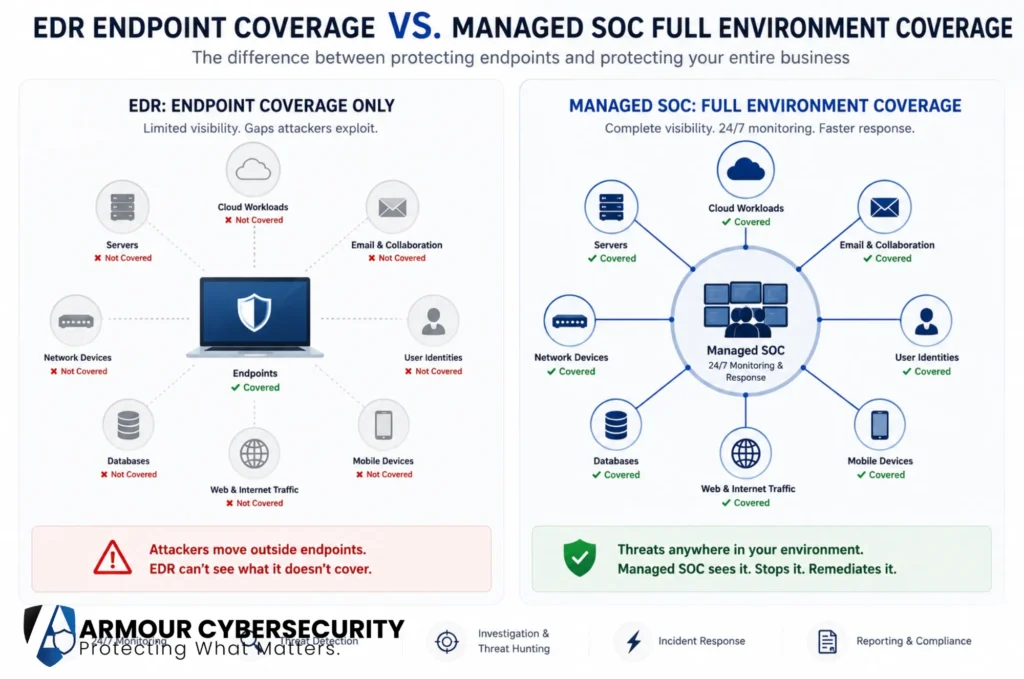
Endpoint Detection and Response, or EDR, is software that runs on individual devices: laptops, desktops, and servers. Endpoint detection and response tools watch process execution, file activity, network connections, and user behavior on each device, and raise an alert when something looks malicious.
EDR is a valuable and necessary part of a modern security program. It is not a managed service. The alerts it generates go to whoever is responsible for reviewing them at your organization. If that person is an IT manager who also runs infrastructure, the helpdesk, and 30 other things, those alerts compete with everything else on the list. EDR with nobody watching the output offers limited protection against sophisticated threats that need a fast, expert response.
EDR also covers only endpoints. An attacker who compromises a cloud environment, exploits a misconfigured network device, or uses a legitimate account to reach a SaaS application generates no EDR alert at all. The gap outside the endpoint layer is wide.
What Is an MSSP and What Are Its Limitations?
A Managed Security Service Provider, or MSSP, manages the security tools in your environment. That usually means firewall management, device monitoring, patch coordination, and alert notification. The MSSP watches the tools and tells you when something looks wrong.
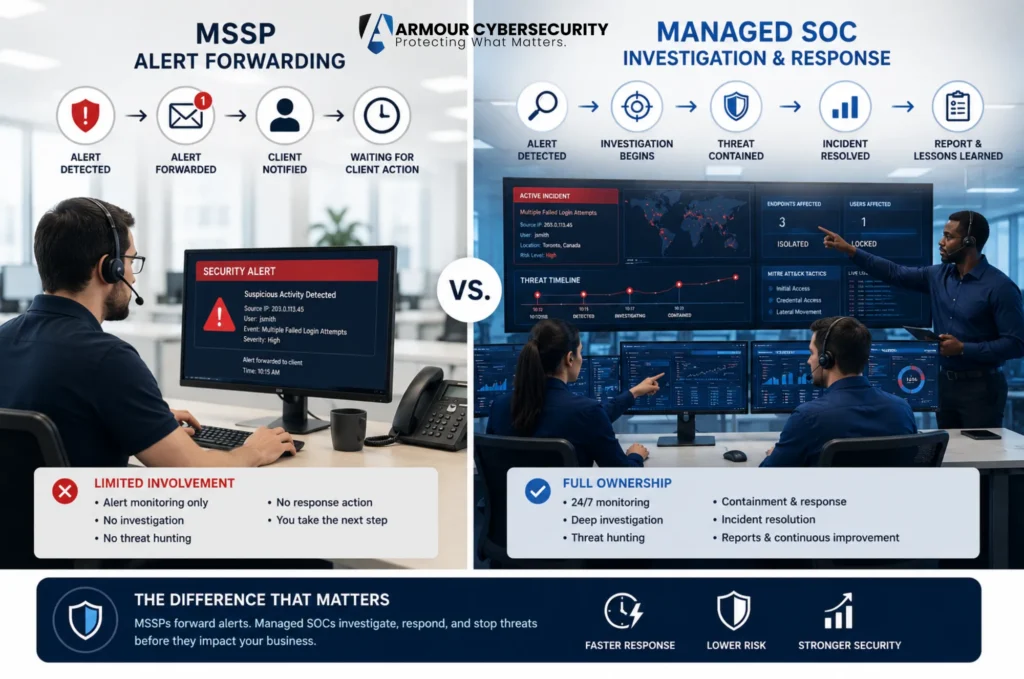
The limit of the traditional MSSP model is the depth it operates at. Most MSSP services are built around Tier 1 alert monitoring. The analyst on duty works the alert queue, closes obvious false positives, and forwards the rest to the client. Investigation, correlation across data sources, threat hunting, and incident response are usually not part of the deal. Those jobs land back on the client’s internal team.
For a business with no internal security capability, that creates a gap. Getting an alert is not the same as having the threat contained. An MSSP that notifies you of a suspicious login at 3 a.m. has done its job. What happens next, how fast, and whether the threat is stopped before it does damage depends entirely on what you do with that notification. This is the core of the difference between an MSSP and a managed SOC.
What Is MDR and How Is It Different?
Managed Detection and Response goes past alert forwarding to include active investigation and response. An MDR provider does not just flag an alert. Its analysts investigate the alert, decide whether it is a real threat, and take containment actions on the client’s behalf.
MDR as a category varies a lot between providers. Some MDR offerings are full managed SOC operations with multiple analyst tiers, integrated threat hunting, and in-house threat intelligence. Others are software-centric services that automate response from pre-set rules with little human investigation. When you evaluate MDR, the makeup of the analyst team and the depth of the response matter far more than the label on the box. That is also where the MDR vs MSSP line gets drawn: MDR responds, a classic MSSP notifies.
What Does a Managed SOC Provide That Others Do Not?
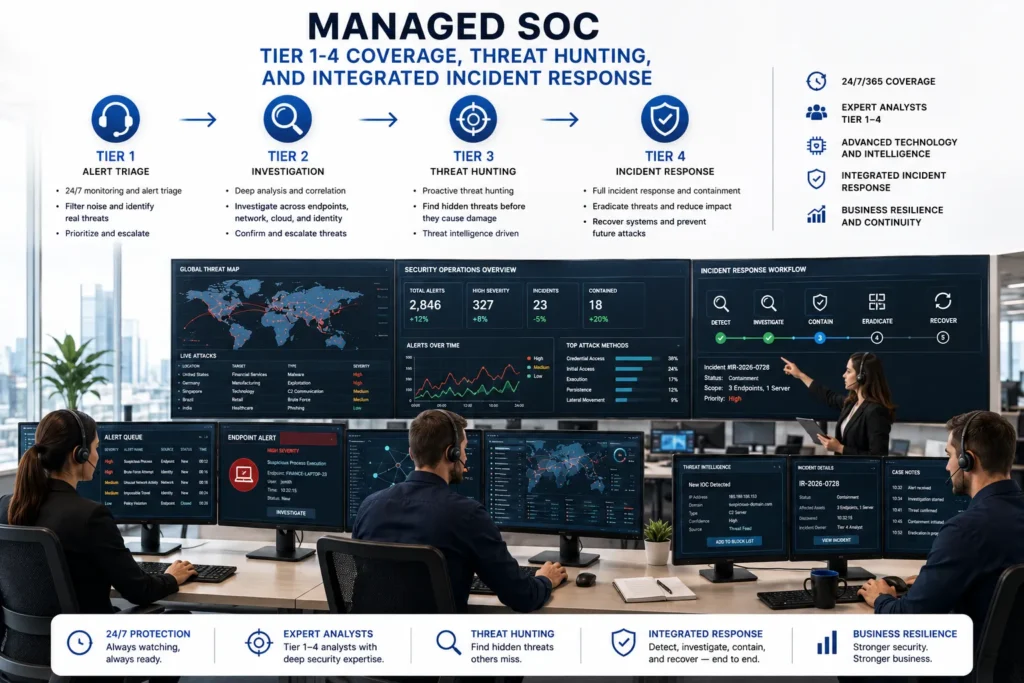
A managed SOC built on a Tier 1-4 operating model delivers what individual tools and basic monitoring services cannot. The distinctions that matter most for an SMB weighing options:
Full analyst coverage, not just Tier 1
Plenty of monitoring services staff Tier 1 analysts for initial triage. Investigation, threat hunting, and incident command need Tier 2, 3, and 4 expertise. A managed SOC with all four tiers means complex threats get investigated and resolved by analysts with the right depth, without you having to find that expertise at the exact moment you need it most.
Integrated incident response
When an alert becomes a confirmed incident, the managed SOC’s integrated incident response function engages from the same team. No handoff to a separate IR vendor, no delay while a new team gets briefed, no gap in the chain of custody. The analysts who opened the alert are the ones who contain and remediate it.
Proactive threat hunting
Rule-based detection catches known patterns. Proactive threat hunting finds attacker activity that has not tripped a rule yet. Adversaries who use legitimate tools and stolen credentials, the living-off-the-land approach, can operate inside a network for months without triggering automated detection. Tier 3 threat hunting finds them before they finish the job.
Custom detection rules
Out-of-the-box SIEM rules are generic. Rules tuned to your environment, your industry’s threat landscape, and the techniques of the adversaries targeting your sector produce more relevant alerts and fewer false positives. Armour’s Managed SOC deploys over 500 custom detection rules, refreshed continuously by the in-house threat research team and fed by current threat intelligence.
Compliance-ready reporting
Board reports, audit evidence, and cyber insurance documentation need more than alert counts. A managed SOC produces weekly and monthly reports that turn operational metrics into governance language, with the detail auditors and carriers actually ask for.
Which Option Is Right for Your Business?
The right answer depends on what you need the security function to actually do.
If your main need is endpoint protection and you have internal staff with time to review and act on alerts during business hours, EDR with a managed wrapper may be enough. If you operate in a regulated environment, hold sensitive client data, or have already seen an incident expose gaps in detection and response, a managed SOC is the appropriate level of coverage. It helps to understand how small businesses get hacked, because the attack paths rarely respect the boundaries of any single tool. For the fuller picture of the operation itself, see our breakdown of what a modern SOC does.
For most SMBs, the managed SOC model closes the gap between what the threat landscape demands and what an internal IT team can realistically deliver. It provides 24/7 coverage, expert investigation, and integrated response at a fraction of the cost of building the equivalent in-house.
Frequently Asked Questions
Can a small business with 50 employees benefit from a managed SOC?
Yes. Company size determines budget, not threat exposure. A 50-person accounting firm holds financial data for hundreds of clients and is a meaningful target. A 50-person law firm holds privileged communications. The value of 24/7 monitoring and response is directly proportional to what the business holds and what it would cost to recover from a breach, not to headcount.
Do I need both EDR and a managed SOC?
Yes. EDR is a data source that feeds into the managed SOC, providing endpoint telemetry that the SOC correlates with network, cloud, and identity signals. The managed SOC is the function that monitors EDR output 24/7, investigates EDR alerts, and responds to confirmed threats. Neither replaces the other; they operate in combination.
What is the difference between a managed SOC and managed detection and response (MDR)?
MDR is a service category; managed SOC describes the delivery model. An MDR service can be delivered through a managed SOC. The critical evaluation criteria are the same regardless of what a provider calls their service: how many analyst tiers are covered, whether incident response is integrated or separate, whether threat hunting is proactive, and what reporting is produced. A managed SOC with a Tier 1-4 model satisfies all of these criteria.
How do I know if my current MSSP is providing real security value?
Ask these questions: what happens in the first 30 minutes after a confirmed threat is detected at 2 a.m.? How many analyst tiers does the team cover? Is incident response included or is that a separate engagement? What evidence does the service produce for compliance and board reporting? If the answers reveal that the MSSP forwards alerts and leaves investigation and response to your team, you have a monitoring service, not a managed SOC.
What makes a detection rule “custom” versus a standard rule?
Standard rules come with the SIEM out of the box and are designed to catch broadly applicable threat patterns. Custom rules are developed specifically for the client environment, the industry they operate in, and the adversary techniques most relevant to their threat profile. A financial services firm needs detection rules tuned for credential theft and business email compromise. A manufacturing company needs rules tuned for OT-specific attack patterns. Custom rules reduce false positives from generic alerts and increase detection of the threats that actually matter to that organization.
The Bottom Line
EDR, MSSP, MDR, and managed SOC are not competing labels for the same thing. They are different amounts of work done on your behalf, and the gap between them only becomes obvious when a real threat lands after hours. If your business holds data worth protecting and cannot staff a round-the-clock team of its own, Armour’s Managed SOC covers the full Tier 1-4 operation, from the first alert through integrated response, on your existing SIEM or as a turnkey deployment. Protecting what matters means matching the service to what you actually need it to do.
About the author
David Chernitzky is the CEO and Co-Founder of Armour Cybersecurity, a Toronto-based firm that protects organizations across North America from advanced cyber threats. He brings more than 25 years of cybersecurity and military cyber intelligence experience, having served as an officer in an elite technology unit before co-founding Armour. Armour’s team of military-intelligence veterans and senior advisors serves 260+ clients across 52+ industries with a 97% client retention rate.