By David Chernitzky, CEO & Co-Founder, Armour Cybersecurity · Toronto-based, serving organizations across North America · Last updated July 30, 2026
Quick answer: Brand impersonation attacks on small business create convincing fake versions of your company: lookalike domains, fraudulent websites, and phishing pages that target your customers and employees. Most of these campaigns are detectable before they launch, because attackers have to register domains, build infrastructure, and test pages before going live. Early detection is what separates a contained threat from a customer-harming, reputation-damaging incident.
Key Takeaways
- Lookalike domains designed to impersonate your brand are registered and operational within hours. Most businesses only learn about them after customers report being defrauded.
- Phishing pages that mimic your login portal or payment page can harvest employee and customer credentials at scale before anyone on your team is aware they exist.
- Brand impersonation is not limited to large organizations. Any business with a recognizable domain, customer-facing services, or a payment process is a viable target.
- Domain and brand monitoring detects these threats at registration or deployment, before campaigns go live, rather than after damage is done.
- Takedown processes can remove fraudulent domains and pages within hours when the right evidence and contacts are in place.
What Is Brand Impersonation in Cybersecurity?
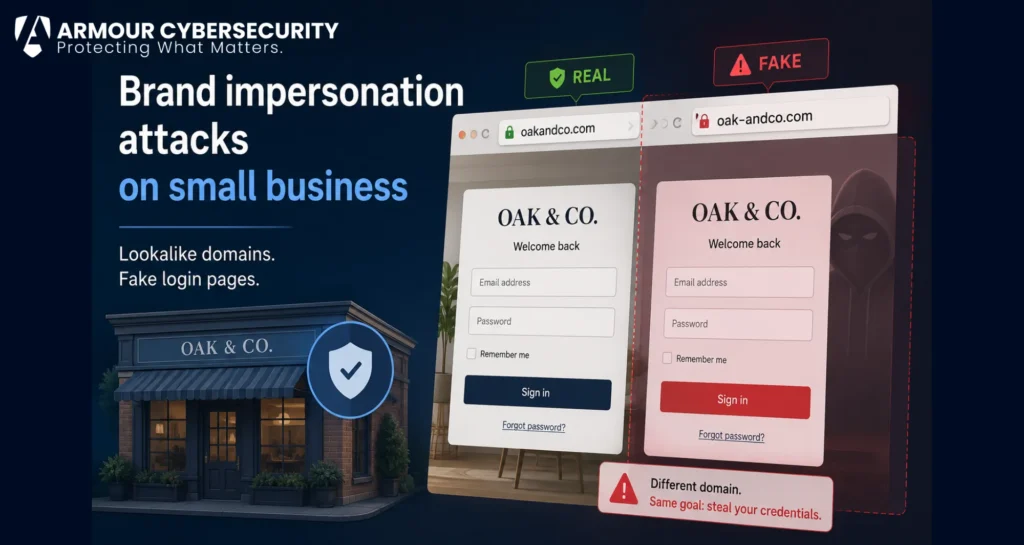
Brand impersonation is the use of your organization’s name, domain, logo, or visual identity by attackers to deceive your customers, employees, or partners. The goal is to make fraudulent communications and websites appear legitimate enough that targets take actions they would not take if they knew the source was malicious: entering login credentials, making payments, downloading attachments, or disclosing sensitive information.
For small businesses, the impact is direct and personal. A customer who is defrauded through a site impersonating your brand does not distinguish between your organization and the attacker. They experience it as a failure by your business to protect them. The reputational damage, the liability questions, and the client relationship consequences follow accordingly.
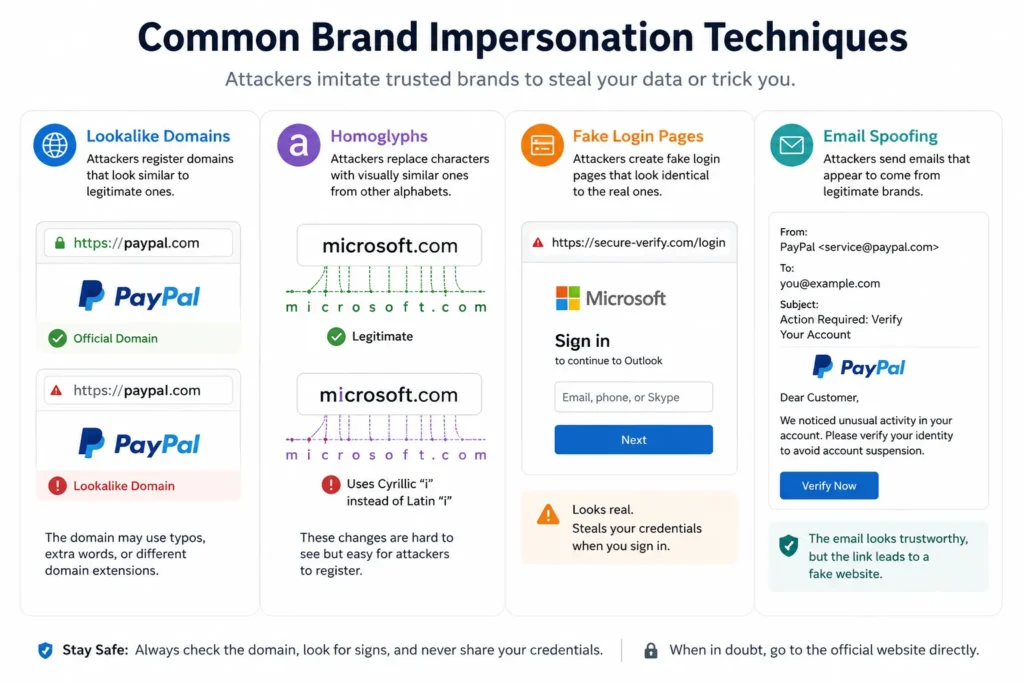
Brand impersonation takes several forms, and attackers often use multiple techniques in combination.
What Are the Most Common Brand Impersonation Techniques?
Lookalike and typo-squatted domains
Attackers register domains that closely resemble your legitimate domain with minor variations: transposed letters, added hyphens, substituted characters that look similar in certain fonts, or the addition of words like “secure,” “login,” or “support.” A business operating from examplefirm.com might find that attackers have registered exarnplefirm.com, example-firm.com, or examplefirm-login.com. These domains are then used to host phishing pages, fake login portals, or fraudulent customer-facing sites.
The registration of these domains is detectable before they become operational. DNS registration monitoring watches for new domains matching your brand patterns and flags them at the point of registration, providing the earliest possible opportunity to take action before a campaign launches.
Homoglyph attacks
Homoglyph attacks substitute visually similar characters from different character sets to create domains that appear identical to the legitimate domain at a glance. Replacing a Latin “a” with a Cyrillic character that renders identically in most fonts produces a domain that passes visual inspection and evades simple string-matching detection. These attacks are particularly effective because even security-aware employees may not notice the substitution in an email address or URL.
Fake login and payment pages
Phishing pages that replicate your login portal or payment process are designed to harvest credentials and financial information from employees or customers. These pages are often hosted on newly registered lookalike domains, compromised third-party hosting accounts, or free hosting services that make rapid deployment easy. They may be live for only a few hours before being taken down, but in that window they can harvest significant volumes of credentials. Because these pages are built to fool people, security awareness training that teaches staff to check domains carefully is a meaningful part of the defense.
Email spoofing and business email compromise
Email-based impersonation does not always require a new domain. Attackers can spoof the display name of executive email addresses to make messages appear to come from a legitimate sender, or compromise an actual business email account to send fraudulent payment instructions from a genuine address. Business email compromise fraud targeting small businesses commonly involves fraudulent invoice modifications, wire transfer requests from spoofed executive addresses, and supplier impersonation, and it is one of the more expensive ways small businesses get hacked.
How Does Brand Monitoring Detect These Threats?
Effective brand monitoring operates across several detection layers, each covering a different stage of an attacker’s campaign preparation.
Domain registration monitoring
The earliest detection opportunity is at domain registration. CTI platforms monitor global domain registration activity for new registrations matching configured brand patterns, using fuzzy matching, homoglyph detection, and keyword monitoring. A lookalike domain flagged at registration gives the organization time to initiate a takedown process before the domain is configured as a phishing site.
SSL certificate transparency logs
When a domain receives an SSL certificate, a record is published in public certificate transparency logs. Monitoring these logs for certificates issued to domains resembling your brand provides a secondary detection layer that catches domains that slipped through registration monitoring or were registered before monitoring began.
Phishing kit and page detection
CTI platforms scan for active phishing infrastructure: pages that incorporate your brand name, logo, or visual assets, hosted on domains or services not associated with your organization. Detection at this stage means the campaign is already operational, but immediate escalation can trigger rapid takedown through hosting provider abuse contacts, which often respond within hours for confirmed phishing infrastructure.
What Happens When a Fraudulent Domain or Page Is Detected?
Detection is only valuable if it connects to an effective response. When Armour’s cyber threat intelligence service detects brand impersonation, the finding is validated by an analyst to confirm it is a genuine threat rather than a legitimate partner site or testing environment. Validated findings are escalated immediately with documentation of the fraudulent domain or page, hosting details, and recommended response actions.
Response actions typically include submitting takedown requests to the domain registrar under applicable dispute policies, reporting the phishing page to the hosting provider, submitting indicators to major browsers for phishing blocklist inclusion, and alerting internal teams to block the domain at email and web filtering layers. Armour is a Toronto-based firm serving small and midsize businesses across North America, and it provides remediation guidance covering each of these response channels. Where a campaign has already caused harm, the same team can move into full incident response and coordinate with legal teams where civil action or law enforcement referral is warranted.
For businesses with customer-facing digital services, early brand monitoring often means that customers are never exposed to a fraudulent campaign that the business was unaware of. That outcome, a threat neutralized before it harmed anyone, is the practical value of detection at registration rather than detection after complaint.
Frequently Asked Questions
How quickly can a fraudulent domain be taken down after detection?
Takedown timelines depend on the registrar, hosting provider, and the nature of the fraudulent use. Domain registrars responding to confirmed phishing abuse reports typically act within 24 to 72 hours. Hosting providers receiving abuse complaints about active phishing pages often respond faster, sometimes within hours. Browser-based phishing blocklist submissions typically propagate to major browsers within a few hours of acceptance. The combination of these channels can render a fraudulent domain harmless within one to two business days of detection.
What is a phishing kit and how does it relate to brand impersonation?
A phishing kit is a pre-packaged set of files that attackers use to quickly deploy a convincing replica of a legitimate website. Phishing kits for major brands are sold and shared in underground communities, allowing attackers with minimal technical skills to stand up convincing fake login pages in minutes. CTI monitoring looks for known phishing kit signatures and pages that incorporate brand assets associated with monitored organizations.
Can brand monitoring detect email spoofing?
Direct email spoofing, where the sender’s address is technically spoofed, is addressed primarily through email authentication controls like SPF, DKIM, and DMARC rather than through CTI monitoring. CTI monitors for domain-based impersonation: newly registered domains that could be used for email-based impersonation, lookalike domains hosting phishing pages linked in emails, and display-name spoofing patterns. DMARC enforcement on your legitimate domain prevents your domain from being spoofed, while CTI monitors for the lookalike domains attackers use as alternatives.
What is a homoglyph attack and how is it detected?
A homoglyph attack substitutes visually similar characters from alternate character sets to create domains that appear identical to a legitimate domain. Detection requires monitoring that is aware of these cross-script substitutions and tests registered domains against visual similarity rather than string matching alone. CTI platforms with homoglyph detection maintain databases of character substitutions and test new registrations against them, flagging domains that would appear identical to your brand in standard display.
My business is small. Are we really a target for brand impersonation?
Yes. Brand impersonation campaigns do not require the target to be a large organization. Any business with a customer-facing domain, payment processes, or client portals is a viable target because the fraudulent infrastructure can be deployed at low cost regardless of the target’s size. Smaller businesses are sometimes more attractive targets because they are less likely to be monitoring for impersonation activity and less likely to have rapid takedown capabilities in place.
Brand Impersonation Attacks on Small Business: The Bottom Line
A fake version of your business can be registered, built, and pointed at your customers in a matter of hours, and you will usually be the last to find out unless you are watching for it. The defense is not reacting faster after a complaint, it is seeing the lookalike domain the moment it is registered and starting the takedown before the campaign ever reaches anyone. To see how brand and domain monitoring would cover your business, start with Armour’s cyber threat intelligence service.
David Chernitzky is the CEO and Co-Founder of Armour Cybersecurity, a Toronto-based firm that protects organizations across North America from advanced cyber threats. He brings more than 25 years of cybersecurity and military cyber intelligence experience, having served as an officer in an elite technology unit before co-founding Armour. Armour’s team of military-intelligence veterans and senior advisors serves 260+ clients across 52+ industries with a 97% client retention rate.