By David Chernitzky, CEO & Co-Founder, Armour Cybersecurity · Toronto-based, serving organizations across North America · Last updated July 30, 2026
Quick answer: Cyber threat intelligence for small business is the structured monitoring of external sources, including the dark web, credential marketplaces, phishing infrastructure, and underground forums, for signs that your company is being targeted. Your internal security tools watch what is happening inside your environment. Cyber threat intelligence (CTI) watches what attackers are doing about your organization before those activities become incidents.
Key Takeaways
- Most external threats leave visible traces before they reach your environment. Leaked credentials appear in underground markets. Lookalike domains are registered before phishing campaigns launch. CTI surfaces these signals early enough to act.
- Internal security tools cannot see outside your perimeter. CTI fills that gap by monitoring the channels attackers use to prepare and execute campaigns against you.
- Credential exposure, brand impersonation, executive targeting, and dark web mentions are the most common early indicators of an impending attack on a small or midsize business.
- CTI is not a threat feed. It is an analyst-led service that validates findings, filters noise, and escalates only what requires action.
- For regulated businesses, board-level intelligence reporting and documented external monitoring increasingly satisfy auditor and insurance carrier requirements.
What Is Cyber Threat Intelligence?
Cyber threat intelligence, commonly abbreviated as CTI, is the practice of collecting, analyzing, and acting on information about threats that exist or are developing outside your organization’s own environment. It is the structured answer to a question that every business faces but most cannot answer: what are attackers doing about us right now?
Traditional security tools are inward-facing. A firewall monitors what traffic enters and leaves your network. An endpoint detection tool watches what happens on your devices. A SIEM correlates logs from your own systems. All of these are valuable, and all of them share the same limitation: they see your environment. They cannot see the dark web forum where someone is selling credentials harvested from your employees, the registration of a domain designed to impersonate your brand, or the underground marketplace listing that mentions your company name alongside stolen data. Many of the ways small businesses get hacked begin in exactly these external channels, out of sight of internal tooling.
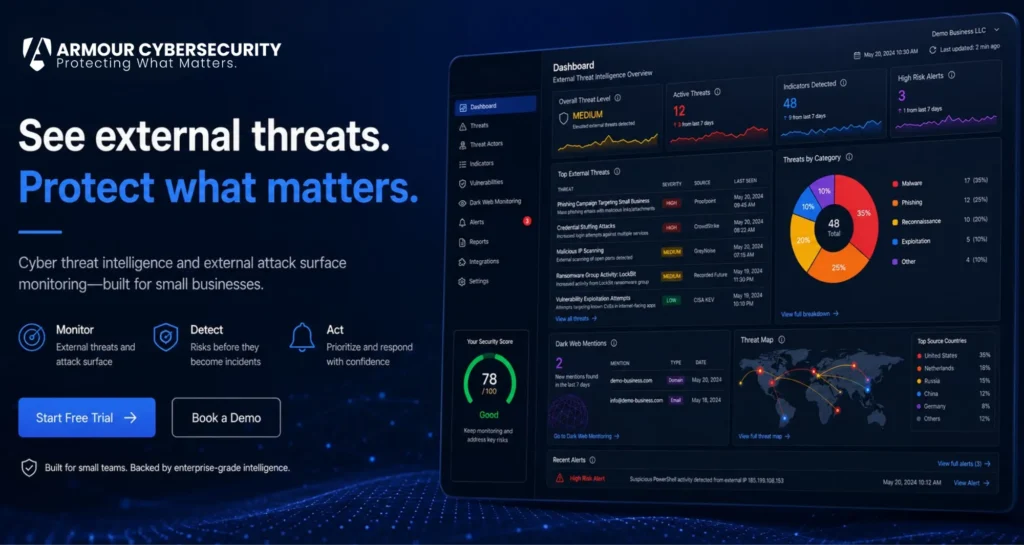
CTI monitors those external channels continuously. It watches credential marketplaces, breach databases, paste sites, dark web forums, phishing infrastructure, DNS registration activity, public code repositories, and threat actor communications for any indication that your organization is being targeted or has already been compromised. When findings are validated and relevant, they are escalated in time to act.
What Does Cyber Threat Intelligence Actually Monitor?
A well-structured CTI program covers the full range of external channels that attackers use to prepare and execute campaigns.
Credential exposure
When employee credentials are stolen through phishing, malware, or third-party data breaches, they typically surface in underground credential marketplaces within days or weeks of the original compromise. CTI monitors these sources continuously for corporate email addresses and associated passwords. Early detection gives the organization time to force password resets and enforce multi-factor authentication before the credentials are used to access company systems.
Domain and brand monitoring
Attackers register lookalike domains, typo-squatted variations, and homoglyph substitutions of corporate domains before launching phishing campaigns and brand impersonation sites. CTI monitors DNS registration activity for domains that resemble your brand, flags them at the registration stage, and supports takedown efforts before campaigns go live. This is far more effective than responding after customers have already been defrauded.
Dark web and underground forum mentions
Threat actors discuss targets, share tools, and sell access in underground forums and dark web communities. When your company name, domain, product, or executive appears in these conversations, it may signal a planned attack, an active compromise being advertised, or stolen data being sold. CTI analysts monitor these sources, validate the relevance of mentions, and escalate findings that represent credible risk.
Phishing and impersonation infrastructure
Before a phishing campaign launches, attackers build the infrastructure: fake login pages, credential-harvesting forms, and redirect chains designed to look like your organization. CTI detects this infrastructure while it is being built or tested, providing an opportunity to block it before it reaches employees and customers.
Executive and VIP exposure
Senior leaders, board members, and high-value personnel are targeted through public information that supports social engineering and fraud. CTI monitors the exposure of executive names, contact information, and associations across public channels that attackers use to research and target individuals, providing early warning of campaigns that often begin with open-source intelligence gathering.
Data leakage indicators
Sensitive keywords, project names, internal terminology, and source code references that appear on paste sites, in public code repositories, or in cloud storage that has been inadvertently exposed are indicators that confidential information has left the organization. CTI monitors these channels and surfaces findings before they propagate further.
How Is CTI Different From a Threat Feed?
This distinction matters for any business evaluating CTI options. A threat feed is a data stream: a list of known malicious IP addresses, domains, file hashes, and other indicators of compromise, updated regularly and ingested into security tools. Threat feeds are valuable inputs to security operations, but they are not CTI.
CTI is an analyst-led service. A CTI platform generates thousands of alerts across the monitored channels. Most of those alerts are noise: false positives, low-confidence matches, and irrelevant mentions that would waste the security team’s time if forwarded directly. The value of CTI as a service is the analyst layer that reviews every alert, validates findings against business context, filters what does not matter, and escalates only the findings that require action, with documented analysis and recommended response steps.
Armour’s cyber threat intelligence service does not pass raw platform output to the client. Every alert is reviewed by a trained analyst before it reaches the security team. The result is actionable intelligence rather than another alert queue that competes for attention alongside everything else. Armour is a Toronto-based firm serving small and midsize businesses across North America, and this analyst-led model is built for teams that do not have a dedicated intelligence function of their own.
Cyber Threat Intelligence for Small Business: Why It Matters
The common assumption is that CTI is an enterprise capability, relevant only to large organizations with sophisticated adversaries and dedicated intelligence teams. The reality is that the threats CTI detects, credential exposure, brand impersonation, and phishing infrastructure, affect smaller organizations at high rates precisely because they are less likely to be monitoring them.
A small accounting firm whose employee credentials appear in a credential marketplace is just as exposed as a large bank whose credentials appear in the same marketplace. The difference is that the bank probably has a CTI program that detects the exposure within days. The accounting firm finds out when the attacker uses those credentials to access client financial data months later.
The same logic applies to brand impersonation. A law firm whose domain is being impersonated by a phishing site targeting its clients has a client relationship problem, a legal liability, and a reputational exposure that exists whether or not the firm knows about it. CTI provides the visibility to detect and respond to these threats before clients are harmed.
Frequently Asked Questions
How long does it take to set up a CTI monitoring program?
The initial engagement phase, covering monitoring profile design, platform deployment, alert severity configuration, and escalation workflow setup, typically takes two to three weeks. Ongoing monitoring begins during this phase, with the first formal report delivered at the end of the first full month of operation. High-priority findings escalate immediately under the agreed workflow rather than waiting for the monthly reporting cycle.
What is included in a CTI monitoring profile?
A monitoring profile covers the specific entities the program watches on your behalf: corporate and subsidiary domains, email domains, brand names, product names, executive names, board members, public IP ranges, third-party vendors, sensitive project names, and industry-specific keywords. The profile is designed during onboarding and refined continuously to reduce false positives and surface the most relevant intelligence.
What happens when CTI finds that our credentials have been leaked?
The finding is validated to confirm that the credentials are current and associated with active corporate accounts. It is then escalated immediately under the agreed workflow, with the affected accounts identified and recommended response steps documented. The immediate response typically involves forcing password resets for affected accounts, reviewing whether those accounts show evidence of unauthorized access, and enabling or enforcing multi-factor authentication where it was not already in place. If the exposure has already been used, it moves straight into incident response.
Can CTI findings be used as evidence in legal proceedings?
CTI findings, including documentation of brand impersonation, phishing infrastructure, and dark web mentions, are structured and documented in a way that supports legal response actions including takedown requests, cease and desist correspondence, and law enforcement referrals. The chain of documentation from initial detection through analyst validation and escalation supports legal and regulatory processes where applicable.
Does CTI replace our internal security monitoring?
No. CTI complements internal security monitoring by extending visibility to the external landscape that internal tools cannot see. The two capabilities work together: CTI may surface a credential exposure that internal monitoring would not detect until the credentials were actively used, giving the organization time to act before the internal event occurs. Many organizations feed CTI findings, particularly indicators of compromise, directly into their managed SOC as additional signals to monitor.
The Bottom Line
For a small or midsize business, cyber threat intelligence is the difference between learning about an exposure in time to act and learning about it after the damage is done. It watches the channels your internal tools cannot see, credential markets, lookalike domains, phishing infrastructure, and dark web mentions, and puts an analyst between the raw alerts and your team so you only act on what is real. If you want to see how analyst-led monitoring would map to your business, start with Armour’s cyber threat intelligence service.
David Chernitzky is the CEO and Co-Founder of Armour Cybersecurity, a Toronto-based firm that protects organizations across North America from advanced cyber threats. He brings more than 25 years of cybersecurity and military cyber intelligence experience, having served as an officer in an elite technology unit before co-founding Armour. Armour’s team of military-intelligence veterans and senior advisors serves 260+ clients across 52+ industries with a 97% client retention rate.