By David Chernitzky, CEO & Co-Founder, Armour Cybersecurity · Toronto-based, serving organizations across North America · Last updated July 30, 2026
Quick answer: External attack surface monitoring for business shows you the same view an attacker has of your organization from the outside. Before targeting a business, attackers research it: they map exposed systems, identify running software and versions, find leaked credentials, research executives through public profiles, and look for brand mentions in underground communities. Monitoring surfaces those exposures so you can close them before they become entry points.
Key Takeaways
- Attackers conduct structured reconnaissance before launching an attack. The information they gather shapes what techniques they use and how successful they are.
- Most external exposure is visible through public channels: DNS records, SSL certificates, publicly accessible services, and job postings that reveal technology stack details.
- Dark web research, credential marketplace checks, and underground forum monitoring give attackers intelligence about past compromises that your organization may not know occurred.
- External attack surface monitoring shows you your organization from the outside, surfaces exposures you cannot see from within your own environment, and provides the context needed to prioritize remediation.
- The goal is not to eliminate all external visibility. It is to ensure that what is visible is intentional, and that unintended exposures are detected and addressed promptly.
How Do Attackers Research a Target Business?
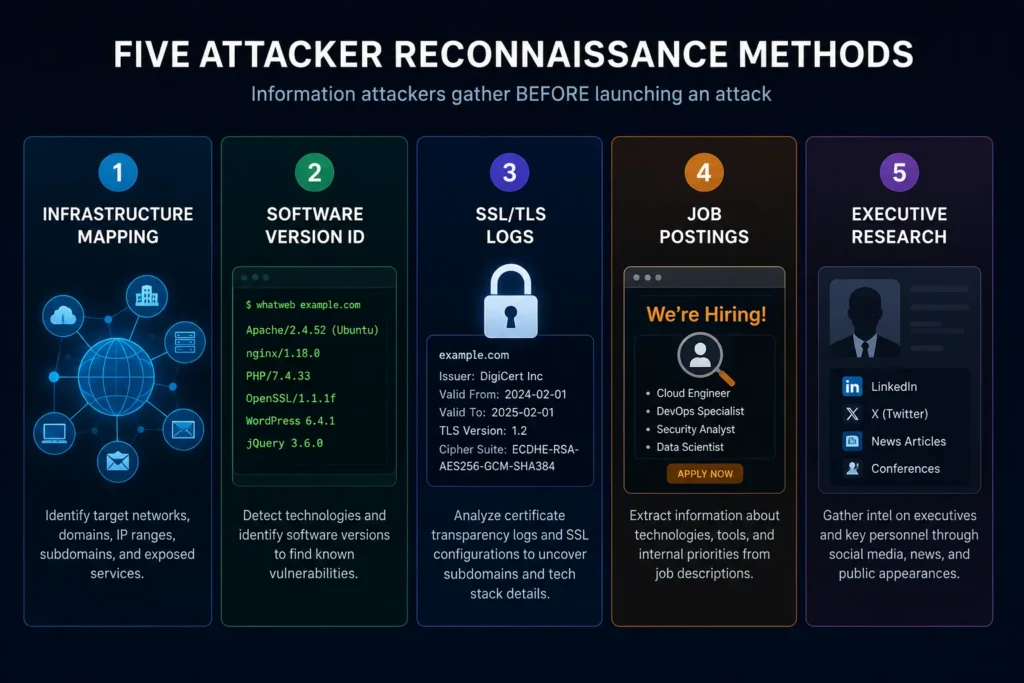
Sophisticated attackers do not start with exploitation. They start with reconnaissance, the structured gathering of information about a target before any attack activity begins. This phase is often entirely passive, using publicly available information and external monitoring tools that generate no traffic to the target’s systems and leave no trace in logs. The intelligence gathered during reconnaissance directly shapes the attack.
Understanding what attackers look for during this phase is the first step toward reducing your external exposure.
Domain and infrastructure mapping
Attackers enumerate your domain infrastructure: all registered domains and subdomains associated with your organization, the IP addresses they resolve to, the hosting providers and cloud platforms in use, and the services running on exposed ports. Tools that perform this enumeration are widely available and require no special access. A subdomain that was stood up for a temporary project and never decommissioned may still be resolving to an IP address running outdated software that no one is monitoring. Attackers find these assets because they look for them systematically.
Software version identification
Services that are accessible from the internet often reveal the software and version they are running through HTTP headers, service banners, or default page content. An attacker who identifies that your internet-facing web application is running a specific version of a content management system or application framework can immediately cross-reference that version against published CVEs to identify known exploitable vulnerabilities. This intelligence is gathered in seconds using automated scanning tools.
SSL certificate history
Certificate transparency logs record every SSL certificate issued for every domain. Attackers review these logs to discover subdomains and services that were not found through direct enumeration. Historically issued certificates may reveal infrastructure that was spun up and down over time, including forgotten subdomains, internal-facing services that were accidentally exposed, and third-party integrations that are no longer monitored.
Job postings and technology stack intelligence
Job postings are a frequently overlooked source of intelligence for attackers. A job listing for a senior developer that specifies experience with a particular database version, cloud platform, or security tool tells an attacker precisely what technology the organization is running. Security researchers have demonstrated that job postings routinely reveal enough information to significantly narrow the attack surface an attacker needs to target.
Executive research and social engineering preparation
Executives and senior staff are researched through LinkedIn, professional directories, conference speaker listings, and press coverage. This information supports social engineering attacks: targeted phishing that references specific projects or relationships, impersonation of executives to authorize fraudulent transactions, and SIM swapping attacks that require accurate personal information. The more detailed the public profile of key individuals, the more convincing a targeted attack can be, which is why security awareness training for leadership matters as much as it does for frontline staff.
What Does the Dark Web Add to Attacker Intelligence?
Open-source intelligence gathering covers what is publicly visible. Dark web research extends the picture with information from previous compromises.
Credential marketplaces reveal whether employee accounts have been compromised in phishing campaigns or third-party breaches, what passwords were associated with those accounts, and whether credentials are fresh or have been circulating for some time. An attacker who purchases a fresh credential log containing valid corporate email credentials and associated passwords has bypassed the entire authentication layer of the organization without touching its systems.
Underground forums may contain discussions of specific organizations as targets, claims of access being sold, or information about data exfiltrated in a previous breach that the organization was not aware of. These mentions are intelligence that informs the credibility and urgency of other findings. A mention of your company alongside claims of internal access is a signal that warrants immediate investigation regardless of whether other indicators are present.
What Is External Attack Surface Monitoring?
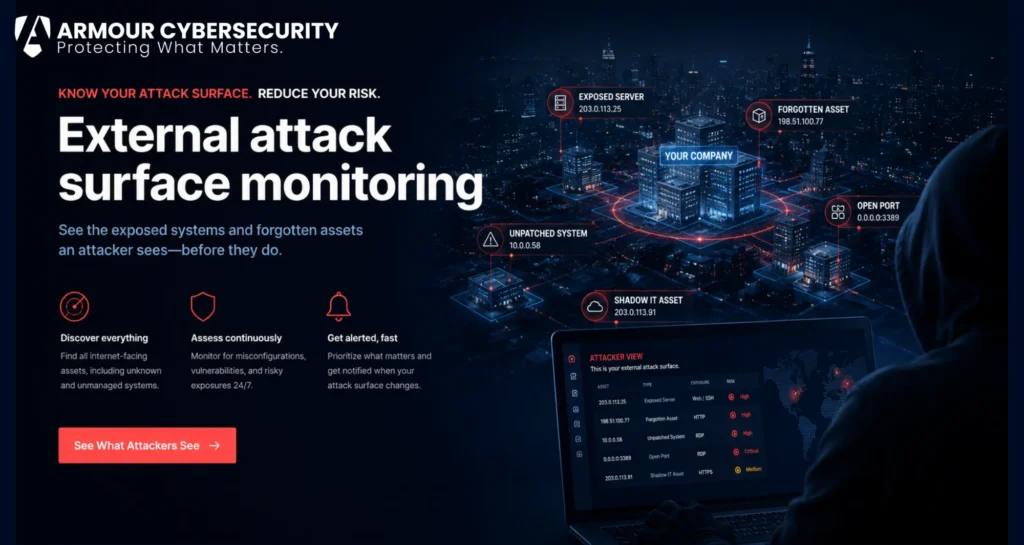
External attack surface monitoring is the continuous inventory and assessment of everything about your organization that is visible from outside your perimeter. It maps the same information an attacker’s reconnaissance would gather, and applies risk analysis to identify what represents meaningful exposure.
The output is not just a list of exposed services. It is a prioritized view of external exposures ordered by the risk they represent, combined with intelligence about whether those exposures are being actively targeted. A subdomain running outdated software is a finding. The same subdomain running outdated software on a version with a public exploit and associated with a dark web mention of your organization is a critical priority.
This combination of external visibility and threat intelligence context is what Armour’s cyber threat intelligence program delivers. Armour is a Toronto-based firm serving small and midsize businesses across North America, and its monitoring profile covers your domains, IP ranges, brands, and associated infrastructure. The analyst layer validates findings, applies threat intelligence context, and escalates the exposures that represent the highest priority for remediation. Monthly reporting translates the external view into governance language that leadership and auditors can use.
How Does Reducing External Exposure Improve Security Posture?
The goal of external attack surface management is to reduce the gap between what is externally visible about your organization and what should be externally visible. That gap is where attackers find their easiest entry points.
Decommissioning forgotten subdomains and unused internet-facing services removes assets that no one is maintaining and monitoring. Patching software versions that are visible to external scanners removes the vulnerability disclosures that those versions carry. Reviewing SSL certificate history identifies historical infrastructure that should be formally decommissioned. Monitoring job postings to remove technology-specific details reduces the intelligence they provide.
None of these are individually transformative changes. Together, they make the organization a systematically harder target. An attacker running reconnaissance against a business that has actively managed its external exposure finds fewer entry points, less useful intelligence about the technology stack, and less certainty that any given approach will succeed. Alongside credential monitoring, brand protection, and dark web monitoring, external attack surface management forms one component of the full external visibility that CTI provides.
Frequently Asked Questions
What is OSINT and how do attackers use it against businesses?
OSINT stands for Open Source Intelligence, the collection and analysis of information from publicly available sources. Attackers use OSINT tools to map a target organization’s domain infrastructure, identify software versions, research personnel, and gather context that makes social engineering attacks more convincing. The same techniques are used by legitimate security teams to understand their external exposure before attackers do.
Can attackers find information about my business without triggering any alerts?
Yes. Most reconnaissance techniques are entirely passive and generate no traffic to your systems. Certificate transparency log queries, domain registration lookups, and dark web credential marketplace searches produce no logs in your environment. Job posting review, executive research on LinkedIn, and DNS enumeration through public resolvers are similarly invisible from an internal monitoring perspective. This is precisely why external monitoring matters: the activity happens in channels your internal tools do not see.
What is a subdomain takeover and how does it happen?
A subdomain takeover occurs when a DNS record for a subdomain points to a third-party service that is no longer active, and an attacker claims that service to take control of the subdomain. For example, if a subdomain pointed to a cloud hosting instance that was later terminated without removing the DNS record, an attacker can provision a new instance at the same address and serve content that appears to come from your domain. External attack surface monitoring detects these dangling DNS records and flags them for remediation.
How does external monitoring help with cyber insurance requirements?
Cyber insurance carriers increasingly ask about external exposure management as part of underwriting. Questions about exposed services, patch currency of internet-facing systems, and whether the organization monitors for credential exposure and brand impersonation are becoming standard in policy applications and renewals. A documented external attack surface monitoring program, with evidence of findings being tracked and remediated, directly supports favorable underwriting outcomes and provides documentation for claims processes when incidents occur. For help aligning controls to what carriers expect, Armour offers cyber insurance advisory.
What is the difference between external attack surface monitoring and penetration testing?
Penetration testing is a time-limited exercise where security professionals actively attempt to exploit vulnerabilities in your external surface to demonstrate real-world impact. External attack surface monitoring is a continuous program that inventories and assesses external exposure on an ongoing basis. Penetration testing validates that exposures found by monitoring are actually exploitable and identifies issues that passive monitoring may miss. The two are complementary: monitoring maintains continuous visibility between penetration testing engagements.
External Attack Surface Monitoring for Business: The Bottom Line
Everything an attacker needs to plan against you, exposed systems, software versions, leaked credentials, forgotten subdomains, is sitting in public and semi-public channels right now, and none of it trips an alert inside your network. External attack surface monitoring puts you on the same side of the perimeter as the attacker, so you find and close those gaps first. To see what your business looks like from the outside, start with Armour’s cyber threat intelligence service.
David Chernitzky is the CEO and Co-Founder of Armour Cybersecurity, a Toronto-based firm that protects organizations across North America from advanced cyber threats. He brings more than 25 years of cybersecurity and military cyber intelligence experience, having served as an officer in an elite technology unit before co-founding Armour. Armour’s team of military-intelligence veterans and senior advisors serves 260+ clients across 52+ industries with a 97% client retention rate.