By David Chernitzky, Co-Founder and CEO, Armour Cybersecurity | Serving organizations across Canada, the US, and beyond | Last updated August 19, 2026
Quick answer: Cybersecurity roadmap development is the discipline of turning a security strategy into a sequenced, budget-attached, outcome-mapped plan for building the capabilities your organization needs over a defined time horizon. The three elements that make a roadmap executable rather than aspirational are proper sequencing by priority and dependency, a budget estimate attached to every initiative, and a measurable outcome that defines what success looks like for each project. Without these three elements, a roadmap is a list of wishes that gets reordered by whoever has the loudest voice in the current budget cycle.
Key Takeaways
- Sequencing is the most undervalued element of roadmap construction. Initiatives that are not ordered by dependency fail when the foundational capability they depend on has not been built yet. Identity foundation before zero trust. Data classification before data loss prevention. Detection baseline before advanced threat hunting.
- A roadmap without budget estimates is not a plan; it is a backlog. Every initiative needs a capital expenditure, operating expenditure, and resource estimate so it can be funded, scheduled, and tracked against spend.
- Quick wins, high-impact, low-effort actions executable within ninety days, should be isolated and executed immediately rather than waiting for the full roadmap to be funded and scheduled. They demonstrate momentum and deliver real risk reduction.
- A three-year roadmap is structured with year-one detail at the initiative level and years two and three sequenced at the program level. The level of detail decreases with time horizon because assumptions that hold for year one become uncertain further out.
- The roadmap must survive a change of CISO, CIO, or executive sponsor. Documentation that enables a new leader to pick up the plan without losing continuity is a measure of the roadmap’s quality.
Why Most Cybersecurity Roadmaps Fail in Execution
Many organizations have experienced the same pattern: a strategy or gap assessment is completed, a list of recommendations is produced, and somewhere between the recommendations and the annual budget cycle the plan loses its shape. Individual projects get approved or rejected based on how they are presented in any given year rather than where they sit in a defined sequence. Dependencies are forgotten. Quick wins get deprioritized because they are small. High-visibility projects get funded regardless of whether the foundational work they require has been completed. Two years later, the organization has spent money on security without building a coherent capability.
The failure is almost always in the roadmap structure itself, not in execution capacity. A roadmap that is a list of recommendations without sequencing, budget, or outcome metrics cannot be executed as a plan because it does not function as a plan. It functions as a to-do list, and to-do lists get reorganized by whoever has the loudest voice in the current budget cycle. This is the gap between having a cybersecurity strategy and having a plan you can actually run: the strategy defines where you are going, and the roadmap is the structured, sequenced mechanism that gets you there.
What a Properly Structured Roadmap Contains
Phase one: the maturity baseline
The roadmap is built from a maturity assessment that scores the organization’s current security capability across every domain against the selected framework. Each domain receives a current-state score and a target-state score derived from the organization’s risk profile, regulatory obligations, and business objectives. The gap between current and target state defines what needs to be built. An independent cybersecurity posture assessment is what produces that baseline objectively, and without a documented baseline the roadmap cannot demonstrate progress because there is no reference point from which to measure.
Initiative identification and definition
Each gap identified in the maturity assessment generates one or more roadmap initiatives. An initiative is more specific than a recommendation and more manageable than a program: it is a defined piece of work with a scope, an owner, a time estimate, and a connection to a specific gap in the maturity assessment. Initiative definition at this level of specificity is what makes the roadmap actionable. “Improve identity security” is not an initiative; “implement privileged access management for all production system administrators, reducing the attack surface from credential compromise by an estimated 70 percent” is.
Sequencing by priority and dependency
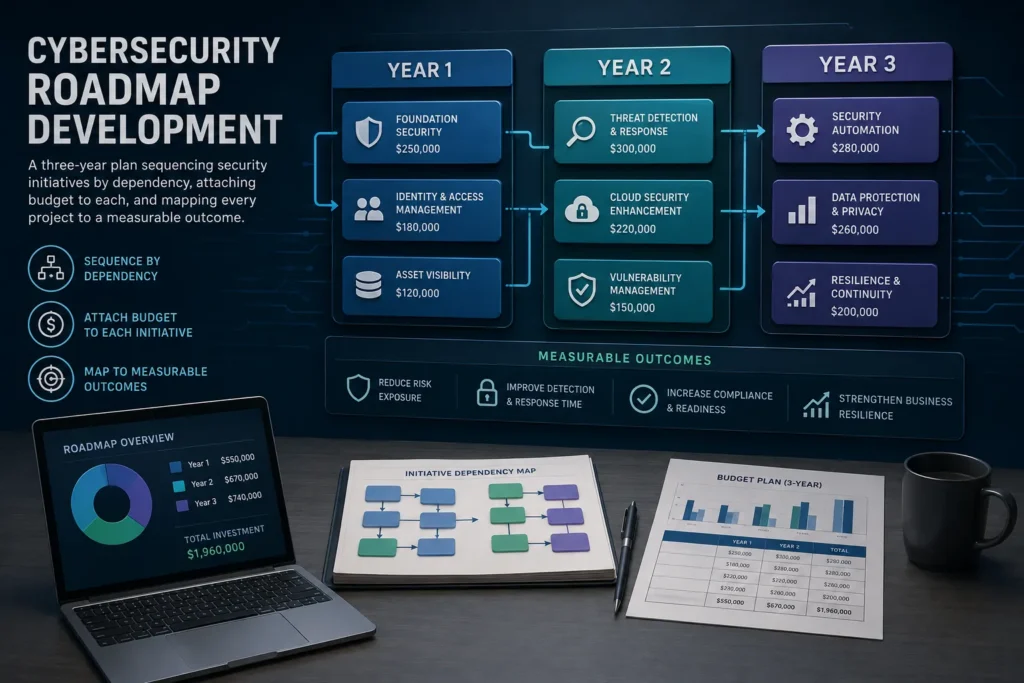
Sequencing is the discipline that separates a roadmap from a backlog. Initiatives are ordered first by dependency: an initiative that requires a foundational capability to be in place cannot be scheduled before that capability is built, regardless of its priority ranking. Identity governance before zero trust network access. Asset inventory before vulnerability management program. Logging infrastructure before detection engineering. Within the dependency constraints, initiatives are prioritized by the combination of risk reduction impact, implementation effort, and strategic importance.
The dependency map is the most important structural document in the roadmap because it constrains the schedule in a way that cannot be overridden by budget cycle politics. When finance asks why the zero trust initiative is in year two rather than year one, the dependency map provides the answer: the identity foundation it requires is year-one work, and attempting zero trust without it produces a security theater outcome rather than a genuine capability.
Budget attachment
Every initiative on the roadmap carries three budget components: capital expenditure for any technology procurement, operating expenditure for ongoing licensing, maintenance, and operational costs, and resource requirements for the internal or external labor needed to implement and operate the capability. Budget estimates developed during the strategy engagement are projections, not contracts; they are refined during implementation planning. Their function in the roadmap is to enable finance integration and multi-year budget modeling, giving the CFO and board a credible projection of what the strategy will cost over the planning horizon.
The multi-year budget model is one of the most governance-relevant outputs of the roadmap process. A board that can see the total security investment over three years, broken down by year and by initiative category, and that can trace each budget line to a specific risk reduction outcome, is in a position to evaluate security investment with the same discipline it applies to capital allocation decisions in other parts of the business. Sequencing initiatives against the risks that matter most depends on a live security risk register that ranks exposures by likelihood and impact, so the budget follows the risk rather than the loudest stakeholder.
KPI and outcome mapping
Each initiative maps to at least one measurable outcome: a risk reduction metric, a maturity score improvement, a compliance objective, or a business capability enabled. The KPI framework aggregates these initiative-level outcomes into a set of program-level metrics that track the strategy’s overall progress. Program-level KPIs feed quarterly governance reporting and board briefings. They provide the mechanism through which the organization can answer the question every CFO and board member eventually asks: what are we getting for our security investment?
What Year One, Year Two, and Year Three Look Like
Year one of the roadmap is the most detailed phase. Each initiative in year one has a defined scope, an owner, a quarterly execution schedule, a budget, and a set of success metrics. The first ninety days are further isolated as quick wins, high-impact actions that can be executed immediately to demonstrate momentum while the larger year-one initiatives are being resourced and scoped for delivery.
Year two is sequenced at the program level: the initiatives are identified, prioritized, and budgeted, but the initiative-level detail is left for refinement during year-one execution when the year-two context is clearer. Year-two planning is refreshed during the annual strategy review, which incorporates the year-one execution record, any changes in the threat landscape or regulatory environment, and any new business initiatives that affect the security program’s priorities.
Year three is a directional commitment: the program-level initiatives are identified, the annual budget projection is made, and the strategic intent is documented, but the specific initiative design is not finalized until year two. This approach reflects the reality that assumptions about technology, organizational structure, and business priorities that hold for year one become increasingly uncertain at a three-year horizon. The roadmap provides strategic direction for year three without the false precision of initiative-level detail that will need to be reworked before year three arrives.
Armour Cybersecurity’s cyber strategy and roadmap development engagement produces a full three-year roadmap with this structure: year-one initiative detail, year-two and year-three program sequencing, quarterly execution phases, and the annual budget projection that feeds board reporting.
Frequently Asked Questions
How do we handle initiatives that span multiple years?
Multi-year initiatives are broken into phases on the roadmap, with each phase scoped, budgeted, and measured independently. A large identity governance program, for example, might be phased across three years: phase one covering privileged access management, phase two extending to workforce identity governance, and phase three implementing advanced identity analytics. Each phase has its own success criteria, budget, and owner. This structure keeps multi-year initiatives measurable on an annual basis rather than treating them as one large project with a three-year success horizon.
What happens when a major incident or regulatory change disrupts the roadmap?
The roadmap is a living document, not a fixed plan. Material incidents and regulatory changes are reviewed against the roadmap at the next quarterly cycle to assess whether re-prioritization is warranted. Some incidents accelerate specific roadmap initiatives because they demonstrate the need in terms the budget process cannot ignore. Regulatory changes create compliance obligations that may need to be inserted into the roadmap with higher priority than their original position. The roadmap structure accommodates these changes precisely because every initiative is documented with its rationale, dependencies, and outcome mapping, making the impact of re-sequencing visible rather than hidden.
How do we keep the roadmap current between annual reviews?
The roadmap is reviewed at each quarterly strategy session against the KPI framework. Initiatives that are on track are confirmed. Initiatives that are behind schedule are assessed for re-sequencing or additional resource. New threats or regulatory developments that affect the roadmap are flagged for the next annual strategy review or, if material, addressed between cycles through the between-quarter advisory process. The KPI framework provides the mechanism for this ongoing review: metrics that are trending in the wrong direction signal where the roadmap needs attention before an annual review identifies the problem.
How long should it take to complete year-one roadmap initiatives?
Year-one initiatives are planned with quarterly execution phases aligned to the business calendar. A well-scoped year-one plan is executable by a team with normal resource constraints, not dependent on everything going right. Overloading year one with more initiatives than the organization can absorb is one of the most common roadmap failures. The strategy engagement sizing process deliberately assesses organizational capacity and sequences year-one work to be ambitious but achievable, prioritizing the quick wins that demonstrate momentum and the foundational initiatives that enable year-two delivery.
Do we need a CISO to execute the roadmap?
A CISO, a vCISO, or a senior security leader with strategic accountability is important for roadmap ownership and governance reporting. Organizations without a full-time CISO can execute a roadmap through a virtual CISO engagement that provides the strategic leadership and board-facing communication the plan requires, with operational execution handled by internal IT staff or specialist service providers for specific initiatives. The roadmap is designed to be vendor-neutral, so the execution model is flexible. What it requires is a designated owner who is accountable for progress against the plan and who can report on it credibly to executive and board stakeholders.
The Bottom Line
A cybersecurity roadmap fails in execution when it is really just a list of recommendations wearing a plan’s clothing: no dependency sequencing, no budget attached, no outcome defined, so it gets reordered every budget cycle by whoever argues hardest. What makes a roadmap survive contact with the annual budget and a change of leadership is structure: a maturity baseline to measure from, initiatives sequenced by dependency so foundational work comes first, a three-part budget on every line, and a measurable outcome that says what each project is for. Year one gets initiative-level detail, years two and three get program-level direction, and quick wins ship in the first ninety days to prove momentum. A structured cyber strategy and roadmap engagement builds the plan in exactly that shape, so the money follows the risks that matter and the plan still makes sense when the next CISO inherits it.
About the author
David Chernitzky is Co-Founder and CEO of Armour Cybersecurity, a Toronto-based cybersecurity firm founded by military intelligence veterans and advised by senior leaders from PwC, KPMG, Deloitte, EY, and Mandiant. Armour serves more than 260 organizations across 52-plus industries, including finance, healthcare, technology, energy, legal, and government, with a 97 percent client retention rate.