Imagine handing a visitor a single master key to your entire office building. Every floor, every server room, every locked cabinet, all accessible from that one key. If the visitor turns out to be a threat, the damage could be catastrophic. Now imagine instead that each zone requires its own key, and doors only open for people with a specific reason to be there. That is the essence of network segmentation, and it is one of the most effective strategies any organization can implement to limit the impact of a cyberattack.
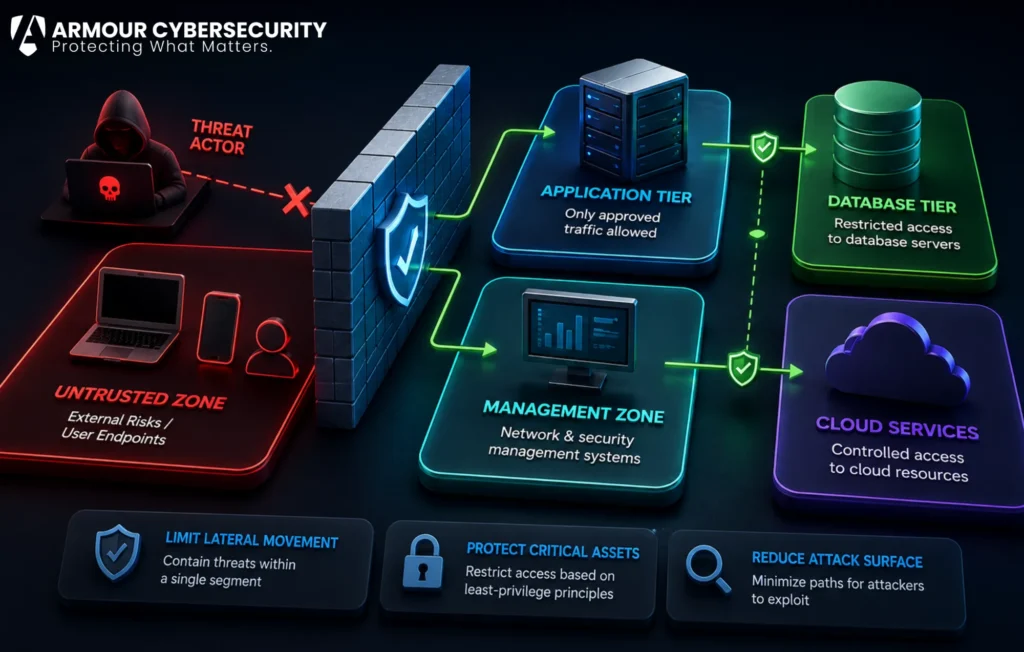
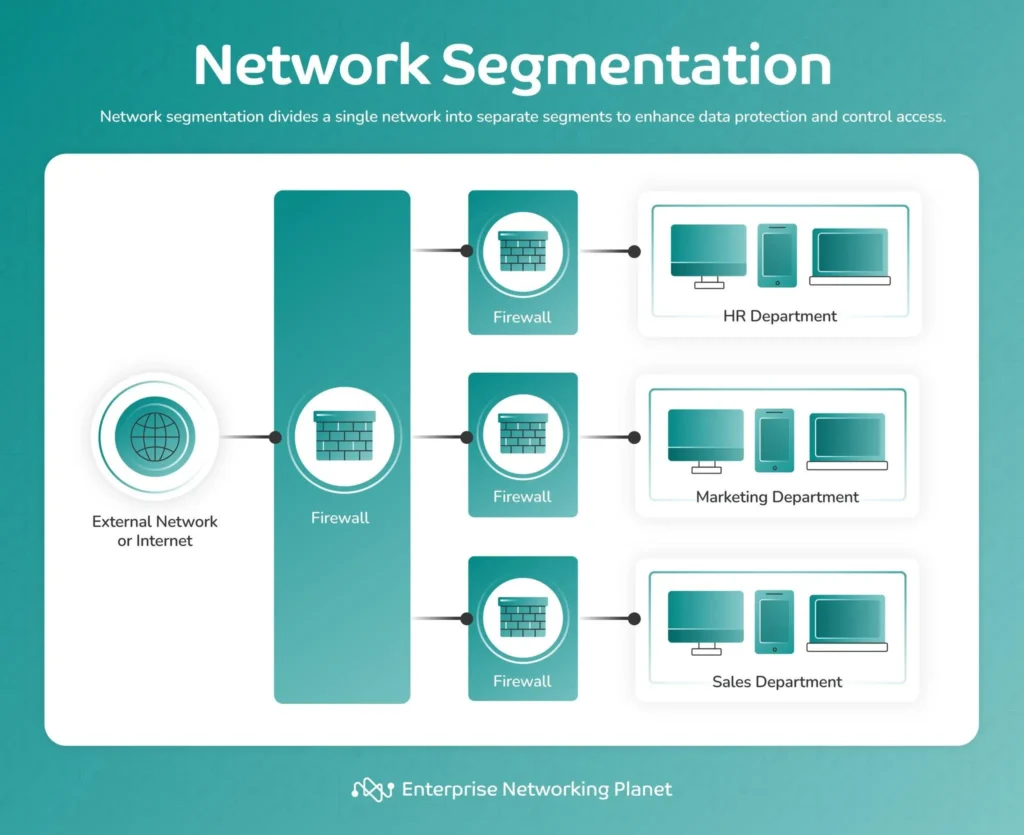
Network segmentation is a cybersecurity technique that divides a company’s network into smaller, isolated zones. Rather than allowing every device and user to communicate freely with every other system, segmentation controls which segments can talk to which, and under what conditions. When a threat actor breaches one segment, they find themselves contained, unable to move through the rest of the environment.
For organizations that handle sensitive data, support remote workforces, or operate cloud and on-premises infrastructure side by side, network segmentation is no longer optional. It is a foundational control that should be incorporated into an organization’s broader cybersecurity strategy.
QUICK ANSWER
Network segmentation is a cybersecurity architecture practice that divides a network into isolated security zones and controls communication between them. By limiting access between systems, network segmentation reduces attack surfaces, prevents lateral movement, improves compliance, and helps contain cyber incidents such as ransomware attacks.
KEY TAKEAWAYS
☑ Network segmentation limits lateral movement after a breach.
☑ Segmentation reduces the attack surface by restricting unnecessary communication.
☑ VLANs, physical segmentation, and microsegmentation are the most common approaches.
☑ Segmentation supports compliance with PCI DSS, ISO 27001, SOC 2, HIPAA, and NIST frameworks.
☑ Proper segmentation significantly reduces the impact of ransomware and insider threats.
Why Lateral Movement Is One of the Biggest Threats Organizations Face
To understand why segmentation matters so much, it helps to understand how modern attackers actually operate. Initial access, phishing a credential, exploiting a public-facing application, or compromising a vendor through weaknesses in third-party cyber risk management, is rarely the end goal. It is the starting point.
Once inside a network, attackers move laterally. They probe adjacent systems, escalate privileges, and quietly work their way toward the most valuable targets: financial databases, customer records, source code repositories, backup systems. This lateral movement phase often lasts weeks or months before any damage is done visibly. In a flat, unsegmented network, nothing stops an attacker who has gained one foothold from reaching everything else.
Network segmentation directly addresses this problem. By placing boundaries between different parts of the network and enforcing strict rules about what traffic can cross those boundaries, organizations can dramatically reduce how far an attacker can travel — even after gaining initial access.
This is not a theoretical benefit. Many of the most damaging breaches in recent history succeeded not because attackers found a clever zero-day, but because once inside, they could move freely through an environment with no internal barriers. A comprehensive cybersecurity assessment can identify these weaknesses before attackers exploit them.
Business Benefits of Network Segmentation
While network segmentation is often viewed as a technical security control, its benefits extend far beyond IT operations. Effective segmentation helps organizations:
- Reduce business disruption during cyber incidents
- Limit ransomware spread
- Protect sensitive customer and employee data
- Simplify compliance audits
- Improve visibility into network activity
- Strengthen cyber resilience
For executive leadership, segmentation is ultimately a risk reduction strategy that helps contain security incidents before they become business crises.
What Are the Main Types of Network Segmentation?
Network segmentation can be implemented in several ways, each suited to different infrastructure models and organizational needs.
Physical Segmentation
Physical segmentation is the most traditional approach. It involves creating entirely separate network environments using distinct hardware — separate switches, routers, and cabling. Critical systems like industrial controls, payment processing infrastructure, or highly confidential databases are placed on physically isolated networks with no shared hardware connecting them to general corporate systems.
Physical segmentation offers strong isolation, but it is expensive to deploy and maintain. It tends to be reserved for environments where the sensitivity or risk level genuinely justifies dedicated hardware, such as operational technology (OT) environments or government systems handling classified data.
Virtual Segmentation with VLANs
Virtual Local Area Networks, or VLANs, allow network administrators to segment traffic logically without requiring separate physical hardware. Devices can be grouped by function, department, or security zone even if they share the same physical switches and cabling. A VLAN configuration prevents devices in one group from communicating directly with devices in another unless traffic passes through a controlled routing point.
VLANs are widely used because they are cost-effective and flexible. Finance systems, HR platforms, guest Wi-Fi, and development environments can all be separated from one another on shared infrastructure. Access control lists (ACLs) define what traffic is permitted between VLANs, giving security teams precise control over communication paths.
Microsegmentation
Microsegmentation takes the concept further by isolating individual workloads, applications, or even specific processes within a data center or cloud environment. Rather than protecting broad zones, microsegmentation creates security perimeters around individual assets.
In a cloud or virtualized environment, microsegmentation policies can be defined in software and applied dynamically as workloads scale or move. If a single virtual machine is compromised, microsegmentation prevents that compromise from propagating to adjacent workloads — even ones running on the same physical host.
Microsegmentation is particularly powerful in hybrid and multi-cloud environments, where traditional network boundaries are blurry and east-west traffic between workloads is heavy.
How Does Network Segmentation Reduce Your Attack Surface?
Attack surface refers to the total number of points through which an attacker could attempt to enter or move through an environment. A flat network, where every device can reach every other device, has a very large attack surface. Any compromised endpoint becomes a potential stepping stone to any other system.
Segmentation shrinks this surface significantly and forms a foundational component of broader network protection services. When a production database server can only be reached from a specific application tier, and that application tier can only be reached from an authenticated gateway, the number of paths an attacker can exploit becomes dramatically smaller. Each segment boundary forces them to overcome an additional control.
Segmentation also limits the blast radius of a successful attack. If ransomware detonates on a workstation in a poorly segmented network, it can encrypt shared drives, backup repositories, and critical servers in minutes. In a well-segmented environment, the same infection may be contained to a single subnet while the rest of the organization continues operating.
How Network Segmentation Helps Prevent Ransomware Spread
One of the most important benefits of network segmentation is limiting ransomware propagation. In a flat network, ransomware can quickly move between endpoints, file shares, application servers, and backup repositories.
Segmentation creates barriers that restrict communication paths between systems. Even if ransomware compromises one segment, properly configured controls can prevent it from spreading into critical business systems, reducing operational downtime and recovery costs.
This containment capability has made segmentation a core recommendation in modern ransomware defense strategies.
Network Segmentation and Compliance Requirements
Beyond security, network segmentation plays an important role in regulatory compliance and supports an effective compliance readiness assessment for organizations preparing for security frameworks and audits. Several major frameworks either require or strongly recommend segmentation as part of a strong security posture.
The Payment Card Industry Data Security Standard (PCI DSS) explicitly requires organizations to segment cardholder data environments from the rest of their networks. Without segmentation, the entire network falls within the scope of PCI assessments, dramatically increasing audit complexity and cost.
ISO 27001, SOC 2, and the NIST Cybersecurity Framework all reference network access controls and the importance of limiting lateral movement, making segmentation a common initiative within a broader cyber strategy roadmap as part of a mature security program. Healthcare organizations subject to HIPAA benefit from segmentation by isolating systems that store or process protected health information (PHI) from general business networks.
For Canadian organizations subject to PIPEDA or industry-specific regulations, segmentation is increasingly treated as a baseline expectation rather than an advanced practice.
Practical Considerations When Implementing Segmentation
Implementing network segmentation is not simply a matter of drawing lines on a network diagram. Effective segmentation requires a clear understanding of what assets exist, how they communicate, and what traffic patterns are legitimate.
Organizations should begin with an asset inventory, traffic analysis, and a cybersecurity risk assessment to understand where segmentation will have the greatest impact. Without knowing what systems exist and how they talk to each other, it is easy to inadvertently break critical business processes by applying overly restrictive segmentation policies. A staged approach — starting with the highest-risk or most regulated segments — allows teams to iterate without disrupting operations.
Access control policies must be precisely defined and regularly reviewed. Overly permissive rules between segments undermine the purpose of segmentation. Rules should follow the principle of least privilege: only the traffic that needs to cross a boundary should be allowed to do so.Vulnerability management and ongoing monitoring through managed SOC services is equally important. Segmented networks are only as effective as the visibility organizations have into traffic flowing across segment boundaries. Anomalous traffic patterns — a workstation attempting to communicate with a database server it has never contacted before, for example — can be an early indicator of lateral movement.
Network Segmentation as Part of a Zero Trust Strategy
Network segmentation aligns naturally with Zero Trust architecture, a security model built on the principle of never automatically trusting any user, device, or system — even those already inside the network perimeter.
In a Zero Trust environment, identity and context determine access rather than network location. Segmentation provides the structural foundation that makes Zero Trust enforceable: by dividing the network into segments and enforcing strict inter-segment access controls, organizations ensure that even verified users and devices only reach the specific resources they are authorized to access.This combination is particularly valuable in environments with significant Cloud Security requirements or remote workforces, where the traditional concept of an internal network perimeter has largely dissolved and organizations increasingly rely on cloud security posture management solutions to maintain visibility and control across distributed environments.
Network segmentation is often considered one of the foundational technical controls supporting Zero Trust Architecture. By enforcing least-privilege access between network zones, organizations can validate every connection request and reduce implicit trust throughout the environment. This approach becomes increasingly important in hybrid, cloud-first, and remote-work environments where traditional network perimeters no longer exist.
Network Segmentation in Cloud and Hybrid Environments
As organizations adopt cloud platforms and hybrid infrastructure, traditional network boundaries become increasingly difficult to define. Modern segmentation strategies extend beyond on-premises networks to include cloud workloads, virtual networks, containers, and SaaS environments.
Cloud segmentation helps organizations:
- Protect cloud-hosted applications
- Restrict workload-to-workload communication
- Reduce exposure from misconfigurations
- Support cloud compliance requirements
- Improve visibility into east-west traffic
Cloud segmentation is now a key component of modern cloud security strategies.

How to Assess Your Current Network Segmentation
Many organizations assume their networks are properly segmented when critical gaps still exist. A network security assessment helps validate whether segmentation controls are functioning as intended and identifies opportunities for improvement.
Typical assessment activities include:
- Network architecture reviews
- Traffic flow analysis
- Firewall rule validation
- Access control reviews
- Segmentation testing
- Lateral movement analysis
The assessment provides visibility into potential weaknesses before attackers discover them.
Frequently Asked Questions
What is network segmentation in cybersecurity?
Network segmentation is the practice of dividing a network into smaller security zones and controlling communication between them to reduce cyber risk and limit lateral movement.
What is the difference between VLANs and microsegmentation?
VLANs segment networks at a broader level, such as departments or functions. Microsegmentation creates highly granular controls around individual workloads, applications, or systems.
Does network segmentation stop ransomware?
Network segmentation cannot prevent ransomware infections entirely, but it can significantly reduce the ability of ransomware to spread throughout the environment.
Is network segmentation required for compliance?
Many compliance frameworks, including PCI DSS, HIPAA, SOC 2, ISO 27001, and NIST guidance, either require or strongly recommend segmentation as part of a mature security program.
How often should network segmentation be reviewed?
Segmentation controls should be reviewed at least annually and whenever significant infrastructure, cloud, or application changes occur.
Strengthen Your Network Security Architecture with Armour
Effective network segmentation is one of the most powerful ways to reduce cyber risk, contain ransomware, and support Zero Trust initiatives. However, many organizations discover their segmentation controls are incomplete, overly permissive, or no longer aligned with business requirements.
Armour Cybersecurity helps organizations:
- Assess current network segmentation effectiveness
- Design secure segmentation architectures
- Validate firewall and access control policies
- Support Zero Trust initiatives
- Reduce ransomware and lateral movement risk
- Improve compliance readiness
Whether your environment is on-premises, cloud-based, or hybrid, our experts can help you build a segmentation strategy that strengthens resilience and supports long-term business growth.
Is Your Network Segmented Effectively?
Many organizations believe their networks are segmented when in practice their controls are either misconfigured, out of date, or incomplete. A network security assessment can reveal whether segmentation policies are being enforced as intended — or whether gaps exist that attackers could exploit.
Armour Cybersecurity’s managed security services team works with organizations across North America to design, implement, and validate network segmentation strategies as part of a comprehensive network security program. Whether your environment is primarily on-premises, cloud-based, or hybrid, our team can help you understand your current exposure and build the controls needed to contain threats before they spread.
Network segmentation is not a one-time project. It requires ongoing maintenance as infrastructure evolves, new systems are added, and business requirements change. Organizations that treat it as a living control — rather than a completed checkbox — are significantly better positioned to contain and recover from the threats that will inevitably test their defenses.