
Businesses must prioritize a proactive and comprehensive approach to cybersecurity. One of the most crucial concepts in this domain is security posture, a holistic measure of an organization’s overall cybersecurity health. From cloud environments to data protection, understanding and managing security posture has become vital for digital resilience.
In this article, we’ll break down what security posture means, explore the tools and strategies like Cloud Security Posture Management (CSPM) and Data Security Posture Management (DSPM), and highlight their benefits for organizations of all sizes.
QUICK ANSWER
A security posture is the overall effectiveness of an organization’s cybersecurity defenses, including its people, processes, technologies, governance, and risk management practices. A strong security posture helps organizations prevent, detect, respond to, and recover from cyber threats while supporting compliance, cyber resilience, and business continuity.
KEY TAKEAWAYS
☑ Security posture measures an organization’s overall cybersecurity readiness.
☑ A strong posture combines governance, technology, risk management, employee awareness, and incident response capabilities.
☑ Security posture assessments help identify gaps before attackers or auditors find them.
☑ CSPM and DSPM improve visibility into cloud environments and sensitive data exposure.
☑ Strong security posture supports compliance, cyber insurance readiness, and long-term cyber resilience.
What Is Security Posture?
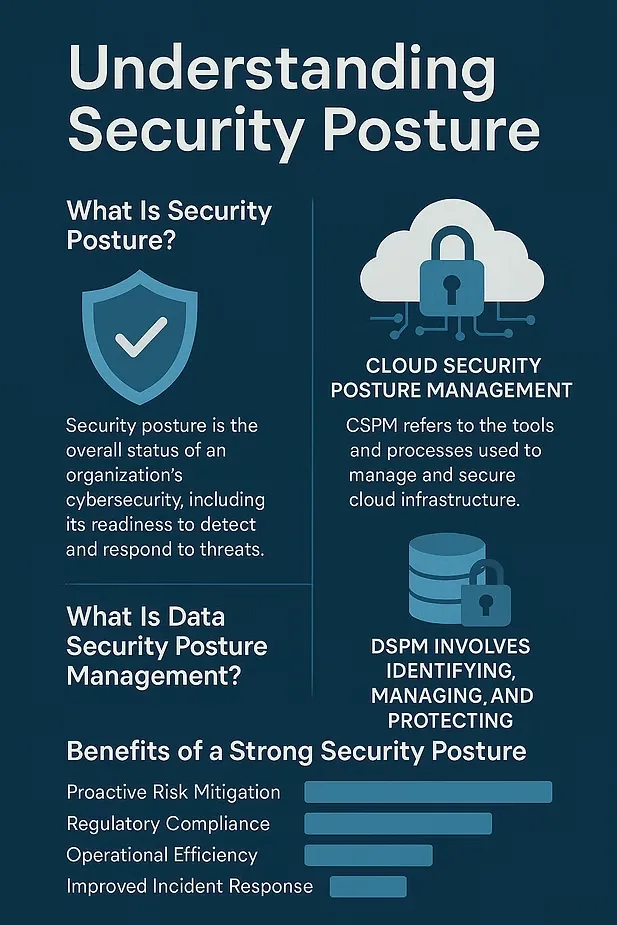
Security posture refers to the overall status and strength of an organization’s cybersecurity efforts. Many organizations begin by conducting a Cybersecurity Posture Assessment to establish a baseline understanding of their strengths, weaknesses, and risk exposure. It encompasses all the strategies, processes, policies, and tools in place to protect digital assets, detect and respond to threats, and recover from cyber incidents.
Key elements of security posture include:
- Preventative controls (e.g., firewalls, anti-malware, access controls)
- Detective controls (e.g., intrusion detection systems, monitoring)
- Responsive strategies (e.g., incident response plans, recovery protocols)
- Compliance alignment (e.g., with GDPR, HIPAA, or ISO standards)
Essentially, your security posture answers the question: How well is your organization prepared to defend against and respond to cyber threats?
Why Is Security Posture Important?
A weak or undefined security posture exposes organizations to significant operational and regulatory risks. Conducting a formal cybersecurity risk assessment helps organizations identify gaps before they lead to breaches or compliance failures.
- Data breaches
- Ransomware attacks
- Regulatory penalties
- Brand reputation damage
- Financial loss
With digital transformation and cloud adoption on the rise, the traditional security perimeter has dissolved. This has made real-time visibility, configuration management, and data control essential components of a robust cybersecurity framework.
How Do You Measure Security Posture?
Understanding your security posture requires more than reviewing technology controls. Most organizations conduct a cybersecurity posture assessment to evaluate their governance, risk management, security controls, monitoring capabilities, incident response readiness, and compliance alignment.
A posture assessment provides leadership with a clear understanding of:
- Current cybersecurity maturity
- Security control effectiveness
- Critical risk exposures
- Compliance readiness
- Recommended improvement priorities
This assessment becomes the foundation for future cybersecurity planning and investment decisions.
What Is Cloud Security Posture Management (CSPM)?
Cloud Security Posture Management (CSPM) is a class of tools and practices designed to automatically identify and remediate risks in cloud environments. As more organizations migrate workloads to the cloud, managing misconfigurations and compliance across complex infrastructures becomes challenging.
CSPM tools offer continuous monitoring and assessment of cloud services, such as:
- Amazon Web Services (AWS)
- Microsoft Azure
- Google Cloud Platform (GCP)
While CSPM focuses specifically on cloud infrastructure, it should be viewed as one component of a broader cybersecurity posture management strategy. Organizations must also address endpoint security, identity and access management, security monitoring, and governance processes to achieve comprehensive protection.
Core Features of CSPM:
- Misconfiguration detection: Identifies unsafe settings like open storage buckets or exposed ports.
- Compliance monitoring: Ensures alignment with standards like CIS Benchmarks, SOC 2, and NIST.
- Automated remediation: Applies fixes or alerts teams to potential vulnerabilities.
- Visibility and inventory: Tracks assets, identities, and network flows.
By implementing CSPM, organizations gain a real-time understanding of their cloud environment’s security posture. These initiatives are often supported through broader cybersecurity consulting services that help align cloud security controls with business objectives.
What Is Data Security Posture Management (DSPM)?
Data Security Posture Management (DSPM) focuses specifically on identifying, managing, and protecting sensitive data across an organization’s digital ecosystem. Unlike CSPM, which targets infrastructure, DSPM zeroes in on the data itself.
In today’s hybrid environments, where data lives across on-premises systems, cloud storage, SaaS platforms, and endpoints, knowing where your critical data resides and how it’s accessed is paramount.
Organizations increasingly use DSPM to support regulatory compliance initiatives, privacy risk management programs, and data governance strategies. As sensitive data becomes distributed across cloud platforms and SaaS applications, maintaining visibility into data exposure risks becomes essential.
Key Capabilities of DSPM:
- Data discovery and classification: Locates sensitive data like PII, PHI, and intellectual property. Organizations managing large volumes of regulated data frequently incorporate GRC services to ensure governance and compliance requirements are consistently enforced.
- Risk assessment: Evaluates who has access to the data and how it’s being used.
- Access control: Implements least privilege policies and monitors for anomalous behavior.
- Encryption and tokenization: Protects data in transit and at rest.
- Audit and compliance reporting: Demonstrates data security for regulatory frameworks such as GDPR or CCPA.
DSPM tools give security teams the visibility and control needed to reduce the attack surface and prevent unauthorized access or data leakage.
Governance and Risk Management
Technology alone does not determine security posture. Effective cybersecurity governance ensures security responsibilities are clearly defined, risks are properly assessed, and leadership maintains visibility into organizational cyber risk.
Strong governance includes:
- Cybersecurity policies and standards
- Risk management processes
- Executive oversight
- Security awareness programs
- Third-party risk management
- Incident response planning
Organizations with strong governance typically achieve better security outcomes and more efficient security investments.
Third-Party and Supply Chain Security
Modern organizations depend heavily on software vendors, cloud providers, managed service providers, and external partners. As a result, third-party risk has become a major component of overall security posture.
Organizations should regularly evaluate:
- Vendor security controls
- Data-sharing practices
- Supply chain dependencies
- Contractual security requirements
- Incident notification obligations
Weak supplier security can significantly impact your own security posture, even when your internal controls are strong.
Understanding Security Maturity
Security maturity refers to how consistently and effectively cybersecurity processes are implemented across an organization. Security posture assessments often benchmark organizations against frameworks such as:
- NIST Cybersecurity Framework (CSF)
- ISO 27001
- CIS Critical Security Controls
Higher maturity levels generally correlate with improved resilience, stronger compliance outcomes, and lower cybersecurity risk exposure.
Benefits of a Strong Security Posture
Whether you’re securing infrastructure with CSPM or safeguarding sensitive information via DSPM, investing in your organization’s security posture yields several critical advantages:
1. Proactive Risk Mitigation
Rather than reacting to threats after they occur, a strong posture allows you to identify vulnerabilities early. Regular vulnerability assessments provide visibility into exploitable weaknesses before attackers can take advantage of them.
2. Regulatory Compliance
Many industries are governed by strict data protection and cybersecurity regulations. A well-defined security posture ensures ongoing compliance with standards like PCI DSS, HIPAA, and ISO 27001.
3. Operational Efficiency
Security posture tools often automate the discovery and remediation of risks, reducing manual work and freeing up security teams to focus on strategic initiatives. This is particularly valuable when implementing cybersecurity solutions for small businesses, where limited IT resources make automation and visibility essential.
4. Enhanced Visibility
You can’t protect what you can’t see. CSPM and DSPM solutions provide centralized dashboards and reports that offer clarity into your entire digital ecosystem.
5. Improved Incident Response
When breaches do occur, having a comprehensive understanding of your security posture enables faster detection, containment, and recovery. Mature organizations often complement these capabilities with dedicated incident response services to accelerate containment and minimize business disruption—minimizing damage and downtime.
6. Customer Trust
Consumers and partners increasingly value privacy and data protection. A strong security posture demonstrates your commitment to cybersecurity, strengthening your brand and customer relationships.
Common Security Posture Gaps
Organizations frequently discover similar weaknesses when evaluating their security posture:
- Weak identity and access management controls
- Inconsistent patch management
- Limited security monitoring
- Insufficient incident response planning
- Lack of cybersecurity governance
- Inadequate third-party risk management
- Poor asset visibility
- Limited employee security awareness training
Addressing these issues often delivers significant improvements in cybersecurity maturity and resilience.
Best Practices to Improve Security Posture
To build and maintain a solid security posture, organizations should:
- Conduct regular cybersecurity risk assessments across cloud and on-prem environments to identify vulnerabilities before they can be exploited.
- Implement continuous monitoring to detect real-time threats.
- Adopt zero trust architecture to minimize lateral movement in networks.
- Train employees on cybersecurity best practices. For many growing organizations, strengthening SMB cybersecurity programs is one of the most effective ways to reduce overall organizational risk.
- Integrate CSPM and DSPM tools into existing workflows.
- Establish and rehearse incident response plans.
Final Thoughts
Security posture is more than a buzzword, it’s a critical metric of how prepared your organization is to handle today’s evolving threat landscape. By investing in Cloud Security Posture Management (CSPM) and Data Security Posture Management (DSPM), companies can gain visibility, reduce risk, and enhance their resilience against cyber attacks.
In today’s digital-first world, your security posture isn’t just an IT concern, it’s a business imperative.
Strengthen Your Security Posture with Armour Cybersecurity
Understanding your security posture is the first step toward reducing cyber risk and improving organizational resilience. Armour Cybersecurity helps organizations identify security gaps, assess cybersecurity maturity, align with industry frameworks, and develop practical remediation roadmaps.
Our experts can help you:
- Evaluate your cybersecurity posture
- Benchmark against NIST CSF and ISO 27001
- Identify critical security gaps
- Improve compliance readiness
- Build a long-term cyber strategy roadmap
Book a Cybersecurity Posture Assessment with Armour Cybersecurity today.
Frequently Asked Questions (FAQs)
What is security posture?
Security posture is the overall strength and effectiveness of an organization’s cybersecurity defenses, policies, processes, and risk management capabilities.
How is security posture measured?
Organizations typically measure security posture through cybersecurity posture assessments that benchmark security controls against frameworks such as NIST CSF, ISO 27001, and CIS Controls.
What is the difference between CSPM and DSPM?
CSPM focuses on cloud infrastructure security, while DSPM focuses on discovering, classifying, and protecting sensitive data across cloud, SaaS, and on-premises environments.
How often should security posture be assessed?
Most organizations should perform formal assessments annually and after major technology, business, or regulatory changes.
Why is security posture important for cyber insurance?
Insurers increasingly evaluate security controls such as MFA, EDR, vulnerability management, and backup capabilities before providing coverage.
What is a cybersecurity posture assessment?
A cybersecurity posture assessment is a structured review of security controls, governance, risk management, and operational capabilities used to identify gaps and prioritize improvements.