By David Chernitzky, CEO, Armour Cybersecurity · Serving Toronto and organizations across North America · Last updated August 24, 2026
Quick Answer
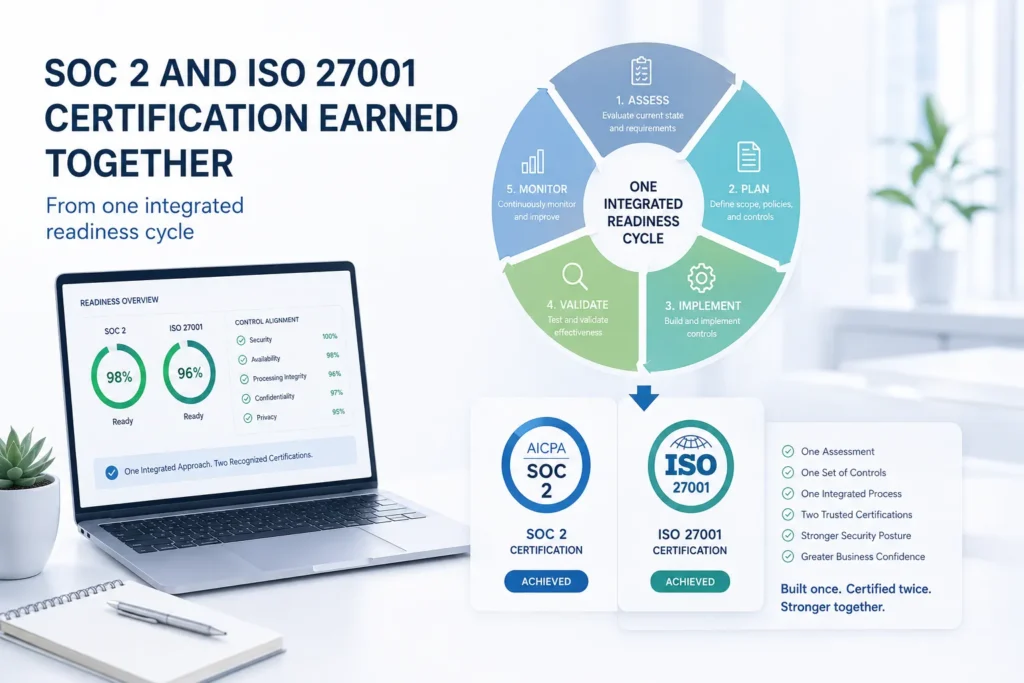
SOC 2 and ISO 27001 certification share roughly 80 percent of the same underlying controls, which means an organization that needs both does not have to run two separate compliance programs. A properly structured integrated compliance audit program maps both standards against a single control set, performs the readiness and remediation work once, and sequences the two audits so you earn both certifications from one cycle of effort. The same approach extends to HIPAA and PCI DSS where they apply, because those frameworks share the same foundational controls.
Key Takeaways
SOC 2 and ISO 27001 rest on the same foundational controls: access management, risk assessment, change management, incident response, vendor oversight, monitoring, and business continuity. These shared domains are the province of a mature governance, risk, and compliance function, and they are where an integrated program does the work once and credits it to both certifications.
- Running a separate program for each certification duplicates the gap assessment, policy development, stakeholder interviews, and evidence collection, typically at two to three times the cost and timeline of pursuing them together.
- The incremental effort to add ISO 27001 to a SOC 2 program (or the reverse) is usually 20 to 40 percent of what a standalone engagement for that certification would cost, because most of the controls are already in place.
- HIPAA and PCI DSS layer onto the same shared control foundation, so a SOC 2 and ISO 27001 program can absorb them as incremental additions rather than fresh projects.
- Audit sequencing matters. Knowing which certification a specific deal or market requires first, and coordinating the audit timelines around it, is a core part of the integrated program design.
Why Do Organizations Need SOC 2 and ISO 27001 Together?
The two certifications serve different markets, and a growing company often finds it needs both. SOC 2 is the standard US enterprise buyers expect from their SaaS and cloud vendors. ISO 27001 is the internationally recognized certification that buyers in Europe, the UK, and much of Asia-Pacific look for. A company that starts with SOC 2 to close US enterprise deals frequently wins an international contract that requires ISO 27001, or the reverse. Deciding which one your customers require first is a market question, but organizations selling into both markets usually end up needing both.
For organizations in certain sectors, multi-certification requirements are a starting condition rather than a gradual accumulation. A health-tech company processing patient data and handling payment card transactions faces HIPAA and PCI DSS on top of the SOC 2 its enterprise customers expect. A fintech operating in the US and EU faces SOC 2 and ISO 27001 from day one. The instinct to treat each as a separate project, tackled sequentially, is understandable but expensive: sequential programs duplicate significant shared work and extend the total timeline to multi-certification compliance by twelve to eighteen months compared to an integrated approach.
What Controls Do SOC 2 and ISO 27001 Share?
The overlap between SOC 2 and ISO 27001, and between both and HIPAA and PCI DSS, is substantial because all four frameworks are ultimately trying to achieve the same thing: ensure that organizations managing sensitive information have implemented and are operating the controls necessary to protect it. The framing, terminology, and documentation requirements differ, but the underlying control domains are largely the same.
Access Management
Every major framework requires that access to systems and data be limited to authorized individuals, granted through a defined provisioning process, separated for privileged accounts, reviewed periodically, and revoked promptly when no longer needed. SOC 2 asks for access review records and provisioning tickets. ISO 27001 looks for a documented access control policy and its implementation. HIPAA requires workforce authorization procedures and audit controls. PCI DSS requires unique user IDs, MFA on cardholder data environment access, and quarterly access reviews. The underlying control is the same, the evidence package is largely the same, and it is collected once and mapped to each certification.
Risk Assessment
ISO 27001 requires a formal documented risk assessment and risk treatment plan as a core element of the Information Security Management System. SOC 2 requires risk assessment as part of the Security criterion under the COSO framework. HIPAA requires a risk analysis covering the confidentiality, integrity, and availability of electronic protected health information. A single risk assessment methodology, documented and executed once, produces the artifacts required across all of them, mapped to each standard’s terminology and format.
Incident Response
Incident response requirements appear in every framework. SOC 2 requires defined incident response procedures and evidence of their operation. ISO 27001 Annex A requires information security incident management. HIPAA requires procedures for responding to security incidents involving protected health information. PCI DSS Requirement 12.10 requires an incident response plan that is tested annually. A single incident response plan, properly documented and tested, satisfies all four, with the HIPAA breach notification process and the PCI DSS card brand notification requirement added as framework-specific layers.
Vendor and Third-Party Management
Third-party risk management is shared across frameworks. SOC 2 requires vendor oversight as part of the Common Criteria. ISO 27001 Annex A requires information security in supplier relationships. HIPAA requires business associate agreements. PCI DSS requires that service providers handling cardholder data maintain their own compliance. The vendor inventory, risk tiering, and assessment process is built once, and the framework-specific outputs are added as incremental layers.
What Is Unique to Each Certification?
The 20 to 30 percent of requirements that are framework-specific are where the incremental effort in an integrated engagement is focused. SOC 2 is unique in its Trust Service Criteria structure, the requirement for a CPA firm as auditor, and the system description that must be produced for the audit. ISO 27001 is unique in its requirement for a formal Information Security Management System with a defined scope, documented management review, internal audit program, and continual improvement process.
HIPAA is unique in its requirements around protected health information: the Privacy Rule governing use and disclosure, the Security Rule governing safeguards for electronic PHI, and the Breach Notification Rule. PCI DSS is unique in its prescriptive technical requirements for the cardholder data environment: network segmentation, encryption of cardholder data in transit and at rest, specific logging and monitoring, quarterly internal and annual external scans, and penetration testing of the CDE. Organizations adding PCI DSS typically have incremental technical remediation to address.
How Does an Integrated Engagement Work?
An integrated engagement begins with a unified readiness assessment that maps the organization’s current controls against every required certification at once. Rather than a separate assessment per framework, one process identifies shared gaps that affect multiple certifications and framework-specific gaps that are unique to one standard. The remediation roadmap that follows is organized around the shared control set first, so implementing MFA, formalizing the risk assessment, building the incident response plan, and completing the vendor inventory addresses gaps across every certification in scope at once.
Framework-specific remediation is then sequenced by certification priority. Understanding the gap assessment findings up front means the shared work is planned and executed once, with resources, stakeholder time, and policy development allocated a single time and credited across all frameworks. The formal audits are then coordinated to minimize audit fatigue: evidence collected for one is reused for another, and a well-organized evidence package produced for the SOC 2 audit reduces the marginal effort for the ISO 27001 certification body audit. Armour Cybersecurity coordinates the auditor engagement sequence across both audits to take advantage of these efficiencies.
How Do You Decide Which Certification to Earn First?
Sequencing should be driven by business need. The certification blocking a specific customer contract, investor requirement, or market entry is prioritized. Where both are needed and neither is blocking a specific deal, the most efficient approach is usually to target the faster path first, obtain that certification as a signal to customers, and complete the other in the months that follow. SOC 2 Type I is typically the fastest to obtain and provides the most immediate commercial benefit for US enterprise pipelines, while ISO 27001 follows on a readiness timeline set by the accredited body. Knowing how long each certification takes is what makes the sequencing decision concrete rather than guesswork.
Across the 260+ organizations Armour Cybersecurity protects in 52+ industries, the companies that pay twice for compliance are almost always the ones that treated the second certification as a brand-new project a year later, rebuilding the same access reviews, the same policies, and the same evidence they already had, instead of mapping both standards to one control set from the start.
Frequently Asked Questions
We already have SOC 2. How much extra work is ISO 27001 certification?
An organization that has completed SOC 2 Type II and maintained the program for a full audit cycle has already implemented the majority of ISO 27001 Annex A controls. The incremental work for ISO 27001 is primarily in the management system elements: formalizing the ISMS scope document, completing the ISO 27001 format risk assessment and risk treatment plan, establishing the internal audit program, conducting a management review, and engaging an accredited certification body. Armour scopes its ISO 27001 add-on for existing SOC 2 holders to exactly this incremental work.
Can we earn SOC 2 and ISO 27001 certification at the same time?
Yes, and this is typically how integrated engagements are structured. The SOC 2 observation period begins as soon as controls are implemented. The ISO 27001 certification audit, which does not require an observation period in the same way, can be scheduled to occur while the SOC 2 observation period is accumulating. An organization that completes readiness in month two can hold ISO 27001 certification while the SOC 2 Type II observation window is still running, then complete the SOC 2 Type II audit a few months later.
Does pursuing both certifications together create audit conflicts?
No, provided the program is structured correctly. The auditors for each framework are separate: the CPA firm conducting the SOC 2 audit and the accredited certification body conducting the ISO 27001 audit operate independently. The evidence packages for each are organized separately even though the underlying controls are shared. A well-managed integrated program produces clean, framework-specific evidence packages for each auditor.
Can we add HIPAA and PCI DSS to a SOC 2 and ISO 27001 program?
Yes. HIPAA and PCI DSS share the same foundational controls as SOC 2 and ISO 27001, so adding them to an integrated program is incremental rather than a separate project. The added work is the framework-specific elements: HIPAA privacy and breach notification requirements and business associate agreements, and PCI DSS cardholder data environment controls such as segmentation, encryption, and quarterly scanning. The shared control foundation built for SOC 2 and ISO 27001 carries most of the load.
The Bottom Line
If your organization needs SOC 2 and ISO 27001, the expensive mistake is treating each as its own project. The two certifications are mostly the same controls wearing different labels, so the readiness and remediation work is done once, mapped to both, and the audits are sequenced to the markets that need them first. HIPAA and PCI DSS layer onto the same foundation. That is the difference between eighteen to twenty-four months of duplicated effort and a single coordinated cycle that delivers everything for materially less. Armour Cybersecurity’s integrated compliance audit program earns SOC 2, ISO 27001, HIPAA, and PCI DSS from one readiness engagement, with Big 4 advisory depth and military-trained advisors, so you get the certification your market requires now without paying twice for the one it requires next.
About the author
David Chernitzky is the CEO and Co-Founder of Armour Cybersecurity, a Toronto-based firm that protects organizations across North America from advanced cyber threats. He brings more than 25 years of cybersecurity and military cyber intelligence experience, having served as an officer in an elite technology unit before co-founding Armour. Armour’s team of military-intelligence veterans and senior advisors serves 260+ clients across 52+ industries with a 97% client retention rate. Learn more about Armour Cybersecurity.