By David Chernitzky, CEO, Armour Cybersecurity · Serving Toronto and organizations across North America · Last updated August 25, 2026
Quick Answer
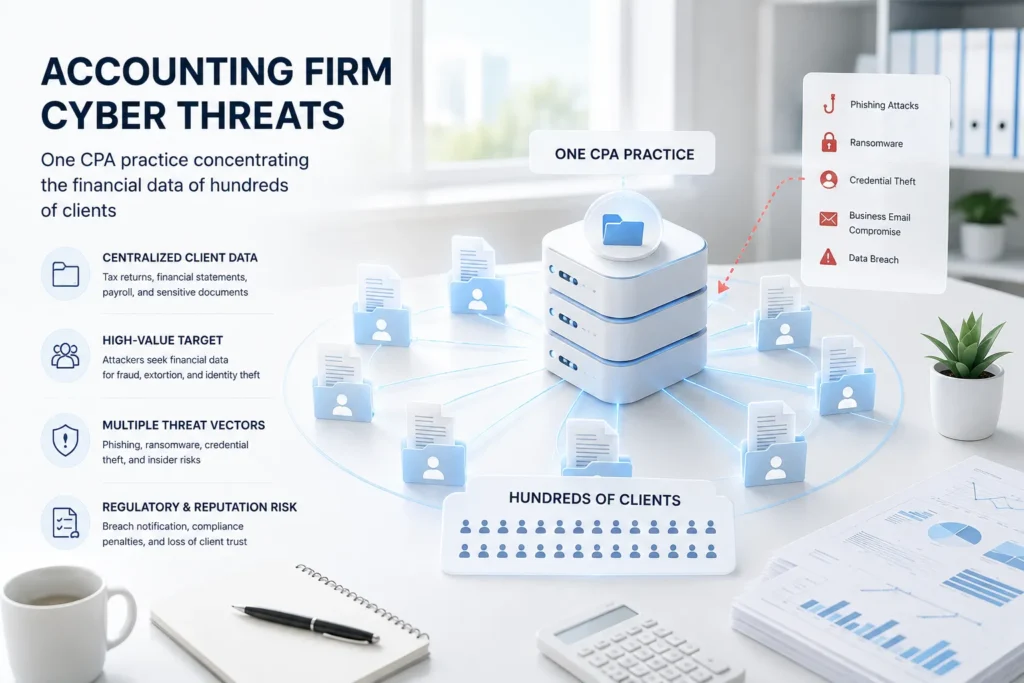
Accounting firms concentrate the financial records, tax returns, and corporate data of hundreds or thousands of clients in one place. That combination of high-value data and often-limited cybersecurity investment makes CPA practices and advisory firms an attractive target for ransomware operators, business email compromise groups, and data thieves alike. The accounting firm cyber threats that follow are not random; they are the predictable result of where the valuable data sits and how hard it is to defend during tax season.
Key Takeaways
- Accounting firms aggregate client financial data at a scale that rivals banks, often with far less security investment.
- Tax season creates a narrow, high-pressure window attackers deliberately exploit.
- Ransomware, BEC fraud, and credential theft are the three dominant threat patterns against the profession.
- CPA confidentiality obligations and client security questionnaires are raising the baseline security standard firms must meet.
- A managed cybersecurity programme built for accounting firm seasonality closes gaps that generic IT support leaves open.
What Makes Accounting Firms Such an Attractive Target?
An accounting firm is, in data terms, extraordinarily valuable. A mid-size practice serving 300 business clients holds corporate financial statements, tax structuring documents, payroll records, personal tax returns, and M&A advisory files across all of them. A single breach gives an attacker the financial blueprint of hundreds of companies and individuals at once.
Criminal groups understand this. Ransomware operators targeting an accounting firm during tax season can demand and receive significantly higher ransoms than they could from any single client company, because the firm cannot afford to be offline during filing deadlines. The data available for exfiltration and sale is equally concentrated.
Nation-state actors see accounting firms as intelligence targets. Corporate acquisition plans, cross-border transactions, and high-net-worth client data are all strategically valuable well beyond their financial worth.
How Does the Tax Season Window Change the Risk Picture?
Tax season compresses risk into a few months. Staff work longer hours under deadline pressure, which increases credential reuse, makes phishing harder to spot, and reduces the bandwidth available for deliberate security decisions. Firms bring on temporary or seasonal staff who need rapid access to systems without the onboarding security review that permanent staff receive.
Attackers time campaigns accordingly. Phishing volumes targeting accounting firms spike during filing periods. Business email compromise attempts impersonating the CRA, IRS, or senior clients increase precisely when partners and managers are most likely to act quickly without verifying.
At the same time, the ability to take systems offline for patching or incident response is effectively eliminated during peak season. A firm that discovers a compromise in March faces the choice between containing it and meeting client deadlines, which is exactly the position attackers want them in.
What Are the Most Common Attack Types Against Accounting Firms?
Ransomware Targeting Practice Management Systems
Practice management platforms, document management systems, tax preparation software, and audit tools are the operational backbone of an accounting firm. Ransomware operators know that encrypting these systems during tax season creates immediate, existential pressure. Recovery timelines measured in days or weeks translate directly into missed deadlines, client loss, and regulatory exposure. Firms that have not tested their backups, isolated recovery systems, or run a breach response exercise are particularly vulnerable. The cost of recovery extends well beyond the ransom itself.
Business Email Compromise and Wire Fraud
BEC attacks against accounting firms exploit the firm’s trusted relationships with clients. An attacker who compromises a partner’s email account or spoofs the firm’s domain can redirect client payments, intercept wire instructions, and request fraudulent transfers while appearing entirely legitimate. The losses from a single successful business email compromise attack frequently reach six figures. These attacks are not technically sophisticated. They rely on the trust that accounting firms work hard to build with clients, and on the volume of financial transactions that flow through firm communications during busy periods.
Credential Theft and Account Takeover
Cloud-based tax and audit platforms require staff credentials to access client files. Phishing campaigns that harvest those credentials give attackers direct access to client financial records without triggering network-level alerts. Once inside a cloud platform, an attacker can exfiltrate data quietly over days or weeks. Multi-factor authentication on practice management and tax platforms is the minimum control. Firms that have not enforced MFA across all cloud tools are operating with a well-documented exposure that insurers are actively checking at renewal.
Why Do Generic IT Providers Fall Short for Accounting Firms?
A generalist IT provider can manage workstations, configure a firewall, and handle helpdesk tickets. What they cannot do is align security controls to CPA confidentiality obligations, understand the seasonality of accounting operations, or prepare the documented evidence that enterprise clients and cyber insurers now expect.
SOC 2 client questionnaires ask about encryption, access management, incident response plans, vendor risk programmes, and security testing. These are not standard IT service deliverables. SOC 2 and ISO 27001 readiness is what lets a firm answer those questionnaires with evidence rather than assurances, and a firm that cannot answer them risks losing enterprise audit and advisory mandates to competitors who can.
The right cybersecurity partner for an accounting firm understands the profession’s obligations, the seasonality of its operations, and the regulatory environment it operates in. Generic security is not the same as accounting-aware security.
How Does Professional Cybersecurity Protect an Accounting Firm?
A cybersecurity programme built for accounting firms addresses the profession’s specific risk profile rather than applying generic controls. Armour Cybersecurity’s approach to cybersecurity for accounting firms covers layered controls aligned to CPA confidentiality obligations and PIPEDA, SOC 2 and ISO 27001 readiness for client RFP responses, monitoring that ramps up during tax season, and evidence packages for cyber insurance renewals.
The programme scales with firm size. Solo practitioners and boutique firms engage through a managed service that covers endpoint protection, email security, and monitoring at small-firm pricing. Mid-size practices add compliance audit and penetration testing to support enterprise client requirements. Larger firms add fractional CISO leadership for governance and partner reporting.
Across the 260+ organizations Armour Cybersecurity protects in 52+ industries, the accounting firms that come through tax season cleanest are rarely the ones with the biggest security budgets. They are the ones whose controls were matched to how a practice actually runs, MFA everywhere before filing season, a tested recovery plan, and email verification habits that hold up under deadline pressure, so an attacker’s favorite month becomes just another busy one.
Frequently Asked Questions
Are smaller accounting firms really at risk, or just large practices?
Smaller firms are frequently more targeted, not less. Large firms often have in-house security resources. Boutique practices and sole practitioners are seen as easier entry points, and the client data they hold is just as valuable. Attackers do not select targets based on firm headcount.
What is the CPA confidentiality obligation in cybersecurity terms?
CPA Codes of Professional Conduct require members to protect client information, with regulators increasingly interpreting that obligation to include technical and administrative safeguards. While the Code does not mandate a specific framework, it expects practitioners to understand the risks of their technology and take reasonable steps to address them. Documented controls are the evidence that those steps were taken.
How much does a cybersecurity programme cost for an accounting firm?
Armour Cybersecurity structures engagements to match firm size and risk profile. A managed service for a small firm is a defined monthly cost with no surprise consulting fees. Compliance readiness and penetration testing are scoped engagements with fixed deliverables. The cost of a programme is typically a fraction of the cost of a single breach or a lost enterprise mandate.
What should we prioritize first?
For most accounting firms, the first priorities are MFA across all cloud platforms, phishing-resistant email configuration, and a clear incident response plan. From there, a gap assessment against CPA confidentiality obligations and PIPEDA identifies what to address next. Armour’s consultation starts with understanding your current state before recommending any specific service.
The Bottom Line
Accounting firms are targeted for a simple reason: one practice holds the concentrated financial lives of hundreds of clients, and tax season is the moment that data is hardest to defend. Ransomware, business email compromise, and credential theft are not exotic; they are the predictable plays against a profession under deadline pressure with generic IT support. The firms that stay out of the headlines are the ones whose controls fit how an accounting practice actually operates, MFA across every cloud platform, tested recovery, insurer-ready evidence, and confidentiality safeguards mapped to the CPA obligations regulators now expect. Armour Cybersecurity works with accounting firms and CPA practices across Canada to build cybersecurity for accounting firms that fits the profession’s seasonality, budget, and partner culture, so protecting client data becomes a routine part of how the firm runs rather than a scramble after something goes wrong.
About the author
David Chernitzky is the CEO and Co-Founder of Armour Cybersecurity, a Toronto-based firm that protects organizations across North America from advanced cyber threats. He brings more than 25 years of cybersecurity and military cyber intelligence experience, having served as an officer in an elite technology unit before co-founding Armour. Armour’s team of military-intelligence veterans and senior advisors serves 260+ clients across 52+ industries with a 97% client retention rate. Learn more about Armour Cybersecurity.