By David Chernitzky, CEO, Armour Cybersecurity · Serving Toronto and organizations across North America · Last updated August 26, 2026
Quick Answer
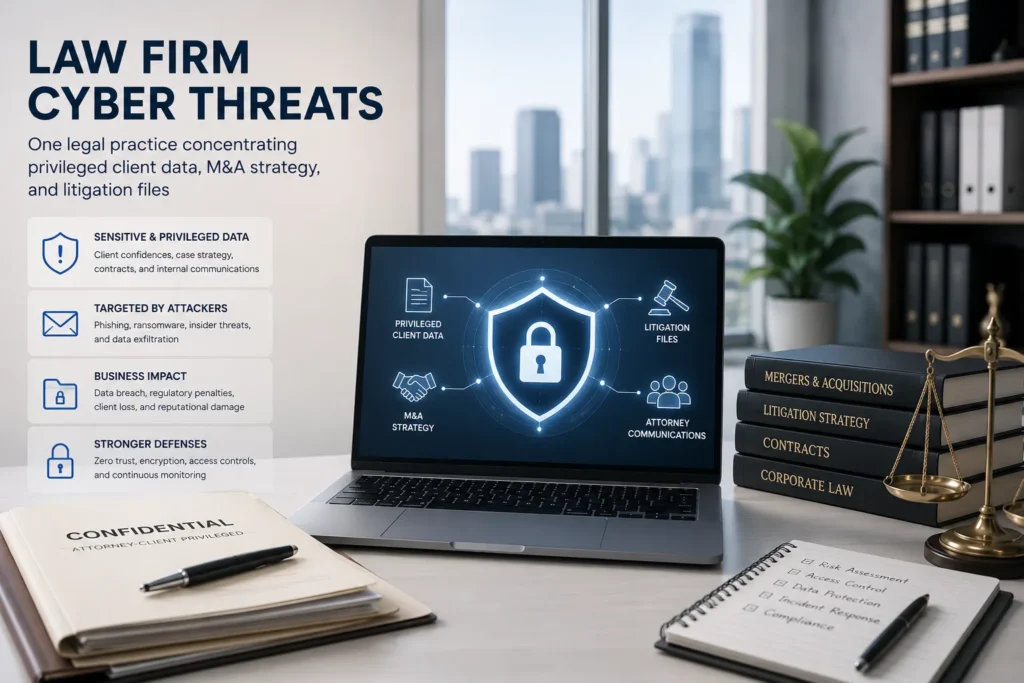
Law firms hold some of the most sensitive information in the economy: M&A strategy before announcements, litigation positions before trial, government investigation details, IP disputes, and the personal financial records of thousands of individuals. That combination of high-value data, professional disclosure constraints, and historically thinner security investment than the clients they serve makes legal practices a priority target for criminal groups and nation-state actors alike. Understanding these law firm cyber threats is the first step toward a defence that privilege alone cannot provide.
Key Takeaways
- Law firms aggregate privileged client communications across transactions, disputes, and regulatory matters that have significant strategic and financial value to adversaries.
- Nation-state actors specifically target law firms to access M&A intelligence, sanctions advice, government investigation details, and IP litigation strategy.
- Ransomware operators target document management and billing systems knowing that firms cannot afford extended downtime during active matters.
- Business email compromise attacks exploit the trusted financial relationships law firms hold with clients, routing settlement funds and escrow payments to fraudulent accounts.
- The gap between the security investment of major law firm clients and the firms that serve them creates an asymmetric risk that sophisticated attackers deliberately exploit.
What Makes Law Firms Such a Valuable Target?
A law firm is a repository of the most sensitive decisions its clients make. M&A counsel holds deal structure and valuation before public announcement. Litigation counsel holds case strategy, witness assessments, and settlement ranges that would be decisive in opposing hands. Government investigations counsel holds information about regulatory exposure that could affect a company’s stock price, regulatory status, and leadership. IP counsel holds the details of patent disputes, trade secret claims, and licensing positions.
All of this information sits in document management systems, email archives, and matter files protected by attorney-client privilege, but privilege is a legal concept, not a technical control. It governs what can be compelled in court. It does not prevent a network intrusion from exfiltrating the same documents that privilege would protect from legal discovery.
Attackers understand this distinction. A sophisticated adversary who cannot compel disclosure through legal process can obtain the same information through a network compromise. The privilege protection that clients rely on provides no barrier once the technical controls protecting the firm’s systems have been bypassed.
Who Is Targeting Law Firms and Why?
Nation-State Intelligence Operations
Foreign intelligence services have targeted law firms consistently and openly. FBI advisories, along with warnings from Canadian cyber authorities, have identified law firms as targets for nation-state cyber espionage, particularly in the areas of M&A, IP litigation, sanctions advisory, and government contract matters. The logic is straightforward: a firm advising on a significant cross-border acquisition holds more deal intelligence than either party’s corporate team, concentrated in a single network that may be less hardened than the client’s own environment.
Nation-state actors operating against law firms do not announce themselves. They establish persistent access, quietly harvest documents over months or years, and exit without triggering incident response. The breach may never be discovered, or may be discovered long after the intelligence value has been extracted and acted on.
Ransomware Criminal Groups
Ransomware operators have identified law firms as high-value targets for a specific reason: active matter pressure. A firm managing a significant transaction, a trial preparation, or a regulatory deadline cannot afford extended system downtime. Encrypting a document management system in the middle of a deal closing or trial preparation creates leverage that translates into ransom payments at rates higher than most enterprise targets.
Law firm ransomware attacks have also increasingly adopted a double-extortion model: encrypt the files and threaten to publish privileged client communications if the ransom is not paid. The reputational damage of a confidentiality breach, compounded by the professional responsibility implications, creates pressure that pure operational disruption does not.
Business Email Compromise Groups
The financial flows through law firm trust accounts, settlement funds, and real estate escrow are significant and move on the basis of instructions delivered primarily through email. BEC groups that compromise a lawyer’s email account, or convincingly spoof a firm’s domain, can redirect those flows to fraudulent accounts before the fraud is detected. A single successful real estate escrow diversion or settlement wire redirect can generate six-figure losses from one attack, which is why email security hardened against impersonation and account takeover is foundational for legal practices.
Why Does the Security Gap Between Law Firms and Their Clients Matter?
Many of the largest law firm clients, public companies, financial institutions, and government contractors, operate security programmes that would stop the majority of attacks directed at them. Those same clients select law firms to handle their most sensitive work, and those law firms frequently operate with a fraction of the security investment their clients maintain.
Sophisticated attackers have mapped this gap explicitly. Targeting a law firm to access client information is a recognized attack pattern because the firm holds the same data in a less hardened environment. FBI advisories have noted this directly: law firms are targeted as a proxy route to their clients’ most sensitive information.
This dynamic is now driving client security questionnaires. Enterprise legal departments, financial institutions, and government contractors are requiring law firms to demonstrate minimum security standards before engaging them on sensitive matters. The questionnaire is the client’s mechanism for closing the gap they recognize exists, and firms increasingly turn to dedicated law firm cybersecurity services to meet that bar without building an in-house security team.
What Are the Specific Risks in a Legal Practice Environment?
The document management system is the core risk in most law firms. It holds every client file, every privileged communication, and every work product produced by the firm. It is also the system that is most operationally critical and most commonly targeted by ransomware. Many firms run document management on ageing on-premise infrastructure with limited monitoring and deferred patching, creating an exposure that perimeter controls alone do not address.
Remote access has expanded the attack surface significantly. Lawyers working from home, travelling, and accessing matters from personal devices create credential exposure and endpoint risks that office-based practice did not generate at the same scale. A lawyer who accesses a client matter from a compromised personal device, or who reuses credentials across personal and professional accounts, creates an entry point that technical controls at the firm level cannot fully compensate for.
Departing lawyers and staff represent a specific insider risk. Client files, matter documents, and contact databases are commercially valuable to departing lawyers building their own practices or moving to competitors. Data loss prevention controls that monitor for unusual file access and exfiltration, combined with structured offboarding procedures, address an exposure that many firms manage through policy alone without technical enforcement.
How Does Professional Cybersecurity Address These Risks?
A cybersecurity programme built for law firms addresses the profession-specific risk profile rather than applying enterprise controls that miss what matters most in legal practice. The programme covers document management and litigation hold system protection, email security hardened against BEC and phishing, credential and endpoint controls for remote and mobile access, insider threat monitoring for departing timekeeper scenarios, and the compliance evidence that client questionnaires and Law Society obligations require.
The vCISO service provides senior cybersecurity leadership that most firms below large-firm scale cannot justify as a full-time hire. The compliance audit service produces the SOC 2 and ISO 27001 aligned documentation that enterprise client questionnaires require. Threat intelligence monitors for credential exposure and impersonation of firm partners and domains, so an attack in preparation is visible before it lands.
Across the 260+ organizations Armour Cybersecurity protects in 52+ industries, the law firms that clear client security questionnaires without friction and never make headlines are not the ones with the biggest IT budgets. They are the ones who treated privileged data as a technical problem rather than a legal one: document management monitored and patched, email hardened against impersonation, privileged access recorded, and offboarding enforced in the system rather than on paper, so a client’s most sensitive matter is as safe inside the firm as it is inside the client.
Frequently Asked Questions
Are boutique and regional firms targeted the same way as Am Law 100 firms?
Different attackers target different firm profiles. Nation-state actors tend to focus on large firms handling cross-border transactions, government advisory, and significant IP matters. Ransomware operators specifically target mid-size firms where the ransom demand can be calibrated to what the firm can pay, and where recovery capabilities are weaker than at large firms. BEC attacks hit firms of all sizes because the trust in email-based wire instructions does not vary by firm headcount. No firm size is outside the threat landscape.
Does privilege protect us if client data is breached?
Privilege is not a data protection control. It governs compelled disclosure in legal proceedings. It does not prevent unauthorized access to privileged documents through a network breach, and it does not limit the liability or professional responsibility exposure that follows a breach. In fact, the professional duty to protect client confidential information creates additional exposure when a breach occurs, beyond standard data protection law.
Our firm has cyber insurance. Is that sufficient?
Cyber insurance responds to losses after an incident. It does not prevent incidents, and policies increasingly require documented controls as a condition of coverage. A firm that cannot demonstrate MFA, a tested incident response plan, and annual security testing at renewal may find coverage declined or exclusions applied that limit the policy precisely when it is most needed. Insurance and a security programme work together, not as substitutes for each other.
What is the first step toward improving our firm’s security posture?
A gap assessment that identifies the current state of controls against the risks that matter most in legal practice is the right starting point. Armour’s consultation begins with understanding the firm’s practice areas, technology environment, and current security investment before recommending any specific service. The starting point differs by firm size, practice mix, and client security requirements. There is no single right answer, but there is a right starting point for every firm.
The Bottom Line
Law firms are targeted because they concentrate what everyone else wants to keep secret, and privilege does nothing to stop a network intrusion from taking it. Nation-state actors want the deal and litigation intelligence, ransomware crews want the leverage of a frozen document management system during an active matter, and BEC groups want the trust-account and escrow flows that move on an emailed instruction. The firms that come through this are the ones that stopped treating security as an IT line item and built a programme around the profession’s real risk: protected document management, hardened email, recorded privileged access, enforced offboarding, and the SOC 2 and ISO 27001 evidence that clients now demand. Armour Cybersecurity helps law firms protect privileged client data and build law firm cybersecurity services that satisfy Law Society obligations and enterprise client requirements, so security becomes a reason firms win sensitive mandates rather than a reason they lose them.
About the author
David Chernitzky is the CEO and Co-Founder of Armour Cybersecurity, a Toronto-based firm that protects organizations across North America from advanced cyber threats. He brings more than 25 years of cybersecurity and military cyber intelligence experience, having served as an officer in an elite technology unit before co-founding Armour. Armour’s team of military-intelligence veterans and senior advisors serves 260+ clients across 52+ industries with a 97% client retention rate. Learn more about Armour Cybersecurity.