By David Chernitzky, CEO, Armour Cybersecurity · Serving Toronto and organizations across North America · Last updated August 28, 2026
Quick Answer:
A failed vendor security questionnaire is not just a lost deal. It is a signal that your security posture has a documented gap between where it is and where your enterprise customers require it to be. The organizations that recover fastest are the ones that treat the questionnaire failure as a starting point for a structured remediation programme, not as a one-time problem to patch before the next submission.
Key Takeaways
- Enterprise security questionnaires test for specific controls and certifications. A failure typically reveals gaps in documentation, access management, incident response maturity, or the absence of a recognized certification such as SOC 2 or ISO 27001.
- A questionnaire failure that costs one deal will cost future deals. Enterprise buyers share vendor risk intelligence and use consistent evaluation criteria. The underlying gaps do not disappear between submissions.
- The path from questionnaire failure to consistent pass requires a compliance readiness programme, not a questionnaire-by-questionnaire remediation approach.
- Most enterprise buyers will re-engage with a vendor that demonstrates credible, time-bound commitment to remediation. A clear programme with a defined certification timeline is a more persuasive response than assurances without evidence.
- The right cybersecurity partner takes organizations from gap assessment through certification, with the governance structure that enterprise infosec reviewers expect to see in place.
Why Do Organizations Fail Enterprise Security Questionnaires?
Enterprise security questionnaires have become more rigorous as the cost of third-party data breaches has become more visible and quantifiable. The average cost of a breach involving a third-party vendor now approaches $4.9 million, and enterprise infosec teams are held accountable for the vendor risk posture of every supplier in their environment. Questionnaires that were once checkbox exercises have become substantive assessments with follow-up questions, evidence requests, and escalation to senior security leadership for anything that falls below threshold.
Organizations fail these assessments for several consistent reasons. The most common is the absence of a recognized third-party certification. SOC 2 Type II is the standard that US enterprise buyers expect from SaaS vendors, cloud providers, and managed service providers. ISO 27001 is the equivalent for international markets. A vendor that cannot produce a current report from either framework is, in most enterprise infosec programmes, an automatic escalation or disqualification.
The second common reason is a gap between what the questionnaire asks about and what the organization can actually evidence. It is not enough to say that multi-factor authentication is enforced, or that an incident response plan exists, or that access reviews are conducted quarterly. The questionnaire asks for evidence of these things: configuration screenshots, policy documents with approval dates, audit logs, test records. Organizations that have informal practices but no documented evidence fail at this stage regardless of their actual security posture.
The third reason is specific control gaps that the organization genuinely has not addressed. Penetration testing that has never been conducted, a vulnerability management programme that does not exist in a formal sense, vendor risk management that consists of nothing more than checking a contract template. These are real gaps that the questionnaire is designed to find, and they require real remediation, not documentation of something that does not exist.
What Does a Questionnaire Failure Actually Cost?
The immediate cost is the deal that did not close. For a SaaS company in an enterprise sales cycle, a security questionnaire failure that kills a contract is a material revenue event. But the downstream cost is often larger. Enterprise buyers share vendor risk assessments. An organization that fails a questionnaire at one enterprise customer is likely to face the same failure at others, because the evaluation criteria are drawn from the same frameworks and the same control gaps will surface each time.
There is also a reputational cost within the sales cycle itself. An account executive who has to deliver the news that the organization’s security programme did not pass the customer’s review is in a weaker position for every subsequent negotiation, even if remediation is eventually completed. The buyer has seen evidence that security is not a priority, and that perception persists.
The cost of remediation is real but finite and predictable. The cost of continuing to fail questionnaires is recurring, compounding, and reputation-eroding. Organizations that calculate the cost of a compliance programme against the value of the deals it enables consistently find the investment straightforward to justify.
What Does a Structured Remediation Programme Look Like?
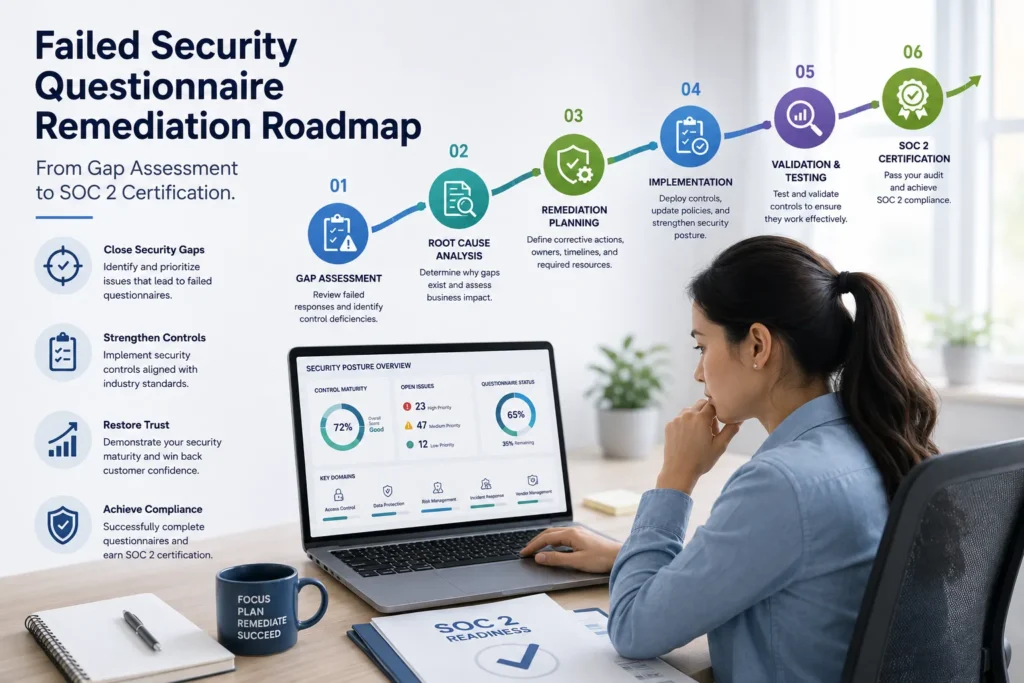
Across the 260+ organizations Armour Cybersecurity protects in 52+ industries, the recovery pattern is consistent: the vendors that come back from a questionnaire failure treat it as the trigger for a certification programme, then turn the resulting SOC 2 or ISO report into a sales asset they hand every subsequent enterprise prospect. The starting point is a compliance readiness assessment that maps the organization’s current security controls against the specific frameworks the enterprise buyers require. Armour Cybersecurity’s Compliance Readiness Assessment identifies every gap between the current state and the certification standard, produces a prioritized remediation roadmap with effort and cost estimates for each item, and gives leadership a clear compliance readiness score. This replaces the guesswork of trying to infer from questionnaire feedback what actually needs to change.
For organizations that need SOC 2, ISO 27001, or both, the Integrated Compliance Audit Program takes the readiness assessment through to formal certification. The programme covers all three phases: gap assessment, readiness check, and independent audit. Organizations that complete the programme receive a certified audit report that satisfies the questionnaire requirements that caused the initial failure, and that can be distributed to every subsequent enterprise prospect in the sales pipeline.
Governance, Risk and Compliance services address the structural gaps that questionnaires consistently find: the absence of a documented risk management framework, the missing policy library, the vendor risk programme that exists in name only. GRC work produces the documented programme that enterprise infosec reviewers are looking for when they ask about risk management maturity. It is not possible to pass a rigorous enterprise questionnaire on security controls alone if the governance and risk management layer is absent.
Penetration testing is required by most enterprise questionnaires and must be conducted by an independent third party. An organization that cannot produce a penetration test report from the past twelve months with evidence of findings remediation will fail this section of virtually every enterprise security assessment. Armour Cybersecurity conducts penetration testing against web applications, infrastructure, and internal networks, producing reports that satisfy enterprise audit requirements and support remediation planning.
For organizations that do not have a dedicated security leader, a fractional vCISO provides the senior cybersecurity governance that enterprise infosec reviewers expect. When a questionnaire asks who is responsible for the information security programme, the answer needs to be a named individual with defined accountability and demonstrable expertise. A vCISO fills that role, owns the compliance programme, represents the organization in customer security reviews, and provides the board-level reporting that enterprise procurement teams increasingly require as evidence of security governance maturity.
How Do You Re-Engage the Customer After a Failure?
The most credible response to a questionnaire failure is a structured remediation commitment with a defined timeline and an independent compliance partner who can be named. An organization that responds to a failed assessment with a letter that describes its compliance programme, names Armour Cybersecurity as its compliance partner, commits to SOC 2 Type I by a specific date and Type II within twelve months, and offers an interim security questionnaire response backed by documented control evidence is in a fundamentally different position than one that promises to do better without specifics.
Many enterprise buyers will re-engage on this basis. Their goal is not to disqualify vendors; it is to manage risk in their supply chain. A vendor that demonstrates a credible, time-bound commitment to the certification the buyer requires gives the buyer a defensible position to continue the relationship while remediation is in progress. The compliance programme becomes a sales asset, not just a compliance obligation.
Frequently Asked Questions
How long will it take to be able to pass the questionnaire?
It depends on which controls the questionnaire flagged. For documentation and policy gaps, remediation can happen in weeks. For certification gaps, SOC 2 Type I takes three to five months from programme start. For technical gaps identified in a penetration test, remediation timelines depend on the severity and complexity of the findings. Armour’s compliance readiness assessment produces a timeline specific to the organization’s starting position within the first three to four weeks of engagement.
Can we respond to the questionnaire while remediation is in progress?
Yes, with appropriate transparency. An honest questionnaire response that describes controls currently in place, acknowledges gaps, and provides a specific remediation timeline supported by an active compliance programme is more credible than an inflated response that does not hold up to follow-up. Armour’s vCISO service supports questionnaire responses and customer security review meetings as part of the engagement.
We have multiple enterprise customers asking for different certifications. How do we manage that?
This is the multi-framework scenario that Armour’s integrated compliance programme is specifically designed to address. SOC 2 for US buyers and ISO 27001 for international buyers share 80% of their underlying controls. A single integrated readiness engagement addresses both frameworks simultaneously, producing both certifications from one programme at significantly lower cost and timeline than sequential engagements.
The Bottom Line
A failed enterprise security questionnaire is a diagnosis, not a verdict. It documents the exact gap between your security programme and what your buyers require, and that gap is closable on a predictable timeline. The vendors that recover fastest stop patching questionnaire by questionnaire and stand up a structured compliance programme that produces a SOC 2 or ISO 27001 report they can hand to every future prospect. Handled that way, the failure becomes the moment your security programme turns into a sales asset. Armour Cybersecurity helps organizations get there, starting with a compliance readiness assessment.
About the author
David Chernitzky is the CEO and Co-Founder of Armour Cybersecurity, a Toronto-based firm that protects organizations across North America from advanced cyber threats. He brings more than 25 years of cybersecurity and military cyber intelligence experience, having served as an officer in an elite technology unit before co-founding Armour. Armour’s team of military-intelligence veterans and senior advisors serves 260+ clients across 52+ industries with a 97% client retention rate. Learn more about Armour Cybersecurity.