By David Chernitzky, Co-Founder and CEO, Armour Cybersecurity | Serving organizations across Canada, the US, and beyond | Last updated August 19, 2026
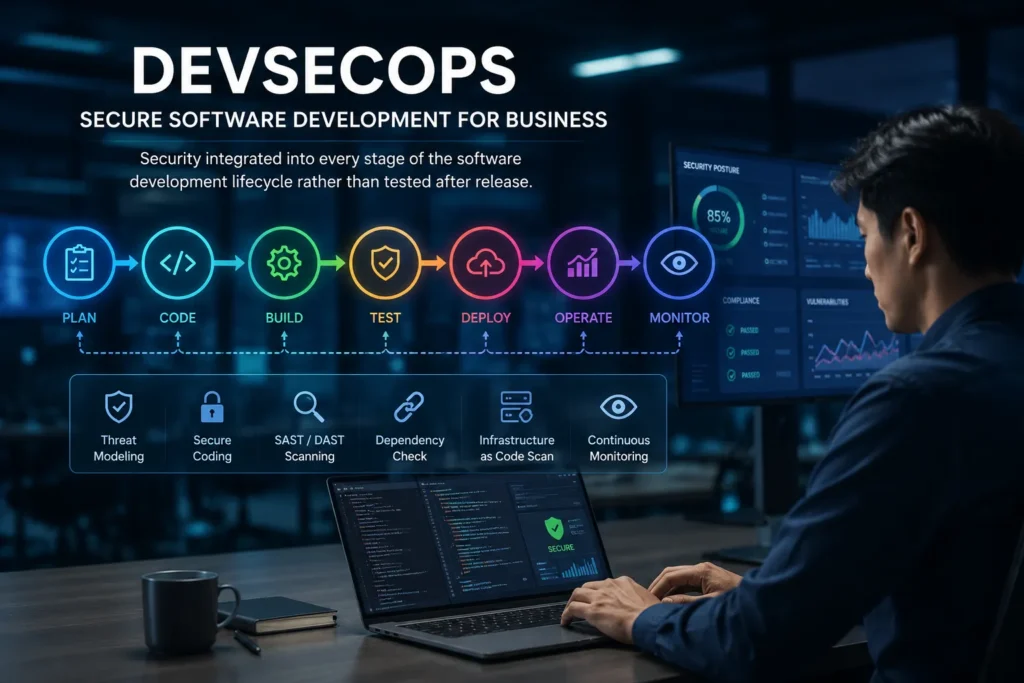
Quick answer: DevSecOps is the practice of building secure software development into every stage of the lifecycle rather than testing for security issues after code has already been built and released. The name reflects the expansion of the DevOps model (development plus operations) to include security as a shared responsibility of the engineering team rather than a separate function that evaluates code at the end. In practice it means automated security scanning running on every pull request, dependency checking that flags vulnerable libraries before they merge, container images scanned before they deploy, and developers who receive security feedback in minutes rather than weeks. The business case is straightforward: IBM research consistently finds that a vulnerability found and fixed during development costs a fraction of the same vulnerability found in production, where it requires emergency response, deployment coordination, customer notification, and potentially regulatory disclosure.
Key Takeaways
- The cost of fixing a security vulnerability scales with how late in the lifecycle it is discovered. A vulnerability caught by a SAST tool at the pull request stage takes minutes to fix with full code context available. The same vulnerability caught in a quarterly penetration test takes days of developer time to triage, reproduce, and remediate with no code context. The same vulnerability discovered in production after exploitation requires incident response, forensic investigation, customer notification, and regulatory assessment. The cost ratio across these three scenarios is not linear; it is exponential.
- DevSecOps does not slow deployment velocity when implemented correctly. Properly tuned automated security gates run in parallel with build steps and add seconds to a pipeline that runs in minutes. The gates surface only the issues that matter, not every theoretical finding. Developers who receive actionable security feedback at the commit stage fix issues faster than developers who receive a ticket from a security team weeks after the merge with no context about why the issue exists or where the vulnerable code path is.
- The OWASP Top 10, refreshed in its 2025 edition, documents the most critical web application security risks. Most are not exotic or difficult to exploit: broken access control, security misconfiguration, injection, cryptographic failures, and authentication failures. The 2025 update also elevated software supply chain failures to its own top-tier category, reflecting how much risk now enters through dependencies rather than first-party code. These are the vulnerability classes that SAST, SCA, and DAST tools are designed to catch. An organization that deploys these tools in its pipeline and trains developers on secure coding for the OWASP Top 10 eliminates the majority of the vulnerability classes that cause real-world application security incidents.
- Supply chain attacks have made software composition analysis a critical control, not an optional enhancement. The SolarWinds attack in 2020 and the Log4Shell vulnerability in 2021 demonstrated that vulnerabilities in widely used third-party components can compromise tens of thousands of organizations simultaneously, and the wave of malicious-package attacks since has only reinforced the point. Every application that uses open-source libraries inherits the security posture of those libraries. SCA tools track the vulnerability status of every dependency in the build and alert when a known vulnerability is discovered in a component the application uses.
- A DevSecOps program is a compliance control, not just an engineering practice. SOC 2, ISO 27001, PCI DSS, and HIPAA all include requirements for secure software development practices. The CI/CD security tool configurations, secure SDLC process documentation, and metrics dashboard produced by a DevSecOps engagement are the compliance artifacts that auditors review to verify these requirements are satisfied.
What Shift-Left Security Actually Means
The term shift-left refers to moving security testing earlier in the software development lifecycle, which is traditionally represented as a left-to-right timeline from requirements through design, development, testing, release, and operations. In the traditional model, security testing happens at the right end of the timeline: a penetration test against the released application, or a vulnerability scan of the production environment. By the time security findings from these tests are delivered to the development team, the code that caused the vulnerability is weeks or months old, the developer who wrote it may have moved on to other work, and the fix requires not just code changes but a new deployment cycle.
Shift-left security means running security checks as early as possible in the development process. Static Application Security Testing (SAST) analyzes source code at the pull request stage, before code is merged to the main branch, and provides the developer with feedback on security issues in the code they just wrote while they still have full context. Software Composition Analysis (SCA) checks the third-party libraries a developer has added to the project against known vulnerability databases, flagging risky dependencies before they are included in a build. Infrastructure-as-code scanning checks cloud resource configuration files before they provision actual infrastructure. These early checks catch issues when they are cheapest and fastest to fix.
The Six Security Domains a DevSecOps Program Covers
Code: Static Application Security Testing
SAST tools analyze source code or compiled binaries without executing the code, identifying patterns that match known vulnerability classes: SQL injection, cross-site scripting, insecure deserialization, hardcoded credentials, and dozens of other issues documented in the OWASP Top 10 and ASVS. SAST integrates into the CI/CD pipeline to run on every pull request, providing developers with findings in their existing workflow (typically as annotations on the pull request in GitHub, GitLab, or Azure DevOps) within minutes of code submission.
SAST tool selection depends on the programming languages in use; different tools have different language coverage and accuracy profiles for different languages. Tool tuning is required to calibrate the finding threshold: a SAST tool configured to flag every potential issue generates too much noise for a development team to act on, while a tool configured too conservatively misses issues that should be caught. The tuning process establishes which finding categories are enforced as blocking gates and which are reported as warnings, calibrated to the organization’s language stack and risk profile.
Dependencies: Software Composition Analysis
Modern applications use open-source and third-party libraries extensively. A typical Node.js, Python, or Java application may have hundreds of direct and transitive dependencies. Each dependency is a potential attack surface: if a library has a known vulnerability and the application uses the affected functionality, the application inherits that vulnerability. This is exactly the risk the supply chain attack surface has made unavoidable, and it is why the 2025 OWASP Top 10 now ranks software supply chain failures as a category of its own. SCA tools track every dependency in the application’s dependency tree, cross-reference each against vulnerability databases including the National Vulnerability Database and vendor security advisories, and alert when a known vulnerability is found in a component the application uses.
SCA findings include the CVE identifier, the severity score, the affected version range, and the version that fixes the vulnerability. This information is sufficient for a developer to assess whether the vulnerability affects the application’s use of the library and to plan the upgrade. License compliance is a secondary SCA function: the tool identifies open-source licenses attached to each dependency and flags licenses that may be incompatible with the organization’s software distribution model, which is a risk that legal teams care about independent of security.
Infrastructure: IaC Scanning and DAST
Infrastructure-as-code (IaC) tools like Terraform, CloudFormation, and Kubernetes manifests define cloud resources through code that is stored in version control and deployed through CI/CD pipelines. IaC scanning tools analyze these files before they are applied, identifying misconfigurations that would create security risks in the provisioned infrastructure: publicly accessible S3 buckets, overly permissive security groups, unencrypted storage resources, and Kubernetes configurations that grant excessive privileges to pods. Catching these issues in the IaC file before the infrastructure is provisioned is far faster than identifying and correcting a misconfiguration in a running cloud environment.
Dynamic Application Security Testing (DAST) tests running applications from an external perspective, simulating attacker behavior against the live application. DAST catches runtime vulnerabilities that static analysis cannot see: server-side request forgery, authentication bypasses that only manifest in certain request sequences, and business logic flaws that require the application to be running to identify. DAST integrates into the CI/CD pipeline to run against a staging or preview environment before changes are promoted to production, catching runtime issues before they reach users.
What a Working DevSecOps Program Delivers
A working DevSecOps program produces a specific set of artifacts that together constitute the secure SDLC program that engineering teams run and auditors evaluate. The CI/CD pipeline has configured, tuned security gates for SAST, SCA, container scanning, IaC scanning, and secrets detection, with documented thresholds and runbooks. The development team has secure coding training aligned to the organization’s language stack and the OWASP Top 10, and a code review checklist that incorporates security. Secrets management is centralized, with rotation policies and repository scanning that prevents credentials from landing in version control.
The security metrics dashboard makes pipeline security posture visible: finding counts by severity and team, mean time to remediate, trend lines that show whether the vulnerability backlog is growing or shrinking, and container scan and secrets detection event tracking. This dashboard feeds both engineering retrospectives (where teams review their security trends alongside velocity metrics) and executive reporting (where leadership sees risk reduction over time rather than a static audit finding). Because SOC 2, ISO 27001, PCI DSS, and HIPAA all expect secure development practices, these same artifacts double as compliance evidence that maps across frameworks. Armour Cybersecurity delivers all of these components through a structured DevSecOps engagement and aligns the program to the compliance frameworks applicable to the organization.
Frequently Asked Questions
How is DevSecOps different from a penetration test?
A penetration test is a point-in-time exercise that finds vulnerabilities in a deployed application by simulating attacker behavior against it. It evaluates the security of the application as it exists at the time of the test, typically on a quarterly or annual basis. DevSecOps shifts security upstream into the development process so vulnerabilities are caught before code reaches production. The two are complementary: DevSecOps reduces the volume and severity of issues that appear in a penetration test, and the penetration test validates that the shift-left controls are working and catches issues that automated tools do not detect. A mature application security program uses DevSecOps for continuous preventive coverage and penetration testing for periodic adversarial validation.
What is NIST SP 800-218 and why does it matter for DevSecOps?
NIST SP 800-218 is the Secure Software Development Framework published by the National Institute of Standards and Technology. It provides a set of practices organized around four groups: Prepare the Organization (governance, training, and security requirements), Protect the Software (security in design and development), Produce Well-Secured Software (security testing and code review), and Respond to Vulnerabilities (ongoing vulnerability management after release). The framework is referenced in US federal software procurement requirements and increasingly in private sector compliance frameworks as the benchmark for secure software development practice. A DevSecOps engagement aligned with NIST SP 800-218 produces the documented practices and controls that satisfy the framework’s requirements and provides the compliance mapping that auditors and procurement reviewers ask for.
Does DevSecOps require a dedicated security team embedded in engineering?
No. The DevSecOps model is designed to enable developers to catch and fix security issues without requiring a security specialist to review every pull request. Automated tools provide the security feedback at the commit stage; developer training provides the knowledge to interpret and fix that feedback; and the security team (internal or external) provides the program design, tool tuning, and governance oversight rather than manual code review. Organizations with small security teams or no dedicated security function can implement effective DevSecOps by automating the detection layer and training developers to handle the findings it generates, with external advisory support for program design, tool configuration, and periodic maturity assessment.
What should we do about vulnerabilities that already exist in our codebase?
Existing vulnerabilities in the codebase are best addressed through a triage exercise that applies a risk-based prioritization framework similar to the one used for infrastructure vulnerabilities: CVSS severity, the exploitability of the vulnerability in the application’s specific context, the sensitivity of the data the affected code path can access, and whether the vulnerability is reachable through any realistic attack vector. High-severity, exploitable vulnerabilities in code that handles sensitive data or authentication functions are remediated immediately. Lower-severity findings are scheduled in the engineering backlog with priority appropriate to their risk score. Findings that are not exploitable in the application’s specific context are documented as accepted risks with a review date. The DevSecOps toolchain is configured to enforce gates on new code from the start of the engagement, preventing the backlog from growing while the team works through existing findings.
Does a DevSecOps program help with SOC 2 or other compliance audits?
Yes. SOC 2 evaluates change management and system operations controls that a DevSecOps pipeline directly supports, and ISO 27001, PCI DSS, and HIPAA each carry secure-development expectations of their own. The tuned pipeline gates, the secure SDLC documentation, the secure coding training records, and the metrics dashboard are exactly the kind of evidence an auditor asks for when testing whether secure development is actually practiced rather than merely claimed. Building the program with the applicable frameworks in mind means the evidence is captured continuously as a byproduct of engineering work, rather than reconstructed under deadline pressure before each audit.
The Bottom Line
Waiting for a penetration test or a production incident to find a vulnerability is the most expensive way to find one. DevSecOps moves the detection to where the fix is cheapest, the moment the code is written, by automating security checks into the pipeline and giving developers feedback in minutes instead of weeks. Done well, it does not slow delivery; it removes the late-stage fire drills that actually slow delivery, and it produces the secure SDLC evidence that auditors and enterprise customers increasingly require. The organizations that treat application security as an engineering discipline rather than an end-of-line gate ship faster and get breached less. A structured DevSecOps engagement builds that capability into the pipeline once, so security becomes a property of how you ship rather than a scramble after you have shipped.
About the author
David Chernitzky is Co-Founder and CEO of Armour Cybersecurity, a Toronto-based cybersecurity firm founded by military intelligence veterans and advised by senior leaders from PwC, KPMG, Deloitte, EY, and Mandiant. Armour serves more than 260 organizations across 52-plus industries, including finance, healthcare, technology, energy, legal, and government, with a 97 percent client retention rate.