By David Chernitzky, Co-Founder and CEO, Armour Cybersecurity | Serving organizations across Canada, the US, and beyond | Last updated August 18, 2026
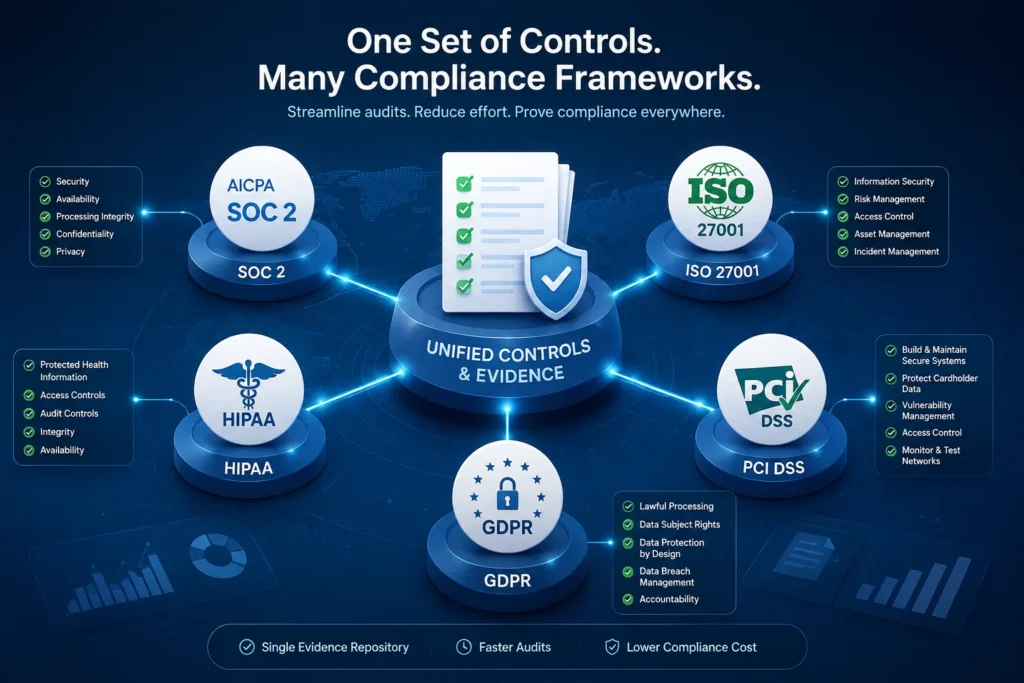
Quick answer: Multi-framework compliance mapping is what lets an organization subject to several frameworks, whether SOC 2 plus HIPAA, ISO 27001 plus GDPR, or any other combination, stop building and maintaining separate programs for each. Instead of duplicating policies, procedures, controls, and evidence collection, mapping identifies where the requirements of different frameworks overlap and allows a single set of controls, documentation, and evidence to satisfy multiple obligations simultaneously. The result is lower compliance cost, less staff time spent on audit preparation, and a simpler control environment that is easier to maintain and demonstrate.
Key Takeaways
- Most major security and privacy compliance frameworks share a substantial core of requirements: access controls, risk management, incident response, business continuity, vendor management, and data protection. Organizations that build separate programs for each framework are duplicating work that could be unified.
- Multi-framework mapping produces a control library in which each control is tagged with every framework requirement it satisfies, a single policy and procedure set written to satisfy multiple frameworks simultaneously, and a unified evidence collection process that captures evidence once and applies it to all relevant audits.
- The efficiency gains are largest for organizations subject to three or more frameworks, where the duplication without mapping compounds significantly. A SaaS healthcare company subject to SOC 2, HIPAA, and GDPR simultaneously can reduce its compliance overhead by thirty to fifty percent through intelligent cross-framework mapping compared to three separate programs.
- Multi-framework mapping requires upfront investment in the mapping analysis and in rewriting policies and procedures to satisfy multiple frameworks at once. This upfront investment is typically recovered within the first annual audit cycle through reduced evidence collection time, fewer policies to maintain, and shorter audit preparation periods.
- The mapping is not static: when a framework updates its requirements, such as the PCI DSS v4.0 update or changes to NIST 800-53 revision 5, the mapping must be reviewed to confirm that existing controls still satisfy the updated requirements, and gaps must be addressed before the next audit cycle.
Why Organizations End Up with Multiple Compliance Obligations
Compliance obligations accumulate through several mechanisms. Customer requirements add frameworks: an enterprise customer requires SOC 2, a healthcare customer requires HIPAA business associate compliance, and a European customer requires GDPR compliance, each adding a framework to the organization’s compliance portfolio. Regulatory requirements add frameworks: a company that processes payment card data is subject to PCI DSS regardless of customer requirements, and an organization handling federal government data may be subject to NIST 800-53 or CMMC through its contracts. Growth adds frameworks: an organization that was previously subject only to PIPEDA expands into the United States and acquires SOC 2 and HIPAA obligations as it signs enterprise and healthcare customers.
The reactive approach is to treat each new framework as a separate compliance project, building a separate policy library, separate control documentation, and separate evidence collection process for each. This approach is understandable when frameworks are added one at a time and the compliance team is managing immediate audit pressure rather than stepping back to design a unified architecture. The accumulated cost of the reactive approach is a compliance environment that requires significantly more staff time to maintain, is more prone to inconsistency, and is harder to audit than a unified program would be. For a business carrying multiple compliance frameworks, that accumulated overhead is exactly what mapping is designed to remove.
Where the Major Frameworks Overlap
The overlap among the major security and privacy frameworks is substantial because the frameworks address the same underlying security and privacy problems, even if they describe them differently and emphasize different aspects. The SOC 2, ISO 27001, and HIPAA overlap is the one most organizations meet first, and it runs through nearly every control domain.
Access control and identity management
Every major framework includes requirements for controlling access to systems and data: multi-factor authentication, least-privilege access, privileged access management, access reviews, and access revocation upon termination. SOC 2 addresses this under the logical and physical access controls category of the Security criterion. ISO 27001 addresses it in Annex A controls covering access control and identity management. HIPAA addresses it under the Security Rule’s technical safeguards. PCI DSS addresses it under Requirement 7 (restrict access to cardholder data) and Requirement 8 (identify users and authenticate access). NIST 800-53 addresses it in the Access Control control family. A single access management program, with a single set of policies, procedures, and evidence, satisfies all of these requirements simultaneously.
Risk assessment and risk management
Every major framework requires a systematic approach to identifying and managing information security risks. ISO 27001 makes the risk assessment and risk treatment process central to the ISMS. SOC 2 requires risk assessment as part of the Security criterion. HIPAA requires a risk analysis and risk management program under the Security Rule. NIST 800-53 includes a comprehensive Risk Assessment control family. The risk assessment methodology, the risk register, and the risk treatment decisions documented for one framework can satisfy the requirements of multiple frameworks if the documentation is structured to address each framework’s specific language and emphasis.
Incident management
Incident detection, response, and notification requirements appear across every framework. SOC 2 requires incident response procedures and evidence of their operation. ISO 27001 requires information security incident management procedures. HIPAA requires a documented response and reporting process for security incidents and a specific breach notification process for protected health information breaches. GDPR requires a 72-hour notification to the supervisory authority for personal data breaches. A single incident response procedure that addresses all of these requirements, with a notification decision framework that covers each applicable regulator and timeline, satisfies the requirements of all relevant frameworks without maintaining separate procedures for each.
Vendor and third-party management
The requirements for managing third-party access to systems and data are consistent across frameworks, even if the terminology differs. SOC 2 addresses vendor management under the security criterion. ISO 27001 addresses supplier relationships in Annex A. PCI DSS addresses third-party service providers under Requirements 12.8 and 12.9. HIPAA addresses business associates under the Privacy Rule and Security Rule. GDPR addresses data processors under Articles 28 and 29. A vendor management program that includes classification, due diligence, contractual requirements, and ongoing monitoring can be designed to satisfy all of these requirements through a single set of procedures.
What Multi-Framework Mapping Produces
A multi-framework mapping engagement produces three primary outputs that reduce ongoing compliance overhead. The control library is a comprehensive catalogue of all controls implemented by the organization, with each control tagged to the specific requirements of every applicable framework it satisfies. When evidence is needed for any framework, the control library identifies which evidence is relevant without requiring the team to re-evaluate each control against each framework independently.
The unified policy and procedure set is a library of policies and procedures written to satisfy the requirements of all applicable frameworks simultaneously. Rather than maintaining separate access control policies for SOC 2, ISO 27001, and HIPAA, a single access control policy is written to address the requirements of all three, with framework-specific sections where the requirements diverge. This approach reduces the number of documents the team must maintain and ensures consistency across the frameworks.
The evidence collection calendar is a schedule of all evidence collection activities, mapped to the controls they support and the frameworks those controls satisfy. A quarterly access review that is required by SOC 2, ISO 27001, and HIPAA is collected once, documented once, and filed once in a location that the audit evidence package for all three frameworks can reference. This is the same discipline that underpins year-round audit readiness: the calendar prevents evidence collection from being fragmented across separate audit cycles and ensures that evidence is captured at the frequency and level of detail required by the most demanding applicable framework.
Armour Cybersecurity’s compliance readiness engagements include multi-framework mapping for organizations subject to multiple frameworks, producing the control library, unified policy set, and evidence calendar that reduce annual compliance overhead.
When to Invest in Multi-Framework Mapping
Multi-framework mapping is most valuable when an organization is subject to three or more frameworks, when a new framework is being added to an existing compliance portfolio, or when the annual evidence collection and audit preparation process has become unmanageable without a unified architecture. Organizations pursuing their first compliance certification typically benefit more from getting the first certification right, which is where a focused compliance readiness audit earns its keep, than from immediately investing in cross-framework architecture. Even for first certifications, though, selecting a framework and building controls in a way that accommodates future frameworks reduces the rework required when the second certification follows. If you already know two certifications are coming, the ISO 27001 vs SOC 2 decision is worth making with the eventual overlap in mind.
Frequently Asked Questions
How do frameworks handle requirements that do not overlap?
Not all framework requirements overlap. HIPAA’s specific requirements for protected health information, including the minimum necessary standard, the Notice of Privacy Practices, and the business associate agreement requirements, have no direct equivalent in SOC 2 or ISO 27001. PCI DSS requirements specific to cardholder data environments, including network segmentation and specific cryptographic standards, are more prescriptive than the equivalent requirements in other frameworks. The multi-framework mapping identifies both the overlapping requirements that can be satisfied by unified controls and the framework-specific requirements that need dedicated controls and documentation. The efficiency gain comes from unifying the overlapping majority; the framework-specific requirements still need their own attention.
What is a controls crosswalk and how is it used?
A controls crosswalk, also called a control mapping matrix, is a document that maps each control or requirement of one framework to the equivalent requirements in other frameworks. For example, a crosswalk might show that SOC 2 CC6.1 (logical access security software, infrastructure, and architectures), ISO 27001:2022 Annex A control A.8.3 (information access restriction), and HIPAA 45 CFR 164.312(a)(1) (access control technical safeguards) all address the same underlying requirement for logical access controls. The crosswalk is used to plan evidence collection so that a single access control review satisfies all three requirements, and to demonstrate to multiple auditors that the same control is relevant to their respective frameworks. This kind of compliance framework mapping is the working core of a multi-framework program.
How does the NIST Cybersecurity Framework fit into multi-framework compliance?
The NIST Cybersecurity Framework is particularly useful as a unifying structure for multi-framework compliance because it maps explicitly to a wide range of other frameworks. NIST publishes informative references that map the CSF to NIST 800-53, ISO 27001, CIS Controls, COBIT 2019, and other frameworks. Organizations that build their security program against the NIST CSF and then add a compliance layer mapping to their specific regulatory requirements, such as SOC 2 or HIPAA, find that the CSF provides a coherent architecture that accommodates multiple compliance overlays without requiring separate programs for each.
How do we handle framework updates in a multi-framework environment?
Framework updates, such as PCI DSS version 4.0, NIST 800-53 revision 5, or the ISO 27001:2022 update, require a review of the multi-framework mapping to confirm that existing controls still satisfy the updated requirements and to identify any new requirements that need new controls or updated documentation. The review is most efficiently conducted as part of the annual compliance planning cycle, with updates to the control library, policy set, and evidence calendar completed before the next audit cycle begins. Organizations that maintain a current control library and mapping matrix can assess the impact of a framework update quickly; those that do not have this documentation must reconstruct the mapping from scratch when an update requires review.
How much does multi-framework mapping actually save?
The savings depend on the number of frameworks, the degree of overlap, and the organization’s current compliance architecture. Organizations that move from entirely separate programs for three frameworks to a unified multi-framework program typically report reductions in annual compliance overhead of thirty to fifty percent, measured in staff hours spent on evidence collection, policy maintenance, and audit preparation. The upfront investment in the mapping and program redesign is typically recovered within one to two annual audit cycles. The secondary benefit, a simpler and more consistent control environment that is easier to explain to auditors and easier to maintain across personnel changes, is harder to quantify but consistently cited by organizations that have made the transition.
The Bottom Line
The frameworks your business answers to were written by different bodies for different purposes, but underneath they ask for many of the same things: control access, manage risk, respond to incidents, govern your vendors, protect data. Building a separate program for each one duplicates most of that work and leaves you with more documents, more evidence trails, and more audit prep than the obligations actually require. Multi-framework compliance mapping unifies the overlapping majority into one control library, one policy set, and one evidence calendar, then handles the genuinely framework-specific requirements as the exceptions they are. For organizations carrying three or more frameworks, that shift routinely takes a meaningful bite out of annual compliance overhead and pays for itself within a cycle or two. A structured compliance readiness engagement builds that unified architecture once, so every audit after it draws from the same well rather than starting over.
About the author
David Chernitzky is Co-Founder and CEO of Armour Cybersecurity, a Toronto-based cybersecurity firm founded by military intelligence veterans and advised by senior leaders from PwC, KPMG, Deloitte, EY, and Mandiant. Armour serves more than 260 organizations across 52-plus industries, including finance, healthcare, technology, energy, legal, and government, with a 97 percent client retention rate.