By David Chernitzky, CEO, Armour Cybersecurity · Serving private clients and family offices across North America · Last updated August 21, 2026
Quick Answer
Personal cybersecurity for high-net-worth individuals exists because HNWIs face a fundamentally different threat profile than the average employee or even the average executive. Attackers who target HNWIs are not running automated scams against millions of random addresses. They research specific targets, build tailored lures from publicly available information, and look for the path of least resistance to wealth, assets, or reputation. That path is almost never the family office firewall or the corporate network. It is the personal phone, the household assistant’s email account, the smart home system a contractor installed two years ago, or the private travel itinerary a family member posted on social media. Personal cybersecurity covers the surfaces corporate programs were never designed to protect: personal devices, family members, household staff, residential networks, digital privacy, and 24-hour incident response when impersonation, extortion, or account takeover occurs.
Key Takeaways
- HNWIs are high-value, individually researched targets. Attackers build detailed profiles from social media, public records, news coverage, charity disclosures, and court filings before making contact. The phishing email that references a recent real estate transaction, a named family member, or a specific donation was not generated randomly. It was built from information already publicly accessible to anyone who looks.
- The household is the attack surface, not the corporate network. Enterprise tools protect enterprise systems. They do not monitor the personal iPhone used for sensitive family communication, the home Wi-Fi router every device connects through, the household manager’s personal Gmail carrying family schedules and property addresses, or the connected cameras a third-party contractor installed.
- Wealth creates a broader range of attack motivations. Financially motivated attackers pursue fraudulent wire transfers, account takeover, and investment fraud. Reputationally motivated actors pursue doxxing, targeted harassment, and exposure of private information. Extortion campaigns combine both. Each motivation calls for a different protective response, and a personal program must account for all of them.
- Family members are targeted as proxies for the principal. Spouses, adult children, and even younger children with a social media presence are targeted precisely because they are connected to the principal but usually receive less security attention. An attacker who cannot phish the principal directly often has more success with a family member whose posture is lower and whose account can serve as a foothold into shared communications.
- Confidentiality is itself a security requirement. A personal program must be conducted with the discretion expected of a wealth manager or private attorney: documentation outside corporate systems, communication over secure channels, and access limited to the personnel directly serving the engagement. Handling a private-client engagement like an enterprise IT project, with broad internal access and standard documentation, is inconsistent with the privacy these clients expect.
How HNWI Threats Differ from Corporate Cyber Threats
Targeting is personal, not organizational
Corporate cyberattacks typically target the organization: its systems, data, intellectual property, or financial accounts. The attacker may use employees as vectors, but the objective is organizational assets. HNWI attacks target the individual: their personal wealth, reputation, family relationships, and private information. That distinction determines what is being attacked and what needs to be defended. The family office’s corporate firewall is not protecting the principal’s personal iPhone. The company’s email gateway is not scanning the personal Gmail used for family communication. The enterprise SOC is not watching the home network where dozens of connected devices run under a residential ISP with no enterprise-grade controls. Countering targeted research starts with hardening the sources that feed it, beginning with digital privacy and data removal.
Targeted attacks against HNWIs frequently begin with extensive open-source research. Public information that seems innocuous in isolation, a LinkedIn profile, a charity board membership, a quoted interview, a post showing a vacation home, a property transfer in public land records, can be assembled into a detailed profile that enables highly personalized social engineering. The attacker who contacts the principal’s assistant posing as the family’s private banker, with the correct bank name, the correct relationship manager, and a recent transaction type that matches the family’s real activity, has done their homework.
The personal device gap
Most high-net-worth individuals use personal devices for a substantial share of their most sensitive communication. Family financial discussions, estate planning conversations with counsel, communication with wealth managers and trustees, and personal correspondence with business counterparts all flow through devices that receive no enterprise monitoring, no managed detection and response, and no configuration management. If a personal device is compromised through a malicious app, a targeted phishing link, or an unsecured Wi-Fi connection during travel, the attacker reaches the most sensitive communications in the principal’s life with no enterprise tool positioned to detect or respond.
Personal device hardening closes this gap. It starts with configuration review: current operating system versions, automatic update channels, screen locks and encryption set correctly, unnecessary apps with broad permissions removed, and correct backup and recovery. It continues with protective tools that run continuously in the background: endpoint protection, secure DNS filtering, and VPN enforcement for sensitive network contexts. And it extends to ongoing monitoring so anomalous device behavior is caught and answered, not discovered months later when the damage is already done.
What a Personal Cybersecurity Program Actually Delivers
Nine protection domains, one integrated program
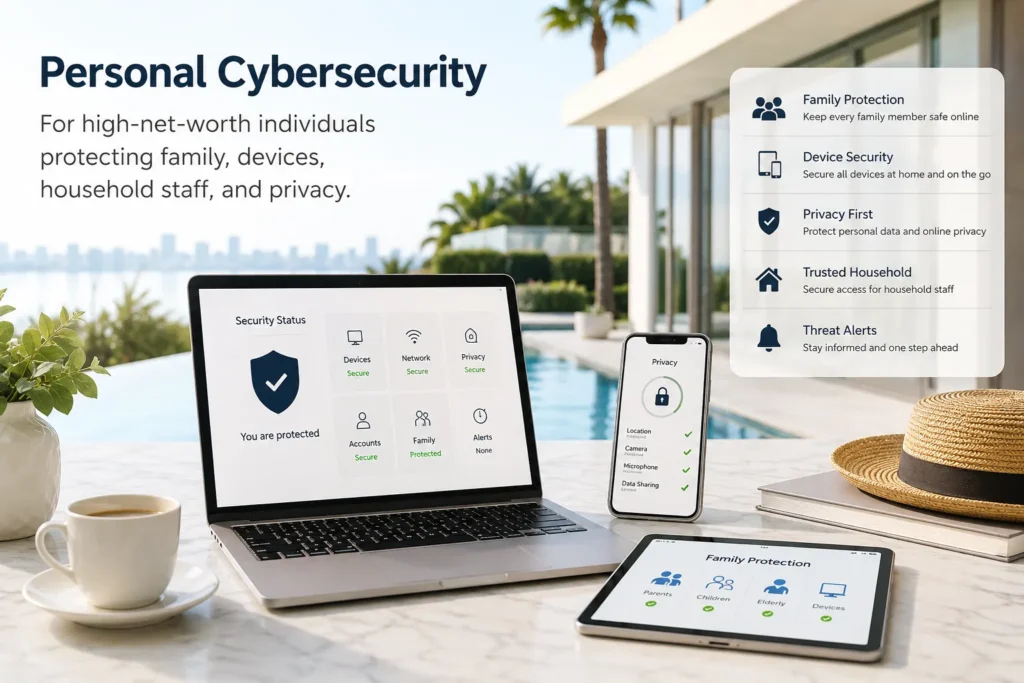
A personal program for high-net-worth individuals addresses the full surface area of the personal threat landscape rather than a single technology or risk. Armour Cybersecurity’s HNWI practice covers nine core domains: personal identity protection with continuous dark web and credential monitoring; personal device hardening for phones, laptops, and tablets used by the principal and immediate family; family digital safety covering spouses, children, and household members; household staff security addressing the credential and access discipline of personal assistants and household managers; digital privacy and data removal from brokers and public records; travel security for high-risk destinations and high-profile events; smart home and connected-device security; impersonation and threat monitoring across social media, email, and the open and dark web; and 24-hour on-call incident response for active incidents involving impersonation, extortion, account takeover, or family-targeted threats.
The integration across these domains is what separates a personal program from a collection of point solutions. Identity monitoring that detects a credential exposure feeds directly into device hardening and account recovery. Privacy work that removes residential addresses from data broker sites reduces the physical-security exposure that feeds targeted harassment. Travel configuration that hardens devices before a high-risk trip works in concert with monitoring that flags anomalous access while the principal is abroad. Each domain reinforces the others; none alone is an adequate program.
Confidential by design
Every aspect of how the program is documented, communicated, and staffed is built for the confidentiality private clients require. Engagement records live outside corporate systems. Communication with the principal and family office runs over secure channels established at the outset. Access to program details is limited to the personnel directly serving the engagement; internal visibility within the advisory firm is restricted on the same principle as attorney-client privilege. Deliverables are structured for private use, with the level of documentation the client wants to retain and nothing more.
Across the HNWI engagements Armour conducts, the pattern that separates a private-client program from a repackaged enterprise one is rarely the tooling. It is discretion: whether the way the work is documented and communicated respects that, for these clients, the paper trail is itself part of the threat model.
For high-net-worth individuals whose threat landscape includes reputational risk, privacy concerns, and the possibility of legal proceedings arising from incidents, the way an engagement is documented and communicated is itself a security and legal consideration. The standard enterprise approach of broad internal documentation, shared project systems, and routine multi-stakeholder status reporting is inappropriate for private-client work. To see how Armour structures cybersecurity for high-net-worth individuals, start with a confidential consultation rather than a scoping questionnaire.
Frequently Asked Questions
Does personal cybersecurity overlap with what my family office already has?
Family offices typically have corporate cybersecurity that protects the office’s own systems, networks, and financial operations. It is not designed to protect the personal devices, home networks, family members, or household staff of the principal. The two are complementary rather than overlapping: the family office program protects the institutional infrastructure, and the personal program protects the personal and household surface area the institutional program cannot reach. A well-structured HNWI engagement coordinates with the family office so the two are consistent, information-sharing is defined, and incident response is coordinated rather than fragmented.
What is the biggest cybersecurity risk for most high-net-worth individuals?
The most consistent gap across HNWI assessments is the combination of personal devices used for sensitive communication with no enterprise-grade monitoring, and family members or household staff with weaker credential hygiene who serve as an easier path to the principal than direct attack would be. The personal iPhone used for conversations with attorneys and wealth managers, protected only by a four-digit PIN and no endpoint security, is typically the most accessible high-value target in a principal’s digital life. The household manager whose personal Gmail holds the family’s calendar, property addresses, and travel schedule, and who reuses passwords across services, is a close second. Both are addressable by a personal program; neither is addressed by the family office’s corporate tools.
How is the initial assessment conducted?
The engagement begins with a confidential discovery session covering the principal, in-scope family members, household staff, devices, residences, travel patterns, and any known prior incidents or concerns. It is conducted privately and documented at the level of detail the client directs. Following discovery, Armour runs an open-source exposure review to assess what is publicly available about the principal and family, a dark web surface check for leaked credentials and personal data, and an identity-data audit across data broker and public records sources. The findings inform the personal security program design, which specifies the services, coverage scope, and monitoring parameters for the ongoing engagement.
Can you work with our existing legal counsel during an incident?
Yes. Armour HNWI incident response is structured to coordinate with legal counsel at the direction of the client. Many incidents involving impersonation, extortion, account takeover, or family-targeted threats have legal implications, and the response must preserve evidence, avoid actions that could complicate legal proceedings, and produce documentation counsel can use. We engage with the client’s attorneys as a technical resource under their direction, maintaining the attorney-client privilege structure when that is appropriate. Coordination with law enforcement, if the client elects to pursue that path, is also part of our incident response capability.
The Bottom Line
The reason corporate security does not protect a high-net-worth individual is that the attack was never aimed at the corporation. It was aimed at the person, the family, and the household, through the personal phone, the assistant’s inbox, the home network, and the information already public about all of them. Personal cybersecurity for high-net-worth individuals is the discipline of defending that surface area as one integrated program, conducted with the discretion private clients require. If your family office program protects the institution but no one owns the personal and household side, that gap is exactly where a researched attacker will go. Armour’s cybersecurity for high-net-worth individuals practice is built to close it.
About the author
David Chernitzky is the CEO and Co-Founder of Armour Cybersecurity, a Toronto-based firm that protects organizations and private clients across North America from advanced cyber threats. He brings more than 25 years of cybersecurity and military cyber intelligence experience, having served as an officer in an elite technology unit before co-founding Armour. Armour’s team of military-intelligence veterans and senior advisors serves 260+ clients across 52+ industries with a 97% client retention rate, and runs a dedicated HNWI practice built around the confidentiality private clients require. Learn more about Armour Cybersecurity.