By David Chernitzky, Co-Founder and CEO, Armour Cybersecurity | Serving organizations across Canada, the US, and beyond | Last updated August 18, 2026
Quick answer: Vendor risk tiering is how you stop treating every third party the same. Most organizations either apply no structured vendor risk assessment at all or apply the same assessment to every vendor regardless of the access they have, the data they touch, or the business impact their failure would create. Vendor criticality tiering is the discipline of classifying vendors by their actual risk profile so that assessment depth, monitoring intensity, and contractual requirements match the risk each vendor carries. Without tiering, you are either under-investing in high-risk vendor oversight or wasting resources on low-risk vendors that do not warrant it.
Key Takeaways
- A managed service provider with administrative access to production systems is not the same risk as a courier company with a login to your shipping portal. Applying identical assessment processes to both wastes resources on low-risk vendors and under-protects you from high-risk ones.
- Vendor criticality tiering classifies vendors across four dimensions: the sensitivity of the data they access, the depth of system access they hold, the business criticality of the service they provide, and how difficult they would be to replace if their service were disrupted.
- Tiering drives every subsequent element of the supplier risk program: how deep the security questionnaire is, how often assessment is repeated, how intensively the vendor is monitored between assessments, and what contractual provisions are required.
- Most vendor ecosystems follow a consistent distribution: a small number of critical or high-tier vendors with deep access, a larger middle tier with material but bounded access, and a long tail of low-risk vendors with minimal or no system access. The program focuses its resources on the first two tiers.
- Tiering is not static. As vendor relationships evolve, vendors move between tiers. A vendor that starts as a low-tier office supply provider and later gains system access to process invoices electronically has moved into a higher risk tier and should be reassessed accordingly.
The Problem with One-Size-Fits-All Vendor Assessment
The one-size-fits-all approach to vendor assessment fails in two directions simultaneously. For high-risk vendors, a brief questionnaire administered once at onboarding, without follow-up, ongoing monitoring, or contractual enforcement, provides a false sense of assurance that is more dangerous than no assessment at all. The organization believes it has assessed the vendor because a questionnaire was sent and returned, but the assessment did not match the depth of access the vendor holds or the consequence of the vendor’s failure. For low-risk vendors, applying the same deep assessment process to a vendor with no system access wastes the time of the vendor, the assessment team, and the procurement function, creating friction in vendor relationships that do not warrant it and consuming resources that should be directed at high-risk vendors. This is the practical failure mode behind the point that your vendors are your attack surface: the vendors most able to hurt you are exactly the ones a flat process under-examines.
The underlying cause of the one-size-fits-all approach is usually the absence of a tiering framework. Without a documented methodology for classifying vendors, every new vendor assessment decision becomes an improvised judgment call. The judgment calls are typically made by whoever is handling the onboarding, who defaults to the most familiar process rather than the most appropriate one. The result is inconsistency: some vendors receive deep scrutiny based on the assessor’s instinct, others receive none based on a different assessor’s instinct, and the overall vendor portfolio has no coherent risk picture.
How Vendor Criticality Tiering Works
A vendor criticality tiering framework classifies vendors into distinct tiers based on a scored assessment of four dimensions. The score for each dimension is combined into an overall risk tier that determines the assessment depth, monitoring cadence, and contractual requirements for that vendor.
Data sensitivity
The most important dimension of vendor risk is the sensitivity of the personal and business information the vendor accesses. A vendor that processes health records, financial data, or large volumes of personal information creates significantly more regulatory and reputational exposure than a vendor that processes anonymous operational data or no data at all. Data sensitivity scoring typically assigns higher risk scores to sensitive personal information categories including health, financial, and biometric data; to large volumes of personal information regardless of category; and to information that is subject to specific regulatory protection under PIPEDA, HIPAA, PCI DSS, or GDPR. Vendors that touch regulated personal information also pull the relationship into the scope of your privacy risk management program. Vendors with no access to personal or sensitive business data score low on this dimension regardless of other factors.
System access depth
The scope and privilege of the vendor’s system access determines how much damage a compromised vendor can do to the organization’s environment. Administrative access to production systems carrying customer data is the highest risk: a compromised vendor with this level of access can read, modify, or exfiltrate any data those systems contain and can potentially use that access to move laterally into adjacent systems. Read-only access to specific data sets is lower risk. Access limited to a dedicated vendor portal with no connectivity to internal systems is lower still. No system access at all scores zero on this dimension. Constraining and monitoring this access is the job of identity and privileged access management, and the level of access a vendor holds is often the single strongest driver of its tier.
Business criticality
Business criticality measures the operational impact on the organization if the vendor’s service were unavailable. A vendor whose service is integral to daily operations, such as a cloud platform hosting the organization’s core application or a payment processor handling all transactions, creates business continuity risk that a vendor providing a discretionary service does not. Business criticality scoring considers how quickly the organization’s operations would be impacted by vendor unavailability, whether alternative vendors could be engaged quickly, and whether the vendor’s service is on the critical path for revenue generation or regulatory compliance.
Replacement difficulty
Some vendors are effectively irreplaceable in practice, even if alternatives theoretically exist. A vendor that provides a highly specialized service, that holds significant proprietary knowledge about the organization’s systems, or that has accumulated years of integration with the organization’s technology stack creates concentration risk that an easily replaceable commodity vendor does not. Replacement difficulty scoring considers the cost and timeline of transition to an alternative vendor, the degree to which the current vendor is embedded in the organization’s processes and systems, and whether alternative vendors with equivalent capabilities exist in the market.
What the Tiers Look Like in Practice
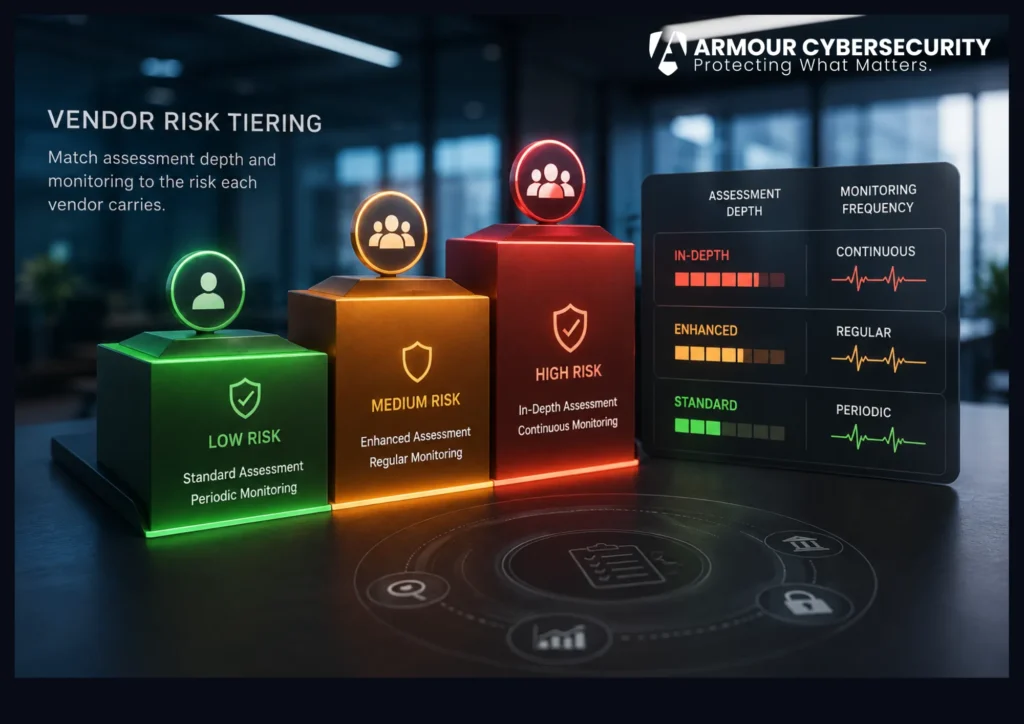
A typical tiering framework defines three or four tiers based on the combined scoring across the four dimensions. Critical vendors, typically a small number of the total ecosystem, are those with high scores across multiple dimensions: broad system access, high data sensitivity, critical business dependency, and difficult replacement. These vendors receive the deepest security assessments, the most intensive ongoing monitoring, pre-arranged incident response protocols, and the most specific contractual security provisions. Assessment is typically annual at minimum and may be more frequent for the highest-risk relationships.
High-tier vendors have significant but not critical risk profiles: meaningful system or data access, material business dependency, but more constrained scope than critical vendors. They receive substantial security assessments, regular monitoring, and specific contractual provisions, though somewhat less intensive than critical vendors. Medium-tier vendors have bounded access and limited business dependency. They receive lighter-touch assessments, periodic monitoring, and standard contractual provisions. Low-tier vendors have minimal or no system access and low business dependency: they receive a brief onboarding screen confirming the absence of significant access and standard purchase terms, with no ongoing assessment required.
Armour Cybersecurity’s Supplier Risk Management engagement designs the tiering matrix as a core deliverable, applying it across the client’s full vendor inventory to produce a prioritized, actionable picture of where assessment and monitoring effort should be concentrated.
Maintaining the Tiering Over Time
The tiering framework is most valuable when it is maintained as vendor relationships evolve rather than applied once and forgotten. Three types of changes typically require tier reassignment. The first is a change in the vendor’s access: when a vendor is granted new system access or loses previous access, the system access dimension of its score changes and should be re-evaluated. The second is a change in the vendor’s service scope: when a vendor takes on new services that create new data access or business dependency, the relationship has effectively become a new one from a risk perspective. The third is a change in the vendor’s security posture: when a vendor’s certification expires, when a security incident is reported, or when monitoring data shows significant deterioration in the vendor’s observable security health, the tier assignment should be reviewed.
Annual vendor inventory reviews that confirm the accuracy of the tiering assignments are a baseline requirement. Organizations whose vendor ecosystems change rapidly, through frequent new vendor onboarding, significant technology platform changes, or business expansion into new markets, need a more frequent cadence and a defined trigger process that initiates a tier review whenever a material change occurs.
Frequently Asked Questions
How many tiers should a vendor risk program have?
Three to four tiers is the most common structure and provides enough differentiation to meaningfully vary assessment depth without creating excessive administrative complexity. More than four tiers typically produces marginal distinctions that are difficult to apply consistently and that do not produce meaningfully different assessment processes. Fewer than three tiers, such as a simple high or low classification, does not provide enough differentiation to calibrate the program effectively. The specific tier definitions should be designed based on the organization’s vendor ecosystem: a business with a small number of highly integrated technology partners may need a different tier structure than one with a large, diverse vendor base spanning many risk profiles.
What happens when a vendor refuses to complete a security assessment?
Vendor refusal to complete a security assessment is itself a risk indicator and should be treated as such in the program framework. The response depends on the vendor’s tier. A critical vendor that refuses to participate in assessment is a significant risk management problem that should be escalated to senior leadership and legal counsel, as it may indicate that the vendor cannot satisfy the organization’s security requirements or that the relationship needs to be restructured or terminated. A medium-tier vendor that declines can often be engaged through an alternative approach such as reviewing published certifications (SOC 2 report, ISO 27001 certificate) in lieu of questionnaire completion. The framework should document the expected response to non-responsive vendors at each tier so that inconsistent ad hoc decisions are replaced by a defined process.
Do we need a third-party risk management tool or platform?
Dedicated third-party risk management platforms automate vendor inventory, questionnaire distribution and tracking, risk scoring, and continuous monitoring integration, which is valuable for organizations with large vendor ecosystems. For organizations with a smaller, more manageable vendor inventory, a well-structured spreadsheet-based register and a disciplined manual process can be adequate during the program’s early stages. The decision to invest in a TPRM platform is typically driven by the volume of vendors to be managed, the frequency of assessment cycles, and the reporting requirements of the compliance frameworks the organization must satisfy. Armour Cybersecurity’s supplier risk engagements provide recommendations for monitoring tooling and platforms scaled to each client’s vendor ecosystem and budget.
How does vendor tiering interact with SOC 2 or ISO 27001 audit requirements?
SOC 2 CC9.2 requires that the organization assesses vendors and business partners whose services affect the trust services criteria and monitors their performance against commitments. The tiering framework directly supports this requirement by demonstrating that the organization has a risk-based methodology for identifying which vendors require assessment and at what depth. ISO 27001:2022 addresses supplier relationships through Annex A controls A.5.19 to A.5.22 (consolidated from the former A.15 controls in the withdrawn 2013 version), covering the supplier-relationship security policy, security within supplier agreements, ICT supply chain security, and monitoring of supplier services. The vendor inventory, tiering matrix, assessment questionnaires, and risk register produced by a supplier risk management program satisfy these requirements and are formatted for direct use as audit evidence.
Should our vendors be tiering their vendors too?
Yes, and this is an emerging expectation in both regulatory guidance and enterprise procurement requirements. The risk that a vendor’s own subcontractors and service providers introduce to the vendor’s environment is called fourth-party risk, and it can flow through to the organization if the vendor’s supply chain is compromised. Mature supplier risk programs ask critical vendors about their own third-party risk management practices as part of the assessment questionnaire, and may require that critical vendors demonstrate a structured third-party risk program as a contractual condition of the relationship. NIST SP 800-161 and ISO 27036 both address supply chain risk management in a way that extends the expectation to the vendor’s own supply chain.
The Bottom Line
Treating every vendor the same is the most common and most expensive mistake in third-party risk. It over-examines the courier with a portal login and under-examines the managed service provider with domain admin, and it burns the resources you should be spending on the vendors that can actually hurt you. Vendor risk tiering fixes that by scoring each third party on data sensitivity, system access, business criticality, and replacement difficulty, then matching assessment depth, monitoring, and contract terms to the tier. It is not a one-time exercise; tiers move as access and services change. A structured supplier risk management program builds the tiering matrix, applies it across your whole vendor inventory, and keeps it current, so your effort lands where the risk actually is.
About the author
David Chernitzky is Co-Founder and CEO of Armour Cybersecurity, a Toronto-based cybersecurity firm founded by military intelligence veterans and advised by senior leaders from PwC, KPMG, Deloitte, EY, and Mandiant. Armour serves more than 260 organizations across 52-plus industries, including finance, healthcare, technology, energy, legal, and government, with a 97 percent client retention rate.