By David Chernitzky, Co-Founder and CEO, Armour Cybersecurity | Serving organizations across Canada, the US, and beyond | Last updated August 18, 2026
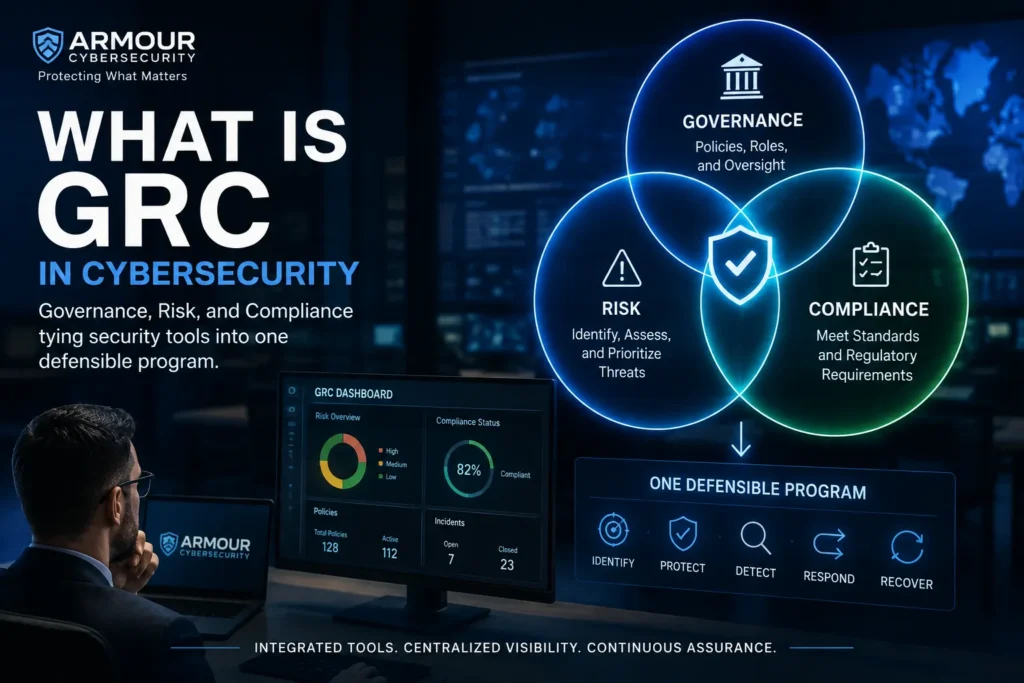
Quick answer: GRC in cybersecurity stands for Governance, Risk, and Compliance. It is the operating framework that connects the security controls an organization runs, the risks it has identified and accepted, and the regulatory obligations it must satisfy, into a coherent program that leadership can manage and that auditors can evaluate. Without a GRC program, organizations have security tools but no governance structure tying them together, risk decisions made without consistent criteria, and compliance managed as a recurring project rather than a continuous function. The result is reactive security, painful audits, and a board that cannot get a straight answer about organizational exposure.
Key Takeaways
- GRC is not a product or a platform. It is an organizational function comprising the policies, processes, risk registers, control catalogues, and governance structures that make security manageable and auditable. Technology tools can support a GRC program but cannot replace the human and process components.
- Governance is the component that establishes accountability: who owns security policy, who approves risk decisions, how those decisions are documented, and how the board is informed of the organization’s risk posture. Without governance, security decisions are made ad hoc by whoever is closest to the problem.
- Risk management in the GRC context means maintaining a structured, current inventory of the threats and vulnerabilities relevant to the organization, scoring them for likelihood and impact, documenting the controls in place to mitigate them, and tracking residual risk through leadership decision-making rather than informal assumption.
- Compliance in a mature GRC program is a continuous function, not an annual project. Evidence is collected and maintained year-round. Controls are operated and documented consistently. When the auditor arrives, the evidence package is ready; it is not assembled under pressure in the weeks before the audit.
- The gap between what executives believe is in place and what auditors actually find is where breaches and failed certifications happen. A GRC program closes this gap by providing an honest, current, documented view of the organization’s security posture that leadership can rely on.
Security Tools Without Governance
Most organizations that have invested in cybersecurity have a collection of security tools: a firewall, endpoint protection, email security, a SIEM or logging platform, perhaps multi-factor authentication and a vulnerability scanner. The tools are real, the investment is real, and the protection they provide is real. What is missing, in a large proportion of mid-market organizations, is the governance layer that ties these tools together into a coherent governance risk compliance program.
Without governance, the firewall rules are managed by whoever most recently had the time to review them, with no documented review cycle and no ownership assignment that survives staff changes. The endpoint protection is deployed on most endpoints but the coverage report that would reveal the gaps has never been reviewed at a leadership level. The SIEM generates alerts that are triaged by IT but not connected to a risk register that would show leadership which threats are being actively monitored and which are not. The MFA deployment covers most accounts but the exceptions were granted for operational convenience and have never been reviewed against the security policy. The vulnerability scanner runs monthly but the remediation backlog grows because there is no ownership process that connects scan findings to remediation timelines and escalation paths.
This is not a tools problem. It is a governance problem. The tools are doing what they were configured to do. The missing element is the framework that defines what they should be configured to do, assigns responsibility for ensuring they are operating correctly, documents the evidence that they are, and surfaces the gaps to leadership before an auditor or attacker finds them first.
What Governance Actually Does
Governance in the GRC context is the organizational mechanism that creates accountability for security decisions and makes those decisions visible and defensible. It comprises several interconnected elements that together answer the question: who decided what, on what basis, and how do we know the decision was the right one?
Policy framework
The policy framework defines the rules the organization has established for security behavior: what is permitted, what is required, and what is prohibited. Policies must exist, must be current, must be aligned to the frameworks the organization is measured against, and must reflect how the organization actually operates rather than how it theoretically should. A policy that requires quarterly access reviews but that nobody has conducted in two years is not a governance control; it is a documented gap waiting to be found in an audit. Governance produces policies that are real: written to match actual operations, assigned to owners who are accountable for their enforcement, and updated on a documented cycle.
Risk decision framework
Governance establishes the criteria by which risk decisions are made and the process by which they are documented and approved. When an IT team decides to delay patching a critical vulnerability because the patch requires a system restart that would disrupt operations, that decision involves a calculated risk acceptance: the operational continuity risk of the restart is being weighed against the security risk of the unpatched vulnerability. In organizations without a governance framework, this decision is made informally, with no documentation, no leadership visibility, and no defined review date for the risk acceptance. In organizations with a governance framework, the decision is documented in the risk register with the rationale, the approver, and a date for re-evaluation. Leadership can see the decision, can question it if the risk appetite threshold is exceeded, and can track whether the risk has been mitigated or renewed.
Board and executive reporting
Governance includes the reporting structures that give board members and executive leadership a reliable view of the organization’s security posture without requiring them to interpret technical data. A board that receives a quarterly report showing the number of open vulnerabilities by severity, the status of the risk register, the compliance status against applicable frameworks, and the trend in key risk indicators can make informed decisions about security investment, risk appetite, and strategic priorities. A board that receives no security reporting, or receives technical output without business context, is making governance decisions without the information the governance function exists to provide. That same board-ready posture view is what an independent cyber posture assessment produces, which is why a posture assessment and a GRC program reinforce each other.
What Risk Management Actually Means in Practice
Risk management in the GRC context is the structured process of identifying what can go wrong, how likely it is, how much damage it would cause, what controls are in place to reduce that likelihood or impact, and what risk remains after those controls are applied. The output is a risk register: a living document that captures this analysis for every material risk the organization faces.
A mature risk register is not a theoretical exercise. It is built from the actual assets, threats, and vulnerabilities relevant to the organization’s specific environment, industry, and operations. It is maintained by people who know what the controls are actually doing, not by consultants who mapped a template to a framework without testing whether the controls work as documented. It is reviewed by leadership on a defined cadence, with risk owners accountable for the status of their assigned risks and escalation paths defined for risks that exceed the organization’s risk appetite threshold. Where the organization handles personal information, this register also connects to the privacy risk management program so that privacy and security risk are governed together rather than in separate silos.
For organizations pursuing certification under ISO 27001, SOC 2, HIPAA, or PCI DSS, the risk register is typically one of the first things an auditor evaluates. A risk register that is current, comprehensive, realistic, and maintained by identifiable owners is evidence of a mature risk management function. A risk register that was produced for a prior audit and has not been updated in 18 months is evidence of the opposite.
What Compliance as a Continuous Function Looks Like
The most common failure mode in organizational compliance programs is treating compliance as a project: an annual effort to collect evidence, remediate the most obvious gaps, and prepare for the audit, followed by a period of relative neglect until the next audit cycle begins. This approach is expensive, stressful, and often ineffective: gaps that were remediated under audit pressure re-emerge during the neglect period, and evidence that was assembled in a rush contains errors or inconsistencies that create problems during the audit itself.
Compliance as a continuous function operates differently. Controls are operated and documented consistently throughout the year, not only in the weeks before the audit. Evidence is collected and stored in an organized evidence repository as it is produced, not assembled from scratch under deadline pressure. The gap analysis is updated when changes occur, such as a new regulation, a system migration, or an organizational change, rather than redone from scratch at the next assessment. When the auditor arrives, the organization is not preparing for the audit; it is presenting the output of a program that has been running all year.
Armour Cybersecurity builds governance, risk and compliance programs designed to operate as a continuous function rather than an annual project. The policy library, risk register, control catalogue, and evidence repository are structured to support ongoing operation, not just point-in-time snapshot production.
Frequently Asked Questions
How is GRC different from just having a security team?
A security team operates controls: they configure the firewall, manage the endpoint protection platform, respond to alerts, and handle incidents. GRC is the governance layer above the security team that defines what those controls should be, why they are in place, how they connect to the organization’s risk posture and regulatory obligations, and how leadership knows they are working. Organizations with capable security teams but no GRC program often have good technical controls and poor governance: auditors find the controls adequate but the documentation, policy alignment, and risk management processes absent. Adding a GRC function to an organization with a good security team typically produces a significant improvement in audit outcomes without requiring changes to the underlying technical controls.
Which frameworks should our GRC program align to?
The frameworks your GRC program should align to are determined by your regulatory environment, your customer requirements, and your business objectives. Organizations in Canadian financial services need to address OSFI guidelines. Healthcare organizations handling US patients or data need HIPAA. Organizations processing payment card data need PCI DSS. Organizations pursuing SOC 2 certification for enterprise customer requirements need the AICPA Trust Services Criteria. Most organizations have more than one applicable framework, and a well-designed GRC program maps controls across multiple frameworks so that a single control satisfies requirements from several obligations rather than requiring separate documentation for each. The NIST Cybersecurity Framework and ISO 27001 are useful organizing frameworks for this multi-framework approach because their control domains are broad enough to encompass the requirements of most sector-specific frameworks.
Can we use a GRC software platform instead of a consulting engagement?
GRC platforms automate control tracking, evidence collection, policy management, and reporting, which is valuable for organizations with mature GRC programs that need to scale their operations. The limitation of platform-first approaches is that they automate a process; they do not design it. An organization that deploys a GRC platform without a well-designed governance framework, a realistic risk register, and a policy library that reflects actual operations will automate an inadequate program rather than building a good one. Most organizations benefit from a GRC consulting business engagement that designs the governance framework and policy library before or alongside the platform deployment, ensuring that the platform is automating something that actually works.
What is the difference between a risk assessment and a risk register?
A risk assessment is the process of identifying and evaluating risks. A risk register is the documented output of that process and its ongoing maintenance. The risk assessment is conducted at a point in time, typically with structured interviews, asset inventories, threat modelling, and control reviews. The risk register captures the output of the assessment and is then maintained as a living document: updated when new risks are identified, when existing risks change in likelihood or impact, when controls are implemented that reduce residual risk, or when risks are formally accepted by leadership with documented rationale. The risk register is the artefact that auditors review; the risk assessment process is what produces and maintains it.
How long does it take to build a GRC program from scratch?
A current-state assessment and gap analysis, which is the foundation of any GRC program build, typically takes four to eight weeks for a mid-market organization depending on the number of frameworks in scope and the availability of internal stakeholders for interviews. The remediation roadmap is delivered alongside the assessment, so the organization can begin closing gaps immediately. Policy development and risk register construction, if conducted concurrently with remediation, typically extend the active consulting engagement to three to six months for a full program build. Ongoing GRC support on a retainer basis then maintains the program through the annual compliance cycle. Organizations with tighter timelines, such as those facing an imminent audit, can engage in an accelerated readiness mode that prioritizes the highest-impact gaps first.
The Bottom Line
Security tools protect you only as far as something tells them what to do, proves they are doing it, and surfaces the gaps before an auditor or an attacker does. That something is a cybersecurity GRC framework: governance that assigns accountability, risk management that keeps a real and current register, and compliance run as a continuous function rather than an annual scramble. The tools are not the problem; the missing governance layer is. A structured governance, risk and compliance program ties the controls you already own into a coherent whole that leadership can defend and auditors can trust, and it runs all year so you are never assembling the evidence the night before.
About the author
David Chernitzky is Co-Founder and CEO of Armour Cybersecurity, a Toronto-based cybersecurity firm founded by military intelligence veterans and advised by senior leaders from PwC, KPMG, Deloitte, EY, and Mandiant. Armour serves more than 260 organizations across 52-plus industries, including finance, healthcare, technology, energy, legal, and government, with a 97 percent client retention rate.