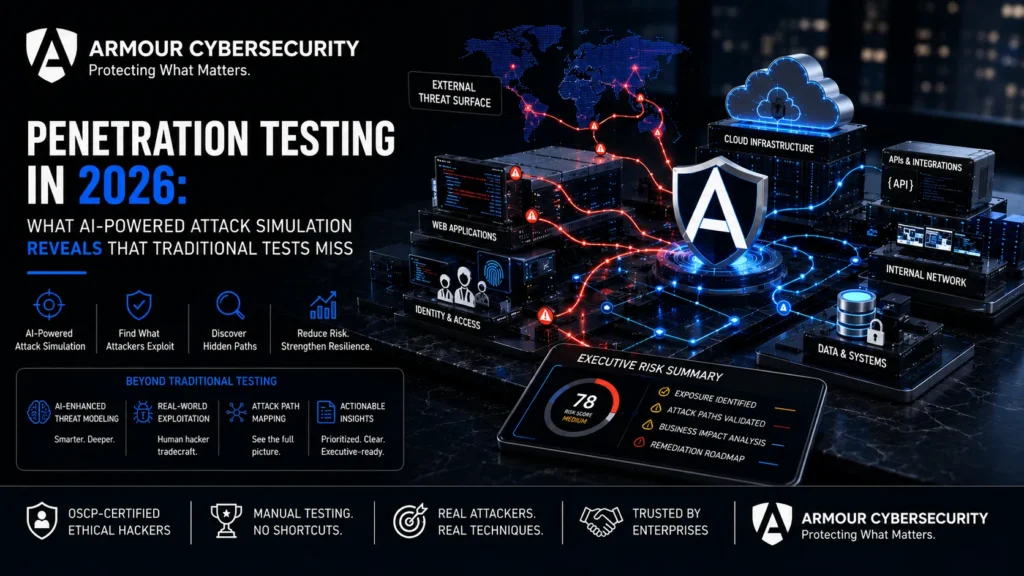
The premise of a penetration test has not changed: simulate an attacker’s approach to your environment, find the paths that lead to your most valuable assets, and report what was discovered so the gaps can be closed. What has changed is the sophistication of both the attacks being simulated and the technology available to simulate them. The gap between a traditional test and a modern AI-assisted engagement is now wide enough to matter in real-world security outcomes.
Many organizations still treat penetration testing as a compliance exercise: something that happens once a year to satisfy an auditor, produce a report, and be filed. That framing misses the actual value of a well-executed test, which is not the certificate or the finding count. It is specific intelligence about how a real attacker would compromise your specific environment, using the techniques and tools attackers are using right now.
Understanding what modern penetration testing covers, how it has evolved, and what separates a genuinely valuable engagement from a checkbox exercise matters for any organization making security investment decisions in 2026.
What Is a Penetration Test, and What Is It Not?
A penetration test is an authorized simulated attack against an organization’s systems, networks, or applications. Skilled security professionals, working with explicit written permission, attempt to compromise the target environment using the techniques, tools, and methods real attackers use. The goal is to identify exploitable weaknesses before an actual attacker does, and to demonstrate the real-world impact of those weaknesses through evidence of successful compromise.
What a penetration test is not is a comprehensive vulnerability scan. A vulnerability assessment identifies known vulnerabilities across a defined scope, cataloging potential weaknesses based on known signatures and patterns. A penetration test goes further: it attempts to actually exploit those weaknesses, chains multiple findings together into realistic attack paths, and assesses the impact of a successful attack in the specific context of your environment. The difference is between a list of unlocked doors and a demonstration that an attacker walked through one, then used what they found inside to unlock three more.
It is also not a one-size-fits-all exercise. Penetration tests vary significantly in scope, methodology, and depth, and choosing the right approach for your environment and objectives is part of getting genuine value from the investment.
How AI Has Changed Penetration Testing
The integration of AI into offensive security tools has changed penetration testing in two important ways: it has increased the speed and scale at which attack paths can be discovered, and it has changed the nature of the attack techniques being simulated.
On the discovery side, AI-assisted tools can rapidly map large environments, correlate information from multiple sources to identify potential attack paths, and prioritize targets by the combination of exploitability and impact. What used to take a human tester several days of manual reconnaissance can now be significantly accelerated, which means a modern test explores a larger attack surface in the same time and is more likely to find the paths that matter.
On the technique side, AI is already in the hands of real attackers. They use it to generate more convincing phishing content, to adapt malware that evades endpoint detection and response tools, and to plan lateral movement. A penetration test that does not incorporate AI-assisted attack techniques is simulating the threat landscape of three years ago, not the one that exists today. AI-generated social engineering, machine learning driven credential attacks, and evasion methods that adapt to your specific detection stack are all part of the current threat reality.
For organizations that have invested in detection and response capabilities, whether those controls can actually identify AI-assisted attack techniques is a specific, important question that only a modern penetration test can answer.
Types of Penetration Tests: Choosing the Right Scope
Penetration testing is not a single service. It covers several distinct engagement types, each fitting different contexts and objectives.
External penetration test
Assesses the attack surface visible from the internet: web applications, email infrastructure, VPNs, remote access portals, and any other internet-facing systems. This is usually the starting point for organizations that have never undergone formal testing, since it covers the surface most directly accessible to external attackers.
Internal penetration test
Simulates an attacker who has already gained initial access, through a successful phishing attack, a compromised vendor, or physical access to the facility. Internal tests examine what happens next: lateral movement, privilege escalation, and access to critical systems and data. This test answers one question: if an attacker got in, how much damage could they do?
Web application penetration test
Focuses on customer portals, internal applications, APIs, and web-based management interfaces. Application vulnerabilities remain one of the most common breach entry points, and dedicated web application penetration testing requires different techniques and expertise than network testing.
Social engineering assessment
Tests the human element: staff susceptibility to phishing, vishing, and physical intrusion attempts. These assessments matter more each year as AI lowers the quality bar for realistic phishing content. They also produce the evidence that makes phishing awareness training concrete, because staff who have been caught by a simulated attack take the training seriously.
Red team exercise
A comprehensive, goal-oriented exercise in which a skilled team attempts specific objectives, accessing sensitive data, gaining administrative control of core systems, or demonstrating the ability to disrupt operations, using any combination of techniques over an extended period. Red team exercises are the ultimate test of detection and response: not just whether weaknesses exist, but whether your security operations center can identify and respond to a sophisticated attack while it is in progress.
What Happens During a Penetration Test?
A penetration test follows a structured methodology, typically across four phases.
Reconnaissance gathers information about the target: domain records, public employee information, technology stack, third-party relationships, and anything else that builds a picture of the attack surface. Modern reconnaissance draws on the same AI-assisted open source intelligence techniques used in cyber threat intelligence work, surfacing exposure the organization never considered relevant.
Scanning and enumeration actively probes the target to identify systems, services, and potential vulnerabilities. This phase produces a detailed map of the environment’s entry points and their relative attractiveness to an attacker.
Exploitation is the core of the test: the active attempt to compromise systems using the vulnerabilities identified. This includes gaining initial access, escalating privileges, moving laterally across the network, and ultimately demonstrating access to the assets that represent the highest-value targets.
Reporting translates technical findings into actionable intelligence. The most valuable reports are not lists of CVEs. They are narratives of how the tester moved through the environment, what they accessed, what the business impact would have been, and which specific remediation steps close each finding. A report a non-technical executive can act on matters as much as one a technical team can execute against.
What Should You Expect After a Penetration Test?
The test is the beginning of the value, not the end. The output is intelligence: specific weaknesses, realistic attack paths, and prioritized remediation actions. What matters is what happens next.
Organizations that get the most from testing turn the findings into a prioritized cybersecurity roadmap. Not every finding needs immediate remediation. Priority should follow exploitability and impact, with the most critical items addressed first. The tester should remain available for remediation guidance and, once fixes are in place, to validate that they actually closed the vulnerabilities.
Retesting, a targeted re-engagement to verify specific findings were remediated, is the component most often cut to save cost and the one that actually completes the exercise. Without it, you have evidence of what was vulnerable but no confirmation the remediation worked.
Armour Cybersecurity’s penetration testing services include detailed technical reporting, executive-level findings communication, remediation guidance, and retesting to confirm findings have been addressed. The goal is not a report. It is a verifiable improvement in your security posture.
To discuss a penetration testing engagement for your environment, visit armourcyber.io or contact the Armour Cybersecurity team.
Frequently Asked Questions
What is the difference between a penetration test and a vulnerability assessment?
A vulnerability assessment scans your environment and produces a list of known weaknesses. A penetration test actively exploits those weaknesses, chains them into realistic attack paths, and proves what an attacker could actually reach. The assessment tells you which doors are unlocked; the pen test shows what happens when someone walks through one.
How often should a business get a penetration test?
At minimum annually, and after any significant change: a new application launch, a major infrastructure migration, a merger, or a shift to remote access. Compliance frameworks like SOC 2 and ISO 27001 generally expect annual testing, and cyber insurers increasingly ask for recent test results during underwriting.
How long does a penetration test take?
A scoped external or web application test typically runs one to three weeks including reporting. Internal tests and combined engagements run two to four weeks. Red team exercises extend over one to three months because they simulate a patient, persistent attacker. Add time for remediation and a retest window after the report lands.
Do small businesses need penetration testing?
Yes, when there is something specific to protect: client data, a customer-facing application, or a compliance or insurance requirement. For smaller environments, a right-sized external test paired with SMB cybersecurity solutions that handle ongoing monitoring usually delivers more protection than a large one-off engagement.
What does AI pen testing mean?
It means the engagement uses AI on both sides of the simulation: AI-assisted tools to map the environment and discover attack paths faster, and AI-generated attack techniques, like adaptive phishing and evasive malware behaviour, that mirror what real attackers now deploy. It tests whether your defences hold against the current threat landscape, not the one from three years ago.