Quick answer: Cyber threat hunting is the proactive practice of searching your environment for hidden attackers that automated tools have missed, instead of waiting for an alert. It is intelligence-led: hunters form a hypothesis about how an attacker might operate, look for the evidence, and either confirm a threat or strengthen defences. It matters because the most damaging breaches are the ones that evade detection and dwell quietly for weeks.
Key Takeaways
- Threat hunting is proactive: it goes looking for attackers rather than waiting for alarms to fire.
- It exists because sophisticated attackers evade firewalls and antivirus, then dwell undetected. Verizon’s 2025 DBIR still ties a human element to nearly 60% of breaches, and many go unnoticed for weeks.
- A good hunt is hypothesis-driven and mapped to frameworks like MITRE ATT&CK, not random searching.
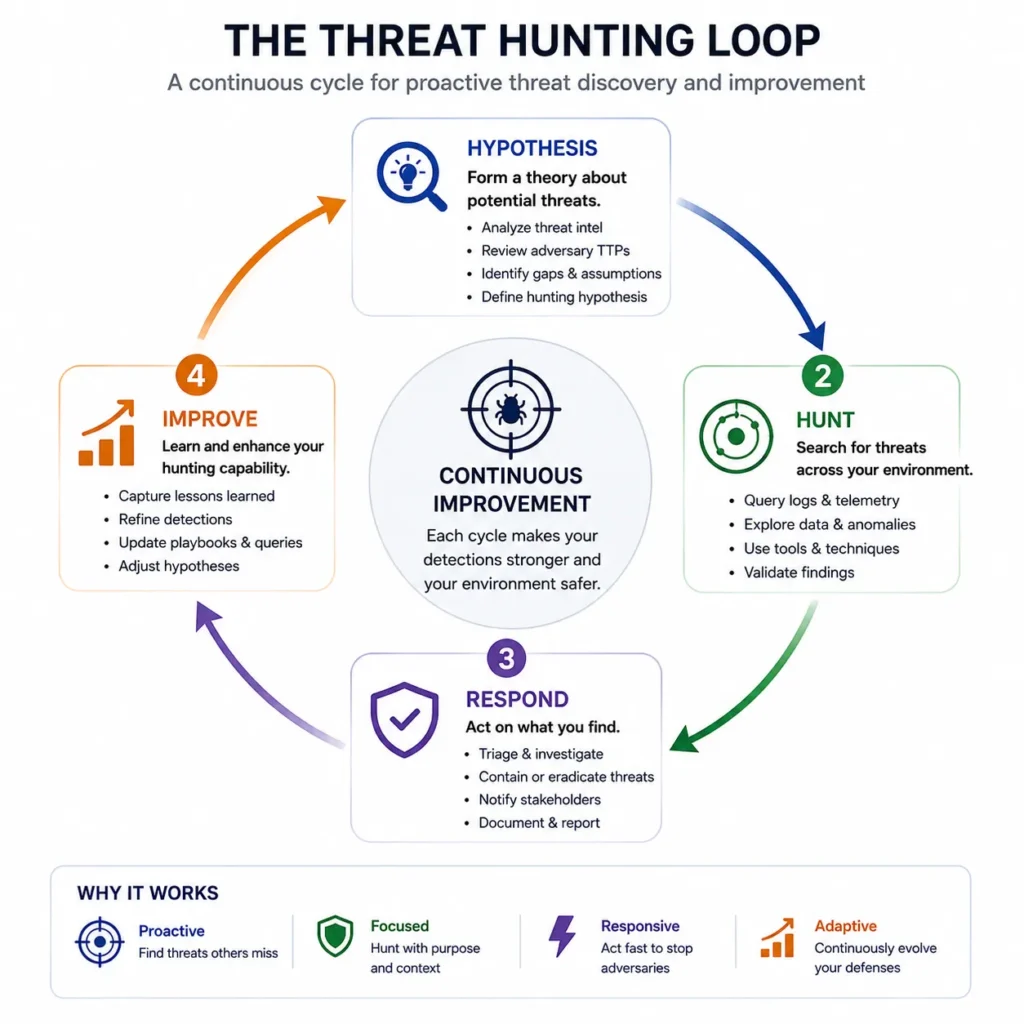
- The practical model is a loop: hypothesis, investigate, respond, and feed findings back into detection.
- Hunting works best on top of strong logging and detection, not as a replacement for them.
Hunting vs Waiting for Alerts
Most security tools are reactive by design: they wait for something to match a known signature or cross a threshold, then raise an alert. That catches the noisy, known threats. It misses the patient, skilled attacker who moves slowly, uses legitimate tools, and generates nothing an automated rule would flag. Threat hunting fills that gap by assuming a breach may already be underway and going to look for it.
This is the difference between a smoke detector and a patrol. Both matter. But if an attacker is deliberately avoiding the smoke detector, someone has to walk the building. That someone is often part of a managed SOC team, hunting across endpoint, network, and identity signals for the traces automated tools overlook.
Why It Matters Now
Attackers increasingly “live off the land,” using the same administrative tools your IT team uses, precisely because those tools do not trigger alerts. Fed by threat intelligence about how specific adversaries operate, hunters know what to look for: the unusual login, the odd process, the small anomaly that, in context, signals an intrusion in progress.
A Practical Threat Hunting Model
Effective hunting is a repeatable loop, not a one-off exercise:
- 1. Hypothesis. Start with a specific, intelligence-informed idea, for example, “an attacker could be using stolen credentials to move laterally,” often mapped to a MITRE ATT&CK technique.
- 2. Investigate. Search your logs and telemetry for indicators of compromise, behavioural anomalies, and the techniques your hypothesis predicts.
- 3. Respond. If you confirm a threat, contain it fast, isolating hosts, disabling accounts, and eradicating malicious files, ideally with forensic support to understand the full scope.
- 4. Improve. Feed every hunt back into your defences: new detection rules, SIEM signatures, and better future hypotheses. Each hunt makes the next one sharper.
What Hunting Needs to Work
Threat hunting is not magic; it runs on good data. You need solid logging, reasonable detection coverage, and the expertise to interpret what you find. Where those foundations have gaps, a breach readiness assessment identifies them first, so hunts are productive rather than blind. For teams without a dedicated hunting function, Armour designs, deploys, and runs threat hunting programmes tuned to your industry and risk profile.
The Bottom Line
The threats that hurt most are the ones that hide. Threat hunting is how you stop assuming your tools caught everything and start actively proving it. Built as a disciplined loop and grounded in good telemetry, it turns detection from a hope into a practice, and shrinks the window an attacker has to operate unseen.
Armour’s military-intelligence-led team hunts across 260+ client environments in 52+ industries, where the threats that matter most are consistently the quiet ones that evade automated tools.
Frequently Asked Questions
What is cyber threat hunting?
A: It is the proactive practice of searching your environment for hidden attackers that automated tools have missed, rather than waiting for an alert. Hunters form an intelligence-led hypothesis about how an attacker might operate, look for the evidence in logs and telemetry, and either confirm a threat or strengthen defences.
How is threat hunting different from normal monitoring?
A: Monitoring is reactive: it waits for known signatures or thresholds to trigger an alert. Threat hunting is proactive: it assumes a breach may already be underway and goes looking for the subtle, unalerted signs, the patient attacker using legitimate tools that automated rules overlook.
What framework is used for threat hunting?
A: MITRE ATT&CK is the most widely used. It catalogues real adversary tactics and techniques, giving hunters a structured basis for hypotheses, for example, hunting specifically for signs of credential theft or lateral movement, rather than searching at random.
Do small and mid-sized businesses need threat hunting?
A: Yes, especially those handling sensitive or regulated data, because sophisticated attackers evade standard tools regardless of company size. SMBs rarely have a dedicated hunting team, so this is commonly delivered as part of a managed SOC service rather than built in-house.
About the Author
David Chernitzky is the CEO and Co-Founder of Armour Cybersecurity, a Toronto-based firm that protects organizations across North America from advanced cyber threats. He brings more than 25 years of cybersecurity and military cyber intelligence experience, having served as an officer in an elite technology unit before co-founding Armour. Armour’s team of military-intelligence veterans and senior advisors serves 260+ clients across 52+ industries with a 97% client retention rate.