You passed the audit. You got the certificate. So why did you still get hacked?
ISO/IEC 27001 is often regarded as the gold standard for information security management. Yet certified companies continue to make headlines for all the wrong reasons. It raises a crucial question: if ISO 27001 represents the gold standard in cybersecurity frameworks, why does it sometimes fail to protect?
The truth is: ISO 27001 isn’t broken — but it’s not foolproof either. The issue isn’t with the framework itself, but in how it’s implemented. Certification proves you have controls in place — not that they’re always effective in practice. An outdated risk register or poorly enforced policy can leave major gaps, regardless of what’s on paper. This is exactly the kind of gap that professional Cybersecurity Advisory Services are designed to identify and close, before they become the headline.
What Is ISO 27001?
ISO/IEC 27001 is a globally recognized standard for establishing an Information Security Management System (ISMS). It provides a structured, risk-based framework that helps organizations of all sizes protect the confidentiality, integrity, and availability of their information, whether it’s stored digitally, on paper, or shared verbally. Instead of prescribing specific technologies, ISO 27001 focuses on people, processes, and policies—promoting accountability, continuous improvement, and resilience against evolving threats. Yet, despite its widespread adoption, headlines still feature ISO 27001-certified companies suffering from cyberattacks. So what gives? Does this mean the certification is flawed? Not quite.
Why ISO 27001 Sometimes Falls Short
Despite its widespread adoption, certified organizations still suffer breaches. The problem isn’t the standard — it’s how companies apply it. Here are the most common failure points:
Compliance Isn’t the Same as Security Certification proves you have controls in place — not that they’re always effective in practice. An outdated risk register or a poorly enforced policy can leave major gaps that attackers will find, even if an auditor didn’t.
Human Error and Social Engineering Even with strong systems, untrained or unaware staff remain a top vulnerability. ISO 27001 calls for regular security awareness training, but not all businesses follow through effectively — leaving people as the weakest link despite a certified ISMS.
Scope Limitations Some companies only certify part of their business, leaving other areas fully exposed. If your ISMS only covers one office or one department, the rest of your organization may be vulnerable. Attackers don’t respect certification boundaries.
Stale Risk Assessments ISO 27001 requires ongoing improvement, but many organizations treat it as a one-and-done exercise. Outdated assessments or failure to track new threats can lead to serious exposure. A cybersecurity risk assessment should not be an annual checkbox — it needs to evolve as your business, technology stack, and threat landscape evolve. Organizations that conduct living, continuously updated risk assessments are far better positioned to catch gaps before they become breaches.
Weak Implementation ISO 27001 lets you tailor controls based on risk, and some companies take a minimal approach — implementing only what’s needed to pass the audit, not what’s needed for real protection. The standard gives flexibility; it doesn’t give permission to cut corners.
ISO 27001 for SMBs: More Relevant Than You Think
You might think ISO 27001 is designed for large enterprises, but SMBs often face the same security threats with fewer resources. Here’s why the standard is increasingly valuable for smaller businesses:
1. Build Customer Trust and Competitive Advantage Demonstrating a strong security posture builds trust with clients and partners. For many enterprise buyers, ISO 27001 certification is now a deal-breaker in the vendor selection process. Without it, you may not even make it past procurement screening.
2. Legal, Regulatory, and Vendor Compliance ISO 27001 supports alignment with global data privacy laws such as GDPR and HIPAA, and helps meet the vendor security requirements of enterprise clients. Smaller businesses that get this right early avoid costly remediation later.
3. Structured Risk Management The standard enforces a systematic process to identify, assess, and treat information risks — prioritizing security investments and reducing the ad-hoc firefighting that plagues under-resourced security teams.
4. Reduced Breach Costs The average cost of a breach for SMBs can exceed $120,000. ISO 27001 mitigates these risks and can also lower your cyber insurance premiums, providing measurable return on the investment in certification.
5. Faster Recovery Through Preparedness Structured ISMS processes help reduce the mean time to contain security incidents by up to 40% — crucial for business continuity and client trust. Critically, this recovery speed depends heavily on having well-practiced incident response services embedded into your ISMS. Organizations that pair ISO 27001 with clearly documented, regularly tested incident response services are 2.3 times more likely to detect a threat before it causes significant damage — and dramatically faster to contain it when it does. ISO 27001 mandates incident response planning; organizations that treat that requirement seriously rather than as a documentation exercise reap the real-world benefit.
6. Non-Compliance Penalty Exposure Non-compliant SMBs are more than twice as likely to face fines under data protection regulations like GDPR or HIPAA. ISO 27001 helps organizations align with these laws — sometimes automatically — through the implementation of policies, access controls, and audit trails.
Key Components of ISO 27001
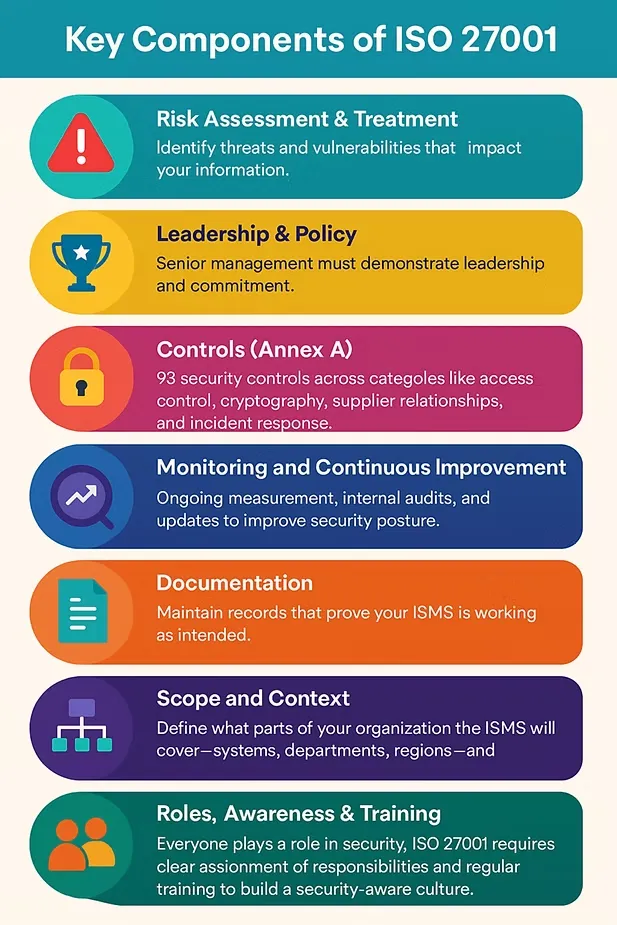
- Risk Assessment & Treatment
- Identify threats and vulnerabilities that impact your information.
- Decide how to address them—mitigate, transfer, accept, or avoid.
- Leadership & Policy
- Senior management must demonstrate leadership and commitment.
- A clear security policy should be in place and communicated.
- Controls (Annex A)
- 93 security controls across categories like access control, cryptography, supplier relationships, and incident response.
- Monitoring and Continuous Improvement
- Ongoing measurement, internal audits, and updates to improve security posture.
- Documentation
- Maintain records that prove your ISMS is working as intended.
- Scope and Context
- Define what parts of your organization the ISMS will cover—systems, departments, regions—and identify relevant legal, business, and stakeholder expectations.
- Roles, Awareness & Training
- Everyone plays a role in security. ISO 27001 requires clear assignment of responsibilities and regular training to build a security-aware culture.
Common Misconceptions
- “It’s Too Expensive” ISO 27001 can be scaled. Start with core risk assessments, policies, and controls.
- “It’s Just Paperwork” The goal is to create a living system of security, not just a series of checkboxes.
- “We’re Too Small” Attackers often prefer small organizations due to weaker defences.
- Our IT Provider Handles Security”While MSPs and IT teams are essential, ISO 27001 goes beyond technical fixes. It brings accountability across leadership, HR, legal, and operations, making security a business-wide priority.
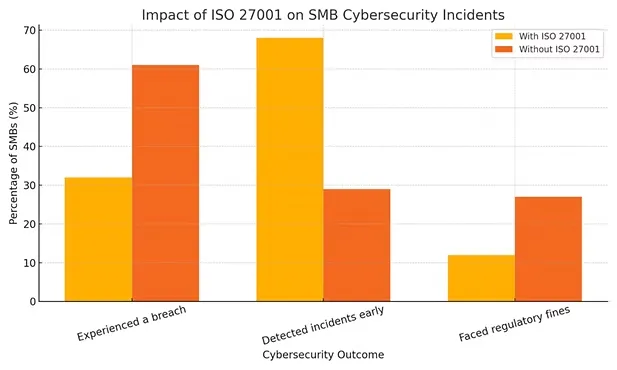
What the Numbers Mean for Your Business
The data reveals a stark contrast in outcomes between SMBs adopting ISO 27001 and those not. While no cybersecurity framework can guarantee complete protection, ISO 27001 provides a structured defence that clearly reduces the likelihood and impact of incidents.
Lower Breach Rates
SMBs with ISO 27001 were nearly 50% less likely to experience a breach. That’s not just a statistic—it’s fewer customer notifications, fewer system shutdowns, and fewer sleepless nights.
Faster Threat Detection
Early detection is critical. Thanks to mandatory logging, monitoring, and incident response planning, ISO 27001 organizations are 2.3x more likely to detect a threat before it causes damage.
Reduced Regulatory Fines
Non-compliant SMBs are more than twice as likely to face fines under data protection regulations like GDPR or HIPAA. ISO 27001 helps organizations align with these laws—sometimes automatically—through the implementation of policies, access controls, and audit trails.
Reduced Breach Costs The average cost of a breach for SMBs can exceed $120,000. ISO 27001 mitigates these risks and can also lower your cyber insurance premiums.
Faster Recovery Structured ISMS processes help reduce the mean time to contain security incidents by up to 40%—crucial for business continuity and trust.
Beyond Numbers: Competitive and Strategic Advantages
Even if you never get attacked, ISO 27001 brings long-term value:
- Improved vendor relationships – Many enterprise clients require ISO compliance from partners.
- Streamlined internal processes – Security controls often uncover inefficiencies.
- Enhanced brand reputation – Security is a trust signal in every industry.
· Faster Deal Cycles – ISO 27001-certified companies often sail through procurement and due diligence processes. You’ll spend less time answering security questionnaires and more time closing deals.
(Source: IBM Cost of a Data Breach Report 2024, CSO Online reports on SMB security frameworks)
Making ISO 27001 Work in the Real World: Best Practices
· Don’t Treat It as a checkbox. Embed ISO 27001 into your business culture. Update policies, test controls, and include leadership in regular reviews.
· Train Your People Continuously. Make security awareness part of onboarding, team meetings, and evaluations. Use real-world examples to drive the message home.
· Audit Internally, Not Just for Certification. Go beyond what auditors check. Evaluate what could happen if key staff left, if new tools were breached, or if vendors were compromised.
· Expand the Scope Thoughtfully. Consider what areas of your business truly matter—and make sure they’re included. Partial scope = partial protection.
· Integrate with Other Frameworks ISO 27001 works best when combined with other tools (e.g., CIS Controls, NIST, cyber insurance reviews) for a layered defence.
Final Thought
Final Thought: Compliance Is the Starting Line—Not the Finish
ISO 27001 lays the foundation for effective information security—but it’s only as strong as the commitment behind it. Too often, organizations mistake certification for invincibility. In reality, true protection comes from continuous effort: leadership that prioritizes security, teams that stay engaged, and systems that evolve with the threat landscape.
So ask yourself – are you building a paper shield, or a living defence?
Let’s start a conversation about transforming your compliance framework into a strategy for lasting cyber resilience. Contact us today to take the first step toward smarter, scalable information security with ISO 27001.
Q&A: ISO 27001 for SMBs – What You Need to Know
Q1: What is ISO 27001, and why should SMBs care?
ISO 27001 is an international standard for an information security management system (ISMS). It provides a structured framework to help organizations identify, manage, and reduce risks to their information assets. For SMBs, it provides a means to protect sensitive data, foster customer trust, and comply with vendor and regulatory requirements.
Q2: Is ISO 27001 only for large companies?
Not at all. While larger companies may have more resources, SMBs are often targeted by cybercriminals because of perceived weaker defences. ISO 27001 is scalable and can be tailored to fit the size and complexity of any business.
Q3: What are the main components of ISO 27001?
* Defining Scope and Context
* Risk assessment and treatment
* Leadership commitment and clear security policies
* Security controls
* Monitoring, auditing, and continuous improvement
* Proper documentation and recordkeeping
* Roles and Awareness
Q4: How does ISO 27001 certification benefit my business?
Certification shows clients, partners, and regulators that your business takes information security seriously, not just in theory, but in practice. It can:
· Win new business: Many enterprises now require ISO 27001 for vendor approval or procurement. Certification speeds up due diligence and helps you stand out in competitive bids.
· Strengthen trust and reputation: Clients are more likely to engage when they know their data is protected.
· Improve internal operations: The certification process clarifies roles, eliminates process gaps, and improves consistency across teams.
· Reduce regulatory and breach risk: ISO 27001 aligns with frameworks such as GDPR and HIPAA, helping to minimize the cost and impact of security incidents.
· Qualify for lower cyber insurance premiums: Some insurers offer discounts to ISO-certified businesses due to reduced risk exposure.
Q5: What if I don’t pursue full certification?
That’s completely okay — many SMBs start by adopting the core principles of ISO 27001 without going through formal certification. Even without the certificate, implementing key components like risk assessments, security policies, access controls, and incident response plans:
- Improves your overall security posture
- Reduces the likelihood and impact of cyber incidents
- Builds confidence with clients, vendors, and insurers
- Makes future certification faster and more affordable
Applying ISO 27001 incrementally shows that your business takes information security seriously — and that commitment alone can go a long way with stakeholders.
Q6: Is it expensive to implement ISO 27001?
It doesn’t have to be. ISO 27001 is highly scalable, and many SMBs start with a lean implementation focused on essentials like risk assessments, security policies, and a few high-priority controls. Over time, you can expand your ISMS based on your business needs, compliance goals, and budget.
The cost depends on factors like:
- Whether you pursue formal certification or not
- How much internal expertise do you already have
- The complexity of your systems and data environments
Many organizations find that even partial implementation offers a strong return on investment, reducing breach risk, streamlining operations, and unlocking new client opportunities.
Q7: How long does it take to become ISO 27001 certified?
Depending on your organization’s size and readiness, it can take anywhere from a few months to over a year. The timeline includes preparation, implementation, internal audits, and the certification audit.
You can speed things up by starting with a focused scope (e.g., a single department or system), using expert guidance, and leveraging existing tools and processes. Many SMBs adopt a phased approach, building maturity over time while working toward full certification at their own pace.
Q8: Who can help me get started?
You don’t need to figure it out alone. Many organizations — including cybersecurity consultants, compliance platforms, and Managed Security Service Providers (MSSPs) — specialize in guiding SMBs through ISO 27001.
Most engagements begin with a gap assessment to determine your current position, followed by a customized roadmap tailored to your organization’s size, industry, and priorities.
Whether you want end-to-end implementation or just help getting started, there are flexible support options to match your budget and internal capabilities.
Pro Tip: Look for a partner who not only understands ISO 27001 but also your business goals, so they can align security with growth, not just compliance.