In almost every significant cyberattack, there is a moment that determines the severity of the outcome: the moment the attacker stops being an ordinary user and becomes an administrator. Privileged accounts — those with elevated permissions to modify systems, access sensitive data, or manage other users — are the keys to the kingdom in any IT environment. Gaining control of a privileged account transforms a limited intrusion into a potentially catastrophic one.Privileged Access Management, known as PAM, is the discipline of controlling, monitoring, and securing these high-risk accounts. It is not a luxury feature of mature cybersecurity services programs — it is one of the most fundamental risk controls any organization can implement. And yet, privileged account security remains one of the most commonly overlooked areas in organizations of all sizes.
QUICK ANSWER
Privileged Access Management (PAM) is the process of controlling, monitoring, and securing accounts with elevated permissions. Effective PAM programs reduce the risk of unauthorized access, insider threats, ransomware, and credential-based attacks by enforcing least privilege, multi-factor authentication (MFA), privileged session monitoring, credential vaulting, and just-in-time access controls.
.
KEY TAKEAWAYS
☑ Privileged accounts are among the most targeted assets during cyberattacks.
☑ Least privilege significantly reduces attack surface and lateral movement opportunities.
☑ MFA should be mandatory for all privileged accounts.
☑ Just-in-time access minimizes standing administrative privileges.
☑ PAM supports compliance, cyber insurance readiness, and overall cybersecurity maturity.
Why Privileged Access Management Matters
Most successful cyberattacks eventually involve privilege escalation. Once attackers gain elevated access, they can disable security tools, move laterally across systems, access sensitive data, and deploy ransomware. Privileged Access Management reduces this risk by limiting who can access critical systems, how long access is granted, and how privileged activities are monitored.
Organizations increasingly view PAM as a foundational security control alongside endpoint security, vulnerability management, and security monitoring.
Why Privileged Accounts Are Among the Highest-Risk Assets in Your Environment
To appreciate why PAM matters so much, consider what privileged accounts can actually do. An administrator account on a domain controller can reset any user’s password, create new accounts, modify group policies, and access virtually any resource on the corporate network. A cloud platform administrator can create and delete infrastructure, modify security group configurations, and access storage containing sensitive data. A database administrator can read, modify, or delete entire tables of customer or financial records.
These capabilities make privileged accounts extraordinarily valuable targets and a critical consideration during a cybersecurity risk assessment. Attackers who gain access to a privileged account can extend their reach across an environment rapidly, cover their tracks, disable security tools, exfiltrate data, and deploy ransomware — all while appearing to operate as a legitimate administrator.
What makes privileged accounts additionally risky is how they are often managed in practice. Many organizations have privileged accounts with passwords that have not changed in years. Administrator accounts are used for daily tasks — email, web browsing — that should be performed with standard accounts. Service accounts with administrative rights are scattered across applications without clear ownership. Shared administrator credentials are passed around teams with no individual accountability. These practices create compounding risk that attackers are well aware of and actively exploit.
Principle of Least Privilege
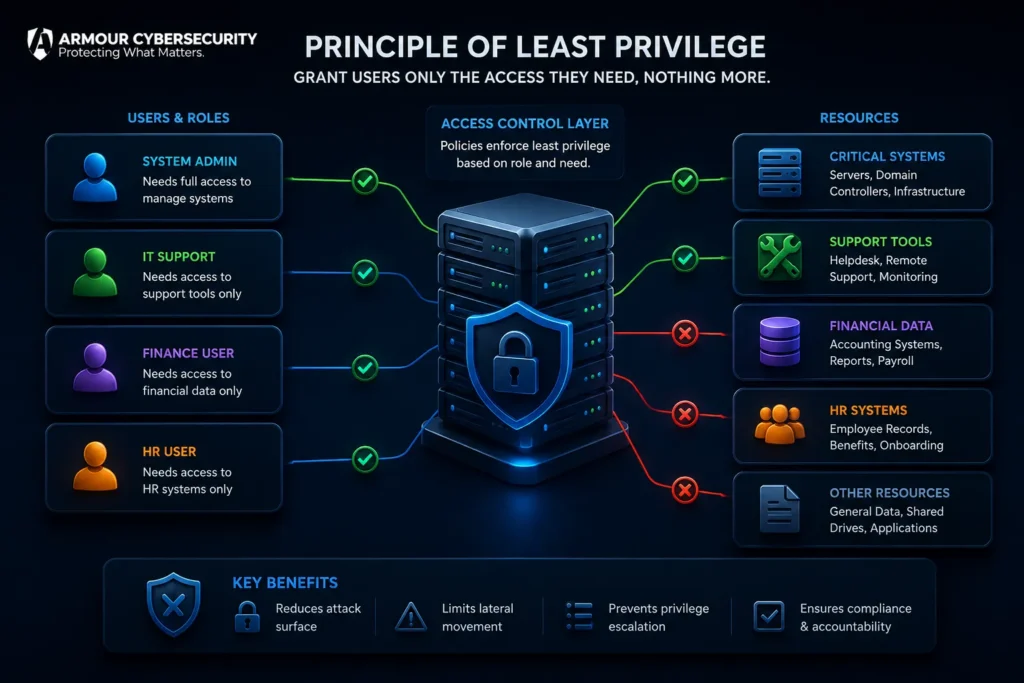
The foundational principle of privileged access management is least privilege, which is also a core component of Zero Trust architecture: every user, application, and service account should have access to exactly what it needs to perform its legitimate function — and nothing more.
In practice, enforcing least privilege requires both a clear understanding of what access different roles genuinely require and the organizational discipline to resist the natural tendency toward over-provisioning. It is always easier to grant broad access upfront than to carefully scope permissions — but that shortcut accumulates into serious risk over time.
Least privilege should apply not just to human users but to service accounts, application identities, and automated processes. A backup service that needs read access to file servers does not need administrative rights on those servers. A monitoring tool that needs to read system metrics does not need the ability to modify system configurations. Tightening these permissions removes potential pathways that attackers can exploit.
Regular access reviews are essential for maintaining least privilege over time. Roles change, responsibilities shift, and projects end — but access permissions tend to persist long after the reason for granting them has passed. Periodic reviews ensure that accumulated entitlements are identified and removed.
Multi-Factor Authentication for Privileged Accounts
If there is a single control that should be non-negotiable for all privileged accounts, it is multi-factor authentication. MFA requires that access to a privileged account not only requires knowing the password but also providing a second verification factor — typically a time-based code from an authenticator application or a hardware security key.
The effectiveness of MFA against credential-based attacks is well documented and is often evaluated through a Cybersecurity Posture Assessment. Even when attackers obtain valid credentials — through phishing, credential stuffing, or purchasing stolen data on underground markets — MFA prevents them from using those credentials to gain access. For privileged accounts, which represent the highest potential impact of any compromise, the case for mandatory MFA is overwhelming.
More advanced implementations use phishing-resistant MFA methods such as FIDO2 hardware keys or certificate-based authentication, which are immune to the real-time phishing attacks that can defeat some simpler MFA approaches.
Privileged Access Management and Cyber Insurance
Cyber insurers increasingly evaluate privileged account controls during underwriting. Organizations that lack multi-factor authentication, privileged access governance, or credential management processes may face higher premiums, coverage exclusions, or difficulties obtaining coverage altogether.
Strong PAM controls help demonstrate cybersecurity maturity and reduce the likelihood of credential-based compromises, making them an important component of cyber insurance readiness.
Just-in-Time Privileged Access
Traditional privileged access management gave administrators persistent elevated access — their accounts always had administrator rights, whether they were actively performing an administrative task or not. This means that if the account is ever compromised, the attacker immediately has full privileged access.
Just-in-time (JIT) access changes this model by making privileged access temporary and task-specific. Instead of having permanent administrator rights, a user requests elevated access when they need to perform an administrative task. The access is granted for a defined time period, and automatically revoked when the time expires or the task is complete.
JIT access dramatically reduces the window of opportunity for attackers and complements network segmentation strategies designed to limit lateral movement. Even if an account’s credentials are compromised, the attacker gains administrator rights only if they happen to be active during the brief window when elevated access was granted — not at any arbitrary time.
Privileged Session Management and Monitoring
Monitoring what privileged accounts actually do is as important as controlling their access. Privileged session management records administrator activity — commands executed, systems accessed, changes made — creating an audit trail that supports both security monitoring and SOC compliance requirements.
Session recording serves multiple purposes. It enables incident response teams to reconstruct exactly what happened during a security incident. It deters misuse by insiders who know their activities are being recorded. It provides the evidence needed for compliance audits. And it enables detection of anomalous activity — an administrator accessing systems they have never touched before, or commands being executed outside normal business hours.
Modern PAM solutions can analyze privileged session activity in real time and generate alerts when behavior deviates from established patterns, allowing security teams to intervene before significant damage is done.

Securing Service Accounts and Non-Human Identities
Service accounts — the credentials used by applications, automated processes, and scripts to authenticate and access other systems — are among the most neglected aspects of privileged access management. They often have elevated permissions, rarely have their passwords rotated, are frequently shared across multiple applications, and are difficult to track because they are not associated with any individual user.
A compromised service account can provide attackers with persistent, difficult-to-detect access. Because service accounts are expected to authenticate regularly as part of normal operations, their activity blends in with legitimate traffic even after compromise.PAM programs should include a complete inventory of service accounts, regular credential rotation (ideally automated), minimal permission scoping, and monitoring for unusual authentication patterns as part of broader vulnerability management efforts. Vaulting service account credentials — storing them in a privileged access management solution rather than in configuration files or scripts — prevents credential exposure and enables automated rotation.
Non-human identities now significantly outnumber human accounts in many organizations. Cloud workloads, APIs, automation tools, and service integrations often require privileged access. Managing these identities through credential vaulting, automated rotation, and continuous monitoring is becoming a critical component of modern identity security programs.
Eliminating Shared Administrator Accounts
Shared administrator accounts — a single set of credentials used by multiple individuals — are a persistent problem in many organizations. They are convenient, because anyone who needs administrative access has it immediately, but they create serious security and accountability issues.
When a shared account is used, there is no way to determine which individual performed a given action. When an incident occurs, forensic investigation becomes far more difficult. When a team member leaves, the shared password should be changed — but in practice, this often does not happen promptly or reliably.
Best practice is to eliminate shared administrator accounts entirely, providing each individual who needs privileged access with their own account, properly governed and monitored. Where legacy systems or specific use cases make individual accounts impractical, additional compensating controls — session recording, step-up authentication, approval workflows — should be applied.
Frequently Asked Questions
What is Privileged Access Management (PAM)?
Privileged Access Management is the process of securing and governing accounts with elevated permissions through controls such as least privilege, MFA, credential vaulting, session monitoring, and just-in-time access.
Why is PAM important?
PAM helps prevent attackers from gaining administrative access, reduces insider threats, improves compliance, and limits the impact of credential compromise.
What is the principle of least privilege?
Least privilege ensures users, applications, and services receive only the minimum permissions required to perform their legitimate functions.
Does PAM require multi-factor authentication?
Yes. MFA is considered a core PAM control and should be enforced for all privileged accounts.
What is just-in-time privileged access?
Just-in-time (JIT) access grants temporary administrative privileges only when needed and automatically removes them after the task is completed.
Does PAM help with compliance?
Yes. PAM supports compliance with ISO 27001, SOC 2, PCI DSS, HIPAA, NIST CSF, and other regulatory frameworks.
Strengthen Privileged Access Security with Armour
Privileged accounts are among the most valuable targets for attackers and one of the most important areas of cybersecurity governance. A mature PAM program helps reduce risk, improve compliance readiness, strengthen cyber resilience, and protect critical systems from unauthorized access.
Armour Cybersecurity helps organizations:
- Assess privileged access risks
- Implement least-privilege strategies
- Deploy MFA and privileged access controls
- Secure service accounts and non-human identities
- Improve compliance and audit readiness
- Build scalable identity security programs
Whether you’re building a PAM program from scratch or improving an existing implementation, our experts can help strengthen control over your most sensitive accounts.
PAM as a Foundational Security Control
Privileged Access Management is not an optional enhancement for organizations that have already covered the basics. It is a baseline security control that belongs in the foundation of any serious security program. The risks associated with poor privileged account management are too significant and too commonly exploited to treat as a future priority.Armour Cybersecurity provides privileged access management consulting and implementation services to organizations across Canada. Whether you are starting from scratch, hardening an existing program, or preparing for a compliance audit, our team can help you build and maintain the controls needed through our cybersecurity consulting services to protect your most powerful accounts. Learn more about our identity security services.