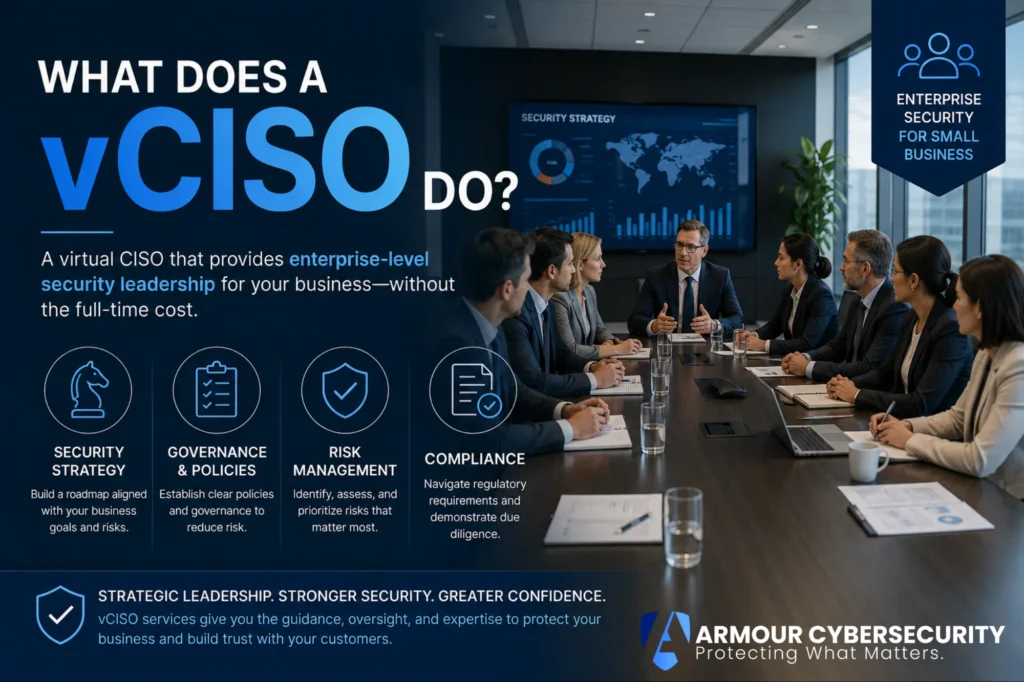
Quick answer: What does a vCISO do? A virtual CISO leads your organization’s security program at the executive level. Day to day, that means setting security strategy, building governance, managing risk, owning compliance, reporting to the board, and commanding the response when incidents occur. Think of the role as your security executive on call, without the full-time salary.
Key Takeaways
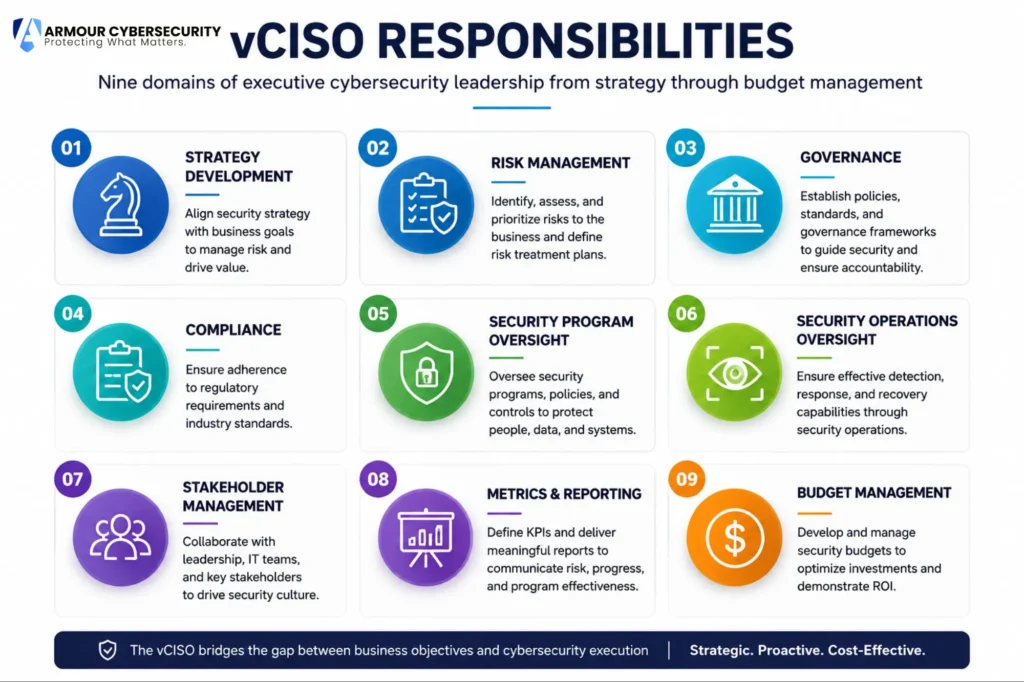
- A vCISO is responsible for nine core domains: strategy, governance, risk, compliance, board reporting, vendor risk, incident command, team development, and budget.
- The role is executive, not operational. The vCISO leads the program; your IT team executes it.
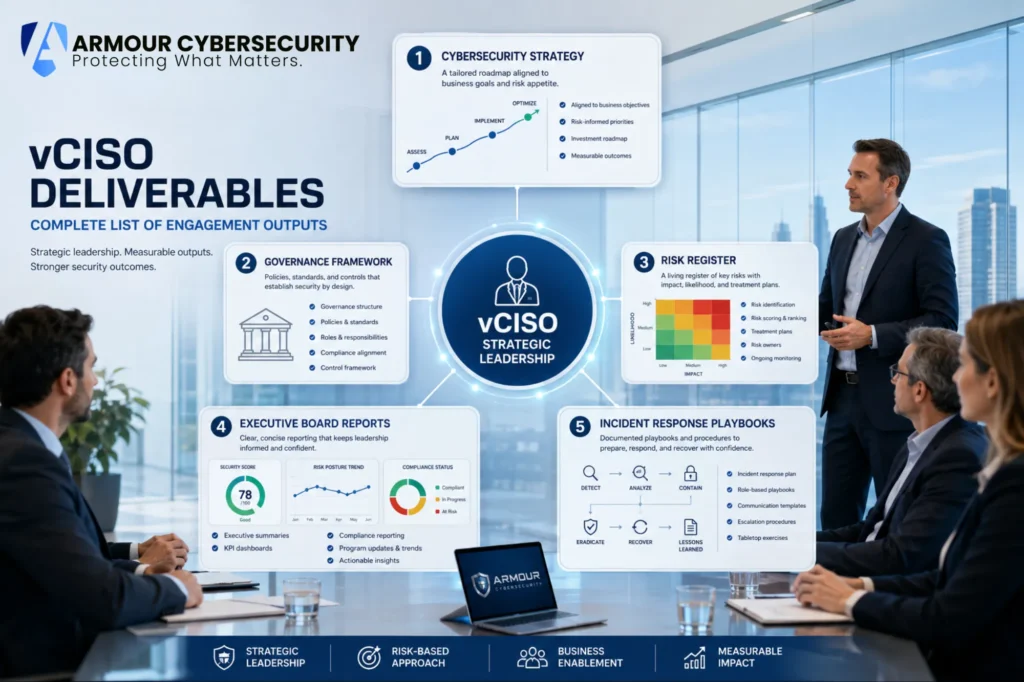
- Every vCISO engagement produces concrete deliverables: a security strategy, a policy library, a risk register, board reports, and incident playbooks.
- The vCISO represents your organization to auditors, regulators, enterprise customers, and the board, as your security executive.
- Engagements are tailored, but the scope of responsibility is consistent: the vCISO owns the security function.
Understanding the Virtual CISO Role: Why It Exists
Most organizations need executive security leadership well before they can justify the cost of a full-time Chief Information Security Officer. The result, for companies that cannot make that hire, is a security function that operates without strategy, without governance, and without an executive owner. Decisions get made by IT staff working outside their lane. Risk accumulates without visibility. Compliance becomes reactive. And when something goes wrong, no one has the standing or the expertise to lead the response.
A virtual CISO fills that gap. The engagement model is flexible by design, because organizations at different stages of growth need different levels of engagement. A 50-person company preparing for its first SOC 2 audit needs something different from a 300-person company whose CISO has just departed. The virtual CISO role adapts to both.
Core vCISO Responsibilities: Nine Domains of Executive Leadership
1. Security strategy and roadmap
The vCISO develops a multi-year cybersecurity strategy and roadmap aligned to your business objectives, growth plans, and risk appetite. This is not a technology shopping list. It is a documented strategy with measurable milestones, clear ownership, and budget guidance over a 12 to 36-month horizon. It answers the question every board should be asking: where is the security program going and how will we know when we get there?
2. Governance and policy oversight
Security governance is the structure that makes a program operate consistently rather than by individual judgment. The vCISO establishes governance committees and decision rights, builds or modernizes the policy library, and ensures policies are enforced rather than aspirational. A strong governance, risk and compliance framework is the foundation of every engagement.
3. Risk management
The vCISO maintains the organizational risk register: a living document of identified threats, vulnerabilities, and risks, each with a likelihood rating, a business impact assessment, an assigned owner, and a tracked remediation status. A cybersecurity posture assessment typically establishes the baseline. Quarterly risk reviews give leadership a current picture of the risk landscape and drive accountability.
4. Compliance and audit leadership
For organizations with regulatory obligations or certification requirements, the vCISO owns the compliance program from end to end. They identify the applicable frameworks, build the controls to satisfy them, manage the auditor relationship, and drive remediation to closure. Armour Cybersecurity’s integrated compliance audit program supports multi-framework readiness for SOC 2, ISO 27001, HIPAA, PCI DSS, and CMMC.
5. Executive and board reporting
The board is responsible for overseeing organizational risk, including cyber risk. They need a security executive who can brief them on the threat landscape, program maturity, incidents, regulatory posture, and strategic priorities in language that supports sound decision-making. The vCISO prepares quarterly board-ready briefings and audit committee materials and presents them directly to leadership.
6. Third-party and vendor risk
Every vendor with access to your systems or data is a potential attack vector. The vCISO builds the framework for evaluating third-party security posture, establishes assessment processes for high-risk vendors, and ensures supplier risk is tracked and managed with the same rigor as internal risk.
7. Incident command and response
When an incident occurs, someone needs to lead the response with executive authority. The vCISO owns the incident command structure, including pre-defined response procedures, executive decision rights, communication protocols with legal counsel and regulators, and post-incident review. Having a breach response capability in place before an incident occurs is central to this function.
8. Team development and mentorship
A vCISO engagement is not designed to create dependency. The vCISO mentors internal IT and security staff, builds their capability over time, and prepares the program for a future full-time CISO. When the organization is ready to make that hire, the documentation, governance structure, and team capability are in place for the transition to succeed.
9. Budget and vendor strategy
Security spending without executive ownership is typically fragmented and reactive. Tools are purchased to address immediate problems without reference to a coherent strategy. The vCISO builds the security budget tied to measurable risk reduction, evaluates the existing technology stack for redundancy and gaps, and ensures every investment is justified by its contribution to reducing organizational risk.
vCISO Deliverables: What Your Engagement Actually Produces
The outputs of a virtual CISO engagement are concrete and board-ready. Every Armour Cybersecurity vCISO engagement produces:
- A multi-year security strategy and roadmap with milestones, ownership, and budget guidance.
- A governance and policy library aligned to applicable frameworks.
- An organizational risk register maintained and updated on a quarterly basis.
- Quarterly board reports and audit committee materials presented in executive language.
- An incident command playbook with pre-defined response procedures and tabletop exercise outputs.
- A vendor risk framework with assessment templates and ongoing monitoring cadence.
- A security budget and technology roadmap tied to risk reduction priorities.
- A CISO transition package if and when the organization is ready for a full-time hire.
These are not advisory recommendations. They are working documents that the business uses, updates, and presents to auditors, customers, and investors.
How Does the vCISO Engagement Actually Work Day to Day?
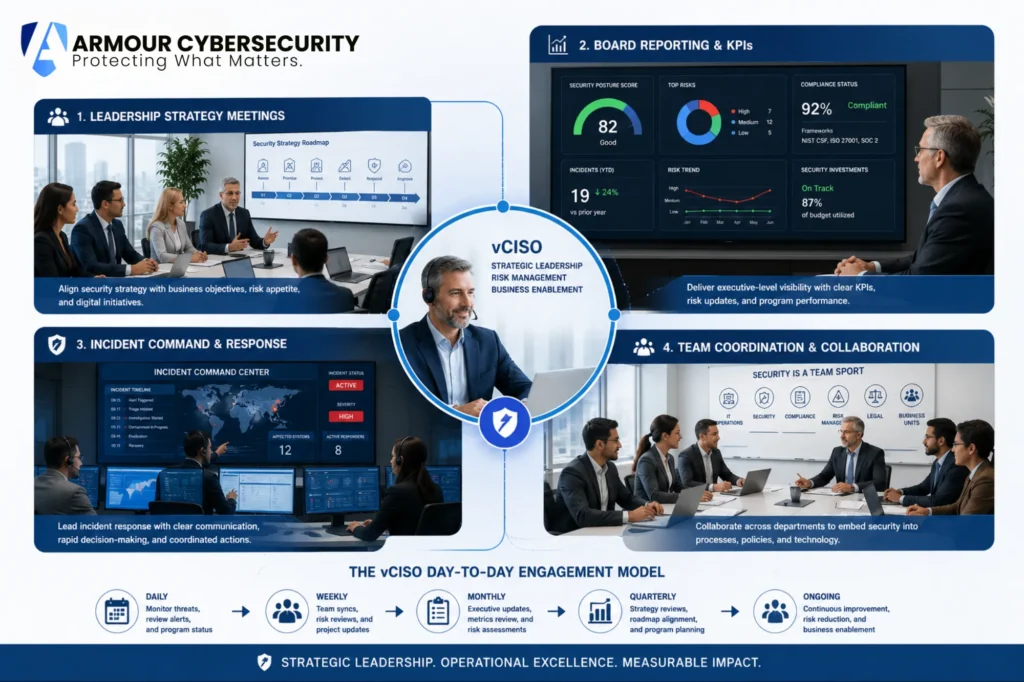
The cadence of a vCISO engagement is defined during the scoping and discovery phase and reflects how the organization actually operates. A fractional engagement might involve two days per week of active work: a standing leadership meeting, a weekly review of security operations outputs, a monthly board briefing cycle, and ad hoc availability for incidents, customer questionnaires, and vendor evaluations.
The vCISO integrates into your existing team structure. They attend your leadership meetings, coordinate with IT staff on operational matters, manage external relationships independently, and produce deliverables on the schedule the engagement requires. They are not a vendor who checks in monthly. They are a member of your executive team who happens not to occupy a full-time headcount.
Many organizations pair the vCISO engagement with a managed security service for operational execution. The vCISO provides strategy, governance, and leadership; the managed service handles 24/7 monitoring, detection, and response. Together, they deliver a complete security program without requiring any full-time security hires.
A vCISO does not just advise. They own your security program: strategy, governance, compliance, board reporting, and incident command. Armour Cybersecurity structures every engagement to produce the deliverables your auditors, customers, and investors expect, on a schedule and budget that fits your business.
Explore vCISO Services from Armour Cybersecurity
Contact the Armour Cybersecurity team at armourcyber.io/vciso-services to scope the right engagement for your organization.
Frequently Asked Questions
Is a vCISO the same as a security consultant?
No. A security consultant typically delivers a specific engagement, such as a risk assessment, penetration test, or policy review, and then leaves. A vCISO is an ongoing executive role with ownership of the security program, accountability for outcomes, and an integrated position in your leadership team. The consultant answers questions; the vCISO owns the answers.
How many hours per week does a vCISO typically work?
Fractional engagements commonly range from one to three days per week, depending on the size and complexity of the organization and the maturity of the program. Fixed-scope engagements, such as a certification readiness build, may involve more intensive work over a defined period. Interim CISO arrangements during a leadership search may be closer to full-time for the duration.
Does the vCISO work with our IT team or separately?
The vCISO works with your IT team, not in parallel to it. The security function and the IT function are related but distinct. The vCISO provides strategy, governance, and executive leadership; your IT team runs operations. The vCISO sets priorities, defines requirements, and holds the program accountable; your IT team implements and maintains.
What happens if we have a security incident while working with a vCISO?
The vCISO activates the incident command structure they have already built and leads the response. They coordinate containment and remediation efforts, manage communication with legal counsel, regulators, and affected parties as required, and ensure the incident is documented and reviewed to improve the program.
Can a vCISO help us respond to an enterprise customer security questionnaire?
Yes, and this is often one of the most visible immediate benefits. Enterprise buyers send detailed security questionnaires before signing contracts. The vCISO owns those responses, ensuring they are accurate, complete, and representative of a real security program rather than aspirational claims.
About David Chernitzky
David Chernitzky brings over 25 years of deep cybersecurity and military cyber intelligence experience, with a career rooted in strategic risk management and protecting critical systems against advanced threats. As CEO and Co-Founder of Armour Cybersecurity, he combines strategic vision with hands-on expertise to deliver practical, high-impact cyber defense solutions.