Quick answer: Knowing when to hire a virtual CISO comes down to recognizing the triggers: security decisions being made without qualified executive ownership, audit or certification pressure mounting, enterprise customers asking security questions the business cannot answer credibly, or an incident revealing how much governance was missing. The right time is before any of those situations becomes a crisis.
Key Takeaways
- Most businesses wait too long to engage a vCISO. The triggers listed below are signs the gap has already opened; the goal is to close it before it costs the business a deal, an audit, or an incident.
- Security audit preparation, enterprise customer requirements, M&A due diligence, and post-incident rebuilds are the four most common engagement drivers.
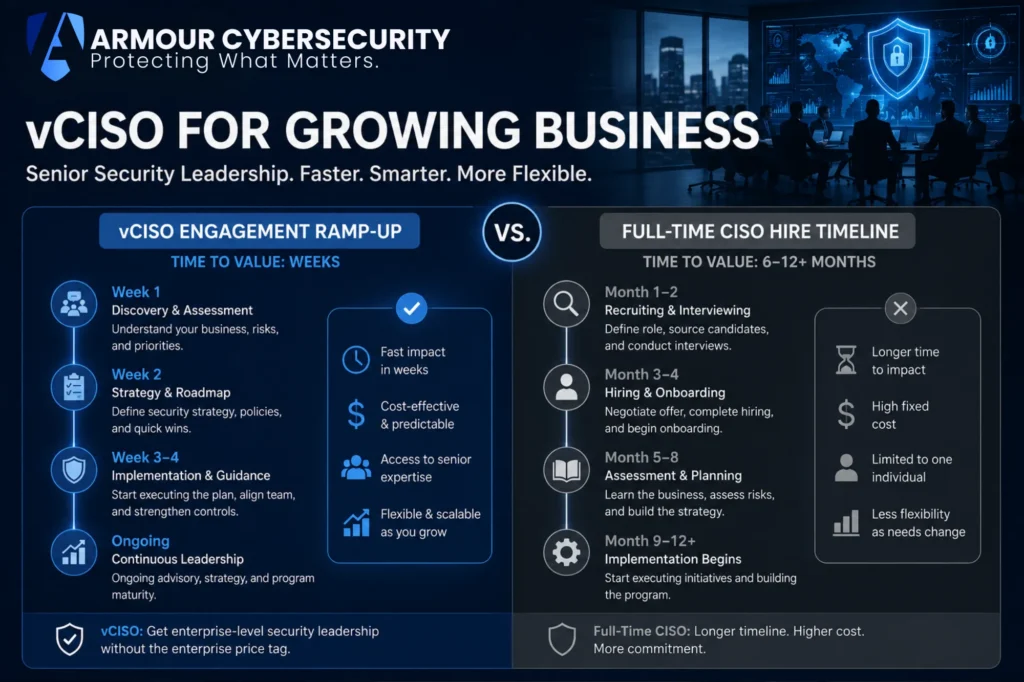
- A vCISO engagement can begin producing value within weeks of kickoff, unlike a full-time CISO hire that takes months to recruit and ramp.
- The cost of not having executive security leadership shows up in failed audits, lost deals, and incidents that escalate further than they should.
- Engaging a vCISO early creates a stronger program and lowers the total cost of compliance over time.
Why a vCISO for Growing Business Pays Off Early
The most common mistake businesses make when it comes to security leadership is waiting until something goes wrong. By that point, the options narrow considerably. A failed audit requires remediation under pressure. A breach response without an incident command structure is slower and more expensive. A deal lost because a security questionnaire was answered poorly cannot be recovered.
A vCISO engagement started before these events occur changes the outcome. The governance, risk and compliance structure is in place before the auditor arrives. The incident playbook exists before the breach happens. The security questionnaire responses are accurate and board-ready before the enterprise buyer asks. The investment in leadership pays the highest return when it precedes the situations that require it.
That said, there is no point at which a vCISO engagement is too late. Organizations recovering from a breach, failing their first SOC 2 audit, or losing deals to security gaps can all benefit immediately from executive security leadership. The question is not whether to engage, but when.
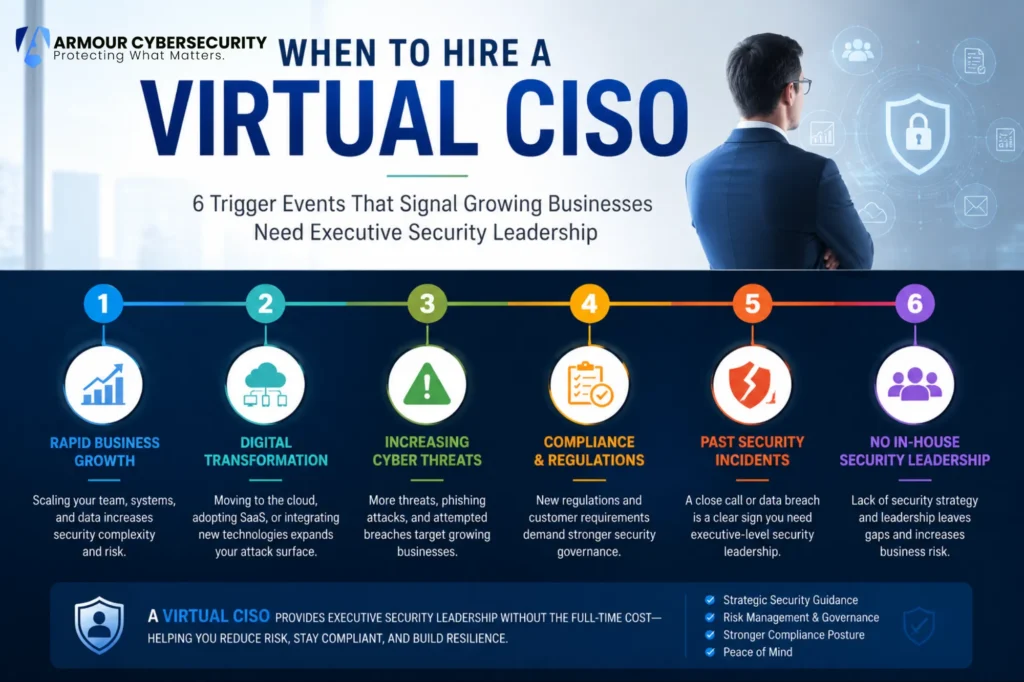
Do I Need a vCISO? Six Signs Your Business Is Ready
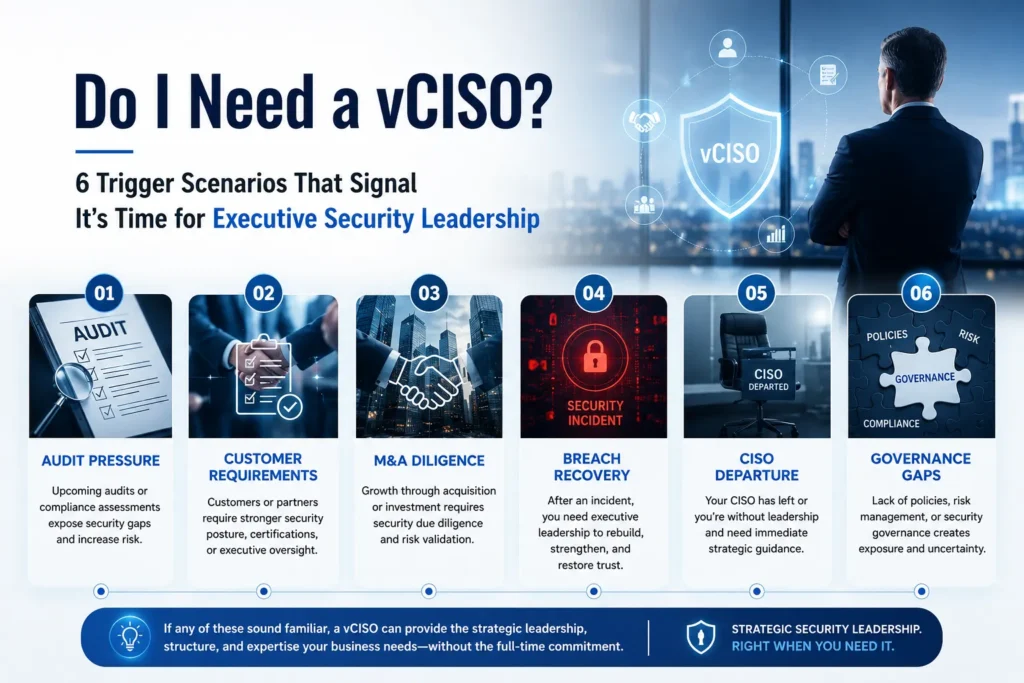
Security decisions are being made without a qualified owner
If the person making security decisions at your organization is an IT manager, an operations lead, or no one in particular, the program is running without governance. Someone is choosing which vulnerabilities to remediate, which vendors to trust, how to respond to an incident, and what to tell the board. Without a qualified executive making those decisions with business context and security expertise, the outcomes are inconsistent and the accountability is missing.
This situation is almost universal among SMBs that have not engaged a vCISO. It is not a criticism of the people involved. IT managers are not trained security strategists, and business leaders cannot be expected to make informed risk decisions without guidance. A vCISO fills that leadership gap with the appropriate level of expertise and authority.
A security audit or certification is on the horizon
SOC 2, ISO 27001, HIPAA, PCI DSS, and CMMC certifications all require executive ownership of the security program. Engaging a vCISO six to twelve months before a certification target gives the program time to build the controls, collect the evidence, and establish the governance structure auditors expect. A compliance readiness assessment establishes the baseline and identifies the gaps.
Enterprise customers are asking security questions you cannot answer well
Large enterprise buyers evaluate their suppliers before signing contracts. The security questionnaire is a standard part of that evaluation, and the quality of the responses reflects directly on the maturity of your program. A vCISO changes that dynamic entirely. The security questionnaire is answered by your security executive, referencing real policies, real controls, and real governance structures.
Investors or acquirers are conducting due diligence
Security governance has become a standard item in investment and acquisition due diligence. A vCISO engagement started in advance of a capital raise or M&A process allows the organization to demonstrate a real program with board-level oversight, documented governance, and a defensible risk management posture. A formal cybersecurity posture assessment strengthens this position.
Your organization has experienced a breach or significant near-miss
A breach, ransomware event, or business email compromise that revealed major gaps in the security program is a signal that the absence of executive leadership had consequences. An Armour Cybersecurity vCISO can take ownership of breach response, manage communications with legal counsel and regulators, lead the forensic investigation engagement, and begin building the governance structure that should have been in place.
Your CISO has departed and you need coverage during the search
When a Chief Information Security Officer leaves, the security program does not pause. Audits continue. Incidents occur. Customers send questionnaires. An interim virtual CISO takes ownership immediately, maintains program continuity, and prepares the role and documentation for the incoming full-time leader.
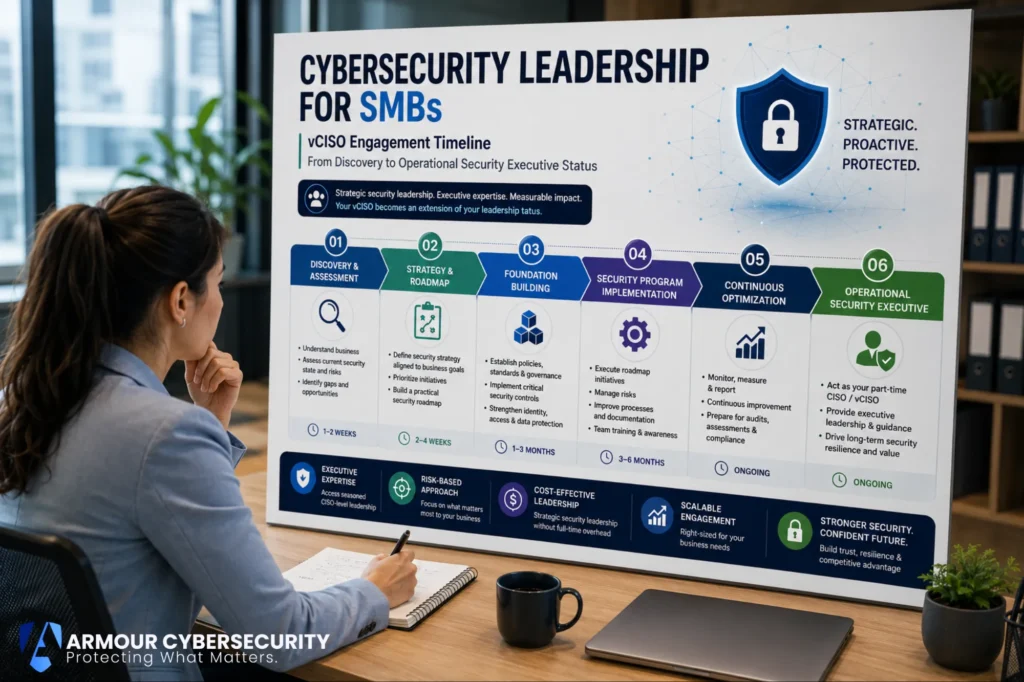
Cybersecurity Leadership for SMBs: What the Engagement Looks Like From Day One
The Armour Cybersecurity vCISO engagement begins with discovery: structured interviews with leadership, IT, and security staff; review of existing policies, audit findings, and the technology stack; and a current-state assessment against applicable frameworks. Armour’s integrated compliance audit program supports multi-framework readiness from the outset.
Within the first few weeks, the vCISO is operational as your security executive. They attend leadership meetings, respond to security questions from customers and auditors, begin building governance documentation, and establish the cadence for ongoing program oversight. A security strategy and roadmap is typically the first major deliverable.
Many organizations pair the vCISO with a managed security service for operational execution. The vCISO provides strategy and governance; the managed service handles 24/7 monitoring, detection, and response. Together, they deliver a complete security program without requiring any full-time security hires.
The right time to engage a vCISO is before the audit fails, before the deal is lost, and before the breach reveals what was missing. Armour Cybersecurity structures every engagement to produce value within weeks of kickoff, not months.
Schedule a vCISO Scoping Conversation
Contact the Armour Cybersecurity team at armourcyber.io/vciso-services to scope the right engagement for your organization.
Frequently Asked Questions
Is there a minimum company size for a vCISO engagement?
No. Armour Cybersecurity vCISO engagements serve organizations ranging from growing businesses with ten or more employees to established mid-market companies with several hundred. The engagement scope and cadence scale to the organization’s size, complexity, and the maturity of its existing security program.
How quickly can a vCISO engagement begin after we decide to move forward?
Most engagements begin the discovery phase within one to two weeks of agreement. The vCISO is typically operational as your security executive within the first month. This is substantially faster than recruiting and onboarding a full-time CISO, which commonly takes three to six months from role opening to productivity.
What if we are not sure which frameworks apply to our business?
Framework selection is part of the discovery and scoping phase. The vCISO reviews your industry, customer base, contractual obligations, and growth plans to determine which frameworks are applicable, which are most urgent, and how to build a program that satisfies multiple requirements without redundant effort.
Can a vCISO engagement lead to a full-time CISO hire later?
Yes, and many engagements are structured with this as an explicit goal. The vCISO matures the program, builds internal capability, and prepares the documentation and governance structure so that a full-time CISO can be hired and immediately effective rather than spending their first year building what should already exist.
How does a vCISO engagement differ from hiring a cybersecurity consulting firm?
A cybersecurity consulting firm typically delivers a bounded engagement: a risk assessment, a penetration test, a policy review, a certification audit preparation. When the engagement ends, the deliverable is handed over and the relationship concludes. A vCISO is an ongoing executive role with ownership of the program and accountability for outcomes over time. The consulting firm does the work; the vCISO owns the program.
About David Chernitzky
David Chernitzky brings over 25 years of deep cybersecurity and military cyber intelligence experience, with a career rooted in strategic risk management and protecting critical systems against advanced threats. As CEO and Co-Founder of Armour Cybersecurity, he combines strategic vision with hands-on expertise to deliver practical, high-impact cyber defense solutions.