By David Chernitzky, CEO, Armour Cybersecurity · Serving organizations across North America · Last updated August 6, 2026
Quick Answer
The first hour of a cyber breach is when the decisions are made that determine whether the incident becomes a contained event or a multi-week crisis. Organizations that have validated their breach readiness in advance contain faster, communicate more clearly, and recover with less business disruption. Those who discover their plan’s gaps under crisis conditions spend the first hour finding the right people and figuring out who is in charge.
Key Takeaways
- The first hour of a breach is when containment decisions, communications decisions, and legal escalation decisions must be made. Getting those decisions wrong under pressure has consequences that last weeks.
- Organizations without validated incident response capability typically spend the first hour locating contacts, determining who has authority to make decisions, and trying to understand what happened, rather than acting on it.
- Decision authority gaps are the most common failure mode in the first hour. Documented authority and real authority often differ significantly in organizations that have never pressure-tested their plan.
- Pre-established relationships with breach counsel, cyber insurance carriers, and forensic responders save hours in the critical early phase and prevent costly errors in legal and insurance handling.
- Breach readiness assessment identifies and closes these gaps before an event forces the organization to discover them under pressure.
Incident response planning for a small business is not a document you file and forget. It is the difference between a contained event and a multi-week crisis, and the gap shows up in the first hour. IBM’s 2025 Cost of a Data Breach Report put the global average breach at $4.44 million, and $10.22 million in the United States, with the average incident taking 241 days to identify and contain. The report is consistent on one point across two decades of data: the faster an organization contains an incident, the less it costs. The first hour is where that clock starts, and how a breach response unfolds in those sixty minutes shapes everything that follows.
| By the Numbers$4.44M global / $10.22M US average cost of a data breach, with a mean lifecycle of 241 days to identify and contain. Source: IBM Cost of a Data Breach Report 2025.88% of small and mid-sized business breaches involve ransomware, which appears in 44% of all breaches. Source: Verizon 2025 Data Breach Investigations Report.$2.77B in reported business email compromise losses in a single year. Source: FBI Internet Crime Report 2024. |
What Actually Happens in the First Hour of a Breach?
When a cyber incident is first detected, the organization faces an immediate sequence of decisions that need to happen in parallel, under incomplete information, with significant business and legal consequences attached to each one. The quality of those decisions in the first hour determines how the incident develops for the next several weeks.
Detection triggers a notification that reaches someone in IT or the SOC. The first decision is whether this is a real incident or a false positive, and how confident the team is in that determination. The second is who to notify immediately and who to wait on. The third is what containment actions to take and whether taking those actions might destroy forensic evidence that will be needed later. The fourth is whether the incident has triggered any regulatory notification obligations with time-bound requirements.
Each of these decisions requires clarity on roles, authority, legal context, and technical facts that are rarely all present at the same time. Organizations that have built and validated their response capability in advance approach these decisions with a framework. Organizations that have not approach them with improvisation.
What Does Improvised Response Look Like?
Improvised response follows a recognizable pattern. The first forty-five minutes are spent trying to understand what happened, who needs to know, and who has the authority to make decisions. This time is wasted not because the people involved are incompetent but because the information and authority structures needed to move faster were never established.
The contact list problem
The incident response plan has a notification list. The first call goes to the security team lead who is on vacation. The second call goes to the IT director whose mobile number in the plan is from a previous job. The third call reaches someone who was not listed in the plan at all but who happens to be available. Twenty minutes have passed before anyone with decision authority is engaged.
The authority problem
The plan says escalate to the CISO. The CISO says this is an executive decision. The CEO is in a board meeting. The COO is not sure they have authority to authorize the containment action being recommended. The legal team has not been notified yet. The question of who can authorize taking a business-critical system offline to stop the spread of an incident takes forty minutes to resolve. In that forty minutes, the incident has spread.
The forensics problem
The IT team, trying to fix the problem, has rebooted compromised systems. The firewall logs have been overwritten because retention was set to forty-eight hours. The endpoint that was the initial access point has been reimaged. The forensic trail that would have explained what happened and confirmed the scope of the breach no longer exists. When the forensic responders arrive, they are working with incomplete evidence, which means the scope of the breach cannot be confirmed with certainty, which affects the notification decision, which affects the legal and regulatory response.
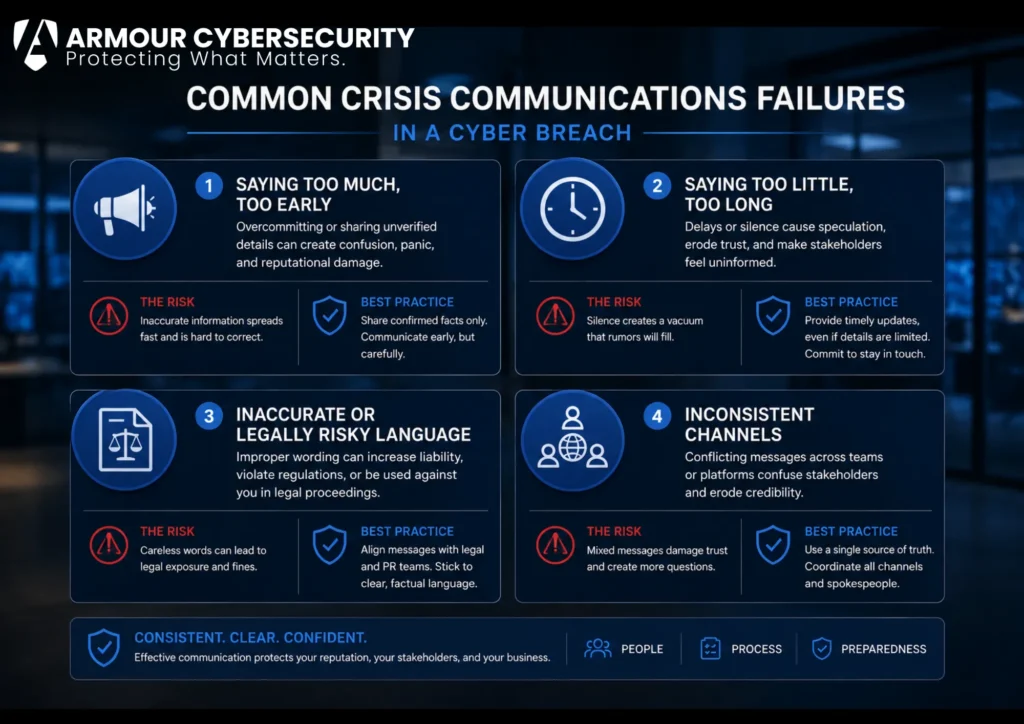
The communications problem
Customers are calling because their service is down. The support team does not know what to say. The communications team is drafting a statement without knowing what actually happened. The legal team is reviewing the draft, which references systems that may or may not have been compromised, and recommending changes that the communications team does not understand. Three hours into the incident, there is no approved external communication. The social media team is monitoring the company mentions.
What Does Prepared Response Look Like?
Organizations that have completed a breach readiness assessment and remediated the gaps it identified respond differently from the first minute of detection.
The notification tree is current and has been tested. The first call reaches the right person. The decision authority map is clear: specific individuals have pre-authorized authority to take specific actions without waiting for a committee. The forensic preservation protocol runs automatically before the containment action, because the response runbook specifies that sequence. The breach counsel relationship is established and the engagement call is made within the first thirty minutes. The cyber insurance carrier dedicated incident response line is known and called before the first public communication is considered.
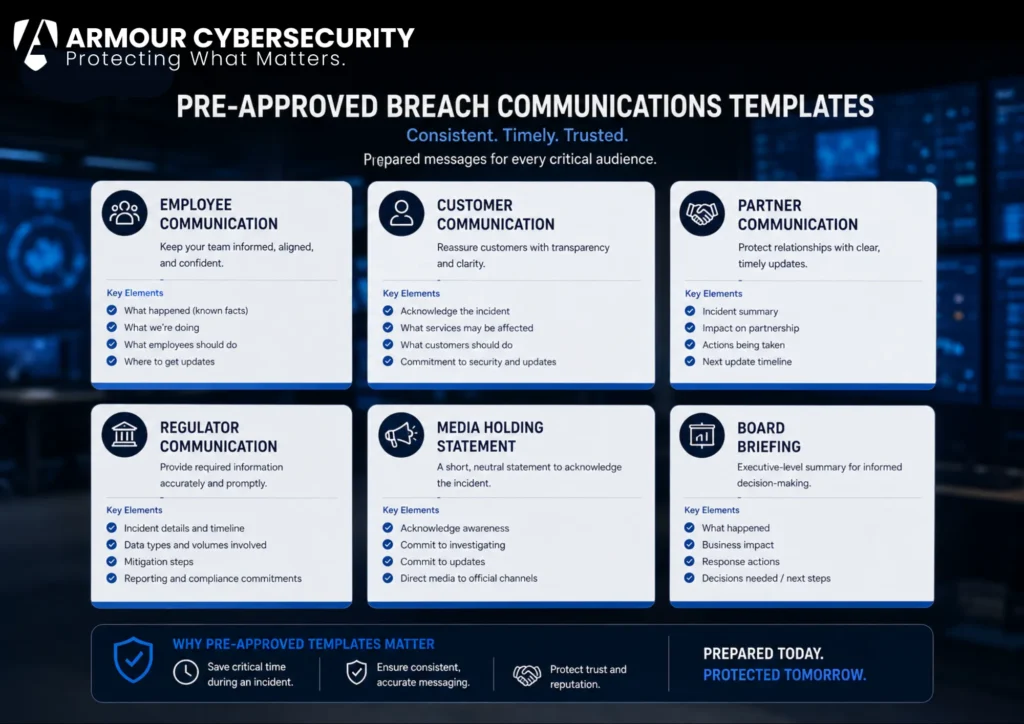
Pre-approved communications templates for internal staff, customers, regulators, and media reduce the drafting and approval time from hours to minutes. The team knows exactly which regulatory notification obligations are triggered by the incident type and jurisdiction, and what the time limits are. The recovery priority list is documented: these systems come back first, in this sequence, because that is what the business continuity analysis determined. The plan is not theoretical, because it has been rehearsed through cyber simulation exercises that put real people under realistic pressure.
This is not a different level of intelligence or a larger budget. It is preparation. The decisions made during a breach readiness assessment and the remediation work that follows it are what make this response possible. Armour Cybersecurity’s assessment covers all of these components specifically: decision authority validation, communications template development, third-party relationship formalization, and forensic readiness.
Which Incident Types Should Playbooks Cover?
The scenarios most likely to trigger a real incident for small and mid-market businesses are well documented in breach data. The playbooks that matter most address these specific scenarios with organization-specific guidance.
Ransomware remains the most common and highest-impact incident type for businesses of every size. In Verizon’s 2025 Data Breach Investigations Report, ransomware appeared in 44 percent of all breaches, and in 88 percent of breaches at small and mid-sized businesses, with a median ransom demand near $115,000. A ransomware playbook needs to cover detection and confirmation, isolation and containment, business continuity activation, forensic preservation, ransom negotiation decision authority and process, recovery sequencing, and regulatory notification assessment. A generic ransomware playbook that does not account for the specific systems, backup architecture, and business continuity options of the actual organization provides limited value under real conditions.
Business email compromise is one of the costliest incident types for businesses. The FBI’s 2024 Internet Crime Report recorded $2.77 billion in reported business email compromise losses in a single year. The playbook needs to cover email account compromise indicators, immediate containment steps specific to the email platform in use, financial fraud reversal procedures, customer and partner notification, and the forensic preservation steps that are required before remediation actions are taken.
Data exposure incidents, whether through misconfigured cloud storage, database exposure, or unauthorized access to systems containing personal information, trigger regulatory notification obligations under PIPEDA and other applicable frameworks with defined time limits. The playbook needs to cover scope determination, privacy counsel engagement, notification trigger assessment, and the documentation required to support the regulator notification.
Where Breach Readiness Fits in Armour’s Managed Services
Breach readiness rarely works alone. It is one pillar of Armour’s managed cybersecurity services, operating alongside a managed Security Operations Center for detection, cyber threat intelligence to see what is coming, vCISO leadership to hold decision authority, cyber awareness training to reduce the human error that starts most incidents, and the all-in-one Armour 360 managed program. The first hour goes well when these pieces are already in place, not assembled during the crisis.
The Bottom Line
The first hour of a breach is decided long before the breach happens. Preparation is the only thing that reliably works, because it is the only variable an organization controls once an incident is underway. A breach readiness assessment turns the first hour from a scramble to locate people and authority into a sequence the team already knows how to run. Validate the plan against your real organization now, while the cost of a gap is a line item on an assessment rather than a line item on an incident.
Across the 260+ organizations Armour protects in 52+ industries, the incident response evidence carriers now ask for at underwriting, a tested plan, documented decision authority, and named third-party relationships, is exactly the evidence most organizations cannot produce on the day the questionnaire arrives.
Frequently Asked Questions
How does incident response planning for a small business change the first hour?
Incident response planning for a small business replaces improvisation with a known sequence. A validated plan means the first call reaches the right person, one named individual already holds authority to take a system offline, forensic evidence is preserved before anyone reboots, and breach counsel and the cyber insurance carrier are engaged within the first thirty minutes. The plan only works if it reflects the real organization, which is what a breach readiness assessment confirms before an incident tests it.
What is the most common gap found in breach readiness assessments?
The most consistently identified gaps are not technical. They are in decision authority and third-party relationships. Organizations frequently have IR plans that document who makes decisions but have not validated that the real organization, with its current personnel and structure, would make those decisions the same way under pressure. Similarly, relationships with breach counsel, cyber insurance carriers, and forensic responders are frequently informal or undocumented, meaning the first real engagement happens under crisis conditions with parties who are strangers to the organization.
How do regulatory notification requirements affect the first-hour response?
Several regulatory frameworks impose time-bound notification obligations that are triggered from the point of detection or the point at which the organization becomes aware of a breach. PIPEDA in Canada requires notification of affected individuals and the Office of the Privacy Commissioner when a breach creates a real risk of significant harm. Some sectors have additional obligations with shorter timelines. The first-hour response needs to include a preliminary assessment of whether notification obligations are triggered, because the clock on those obligations may already be running.
What is forensic preservation and why does it matter in the first hour?
Forensic preservation is the protection of evidence that will be needed to understand what happened, confirm the scope of the breach, and support legal and insurance proceedings. In the first hour, the most common forensic preservation failure is taking remediation actions, rebooting systems, reimaging devices, deleting logs, before evidence is captured. A breach readiness assessment evaluates whether log retention is sufficient to support forensic investigation, whether evidence preservation procedures are documented, and whether the response team knows which actions will destroy evidence before taking them.
Should law enforcement be notified during the first hour?
The decision to notify law enforcement is a legal and strategic judgment that should be made with breach counsel engaged. In some cases, law enforcement engagement in the early phase of an incident can provide intelligence about the threat actor or assist with recovery. In others, it may complicate the response or create additional disclosure obligations. This decision should be documented in the IR plan as a specific decision point with clear guidance on who makes it and what factors they should weigh, rather than being improvised under pressure.
What is a breach coach and when should one be engaged?
A breach coach, also called breach counsel, is a lawyer specializing in cyber incident response who provides legal guidance throughout the incident. They advise on regulatory notification obligations, privilege issues affecting forensic communications, ransom payment legality, and the legal dimensions of customer and partner notifications. Breach coaches should be engaged in the first hour of a significant incident and their relationship should be pre-established before an event occurs. Many cyber insurance policies provide access to breach counsel as part of the coverage; the specific firm and engagement process should be documented in the IR plan before it is needed.
About the Author
David Chernitzky is the CEO and Co-Founder of Armour Cybersecurity, a Toronto-based firm that protects organizations across North America from advanced cyber threats. He brings more than 25 years of cybersecurity and military cyber intelligence experience, having served as an officer in an elite technology unit before co-founding Armour. Armour’s team of military-intelligence veterans and senior advisors serves 260+ clients across 52+ industries with a 97% client retention rate.