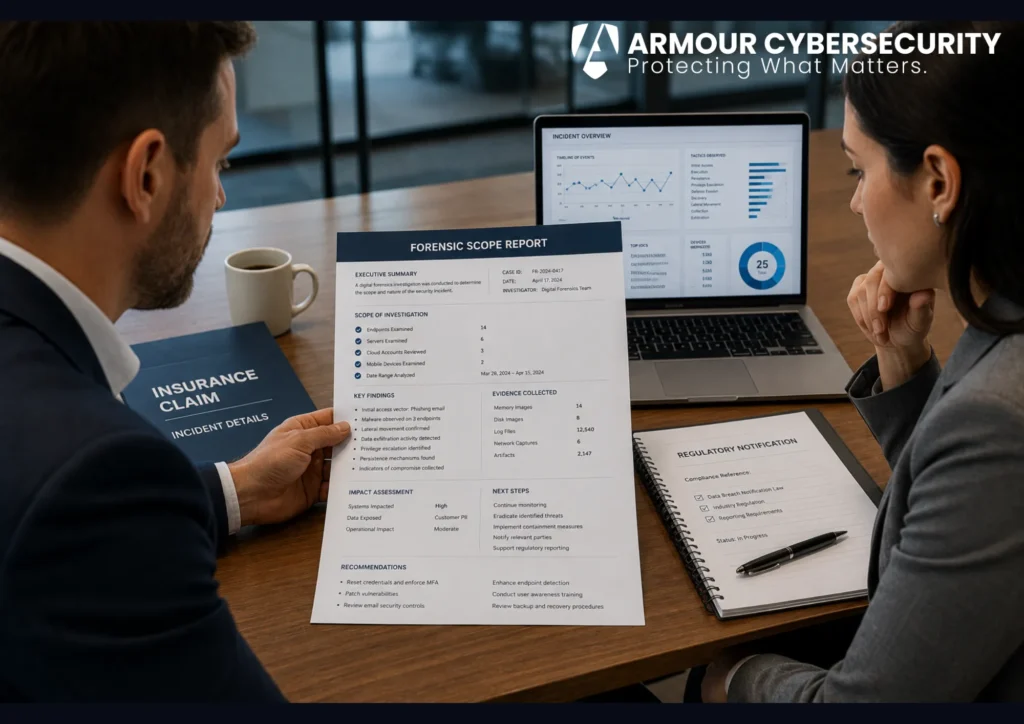
| Quick Answer Cyber insurance claims and regulatory notifications both rest on the same foundation: a credible, documented account of what happened, what data was affected, and what the organization did in response. Digital forensics produces that foundation. The investigation establishes the attack vector, the scope of compromise, the data accessed or exfiltrated, and the duration of attacker presence, all documented to evidential standards that insurance carriers and regulators can rely on. |
Key Takeaways
- Cyber insurance carriers investigate claims by examining whether the incident occurred as described, what data was affected and to what extent, and whether the organization’s response followed documented procedures. Forensic investigation provides the evidence for all three.
- Regulatory notification obligations are triggered by legal tests that depend on knowing what personal information was involved and what risk of harm exists. Establishing this requires forensic scope determination, not estimation.
- Forensic reports produced without documented chain of custody, without peer review, and without acquisition methods appropriate to each medium are vulnerable to challenge by carriers and regulators.
- The quantum of an insurance claim, the total losses covered, is established partly by the forensic scope determination. Underestimation due to incomplete investigation reduces the claim; overestimation creates credibility problems.
- Notification obligations create urgency for forensic scope findings. Organizations with forensic teams engaged early in the response can meet notification timelines with confirmed findings rather than estimates.
When digital forensics meets a cyber insurance claim, the forensic report stops being a technical document and becomes the evidence base a carrier pays against and a regulator reviews. A cyber insurance claim and a regulatory notification ask the same underlying questions: what happened, what data was affected, and how the organization responded. Forensics answers them to a standard that holds up. Estimate instead of investigate, and both the claim and the notification are built on ground that can shift.
| By the NumbersThe forensic scope determination sets how much of the loss a carrier will cover. The global average breach cost $4.44M ($10.22M in the US); the claim quantum tracks the scope forensics establishes. Source: IBM Cost of a Data Breach Report 2025.Notification is triggered by legal tests, not clocks alone. PIPEDA turns on a real risk of significant harm, and Quebec Law 25 on a risk of serious injury. Both hinge on a forensic finding of what personal information was actually involved.Early forensic engagement changes the timeline. Teams engaged in the first hours can produce confirmed scope findings within the notification window instead of estimates that later require amendment. |
What Cyber Insurance Carriers Need from Forensics
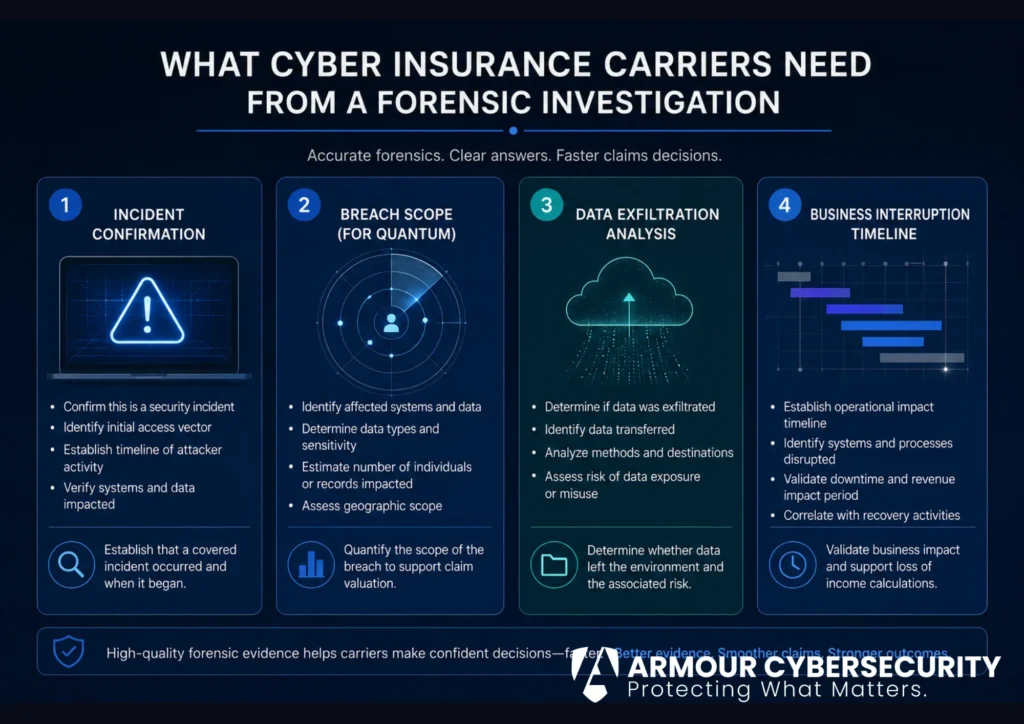
When a cyber insurance claim is filed, the carrier’s claims investigation examines the incident from multiple angles: did the incident occur as described, is the scope of impact consistent with the evidence, were covered expenses reasonable and appropriate, and did the organization follow its documented incident response procedures and the conditions of the policy. Forensic evidence is the evidentiary foundation for most of these questions.
Confirming the incident occurred as described
Inaccurate incident characterization, whether deliberate or simply mistaken, is a claims investigation risk that carriers manage by examining whether the forensic evidence supports the incident description in the claim. The forensic documentation of the attack vector, the attacker’s activities, the systems affected, and the timeline either corroborates or contradicts the claim narrative. When forensic evidence is not available, or was collected without the standards needed to make it credible, the carrier has less basis for confidence in how the claim is characterized.
Establishing breach scope for claims quantum
The quantum of a cyber insurance claim, the total covered losses, is directly connected to the scope of the breach: which systems were affected, what data was compromised, how many individuals were impacted, and what notification and remediation costs follow from that scope. Forensic investigation is the mechanism for establishing this. An investigation that establishes with confidence that specific databases were accessed and specific data categories were involved produces a defensible scope determination. One that cannot establish scope leaves the claim quantum uncertain and the carrier with less basis for approving the full amount.
Data exfiltration analysis
Whether data was exfiltrated, and if so what data and in what volume, is one of the most consequential forensic findings for insurance claims. Exfiltration affects the notification obligations, the credit monitoring and notification costs, the reputational exposure, and the potential regulatory fines. Forensic analysis of network traffic logs, memory captures, and system artifacts can identify exfiltration activity, the destination of exfiltrated data, and in some cases the volume and nature of what was transferred. This analysis is the basis for the exfiltration determination that drives much of the claim quantum.
Business interruption period documentation
Business interruption coverage requires establishing when normal operations were disrupted and when they were restored, and documenting that the disruption was caused by the covered incident rather than by pre-existing conditions or unrelated factors. Forensic investigation establishes the incident timeline: when the initial compromise occurred, when the attacker’s activity expanded, when it was detected, and when remediation was completed. This timeline is the reference against which the business interruption period is measured and the claim calculated.
What Regulatory Notifications Need from Forensics
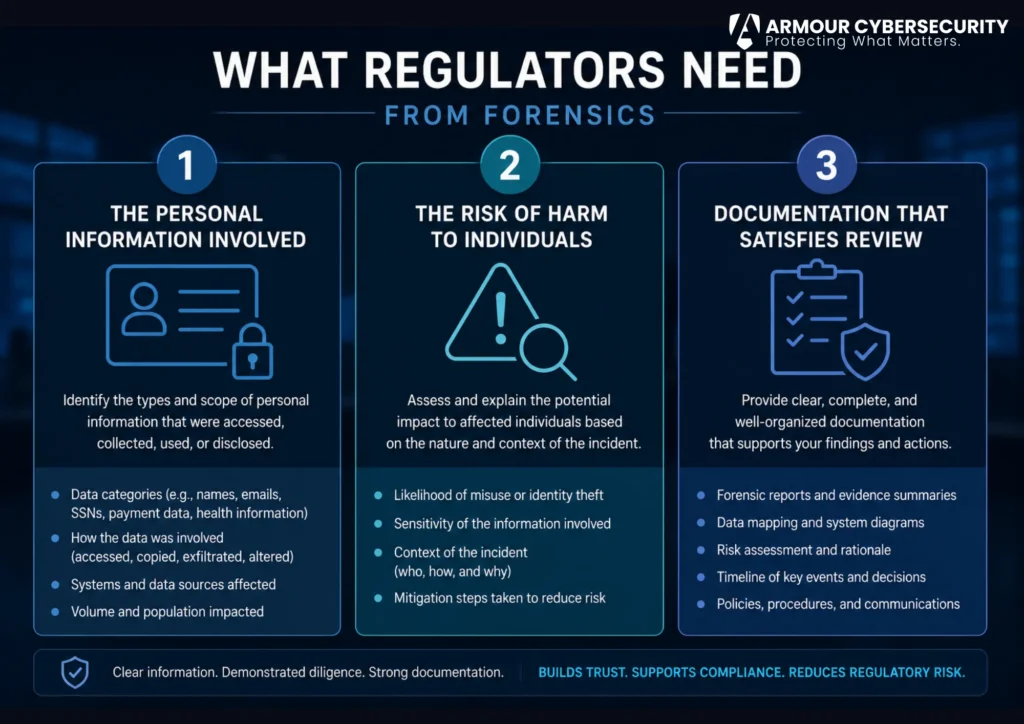
Regulatory notification obligations, whether under PIPEDA, Quebec Law 25, sector-specific frameworks, or applicable US state laws, are triggered by legal tests that depend on factual determinations about the breach. The most important is the scope determination: what personal information was involved, whose information it was, and what risk of harm to affected individuals exists as a result. Getting this right is often the difference between a compliant notification and one that has to be amended.
Establishing what personal information was involved
Regulatory notifications must describe the nature of the personal information involved. This is a forensic question: which databases, file systems, or communications were accessed by the attacker, and what categories of personal information did they contain? Forensic investigation of the compromised systems, combined with analysis of the attacker’s activity and any evidence of data exfiltration, produces the factual basis for this determination. Notifying regulators based on assumptions rather than forensic findings risks an inaccurate notification that must be amended when the investigation reaches different conclusions.
Meeting notification deadlines with confirmed findings
Notification timing is governed by legal tests, not a single universal clock. PIPEDA requires reporting to the Privacy Commissioner and notifying individuals as soon as feasible once the organization is aware that a breach creates a real risk of significant harm. Quebec’s Law 25 requires an organization to notify the Commission d’access a l’information and affected individuals with diligence, meaning promptly, once it determines a confidentiality incident presents a risk of serious injury. Unlike the European GDPR, which sets a fixed 72-hour reporting clock, Law 25 does not impose a specific statutory number of hours, though many organizations adopt 72 hours as an internal operational benchmark. The tension between these prompt-notification obligations and the time a thorough forensic investigation takes creates pressure to notify on preliminary findings. Organizations with forensic teams engaged from the first hours of the response can prioritize the scope determination to support the notification, producing confirmed findings quickly rather than estimates that require amendment.
Producing documentation that satisfies regulatory review
When regulators review a breach notification, they may request the investigation documentation supporting it: what was investigated, how, with what findings, and when. A forensic investigation report with documented methodology, chain of custody, peer review, and evidential rigor is a more credible response than a summary written by the internal IT team. Regulators who receive professionally produced forensic documentation have a clear picture of the investigation’s scope and confidence level. Those who receive inadequate documentation may conduct their own investigation or impose more demanding reporting requirements.
What Makes Forensic Evidence Credible to Carriers and Regulators?
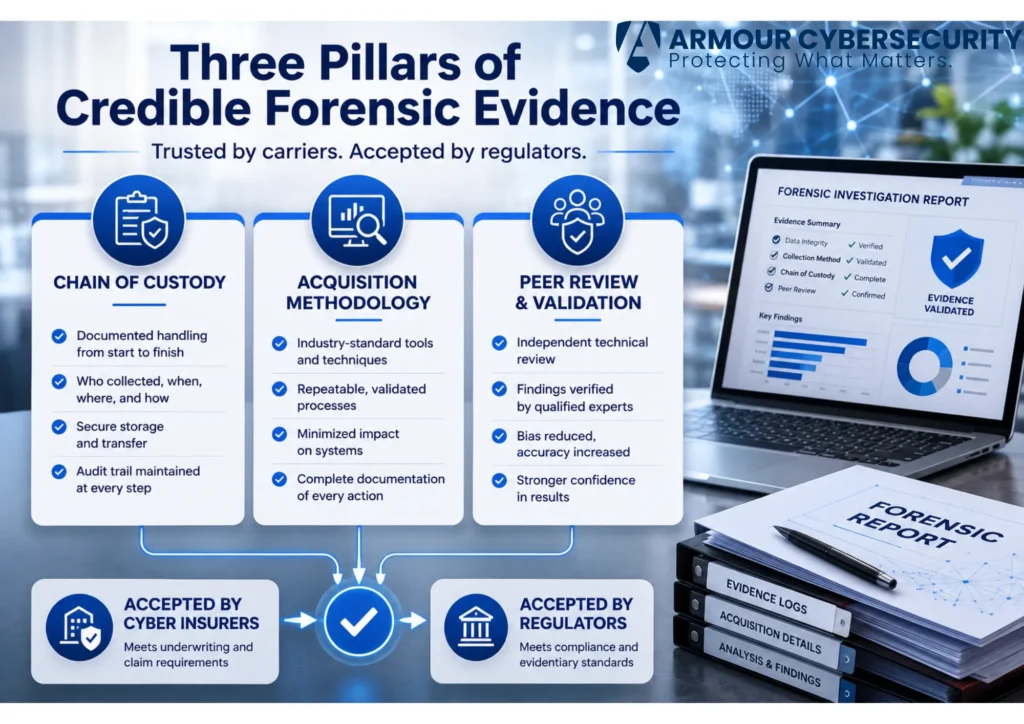
The credibility of forensic evidence in insurance and regulatory contexts depends on several specific characteristics that professional forensic investigations are designed to produce and improvised internal investigations typically do not.
Across the 260+ organizations Armour serves in 52+ industries, the claims that get paid in full and the notifications regulators accept without a second inquiry have one thing in common: a forensic scope determination that was documented rather than estimated. The organizations that run into trouble are almost always the ones that claimed or notified on a guess and then had to walk the number back.
Chain of custody is the most foundational requirement. Evidence that cannot demonstrate an unbroken record of custody from acquisition to report is vulnerable to challenge. Professional forensic investigations document every transfer of evidence, every person who has accessed it, and every action taken with it from the first moment of collection.
Acquisition methodology documentation establishes that forensically sound methods were used: write-blockers for storage media, hash verification for integrity confirmation, and documented tools and versions for each acquisition step. This documentation demonstrates that the acquired evidence is an accurate representation of what was on the original systems at the time of collection.
Peer review, in which a second qualified analyst reviews the findings before they appear in the final report, adds a layer of quality assurance that makes the conclusions more defensible under challenge. Armour Cybersecurity’s technical forensics service incorporates peer review as a standard component of every engagement, not an optional add-on, and structures its reporting, often alongside breach counsel, to support both the insurance claim and the regulatory submission.
Where Forensics Fits in Armour’s Managed Services
Claim-and-regulator-ready forensics is one pillar of Armour’s managed cybersecurity services, working next to the incident response engagement it runs inside, a breach readiness assessment that checks whether your evidence and log retention would survive an incident, a managed Security Operations Center whose logs feed the scope determination, and the all-in-one Armour 360 managed program. The investigation finds the facts. The documentation makes them count.
The Bottom Line
A cyber insurance claim and a regulatory notification are only as strong as the forensic evidence underneath them. Scope that is documented gets paid and accepted; scope that is estimated gets challenged and amended. If a breach would leave your business notifying regulators and filing a claim on a best guess, Armour’s technical forensics service is built to give you confirmed findings instead, documented to the standard carriers and regulators actually accept.
| Across the 260+ organizations Armour serves in 52+ industries, the claims that get paid in full and the notifications regulators accept without a second inquiry have one thing in common: a forensic scope determination that was documented rather than estimated. The organizations that run into trouble are almost always the ones that claimed or notified on a guess and then had to walk the number back. |
Frequently Asked Questions
How does digital forensics support a cyber insurance claim?
Digital forensics supports a cyber insurance claim by producing the documented evidence the carrier’s claims investigation relies on: confirmation that the incident occurred as described, the scope of systems and data affected, whether and what data was exfiltrated, and the incident timeline that sets the business interruption period. Because the claim quantum is tied to that scope, a forensic investigation that establishes it with confidence produces a defensible claim, while an investigation that cannot establish scope leaves the carrier with less basis to approve the full amount. The evidence must be documented to evidential standards, chain of custody, sound acquisition, and peer review, or the carrier can challenge it.
Can forensics determine whether data was actually taken or just accessed?
In many cases, yes, though the confidence of the determination varies with the evidence available. Network traffic logs that capture outbound connections and data volumes can indicate exfiltration activity. Memory analysis can reveal data being processed for exfiltration. File system artifacts show what files were accessed and when. Cloud audit logs record data download events. Together these sources can establish with reasonable confidence whether data was exfiltrated, to what destination, and in approximately what volume. Where log retention is insufficient or evidence was destroyed before collection, the determination may need to be expressed as a qualified finding rather than a confirmed conclusion.
What if the forensic investigation finds less than we reported to the carrier?
If the forensic investigation indicates the breach scope was smaller than described in the initial notification, the claim should be updated to reflect the confirmed findings. Carriers expect that initial notifications are made under incomplete information and that the forensic investigation will refine the scope, so the update is handled as a claim amendment rather than a problem, provided the initial notification was made in good faith based on the information available at the time. Findings that consistently undercut initial characterizations over many claims would raise different questions, but a single scope refinement based on a completed investigation is a normal part of the claims process.
How does forensic privilege work with the insurance carrier?
Forensic investigation reports created at the direction of breach counsel for the purpose of obtaining legal advice may be protected by legal privilege, shielding them from disclosure in adversarial proceedings. When the same report is shared with the insurance carrier to support a claim, that sharing may waive privilege, depending on the jurisdiction and the specific circumstances. Breach counsel manages privilege decisions during the investigation and advises on what to share with the carrier, in what format, and with what protections. The forensic team structures its reporting in consultation with counsel to support the privilege strategy while giving the carrier the evidence needed for the claim.
What is the difference between an incident response report and a forensic investigation report?
An incident response report documents what happened, what the response team did, and what the outcome was, written from the perspective of the response lifecycle. A forensic investigation report documents the evidence collected, the analysis performed, and the findings derived from it, specifically to provide an evidential account of the incident that holds up under scrutiny. The forensic report is more rigorous in its documentation of methodology, chain of custody, and evidential basis for each finding. For insurance claims and regulatory submissions, the forensic investigation report is the appropriate reference document.
Do we need forensics if the attacker only got into our email?
Business email compromise is one of the scenarios where forensic investigation is most valuable, precisely because the scope of a compromised email account is not obvious from the surface. Forensic examination of the account and its authentication logs establishes when access occurred, what was read or downloaded, what communications were sent from the compromised account, and whether the attacker used it as a foothold to reach other connected systems. This scope determination is the basis for the notification decision, the fraud recovery assessment, and the insurance claim. Organizations that assume email compromise is limited without forensic investigation sometimes discover months later that the scope was significantly larger.
About the Author
David Chernitzky is the CEO and Co-Founder of Armour Cybersecurity, a Toronto-based firm that protects organizations across North America from advanced cyber threats. He brings more than 25 years of cybersecurity and military cyber intelligence experience, having served as an officer in an elite technology unit before co-founding Armour. Armour’s team of military-intelligence veterans and senior advisors serves 260+ clients across 52+ industries with a 97% client retention rate.