By David Chernitzky, CEO and Co-Founder, Armour Cybersecurity · Serving Toronto and organizations across Canada · Last updated August 10, 2026
Quick answer:
An incident response retainer is a pre-established agreement with a breach response team that guarantees activation speed, onboards the team with your environment in advance, and defines the commercial terms before anything goes wrong. It is the difference between calling a stranger mid-crisis and activating a team that already knows your business. Traditional retainers charge an upfront block of hours whether or not an incident occurs. Some newer models, including Armour’s, remove the upfront fee and charge only for hours actually consumed.
Key Takeaways
- A retainer pre-establishes the relationship, the environment context, and the engagement procedures before an incident, which compresses activation time at the point where speed matters most.
- Pricing models differ sharply. The traditional structure is an upfront block of prepaid hours. Armour’s Zero Dollar Incident Response Retainer has no upfront fee and bills only for hours consumed during an actual incident.
- Cyber insurance policies commonly require notifying the carrier and using panel-approved forensic vendors, so engaging an unapproved responder first can create a coverage problem.
- Onboarding produces asset and stakeholder mapping, established communication channels, and incident-specific playbooks that hold value whether or not an incident ever occurs.
- Detection is usually late. Mandiant’s M-Trends 2026 puts global median dwell time at 14 days, which means the response relationship needs to exist before the clock is already running.
What Is an Incident Response Retainer?
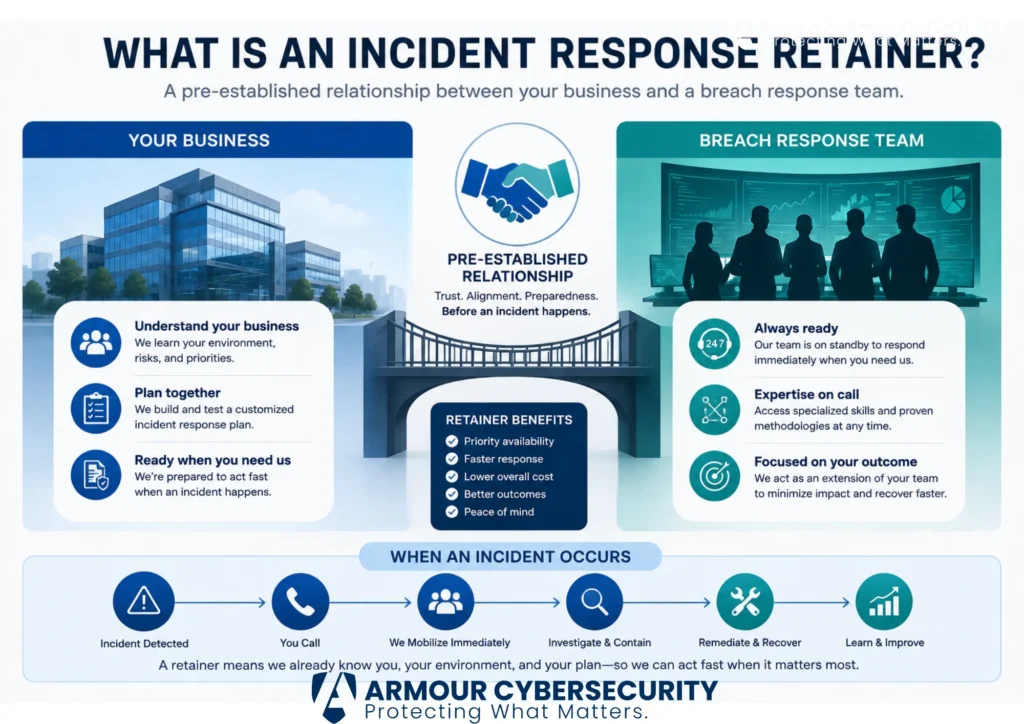
An incident response retainer is a contractual arrangement between an organization and a professional breach response team that establishes a guaranteed response relationship before any incident occurs. Three components define it: a defined response time that activates when the client engages, an onboarding process that builds the response team’s understanding of the environment in advance, and agreed commercial terms for the hours an incident consumes.
It exists to solve a specific problem, which is the time lost to discovery when an emergency team arrives at an organization it has never worked with. Without a retainer, the first hours go to questions that should already have answers. What systems are in the environment? Which are the most critical? Who are the key contacts? What does normal network behaviour look like, and where are the logs? With a retainer, those were answered during onboarding, and the same hours go to containment instead.
The timing argument is not theoretical. Mandiant’s M-Trends 2026 report puts the global median dwell time at 14 days, up from 11 the year before. By the time most organizations detect an intrusion, the attacker has had two weeks. There is no slack left for a procurement exercise. The first two hours of a breach are where a retainer earns its keep.
What Does Retainer Onboarding Cover?
Onboarding produces the baseline context the response team needs to activate effectively, and most of it doubles as documentation the organization should have anyway.
Asset and stakeholder mapping
Armour’s onboarding runs as a two-hour workshop that maps networks, compute, servers, mobile devices, the cloud environment, business applications, and SaaS platforms, and identifies the stakeholders attached to each. That map becomes the triage reference during an incident: which systems are affected, which need protecting first, and which hold the data most likely to be targeted.
Critical system context
Containment decisions turn on knowing which systems can go offline without stopping revenue and which cannot be touched without triggering a business continuity scenario. That is not researchable at 2am during an active intrusion. Capturing it in advance is what lets a response team make an isolation call in minutes rather than escalating it through people who are unreachable.
Contact and escalation protocols
Key internal contacts, their roles, and their decision authority get documented during onboarding, along with the communication channels the response team will use. That includes out-of-band channels that do not depend on a corporate email system that may itself be compromised. This groundwork is what prevents the authority delays that define improvised response.
Customized playbooks and runbooks
For retainer clients, the response team develops playbooks for the incident types most likely to hit the organization, based on industry, technology environment, and threat profile. A ransomware playbook written around your actual backup architecture is more useful under pressure than a generic template, and each engagement refines it further.
How Is Incident Response Retainer Pricing Structured?
Two models dominate, and the difference matters more than most buyers expect.
The traditional block-hour retainer. The organization prepays a block of professional hours at contracted rates and draws them down during an incident, across triage, forensic investigation, containment support, recovery, communications, and post-incident reporting. Block size is scoped to the organization’s size, environment complexity, and likely incident types. The drawback is obvious: the money is committed whether or not anything happens, which is exactly why the retainer line item so often loses to competing security priorities.
The consumption-based retainer. Armour’s Zero Dollar Incident Response Retainer removes the upfront fee entirely. The organization invests in the proactive onboarding workshop, holds a guaranteed 24-hour remote response activation for a twelve-month renewable term, and pays only for the hours an actual incident consumes. The relationship, the context, and the response guarantee are all in place; the financial commitment tracks the actual need.
Set that against emergency engagement without any retainer. Emergency response carries premium pricing, starts with zero context, and produces a first working relationship under the worst possible conditions. The response quality difference shows up as slower containment, higher total incident cost, and weaker claim documentation.
What Does a Retainer Mean for Cyber Insurance?
Most cyber policies require notifying the carrier within a defined period of becoming aware of an incident, and many direct the insured to panel-approved forensic vendors and breach counsel. Engaging an unapproved responder before that notification happens can create a coverage argument at exactly the wrong moment.
A documented retainer relationship helps on both sides of that. It gives the organization a named responder and a defined activation time to point at during underwriting, and it produces engagement evidence that supports the claim afterward. Whether it earns a premium credit or improved terms depends entirely on the carrier and the policy wording, so that question belongs with your broker rather than in a blog post. Cyber insurance advisory work exists to align the retainer, the policy conditions, and the panel requirements before a claim tests them.
Is a Retainer Right for Your Organization?
Four situations make the case strongest.
Regulated organizations with notification obligations, whether under PIPEDA, sector-specific frameworks, or policy conditions, benefit from a guaranteed response time and documented engagement evidence. Canadian organizations in particular have to report a breach to the Privacy Commissioner as soon as feasible once a real risk of significant harm is established, and that assessment depends on forensic work happening early and correctly.
Organizations renewing or applying for cyber coverage benefit from having a named responder to put on the questionnaire rather than an intention to find one.
Organizations that have already been through an incident often establish a retainer as the concrete output of the post-incident review. The prior incident enriches onboarding: the lessons learned feed the playbooks directly, and the recovery requirements are known from experience rather than guessed at.
Mid-market organizations carrying enterprise-level breach risk without an in-house response team get the clearest return. The alternative is paying a premium for slower activation, zero context, and a team learning the environment while the attacker is still inside it. An incident response plan covers the internal half of that problem, and a retainer covers the external half.
The retainer also runs the full incident response lifecycle rather than stopping at containment, which is where cheaper arrangements tend to end.
Frequently Asked Questions
How much does an incident response retainer cost?
It depends on the model. A traditional retainer prices as an upfront block of professional hours at contracted rates, scoped to the organization’s size, environment complexity, and likely incident types, and that money is committed whether or not an incident occurs. A consumption-based retainer such as Armour’s Zero Dollar Incident Response Retainer has no upfront fee at all: the organization invests in the proactive onboarding workshop and pays only for hours actually consumed during an incident. Specific commercial terms are scoped during a discovery call.
How is a retainer different from a managed security service?
A managed security service such as a managed SOC or managed detection and response provides continuous monitoring and operational security on an ongoing basis. A retainer is a breach response capability held in reserve for activation when an incident occurs. The two are complementary: the managed SOC provides the monitoring that detects incidents, and the retainer provides the specialized response capability that handles them once confirmed. Some organizations run both, and others use a retainer alongside internal IT security.
Can we set up a retainer after experiencing a breach?
Yes, and it is one of the more common triggers. Many organizations establish a retainer as part of the post-incident improvement program. The prior incident accelerates onboarding, since the lessons learned apply directly to playbook development and the organization’s specific vulnerabilities and recovery requirements are already known from direct experience rather than inferred.
Does having a retainer affect our cyber insurance terms?
It can, though the effect varies by carrier. Most policies require carrier notification within a defined window and many specify panel-approved forensic vendors, so a documented retainer relationship with a confirmed activation time gives the organization something concrete to point at during underwriting and produces engagement evidence that supports a claim. Whether that translates into a premium credit or improved terms depends on the carrier and the policy wording, which is a question for your broker.
What if we have an active incident right now and no retainer in place?
Emergency activation is available for organizations under active attack without a retainer, with response time depending on team availability at the moment of engagement. Contact Armour Cybersecurity directly and state that the incident is active, since active incidents are escalated immediately rather than queued behind standard discovery calls. Without a retainer the team begins without onboarded context, but the response lifecycle and the professional capability are the same.
The Bottom Line
The honest test for a retainer is not whether a breach is likely. It is what the first two hours would look like today if one happened, and whether the answer involves anyone searching for a phone number. Organizations that can name their responder, their breach counsel, and their carrier contact without opening a browser have already bought most of what a retainer sells. Everyone else is holding the risk without a plan for it. Armour’s breach response services run on both models, retainer and emergency activation, and the difference between them shows up long before anyone opens an invoice.
About the author
David Chernitzky brings over 25 years of deep cybersecurity and military cyber intelligence experience, with a career rooted in strategic risk management and protecting critical systems against advanced threats. As the driving force behind Armour Cybersecurity, he has guided the company’s growth into a trusted global security partner for enterprises and small-to-midsized organizations.