By David Chernitzky, CEO and Co-Founder, Armour Cybersecurity · Serving Toronto and organizations across Canada · Last updated August 10, 2026
Quick answer:
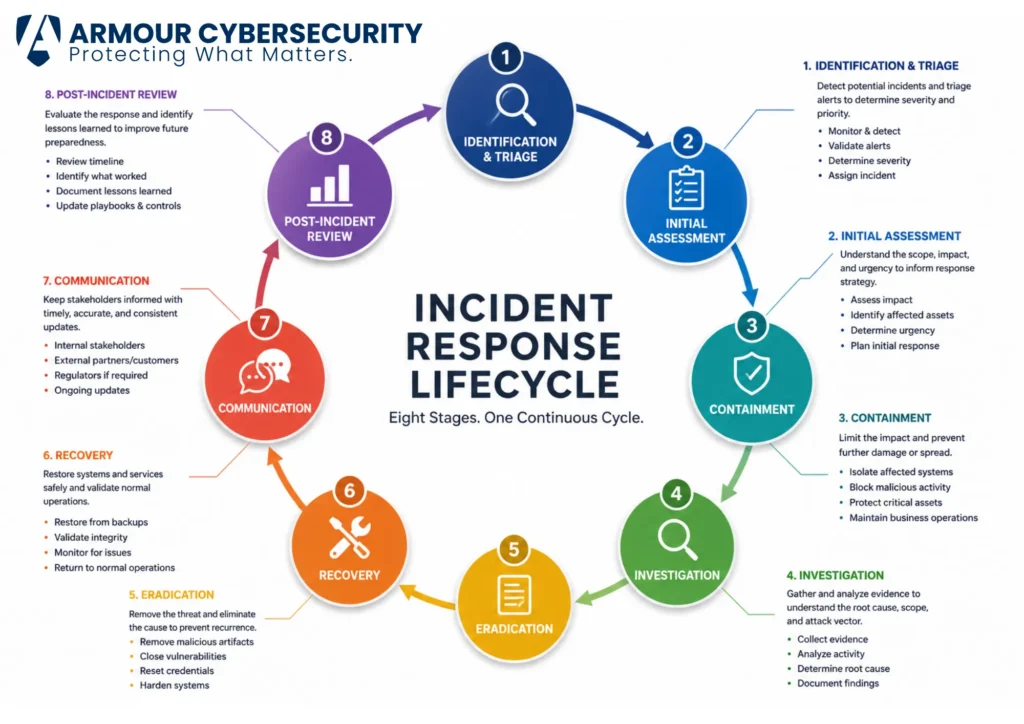
The incident response lifecycle is the ordered sequence a breach response team works through after a security incident is confirmed: identification and triage, short-term containment, long-term containment, investigation and root cause, eradication, recovery, communications coordination, and post-incident documentation and review. Each stage creates the conditions the next one needs. Knowing the sequence tells a business owner what to expect, which decisions land on their desk, and why the first two hours shape the last two weeks.
Key Takeaways
- Breach response is a sequence, not a single event. Each stage creates the conditions for the next, and skipping one degrades everything that follows.
- The first two hours, identification and short-term containment, have a disproportionate effect on total recovery time and on how much of the business stops.
- Investigation and eradication have to finish before recovery starts. Organizations that skip investigation to restore faster often find the attacker still there afterward.
- Documentation captured live during the response, rather than reconstructed later, is what holds up for legal, regulatory, and insurance reporting.
- Under PIPEDA, Canadian organizations must record every breach of security safeguards for at least 24 months, whether or not it gets reported to the Privacy Commissioner.
What Is the Incident Response Lifecycle?
The incident response lifecycle is the structured order of operations a response team follows from the first confirmed alert to the closing report. It exists because incidents are chaotic and human judgment under pressure is not reliable. A defined sequence removes the improvisation.
The framework landscape shifted recently. In April 2025, NIST withdrew SP 800-61 Revision 2, the guide that gave the industry its familiar four-phase model of preparation, detection and analysis, containment/eradication/recovery, and post-incident activity. Its replacement, SP 800-61 Revision 3, reorganizes incident response around the six Functions of the Cybersecurity Framework 2.0 and treats improvement as continuous rather than something that happens once at the end. A good deal of the incident response content still circulating online describes a document NIST has formally retired.
Armour’s eight-stage lifecycle expands the same underlying logic into the discrete decision points an organization actually experiences during an engagement. It sits inside a broader set of incident response services that covers readiness before an event and forensics during one.
Why the Sequence Matters More Than Speed
Breach response gets described as urgent, and it is. But urgency without sequence extends the crisis instead of ending it.
Skip investigation to restore from backup faster, and the attacker frequently persists through the restoration. Start external communications before triage is finished, and the statement gets corrected in public a week later. Eradicate malware before forensic evidence is captured, and the documentation an insurance claim depends on is gone.
That is the argument for a breach readiness assessment before anything happens. A team that has run this sequence before recognizes when conditions are ready to move forward, when they are not, and when the incident calls for a variation.
Stage One: Identification and Triage
Response begins with confirmation. An alert, an employee report, a third-party notification, or an anomaly in monitoring triggers the engagement, and the first job is verifying that an incident actually occurred, then characterizing its nature and severity well enough to allocate the right people.
Triage reviews alerts, system logs, network traffic, and indicators of compromise against four questions. What type of incident is this? Which systems are affected? Is the attack ongoing or finished? How far could the impact reach? The answers set the urgency and the shape of the team. A ransomware event still propagating demands different immediate priorities than a credential exposure spotted in a threat intelligence feed.
Retainer clients start further along. The response team already holds the asset inventory, the network architecture, the critical system documentation, and the contact tree, all established during onboarding. Triage compresses accordingly. An emergency engagement builds that context from scratch while the incident keeps moving.
Stage Two: Short-Term Containment
Short-term containment stops the bleeding. The objective is limiting spread while investigation continues, and the specific actions follow the incident type: isolating affected endpoints from the network, blocking malicious addresses and domains at the perimeter, disabling compromised user and service accounts, cutting the connections the attacker is actively using.
There is a real tension here. Isolate too aggressively and the business stops. Isolate too little and the attacker keeps moving laterally, keeps exfiltrating, keeps preparing whatever comes last. The team weighs triage findings against the business context of each affected system.
Evidence preservation runs alongside all of it. Systems about to be isolated or powered down need to be captured first, because containment actions destroy the very artifacts an investigation depends on. Memory captures, log exports, and network traffic snapshots document the state of the environment before it changes. Technical forensics work sequenced this way is a practiced discipline. It is also the clearest difference between professional response and an internal team working it out for the first time at 2am.
Stage Three: Long-Term Containment
Long-term containment applies sustainable controls so the business can operate while investigation and eradication proceed. Network segmentation restricts lateral movement. Enhanced monitoring provides visibility into whatever was not fully contained. Compensating controls cover vulnerabilities that cannot be patched immediately without breaking something.
This is the phase where the organization functions at reduced but real capacity. The response team and internal IT coordinate closely, checking that containment measures have not introduced new problems and that monitoring will catch any attempt by the attacker to re-establish access.
Stages Four Through Six: Investigation, Eradication, and Recovery
Investigation runs in parallel with containment and continues until the root cause is understood, the attack vector is identified, the full scope of compromise is established, and the attacker’s tooling is documented. Everything downstream rests on it. Eradication cannot be confident without it, recovery cannot be trusted without it, and nobody can make a defensible regulatory notification decision without it.
Eradication then removes every artifact of the attacker’s presence. Malicious software, persistence mechanisms, unauthorized accounts, altered configurations, backdoors planted along the way. This has to be thorough before recovery starts. Organizations that rush from containment straight to restoration tend to rediscover the attacker afterward.
Recovery restores systems and services with integrity verification at each step. Restored systems are not simply switched back on. They are watched closely for signs of lingering compromise before rejoining production, and post-recovery monitoring stays heightened for a defined period after restoration finishes.
Stages Seven and Eight: Communications, Documentation, and Review
Communications coordination runs throughout the response rather than arriving at the end. Internal stakeholders need situational awareness that keeps them current without compromising the investigation. External communications to customers, partners, and regulators follow a defined process coordinated with breach coach services, which keeps the technical response and the legal position aligned instead of contradicting each other.
Documentation captured live produces the incident timeline, the action logs, and the decision records that support legal proceedings, regulatory notification, and insurance claims. Reconstructed afterward, that same documentation is thinner, less accurate, and considerably less credible when someone starts asking who decided what and when. Professional teams document as they go and treat it as a concurrent deliverable, which is also what a carrier expects to see during cyber insurance advisory review and at claim time.
The post-incident review closes the loop. Conducted with internal stakeholders once operations are restored, it turns lessons learned into specific updates to response plans, security policies, and detection capability. Cyber simulation exercises are how organizations confirm those updates actually work before the next event tests them.
What Canadian Organizations Have to Report, and When
The lifecycle carries legal obligations in Canada that a purely technical playbook will miss.
Under PIPEDA, an organization must report a breach of security safeguards to the Office of the Privacy Commissioner of Canada as soon as feasible when it is reasonable to believe the breach creates a real risk of significant harm to an individual. Affected individuals must be notified, along with any other organization that could reduce or mitigate the harm.
The record-keeping rule catches more businesses off guard. Every breach of security safeguards has to be recorded and kept for a minimum of 24 months, whether or not it met the reporting threshold, and the Privacy Commissioner can ask to see those records. That single requirement is why documentation belongs in the response lifecycle rather than in a report written afterward. Organizations building this capability from scratch should start with an incident response plan that names who makes the determination and where the record lives.
Provincial regimes add their own timelines. Quebec’s Law 25 sets a longer retention expectation for breach records, and organizations operating across provinces should confirm which rules apply before an incident rather than during one.
What Does a Breach Response Team Do in the First Hour?
The first hour sets the ceiling on everything that follows, and most of it happens before the external team is fully engaged. Preserve evidence, which means no rebooting compromised systems, no deleting logs, and no remediation that destroys forensic artifacts. Notify the cyber insurance carrier through the procedure the policy specifies, since carriers routinely require panel responders and prior authorization, and engage breach counsel if that relationship exists.
Then write down the timeline: when the incident was first detected, what triggered detection, and what has been done since. Handing that over accelerates triage and preserves the forensic baseline the investigation needs.
Frequently Asked Questions
What are the eight stages of the incident response process?
Identification and triage, short-term containment, long-term containment, investigation and root cause analysis, eradication, recovery, communications coordination, and post-incident documentation and review. The stages run in that order because each one produces something the next one requires. Investigation, for example, determines what eradication has to remove, and eradication has to finish before recovery can be trusted.
How fast can a breach response team activate?
Retainer clients receive a 24-hour remote response activation, with the assigned response lead, communication channel, and initial action plan confirmed within that window. The retainer model compresses activation because onboarding is already complete, so the team starts with context instead of building it during the incident. Emergency activation for non-retainer organizations under active attack is available, with response time depending on team availability at the moment of engagement.
What is the difference between containment and eradication?
Containment stops the spread and limits impact while the investigation continues, and it may deliberately leave the attacker’s tools in place in order to observe and gather evidence. Eradication removes all traces of the attacker from the environment: malware, persistence mechanisms, unauthorized accounts, and modified configurations. Eradication comes after investigation because removing everything requires first knowing what everything is.
Can breach response be conducted remotely?
Yes. Most breach response activity can be conducted effectively through remote forensic tooling and secure remote access, and this is the default model for most engagements. Remote response activates faster than on-site deployment and suits the majority of incidents affecting IT and cloud environments. On-site response is mobilized on a best-effort basis for retainer clients where physical presence is required, such as sensitive OT or ICS environments, specific evidence handling requirements, or executive coordination, with travel expenses covered by the client.
What documentation does the response produce for our insurance claim?
The response produces an incident triage and classification report, a containment plan and execution log, investigation reports documenting attack vector, scope, and attacker tactics, a recovery and hardening summary, and a comprehensive post-incident report covering the full timeline, actions taken, and decisions made. This package is structured to support insurance claim evidence requirements and is captured live during the response rather than reconstructed afterward, which makes it more complete and more credible at claim time.
What should we do before the response team arrives?
Preserve evidence: do not reboot compromised systems, do not delete logs, and do not take remediation actions that could destroy forensic artifacts. Notify the cyber insurance carrier using the engagement procedure specified in the policy. Engage breach counsel if the relationship is established. Document the timeline of what has been observed, including when the incident was first detected, what indicators triggered detection, and what actions have been taken so far.
The Bottom Line
The incident response lifecycle is not bureaucracy. It is the order that experienced responders learned produces better outcomes across every incident type, and the organizations that come through a breach well are almost always the ones that had the sequence, the team, and the context settled before the alert fired. Armour Cybersecurity delivers the full lifecycle from the first activation call through the final post-incident report, on retainer or through emergency engagement. To scope either model, see breach response services.
About the author
David Chernitzky brings over 25 years of deep cybersecurity and military cyber intelligence experience, with a career rooted in strategic risk management and protecting critical systems against advanced threats. As the driving force behind Armour Cybersecurity, he has guided the company’s growth into a trusted global security partner for enterprises and small-to-midsized organizations.