By David Chernitzky, CEO, Armour Cybersecurity · Serving organizations across North America · Last updated August 11, 2026
| Quick Answer A serious cyber breach confronts a CEO with decisions that carry material legal, financial, and reputational consequences, often made under time pressure, with incomplete information, and for the first time. The executives who navigate these events most effectively are not necessarily the ones with the most technical knowledge. They are the ones who have an experienced advisor in the room: someone who has been through this before, who can sequence decisions correctly, and who can hold the leadership team to a coherent strategy when the pressure to act in every direction at once is overwhelming. |
Key Takeaways
- Most CEOs will face a serious cyber incident at some point. Very few have experienced one before it happens to their organization.
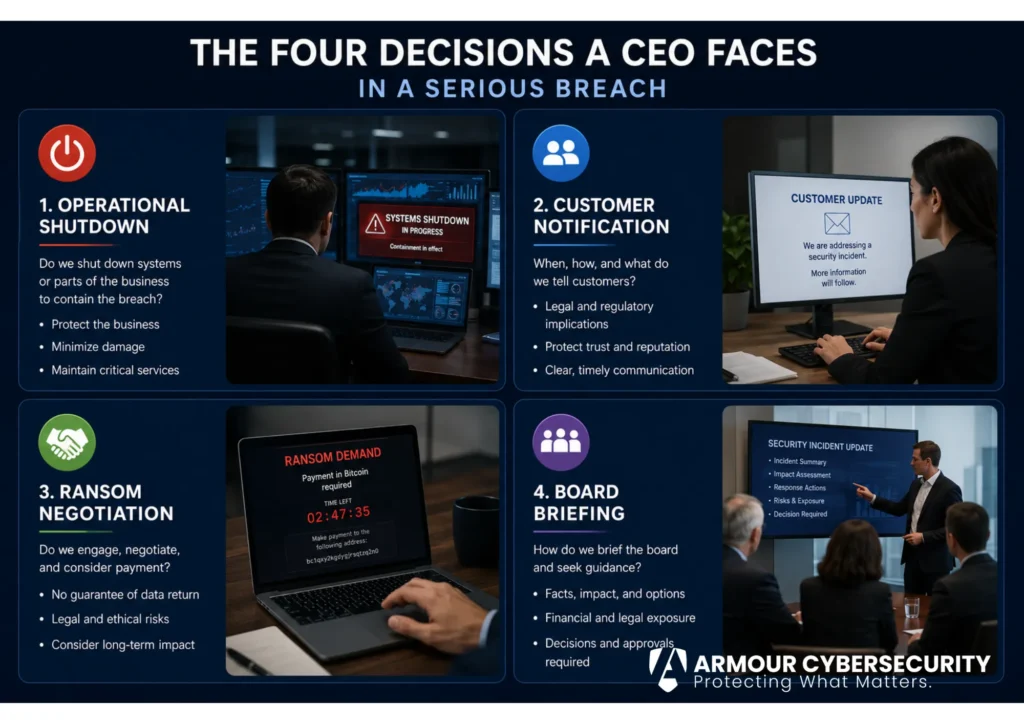
- The decisions a CEO must make during a breach are business decisions, not technical ones: operational shutdown, customer notification, board briefing, ransom consideration, and regulatory disclosure.
- First-time crisis management under pressure produces predictable failure patterns: premature statements, delayed decisions, and uncoordinated messaging that compounds the original incident.
- An experienced breach coach gives the executive a trusted advisor who has seen these decision points before, can sequence them correctly, and can translate the complexity of the incident into clear strategic guidance.
- The cost of poor executive decision-making during a serious breach, in legal exposure, reputational damage, and extended recovery, consistently exceeds the cost of the breach coach engagement.
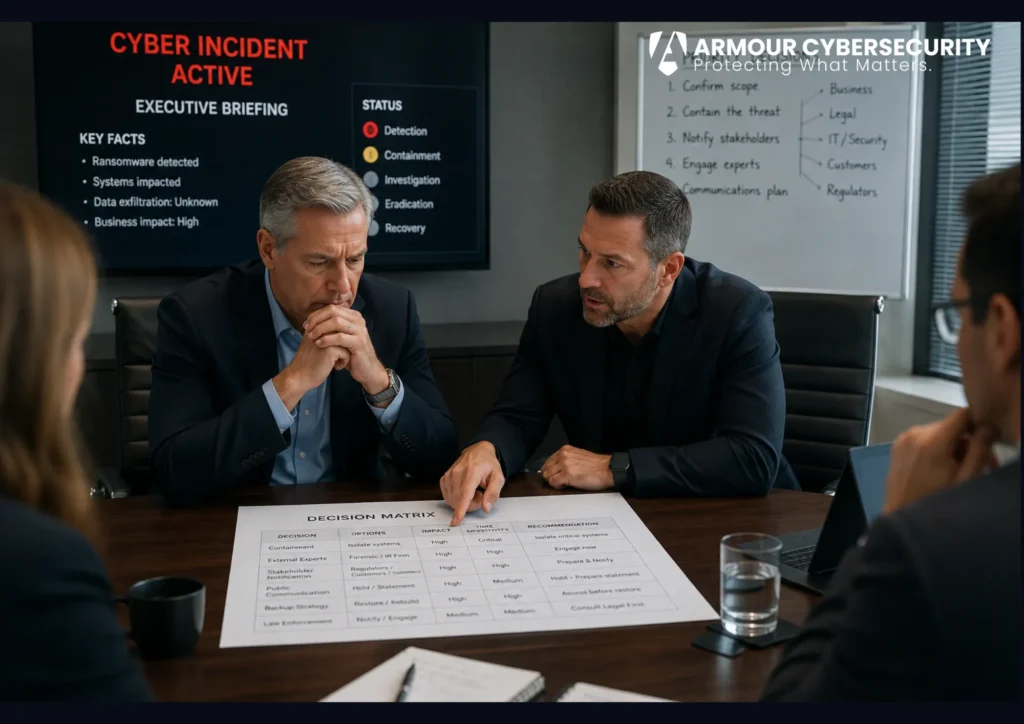
CEO cyber breach response advisory addresses the part of an incident the org chart does not: the decisions only the chief executive can make. When a serious breach hits, the incident response team can contain and investigate, but no one else can decide whether to take the business offline, when to tell customers, whether to consider a ransom payment, or what to tell the board. Most CEOs make those calls for the first time, under pressure, with the facts still coming in. That is precisely where an experienced advisor changes the outcome.
| By the NumbersThe costliest decisions are the CEO’s, not IT’s. The global average breach cost $4.44M ($10.22M in the US); whether to disrupt operations, when to notify, and whether to pay move that number more than any technical control once the incident is live. Source: IBM Cost of a Data Breach Report 2025.Speed is an executive lever. IBM 2025 finds faster containment lowers cost, and containment often waits on a leadership decision to accept operational disruption.Some calls carry their own legal exposure. Paying a sanctioned threat actor can itself violate sanctions under US Treasury (OFAC) guidance, a CEO-level legal risk, not an IT one. |
What Decisions Does a CEO Actually Face During a Serious Breach?
The assumption that cyber incidents are primarily technical problems handled by IT and security is common and largely incorrect. The technical response is one workstream in what becomes, for serious incidents, a multi-front management challenge with consequences at every level of the organization. The CEO or business owner is the decision-maker for the choices that cannot be delegated.
Whether to accept operational disruption to contain the attack
Containing a spreading ransomware attack or cutting off an attacker’s access often requires taking business-critical systems offline. That is not a decision the IT team can make unilaterally. It is a business decision with immediate financial consequences: lost transactions, disrupted customer service, and potential contractual exposure. The CEO has to weigh the cost of disruption against the cost of continued attacker access, on incomplete information, quickly. The right answer depends on the specific systems, the attacker’s activity, and the business context.
Whether and when to notify customers
Customer notification involves legal obligations, reputational judgment, and the state of the investigation at the same time. Regulatory frameworks may impose mandatory timelines running from the moment of detection. Notifying too early, before the scope is confirmed, risks statements that need correcting. Notifying too late, after customers learn of the breach elsewhere, creates the appearance of concealment. A CEO who has never made this call is navigating trade-offs with no obvious correct answer without experience and legal guidance.
Whether to engage a ransom negotiator
When ransomware has encrypted critical systems and backup recovery is not viable on the required timeline, the ransom-negotiator question lands on the CEO’s desk. It has legal dimensions (certain threat actors are sanctioned, making payment a potential violation), cyber insurance dimensions (coverage conditions may apply), strategic dimensions (whether paying actually yields usable decryption), and reputational dimensions (public knowledge of payment can invite repeat attacks). Most CEOs have never worked through this framework before it arrives under active pressure.
How to brief the board
The board needs to understand what happened, what the organization is doing, and what the strategic and legal implications are. The CEO briefing the board during an active incident is translating a fast-moving technical and legal situation into governance language, under time pressure, while the board asks questions the CEO cannot yet fully answer. Getting it right, enough information to satisfy oversight without overstating certainty or creating legal exposure, is a skill experienced advisors bring to the preparation.
What Failure Looks Like Without Strategic Advisory
The pattern of executive decision-making failure during cyber incidents is well documented across publicly reported cases and in the experience of incident response professionals. The failures are usually not failures of intelligence or integrity. They are failures of first-time crisis management under conditions designed to produce poor decisions.
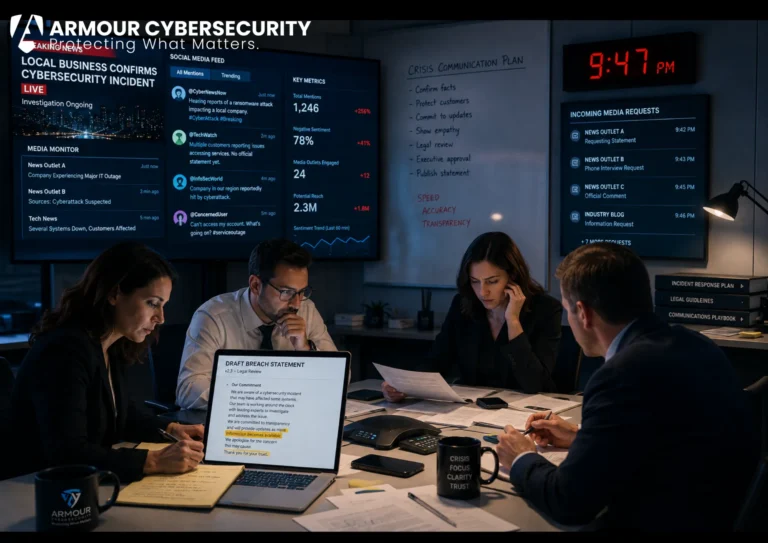
Premature public statements are among the most common. The pressure to demonstrate control in the first hours produces statements that characterize the incident as limited or contained before the investigation has confirmed scope. When the scope turns out larger, the correction amplifies the story and raises questions about whether the original statement was deliberate. Experienced advisors know to say less earlier and more accurately later, and can hold the communications workstream to that discipline even when the pressure to say something specific is intense.
Across the 260+ organizations Armour serves in 52+ industries, the CEOs who come through a serious breach with the fewest regrets are almost never the most technical ones. They are the ones who did not make the first-hour calls alone, who had someone at the table who had already lived through the exact decision they were staring at for the first time. Delayed decisions are the mirror image of premature ones and just as common: a CEO unsure who has authority to authorize a major containment action, or who wants to wait until all the facts are in before the ransom decision, can let a situation worsen while the process drags. An advisor who has seen this sequence before helps the CEO separate the decisions that must be made on today’s information from the ones that can safely wait for more certainty.
What a Breach Coach Provides to Executive Leadership
The breach coach function is specifically designed to address the executive challenge in a serious incident. The coach sits with leadership throughout the response, not as a workstream lead but as the trusted advisor who synthesizes the complexity into clear guidance.
The daily situational briefings the coach provides translate technical findings, legal analysis, and carrier engagement into a coherent status picture and a clear set of pending decisions with options analysis for each. The CEO who receives this briefing knows what has happened since the last update, what decisions need to be made in the next twelve hours, what the options are for each, and what the coach recommends based on experience with similar situations.
The coach also manages the relationships between workstreams on the CEO’s behalf. When the technical team and legal counsel disagree on the sequence of containment actions, the coach facilitates resolution. When communications wants to release a statement counsel has not reviewed, the coach holds the process to the right sequence. When the carrier asks for documentation the forensic team has not yet assembled, the coach coordinates the response. That intermediary function takes the coordination overhead off the CEO’s plate so it does not compete with strategic decision-making during an already demanding period. Armour’s breach coach service is available on retainer for pre-established engagement and on emergency activation when an incident is already in progress.
Where This Fits in Armour’s Managed Services
Executive breach advisory is one pillar of Armour’s managed cybersecurity services, alongside the deeper explainer on what a breach coach is, the tabletop exercises that rehearse these decisions before an incident, and the vCISO leadership that keeps the security program strong between incidents. The coach is the person who makes sure the executive is never deciding alone.
The Bottom Line
A breach does not test a CEO’s technical knowledge; it tests their decision-making under pressure, on choices they have never faced, with consequences on every side. The executives who come through best are the ones who did not face it alone. If a serious incident would put you in that chair for the first time, Armour’s breach coach service puts an experienced advisor beside you, on retainer before an incident or on emergency activation during one.
Frequently Asked Questions
What is CEO cyber breach response advisory?
CEO cyber breach response advisory is senior, experienced guidance for the executive making the non-technical decisions in a serious cyber incident: whether to take systems offline, when to notify customers, whether to engage a ransom negotiator, and how to brief the board. It is delivered by a breach coach who sits with leadership through the response, synthesizes the technical, legal, insurance, and communications workstreams into a clear picture, sequences the decisions, and recommends a path based on having been through similar incidents before. The point is not to replace the CEO’s judgment but to make sure the CEO is not exercising it alone and for the first time under pressure.
At what point in an incident should the CEO call the breach coach?
As early as possible. The breach coach provides the most value when engaged at the beginning of the response, before major decisions have been made and before workstreams have started operating independently. The first-hour engagement typically involves rapid context-building, an assessment of the strategic decisions that need to be made in the next 24 hours, and establishment of the coordination cadence across workstreams. Engaging the coach after the early decisions have already been made limits the ability to prevent errors that are already in motion.
What if we already have a general counsel who can advise during a breach?
General counsel is an essential part of the response team, and the breach coach and general counsel serve complementary functions. Counsel provides legal advice, manages privilege, and leads the regulatory and legal dimensions of the response. The coach provides strategic coordination across all workstreams, executive advisory on the business decisions, and translation between the technical and legal workstreams. Where general counsel has deep cyber incident experience, the coach’s role weights more toward technical-legal translation and coordination. In most small and mid-market businesses, the breach coach brings incident experience general counsel may not have.
How does the breach coach help with board communications specifically?
Board briefings during a serious incident need to provide governance oversight information without inadvertently creating legal exposure or conveying more certainty than the investigation supports. The coach prepares briefing materials in governance language, coordinates the content with breach counsel so it reflects the current legal position accurately, and advises the CEO on which information is appropriate for the board at each stage of the investigation. For boards that have previously received cyber risk briefings or completed tabletop exercises, the coach connects the incident narrative to the governance context the board already understands.
Can a breach coach help if the CEO made early decisions that now look problematic?
Yes. Emergency engagement mid-incident is one of the most common scenarios for breach coach activation. The coach who arrives after some decisions have been made focuses first on understanding the current position, then on identifying which decisions can be course-corrected, which need to be managed as they stand, and what the path forward looks like from here. An early statement that overstated certainty cannot be withdrawn, but the approach to subsequent communications can be adjusted. An early containment decision that was suboptimal cannot be undone, but the investigation and eradication strategy can be adapted. The coach works from the current position, not the theoretical ideal.
What industries most commonly need a breach coach?
Any organization whose incident will involve regulatory notification, customer communication, insurance claims, and board-level governance scrutiny benefits from breach coach advisory. In practice the highest engagement is in finance, healthcare, legal, professional services, and technology, all sectors where incidents carry high regulatory scrutiny, significant client-relationship implications, and material reputational exposure. Mid-market organizations in these sectors without large internal legal and communications teams find the role particularly valuable, because it supplies expertise that would otherwise require engaging multiple separate specialists with no one coordinating them.
About the Author
David Chernitzky is the CEO and Co-Founder of Armour Cybersecurity, a Toronto-based firm that protects organizations across North America from advanced cyber threats. He brings more than 25 years of cybersecurity and military cyber intelligence experience, having served as an officer in an elite technology unit before co-founding Armour. Armour’s team of military-intelligence veterans and senior advisors serves 260+ clients across 52+ industries with a 97% client retention rate.