By David Chernitzky, CEO, Armour Cybersecurity · Serving organizations across North America · Last updated August 11, 2026
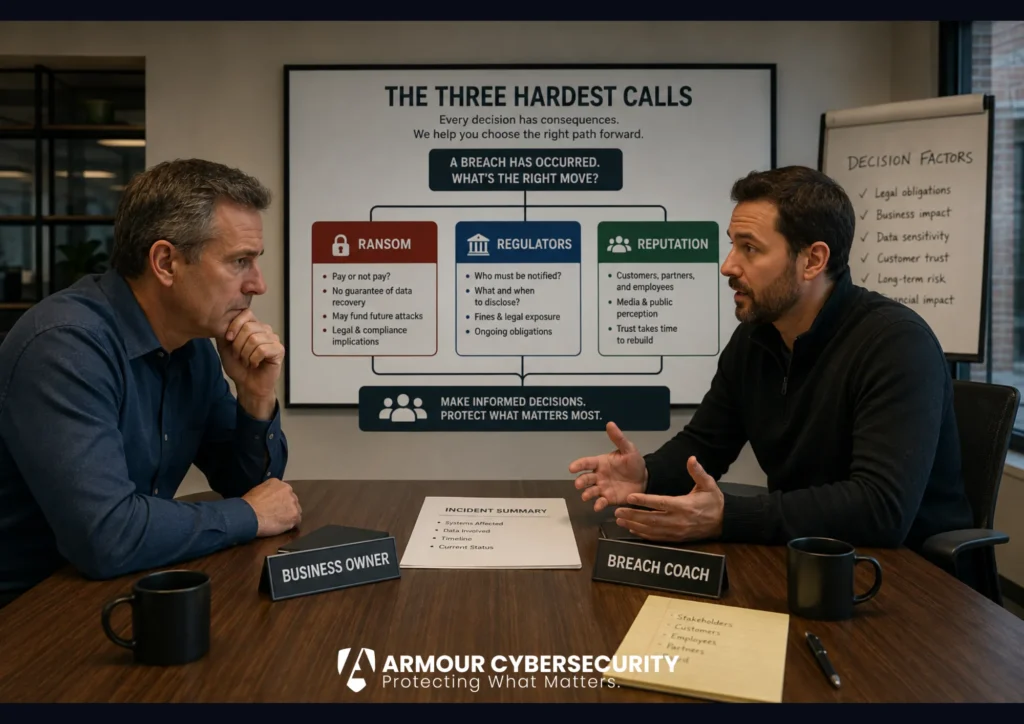
| Quick Answer Three decisions in a serious cyber breach have consequences that extend far beyond the incident itself: whether to engage in ransom negotiation, how to handle regulatory notification, and how to protect the organization’s reputation. Each involves trade-offs between legal obligations, business priorities, and strategic judgment that most organizations are making for the first time under pressure. Experienced breach coach advisory changes these outcomes by bringing a framework that has been worked through before. |
Key Takeaways
- The ransom decision is not just financial. It involves legal analysis of sanctions risk, insurance coverage conditions, strategic assessment of recovery alternatives, and a judgment about whether the attacker will actually deliver working decryption keys.
- Regulatory notification obligations are triggered by specific legal tests, not by a general sense that a breach occurred. Getting the timing and content wrong creates regulatory exposure on top of the incident costs.
- Reputation in a breach is determined largely by the communication decisions made in the first 48 hours. These decisions cannot be reversed; they can only be built on or managed around.
- All three decisions are interconnected. The ransom decision affects the forensic scope, which affects the notification assessment. The notification strategy shapes the communications approach, which shapes the reputational trajectory.
- A breach coach who has navigated these decisions before provides the framework and experienced perspective that prevents the most common decision failures.
Cyber breach decision-making for business owners comes down to three calls that outlast the incident itself: ransom, regulators, and reputation. The technical team can contain and investigate, but the owner is the one who decides whether to consider a payment, how and when to notify, and what the organization says to the world. Each trades off legal obligation, business priority, and strategic judgment, and most owners make all three for the first time, under pressure, at once. A breach coach brings a framework that has already been through them.
| By the NumbersThe decisions cost more than the attack. The global average breach cost $4.44M ($10.22M in the US); the ransom, notification, and reputation calls move that total more than the initial attack vector. Source: IBM Cost of a Data Breach Report 2025.Ransom is a legal decision before a financial one. Paying a sanctioned threat actor can itself violate sanctions law (US Treasury OFAC guidance; Canada maintains its own regimes), so the payment question has to clear legal review first.Reputation tracks response quality, not incident severity. What decides the reputational outcome is how well the organization responds and communicates, not how bad the breach was. |
Decision One: Ransom
The ransom decision is the most commercially significant choice in a ransomware incident and one of the most misunderstood. It is frequently framed as a binary, pay or do not pay. The reality is a structured decision process with several inputs that need to be assembled before the decision can be made well.
The recovery alternative assessment
The first input is whether viable recovery alternatives exist. If backups are intact, current, and isolated from the ransomware, recovery from backup is generally preferable to payment on both cost and risk grounds. If backups are incomplete, outdated, or compromised, the recovery timeline and cost may exceed the ransom demand. Backup viability is a technical determination that needs to be completed before the ransom decision, not after a payment deadline forces a decision without full information.
Legal and sanctions analysis
Ransomware attacks are increasingly attributed to threat actors subject to sanctions under Canadian and US law. Making a payment to a sanctioned entity can create legal liability for the organization and its officers regardless of the circumstances that led to it. Breach counsel needs to assess the available intelligence on the threat actor’s identity before the payment decision is made, and the decision should not be finalized without that analysis. This step cannot be skipped under time pressure, because the legal exposure from a payment to a sanctioned actor is potentially more damaging than the ransomware event itself.
Insurance coverage conditions
Cyber insurance policies that cover ransom payments typically impose conditions: prior notification and approval from the carrier, use of carrier-approved negotiators, documentation of the negotiation, and confirmation that the payment complies with law. A payment made without following these conditions may not be covered. The breach coach coordinates the cyber insurance carrier engagement that is a precondition for a covered payment, so the process is followed in a way that supports the claim.
Negotiation and delivery assessment
Even when the other factors favor payment, whether the attacker will actually deliver working decryption keys is a judgment informed by threat intelligence. Not all ransomware operators deliver: some take the payment and provide keys that do not work, some take the payment and publish the exfiltrated data anyway. A ransom negotiator with experience in the specific threat actor group can assess these probabilities and advise on strategy. The breach coach coordinates the negotiator’s engagement and ensures the negotiation outputs stay aligned with the legal and carrier workstreams.
Decision Two: Regulators
Regulatory notification decisions are legal decisions with operational and reputational dimensions. The legal analysis is breach counsel’s domain; the coach’s role is to make sure the decision is made with the right inputs, at the right time, in coordination with the other workstreams. Getting it right is the difference between a compliant notification and one that has to be amended.
Understanding what triggers notification
Under PIPEDA, the notification obligation is triggered when a breach of security safeguards involving personal information creates a real risk of significant harm to an individual. That is a legal test applied to specific facts: what personal information was accessed, by whom, under what circumstances, and what harm could result. Applying it requires confirmed forensic findings about the scope. The coach coordinates the timing of the notification decision with the investigation, so the legal analysis is applied to confirmed facts rather than preliminary estimates.
Timing and the running clock
Notification obligations run from the point of becoming aware of the breach, not from the point the investigation is complete. PIPEDA requires reporting to the Privacy Commissioner and notifying individuals as soon as feasible once a real risk of significant harm is identified. Quebec’s Law 25 requires notification to the Commission d’access a l’information and affected individuals with diligence, meaning promptly, once the organization determines a confidentiality incident presents a risk of serious injury; unlike the European GDPR, which sets a fixed 72-hour clock, Law 25 does not impose a specific statutory number of hours, though some organizations adopt 72 hours as an internal benchmark. Missing a mandatory deadline creates regulatory exposure separate from and on top of the incident costs, so the coach tracks notification timelines from the first hour and escalates the decision as they approach.
The content of the notification
What is said in a regulatory notification matters. Notifications that overstate certainty about scope before the investigation is complete require amendments; ones that understate scope may be viewed by regulators as incomplete or misleading. The language used to characterize what happened, the safeguards in place, and the steps being taken all carry legal weight. Breach counsel leads the drafting; the coach ensures the technical facts described are consistent with the forensic findings and that the response narrative is coherent across the regulatory and public communications.
Decision Three: Reputation
Reputation management in a cyber breach is not primarily a marketing or PR challenge. It is a consequence of every decision made during the response. The organizations that emerge with their reputations intact are not usually the ones with the best PR strategy. They are the ones that made the substantive response decisions well and communicated them clearly, accurately, and in a sequence stakeholders found credible.
Across the 260+ organizations Armour serves in 52+ industries, the ones whose reputation survives a serious breach are almost never the ones with the best PR. They are the ones who got the three hard decisions right: they paid or did not pay for defensible reasons, they notified on confirmed facts rather than a guess, and they told the truth quickly. Good communication followed good decisions rather than trying to substitute for them, which is the substitution that fails most often.
The 48-hour window
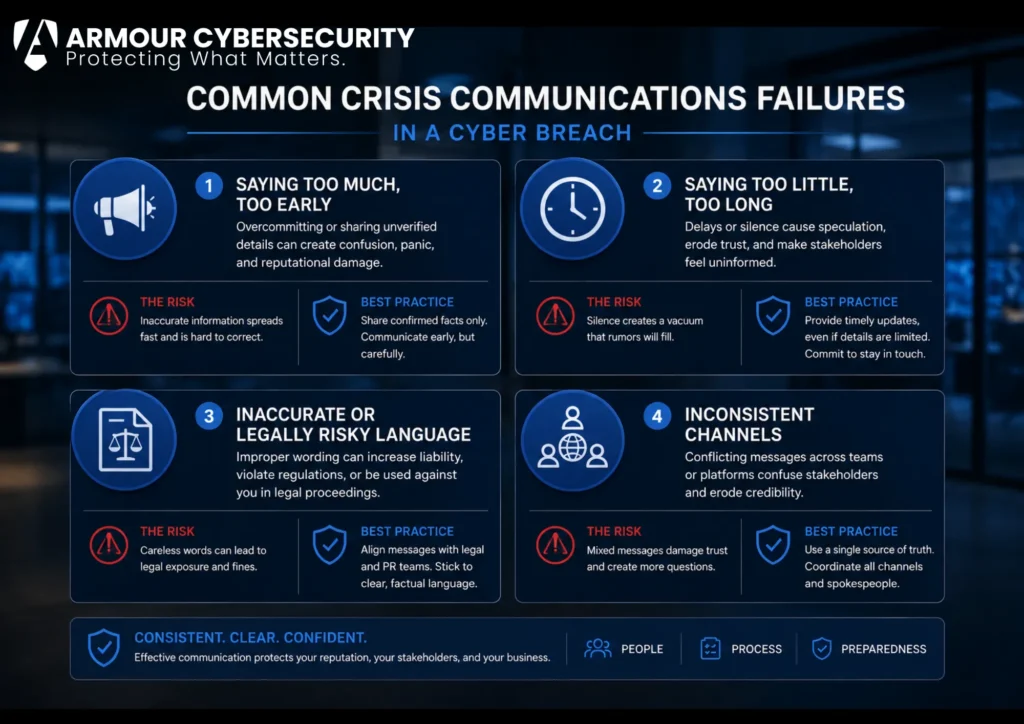
The most consequential communications decisions in a breach happen in the first 48 hours. What is said, when, to whom, and by whom in this window establishes the narrative framework all subsequent communications are judged against. A premature statement that overstates certainty, an employee message that leaks before customer notification, or a media inquiry handled inconsistently with the regulatory notification all become part of the story stakeholders tell about how the organization handled the incident. These early decisions are not reversible; they can only be built on or managed around.
The accuracy-speed tension
Every communications decision in the first 48 hours trades speed, the desire to say something quickly to control the narrative, against accuracy, the requirement to say only what can be confirmed. The organizations that handle it best acknowledge the incident quickly and in general terms without overstating what is known, provide updates as facts are confirmed rather than one comprehensive statement, and communicate the actions being taken rather than conclusions about cause and scope that may need revising.
The breach coach manages this tension by reviewing all communications before release, coordinating with breach counsel for legal accuracy, and holding the process to a discipline that prevents the most common errors. The coach does not write the communications; the coach ensures they are technically accurate, legally sound, and strategically consistent with the narrative the organization is building. Armour’s breach coach service is built for exactly these three decisions.
Where This Fits in Armour’s Managed Services
These three decisions sit at the center of Armour’s managed cybersecurity services, alongside the rest of the breach coach series: what a breach coach is, why a CEO should not face a breach alone, and how the coach keeps the workstreams aligned. Together they describe the role; this piece describes the decisions the role exists to get right.
The Bottom Line
A serious breach is decided less by the attack than by three calls the business owner has to make while it is still unfolding: whether to pay, when and how to notify, and what to say. Made well, they contain the damage; made alone and for the first time, they compound it. Armour’s breach coach service puts an experienced framework behind all three, on retainer before an incident or on emergency activation during one.
Frequently Asked Questions
What are the hardest cyber breach decisions for business owners?
The three hardest are the ransom decision, the regulatory notification decision, and the reputation decision, and they are hard because each is made once, under time pressure, usually for the first time, and each has consequences that outlast the incident. The ransom decision is a structured legal, insurance, and strategic assessment, not a simple pay-or-not. The notification decision turns on a legal test applied to confirmed forensic scope, on a running clock. The reputation decision is set largely in the first 48 hours of communication and cannot be taken back. They are also interconnected, so getting one wrong tends to worsen the others. A breach coach supplies the framework and the experience that turns first-time judgment calls into structured decisions.
What is a ransom negotiator and when should one be engaged?
A ransom negotiator is a specialist who engages with the threat actor to assess the credibility of the demand, determine whether the attacker actually possesses the claimed data or decryption capability, negotiate the amount if payment is being considered, and advise on the intelligence dimensions of the specific threat actor group. Engagement typically happens after the recovery-alternative assessment confirms that backup recovery is not viable on the required timeline and breach counsel has cleared the payment legally. The breach coach coordinates the engagement and ensures the negotiation is conducted in a way that satisfies carrier coverage conditions.
Can we ignore a ransomware demand if we can recover from backups?
Backup recovery avoids the payment decision and is generally preferred when backups are confirmed intact, current, and isolated from the ransomware. However, the incident may have involved data exfiltration before encryption, meaning the attacker may still hold data and may threaten publication regardless of payment. The decision not to engage with a ransom demand should be made after confirming both that backup recovery is viable and that the exfiltration risk has been assessed and a strategy for managing it is in place.
What is the difference between a breach notification and a public statement?
A breach notification is a formal communication to affected individuals, regulators, or both, required under applicable law when specific legal tests are met, with defined content requirements and timelines. A public statement is a voluntary communication to the general public, media, or customer base that is not legally mandated but may be strategically appropriate. The two serve different purposes, have different content standards, and are prepared through different processes. Breach counsel leads the regulatory notification; the breach coach coordinates the alignment between the notification and any public statement so they stay consistent.
How should we communicate with customers who may have been affected?
Customer communications after a breach should be factual, clear, and actionable: what happened, what information was involved, what the organization is doing, and what customers can do to protect themselves. They should not speculate about cause, overstate certainty about scope, or promise future security improvements that cannot be confirmed. The breach coach reviews customer notification drafts before release, coordinating with breach counsel on legal accuracy and with the communications team on tone and channel.
Does handling a breach well actually protect the organization’s reputation?
Consistently, yes. The determining factor in reputation outcomes is not the severity of the incident but the quality of the response and communication. Organizations that notify promptly, communicate accurately and consistently, take demonstrable corrective action, and handle the incident with evident competence typically recover reputation faster than those that delay notification, issue inaccurate statements, or appear confused or evasive. A breach coach whose role includes strategic communications oversight directly supports the response quality that produces the better outcome.
About the Author
David Chernitzky is the CEO and Co-Founder of Armour Cybersecurity, a Toronto-based firm that protects organizations across North America from advanced cyber threats. He brings more than 25 years of cybersecurity and military cyber intelligence experience, having served as an officer in an elite technology unit before co-founding Armour. Armour’s team of military-intelligence veterans and senior advisors serves 260+ clients across 52+ industries with a 97% client retention rate.