By David Chernitzky, Co-Founder and CEO, Armour Cybersecurity | Serving organizations across Canada, the US, and beyond | Last updated August 17, 2026
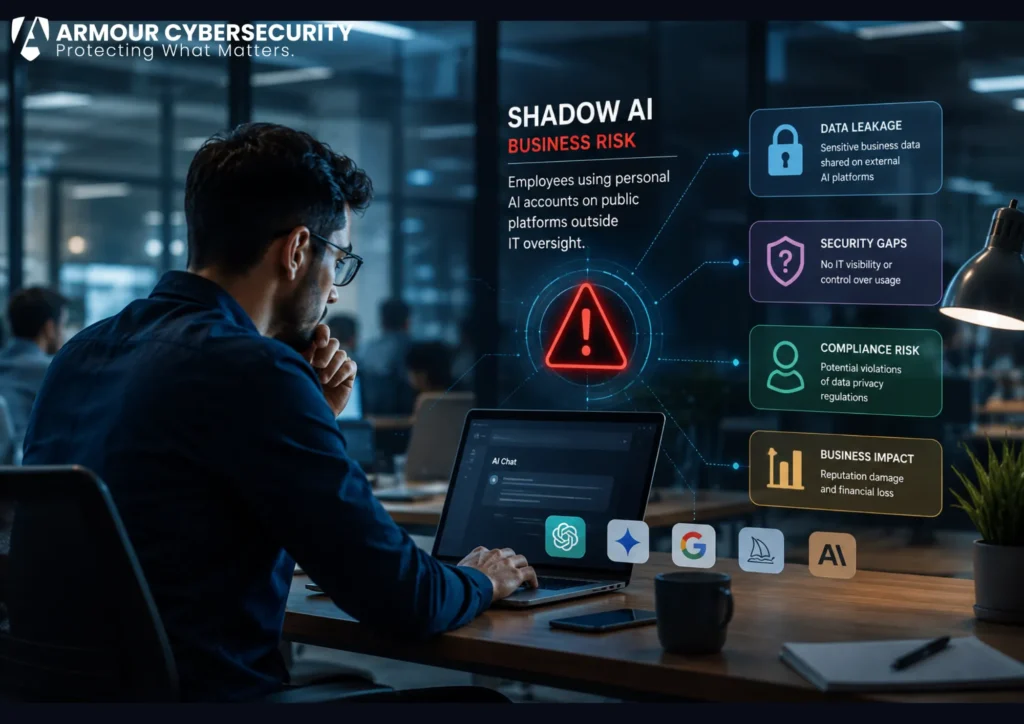
Quick answer: Shadow AI business risk comes from employees using AI tools outside the organization’s approved and monitored environment: personal accounts on public AI platforms, browser extensions that process page content, coding assistants connected to personal accounts, and productivity tools running on individual subscriptions with no IT oversight. Most organizations already have significant shadow AI activity in progress, and most do not have the visibility to know what data is being processed through these channels. The risk is not theoretical. Employees paste source code, customer records, financial data, and confidential contracts into public AI tools because the tools make them productive, and most organizations have no mechanism to detect or respond to it.
Key Takeaways
- Shadow AI is pervasive. Studies of enterprise network traffic consistently find that employees in organizations without a formal AI governance program are already using dozens of AI tools, most of them through personal accounts that IT has no visibility into and no ability to monitor or control.
- The data flowing through shadow AI channels is not limited to low-sensitivity content. Source code, customer records, financial models, legal documents, contracts, and internal business strategies are among the most common types of content employees submit to public AI tools, because these are the tasks where AI provides the most productivity benefit.
- Personal accounts on public AI platforms do not provide enterprise data protections. Inputs may be used to train the model, may be accessible to the provider’s staff for safety review, and are not subject to the data processing agreements, confidentiality obligations, or audit rights that enterprise procurement requires.
- Shadow AI creates liability exposure outside the organization’s risk framework. Regulators in Canada, the EU, and the US have begun enforcing privacy obligations against organizations whose employees submitted personal data to AI platforms without a legal basis, intentional or not.
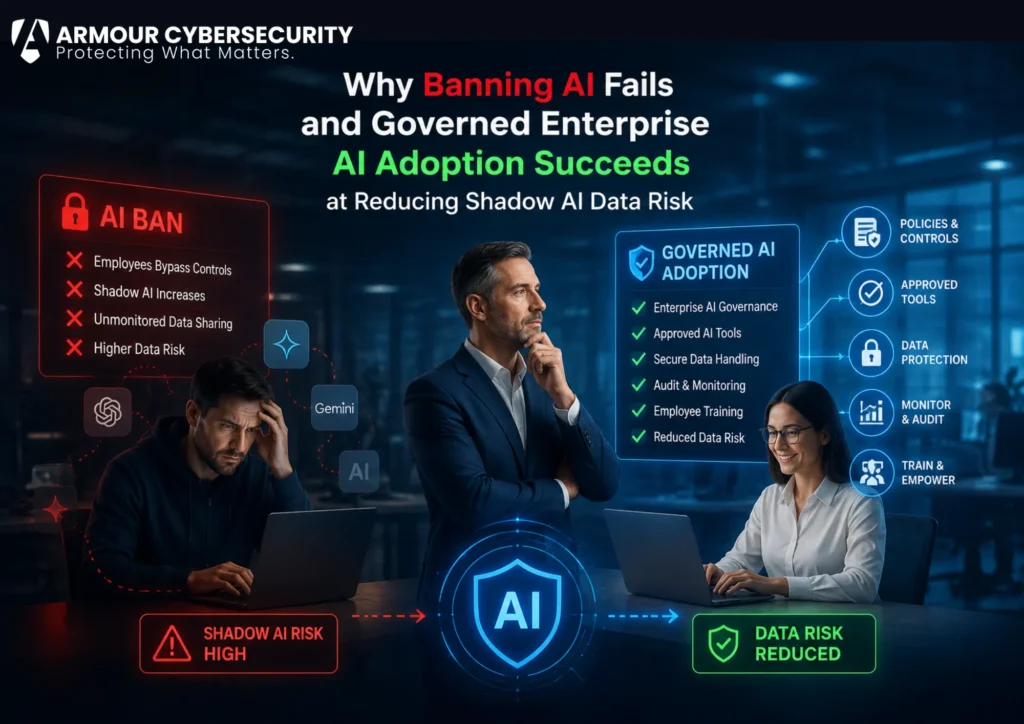
- The solution is not to ban AI. Prohibition without a sanctioned alternative drives usage underground and eliminates visibility. The solution is a governed enterprise AI adoption program that gives employees a controlled, monitored, enterprise-grade alternative to personal accounts.
What Shadow AI Business Risk Looks Like in Practice
Shadow AI is not a fringe phenomenon limited to technically sophisticated employees experimenting with new tools. It is the normal behavior of productive employees who have discovered that AI dramatically accelerates the work they are paid to do and who have adopted the most accessible version of that AI, which is a personal account on a public platform. The accounting team member who drafts client communications faster with AI assistance is using a personal account because their employer has not provided a corporate one. The developer who generates boilerplate code with a coding assistant is using a personal subscription because the organization has not deployed a sanctioned alternative. The business analyst who summarizes long documents is pasting them into a public AI chat interface because it is faster than reading them and the employer has not deployed a managed productivity assistant.
The activity happens at every seniority level and across every function. Legal teams use AI to draft contracts and review documents. Finance teams use it to analyze spreadsheets and generate reports. HR uses it to draft job descriptions and summarize applications. Executives use it to prepare presentations and refine communications. In each case, the user’s intent is productivity, not malice. But the mechanism, a personal account on a public platform, creates data handling risks that the user has typically not considered and that the organization has no visibility into.
What Data Is Actually at Risk
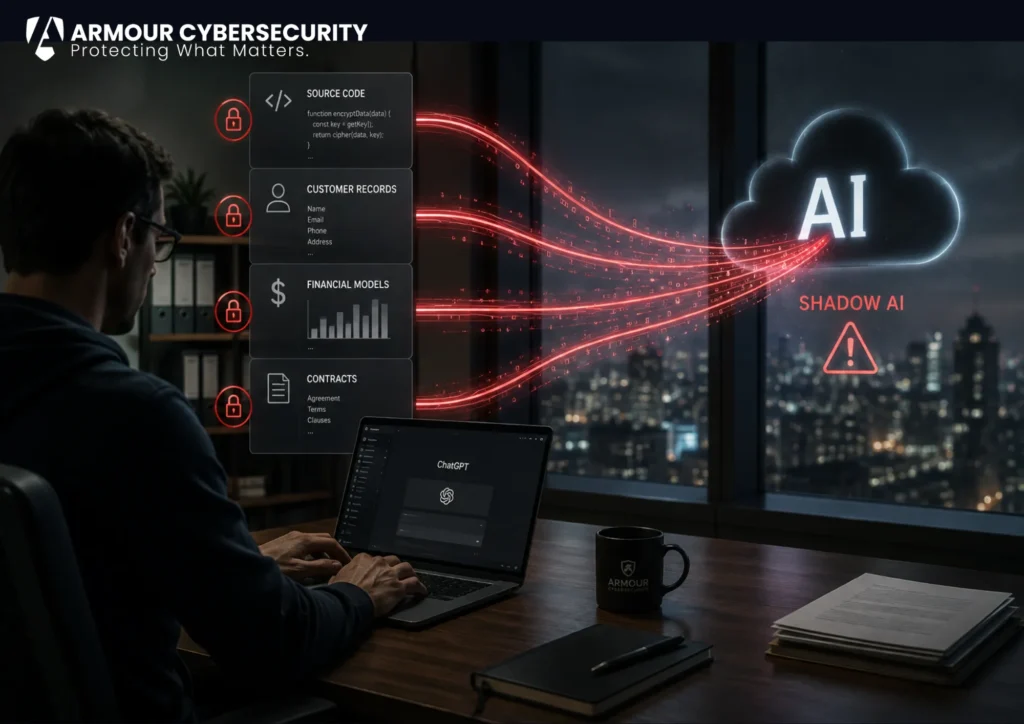
This is the shadow AI data risk in concrete terms. The content leaving the building through unmanaged AI channels is rarely trivial, because the tasks where AI helps most are the tasks that involve the most sensitive material.
Source code and intellectual property
Developers are among the most active users of public AI tools, and the inputs they submit include proprietary source code, algorithm implementations, database schemas, and architectural documentation. When this content is submitted through a personal account on a public AI platform, it leaves the organization’s control boundary. Depending on the platform’s terms of service, it may be used for model training or accessible for safety review. For software companies, technology vendors, or any organization whose competitive advantage lies in its code and technical architecture, this represents a direct intellectual property risk that is difficult to quantify and essentially impossible to remediate once the disclosure has occurred. Routing AI-assisted development through a governed secure SDLC keeps that code inside the organization’s control boundary.
Customer and personal data
Customer records, including contact information, transaction histories, support tickets, and account details, are frequently submitted to AI tools for analysis, summarization, and response drafting. Employees in customer success, support, sales, and account management routinely handle personal information as part of their daily work, and AI tools that accelerate that work receive that personal information as input. Under PIPEDA, Quebec Law 25, GDPR, and similar privacy frameworks, submitting personal information to a public AI platform without a data processing agreement, without a legal basis for the transfer, and without disclosure to the individuals whose data is being processed is a compliance violation that can trigger regulatory investigation and enforcement action. Understanding and containing that exposure is core privacy risk management work.
Financial and strategic information
Financial models, budget documents, acquisition analysis, strategic plans, and board materials are high-value confidential information that appears in AI tool inputs when executives and finance teams use AI to accelerate planning and analysis work. This content is not personal data in the regulatory sense, but its disclosure to a public AI platform creates confidentiality risk, potential securities law issues for public companies, and counterparty risk in any transaction context where the information relates to a pending deal. The disclosure is typically invisible to the organization until it is too late to prevent.
Legal and contractual information
Lawyers and in-house legal teams use AI to draft, review, and summarize contracts and legal documents. The content of contracts, including commercial terms, liability provisions, dispute histories, and settlement details, is confidential and often subject to solicitor-client privilege. Submission of privileged legal communications to a public AI platform may constitute a waiver of privilege, a consequence that is legally significant and practically irreversible. Law firms that permit lawyers to use personal AI accounts for client work are exposing client confidences and professional privilege in ways that the clients have not consented to.
Why Banning AI Does Not Work
The instinct of a risk-aware organization discovering the scope of shadow AI activity is often to prohibit it: issue a policy banning the use of personal AI accounts for work purposes and enforce it through acceptable use monitoring. This approach consistently fails to achieve its objective and often makes the situation worse. Prohibition without a sanctioned alternative does not eliminate AI use; it pushes it further underground and eliminates whatever residual visibility the organization had. Employees who were using a browser-based AI tool on the corporate network switch to a mobile device on personal connectivity. Those who were using a personal subscription on a managed workstation use a home computer instead. The productivity benefit that AI provides does not disappear because a policy says it should; it continues to be extracted through channels the organization can no longer observe.
The effective response to shadow AI is governance and displacement: establishing an AI governance committee that owns the policy and use case approval process, deploying a corporate enterprise AI access layer that gives employees a sanctioned, monitored, enterprise-grade alternative to personal accounts, and implementing AI usage detection that identifies attempted use of unapproved tools while directing users to the corporate alternative. This approach treats the productivity benefit of AI as legitimate, provides the controls the organization needs, and gives employees a reason to use the governed channel rather than working around it. In many organizations the governance committee is chaired by a virtual CISO, and it sits alongside the broader accountability that board cyber governance already demands.
Detecting unapproved AI tools in the workplace
Displacement only works if you can see what is still leaking. AI usage detection across endpoints, browsers, and network channels surfaces attempted use of unapproved AI tools in the workplace and flags risky data uploads, then points users toward the sanctioned alternative. Many organizations fold this monitoring into the managed SOC they already run, and reinforce it with security awareness training so employees understand why the governed channel exists.
Armour Cybersecurity’s Secure AI Adoption Program is built around this model: governance first, then a sanctioned enterprise access layer that displaces personal account usage, then detection and enforcement that monitors compliance and catches the exceptions.
Frequently Asked Questions
How do I know if my employees are using personal AI accounts for work?
Without active monitoring, you almost certainly do not know the full extent of AI usage in your organization. Indicators that shadow AI is active include employees mentioning AI tools in casual conversation or meetings, productivity improvements that are not explained by any deployed tool, code commits that contain patterns characteristic of AI-generated code, and network traffic to known AI platform domains from managed endpoints. A formal AI use case discovery exercise, typically structured interviews with team leads across business functions alongside network traffic analysis, consistently surfaces significantly more AI usage than leadership expects. Organizations that have conducted this discovery typically find that they have more AI usage than they knew about, across more sensitive data categories than they anticipated.
Are there any legal consequences for shadow AI data exposure?
Yes, and regulators are increasingly taking action. The most immediate legal risk is privacy and data protection liability: submitting personal information to a public AI platform without a data processing agreement and without a legal basis for the processing violates PIPEDA, Quebec Law 25, GDPR, and equivalent frameworks. The Italian data protection authority took enforcement action against a major AI platform in 2023 for processing personal data without a sufficient legal basis. Canadian and European regulators have published guidance making clear that organizations are responsible for ensuring that personal data processed through AI tools has a lawful basis, regardless of whether the submission was made by an employee on a personal account. Beyond privacy law, organizations in regulated industries face sector-specific risks: healthcare organizations submitting patient data to public AI tools face HIPAA exposure; financial institutions face securities and data residency risks; legal professionals face privilege waiver and professional responsibility issues.
What is the difference between a personal AI account and an enterprise AI deployment?
A personal AI account is a subscription held by an individual under their own name and email address, subject to the platform’s consumer terms of service. Data submitted through a personal account is subject to the platform’s consumer privacy policy, which typically reserves the right to use inputs for model training unless the user has opted out, does not include a data processing agreement with the account holder’s employer, and does not provide audit rights, incident notification obligations, or the data handling commitments that enterprise procurement requires. An enterprise AI deployment is a corporate subscription subject to enterprise terms of service that include a data processing agreement, confidentiality commitments, defined data retention and deletion obligations, audit rights, incident notification timelines, and typically an opt-out of data use for model training as a default. The distinction is significant from a regulatory, contractual, and risk management perspective.
What is an AI Governance Committee and what does it do?
An AI Governance Committee is the organizational body responsible for owning and enforcing the AI acceptable use standard, evaluating and approving AI use case requests, maintaining the approved AI tool and use case registry, reviewing AI-related incidents and exceptions, and providing leadership with periodic reporting on AI usage and risk. It is typically a cross-functional committee with representation from IT, cybersecurity, legal, privacy, business leadership, development, and engineering, with a defined chair and clear decision rights. The committee is not a bureaucratic bottleneck: it is the governance mechanism that allows the organization to approve beneficial AI use cases quickly while maintaining oversight of higher-risk deployments. Without a governance committee, AI adoption decisions are made ad hoc by whoever is closest to the tool, with no organizational accountability for the cumulative risk profile.
How long does it take to move from shadow AI to governed adoption?
The timeline depends on the organization’s size, existing cloud infrastructure, and the maturity of its identity and access management stack. The Secure AI Adoption Program is structured as a two-phase engagement. Phase 1 covers governance standup, acceptable use policy, corporate enterprise AI access deployment, and secure SDLC for AI-generated code. Phase 2 layers AI usage detection and enforcement, productivity assistant hardening, and supporting data protection controls. Most organizations complete both phases within a few months from kickoff to operational program, depending on the complexity of the environment. The governance committee and acceptable use policy can be stood up in a matter of weeks; the corporate AI access layer deployment timeline depends on the organization’s cloud environment.
The Bottom Line
Shadow AI business risk is not a reason to ban AI, it is a reason to govern it. Employees will keep reaching for AI because it makes them productive, so the durable fix is a sanctioned, monitored enterprise alternative that displaces personal accounts rather than a policy that pushes usage out of view. A governed AI adoption program turns invisible, unmanaged activity into controlled, auditable AI access. Start by discovering where AI is already in use, then stand up governance, secure access, and detection in that order.
About the author
David Chernitzky is Co-Founder and CEO of Armour Cybersecurity, a Toronto-based cybersecurity firm founded by military intelligence veterans and advised by senior leaders from PwC, KPMG, Deloitte, EY, and Mandiant. Armour serves more than 260 organizations across 52-plus industries, including finance, healthcare, technology, energy, legal, and government, with a 97 percent client retention rate.