By David Chernitzky, Co-Founder and CEO, Armour Cybersecurity | Serving organizations across Canada, the US, and beyond | Last updated August 18, 2026
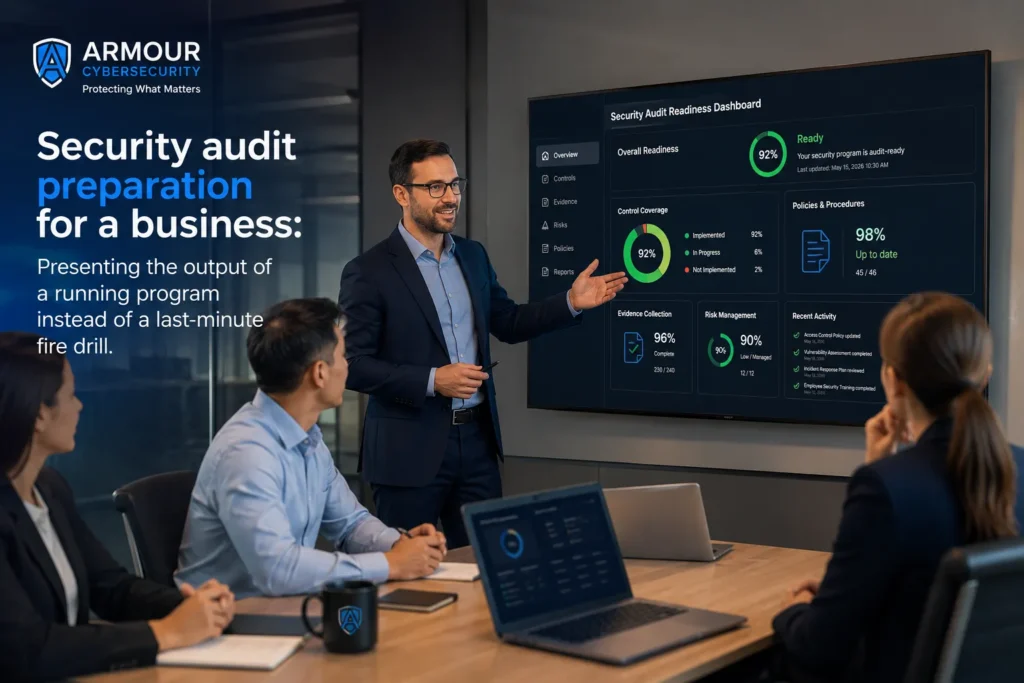
Quick answer: Security audit preparation becomes a fire drill when an organization treats compliance as an annual project rather than a continuous program. The organizations that sail through audits are not doing something special in the weeks before the auditor arrives; they are doing the same things they do all year. Their evidence is collected as controls operate. Their risk register is reviewed quarterly. Their policies are current. Their gaps are documented with remediation timelines. When the auditor arrives, they are presenting the output of a running program, not assembling a package under deadline pressure.
Key Takeaways
- The most expensive time to prepare for an audit is in the weeks before it starts. Evidence collected in a rush contains errors. Remediations completed under audit pressure are not properly tested. Policies updated the week before an auditor review look exactly like what they are, and experienced auditors notice. The investment in year-round compliance maintenance consistently produces better audit outcomes at lower total cost than periodic audit-preparation sprints.
- Auditors evaluate three things: documentation (do the policies and procedures exist, are they current, are they approved), evidence (do the records demonstrate that the documented controls are actually operating), and process (do the people responsible for the controls understand and consistently execute them). Gaps in any of the three dimensions produce audit findings.
- A mock audit conducted sixty to ninety days before the formal engagement is the most reliable way to surface findings before the auditor does. The mock audit reviews the same documentation, requests the same evidence, and asks the same process questions the formal audit will, with findings addressed during the remediation window rather than documented in the formal report.
- Cross-framework evidence mapping eliminates the most significant source of audit preparation redundancy: the same control evidence collected multiple times in different formats for different frameworks. A single evidence package, organized to demonstrate compliance with all applicable frameworks simultaneously, reduces collection burden and produces more consistent audit responses.
- Audit readiness is a governance function, not an IT function. The CISO or GRC lead who owns the audit readiness program needs executive support to obtain evidence from business units, HR, legal, and finance who may not understand why their participation in control documentation matters.
What Auditors Actually Look For
Understanding what auditors actually evaluate is the foundation of effective audit preparation. Auditors are not trying to catch organizations out; they are trying to determine whether the controls an organization claims to have are actually in place and operating effectively. This determination has three dimensions, each of which produces a different type of finding when it fails.
Documentation
Documentation findings occur when the required policies, procedures, or records do not exist, are not approved at the required level, are not current (typically defined as reviewed within the past twelve months), or do not address the specific requirement the framework imposes. Common documentation findings include policies that reference roles or systems that no longer exist, policies that have never been formally approved by the required authority, risk registers that have not been updated since the prior assessment period, and procedures that describe how a control was implemented in a previous technology environment rather than the current one. These are the same cybersecurity policy gaps that quietly accumulate between audits, and they are typically the easiest to remediate before an audit, which is why the sixty to ninety day pre-audit mock audit window is valuable: documentation gaps identified six to eight weeks before the audit can usually be addressed before the formal engagement begins.
Evidence
Evidence findings occur when the records that should demonstrate a control is operating do not exist, are incomplete, cover the wrong time period, or are inconsistent with the control description. Common evidence findings include access reviews that were supposed to be conducted quarterly but for which evidence exists for only one quarter of the audit period, vulnerability scans that were conducted but whose remediation tracking does not demonstrate that identified vulnerabilities were addressed within the required timeframe, training completion records that do not cover the entire employee population subject to the training requirement, and change management records that show approvals were granted but do not demonstrate that the approval included the required security review. Evidence findings require that the underlying control be operated correctly through the remainder of the audit period; they cannot be remediated retrospectively for periods during which the control was not operating.
Process
Process findings occur when the people responsible for operating a control cannot demonstrate that they understand and consistently execute it. Auditors conduct interviews with control owners and operators to assess process understanding; they ask specific questions about how the control works, what happens when an exception occurs, how the output of the control is reviewed, and who is notified when the control identifies an issue. Control owners who cannot answer these questions, who give answers that contradict the documented procedure, or who are unfamiliar with the evidence that their control produces are indicators of process weakness that produce findings regardless of whether the documentation and evidence are otherwise adequate. Process findings are the hardest to remediate quickly because they reflect genuine operational gaps rather than documentation or collection issues.
Building a Year-Round Compliance Calendar
The most practical framework for maintaining audit readiness throughout the year is a compliance calendar: a documented schedule of every control activity that produces evidence required for audit, with the frequency, responsible party, evidence output, and storage location specified for each activity. The compliance calendar converts audit readiness from a project that happens before audits into a continuous operational function whose output is audit-ready evidence produced as a byproduct of running the controls.
A typical compliance calendar for an organization pursuing ISO 27001 or SOC 2 compliance includes monthly activities such as vulnerability scan review, access log review, and security monitoring report review; quarterly activities such as access review for all privileged and sensitive system accounts, risk register review, policy review for expiring documents, and vendor risk monitoring review; semi-annual activities such as penetration testing or vulnerability assessment, disaster recovery testing, and business continuity plan review; and annual activities such as the full risk assessment, policy library review and approval, security awareness training completion verification, and the formal external audit. Each activity is assigned to a named responsible party, produces a defined evidence output, and is tracked for completion through the governance committee review process. Building this calendar is the single most useful step in ISO 27001 audit preparation and in maintaining SOC 2 audit readiness year over year.
The Pre-Audit Mock Audit
A mock audit conducted sixty to ninety days before the formal engagement is the highest-value single investment in audit preparation. The mock audit replicates the formal audit process: a structured review of the documentation and evidence package, interviews with key control owners and operators, and a gap assessment that identifies findings before the formal auditor does. Findings identified in the mock audit can be remediated during the pre-audit window. Control owners identified as unable to articulate their control responsibilities can be briefed and prepared. Evidence gaps identified in the mock audit can be addressed for the remaining audit period. Documentation issues can be corrected before the formal documentation review.
The mock audit should be conducted by someone other than the people who prepared the evidence package, because familiarity with the package will cause them to miss gaps that a fresh reviewer would find. A cyber posture assessment run against the same control set is a useful complement, giving an independent read on where the controls themselves, not just the paperwork, fall short. Armour Cybersecurity conducts pre-audit mock audits from the auditor’s perspective, using the same frameworks and evidence standards the formal audit will apply, and delivers findings with sufficient lead time for meaningful remediation before the formal engagement, as one component of its GRC services.
Cross-Framework Evidence Mapping
Organizations subject to multiple frameworks, such as ISO 27001 and SOC 2, or HIPAA and SOC 2, or PCI DSS and NIST CSF, face the challenge of demonstrating compliance across all of them without collecting evidence multiple times in different formats for the same underlying control. Cross-framework evidence mapping solves this problem by establishing which controls satisfy which framework requirements and organizing evidence collection around controls rather than around frameworks.
The compliance mapping matrix is the working tool for cross-framework evidence management. It lists every control the organization operates, maps each control to the specific requirements it satisfies across all applicable frameworks, identifies the evidence that demonstrates the control is operating, and specifies where that evidence is stored. When an auditor for any of the applicable frameworks requests evidence for a specific requirement, the matrix identifies the relevant control and the pre-collected evidence immediately, without requiring a new evidence collection exercise. For organizations pursuing multiple certifications or operating under multiple regulatory frameworks, the compliance mapping matrix typically reduces audit preparation time by thirty to fifty percent compared to framework-by-framework evidence collection.
Frequently Asked Questions
How far in advance should we start preparing for a security audit?
If compliance is maintained as a continuous program with a compliance calendar and year-round evidence collection, formal audit preparation begins sixty to ninety days before the engagement starts, with the mock audit at the beginning of that window and evidence package compilation and review in the final thirty days. If compliance has been managed as an annual project, meaningful preparation requires four to six months before the audit date to conduct a current-state assessment, identify and remediate material gaps, update documentation, and collect evidence for the audit period. Starting formal audit preparation less than three months before the engagement date when compliance is in project mode typically results in findings that could have been remediated with more lead time. The most reliable answer to how far in advance to start preparing is that preparation should be ongoing, which means the question becomes when to intensify the year-round effort rather than when to start it.
What should we do if we find a gap during audit preparation that we cannot remediate before the audit?
Gaps that cannot be remediated before the formal audit should be documented with a remediation plan that includes a target date, responsible owner, and resource commitment. Auditors distinguish between organizations that have identified and documented a gap with a credible remediation plan and those that have left a gap unaddressed without acknowledgment. A documented gap with an active remediation plan may result in a conditional certification or a finding with a remediation commitment rather than an outright audit failure, depending on the framework and the severity of the gap. Attempting to conceal a material gap from the auditor, by providing misleading evidence or incomplete answers to auditor questions, creates a significantly worse outcome: a finding of misrepresentation in addition to the underlying control gap, which affects the organization’s credibility with the auditing body and in some certification contexts can result in suspension of certification.
Who needs to be available during a security audit?
The typical audit requires access to a wider range of personnel than many organizations anticipate. The auditor will want to interview the CISO or security program owner, the IT leadership responsible for technical controls, the HR leader responsible for security awareness training and employee onboarding and offboarding processes, legal counsel or the privacy officer for regulatory compliance and data protection controls, finance or accounting leadership for financial system access controls and change management, and business unit owners for controls operating within their functions such as access approvals and data handling practices. Coordinating audit availability across these stakeholders requires advance planning; leaders who are unavailable during the audit window create scheduling delays that extend the engagement and can result in incomplete evidence evaluation for controls in their domain.
What is the difference between a Type I and Type II SOC 2 report?
A SOC 2 Type I report expresses the auditor’s opinion on whether the organization’s controls were suitably designed as of a specific date. It is a point-in-time assessment of design adequacy; it does not evaluate whether the controls operated effectively over a period of time. A SOC 2 Type II report expresses the auditor’s opinion on whether the organization’s controls were suitably designed and operated effectively over an observation period, typically six to twelve months. Type II provides significantly stronger assurance to relying parties (customers, partners, regulators) because it demonstrates operational effectiveness rather than just design. First-time SOC 2 organizations often pursue Type I to establish the baseline before building the evidence record required for Type II. Enterprise customers increasingly require Type II specifically, recognizing the difference in assurance between the two report types.
How does audit preparation relate to ongoing GRC program management?
The relationship between audit preparation and GRC program management is simple: a mature governance, risk and compliance program makes audit preparation a manageable intensification of normal activity rather than a disruptive sprint. The risk register review that happens quarterly anyway becomes the basis for the auditor’s risk assessment evaluation. The evidence collected throughout the year by the compliance calendar becomes the audit evidence package. The policy review cycle that runs according to the governance calendar produces current, approved documentation without a pre-audit rush. The control owner interviews that auditors conduct test understanding that has been developed through ongoing training and process documentation. Every investment in year-round GRC program maturity reduces the marginal cost and disruption of each subsequent audit cycle.
The Bottom Line
An audit is a fire drill only when the work it checks was never happening in the first place. The organizations that get through cleanly are not better at cramming; they run compliance as a continuous program, so the auditor is simply reviewing a year of output. Build a compliance calendar that produces evidence as controls operate, run a mock audit sixty to ninety days out to catch findings before the auditor does, map your evidence once across every framework you answer to, and document any gap you cannot close with a real remediation plan rather than hiding it. That is what security audit preparation looks like when it is a governance discipline instead of an annual scramble, and it is exactly what a structured governance, risk and compliance program is built to sustain.
About the author
David Chernitzky is Co-Founder and CEO of Armour Cybersecurity, a Toronto-based cybersecurity firm founded by military intelligence veterans and advised by senior leaders from PwC, KPMG, Deloitte, EY, and Mandiant. Armour serves more than 260 organizations across 52-plus industries, including finance, healthcare, technology, energy, legal, and government, with a 97 percent client retention rate.