By David Chernitzky, Co-Founder and CEO, Armour Cybersecurity | Serving organizations across Canada, the US, and beyond | Last updated August 19, 2026
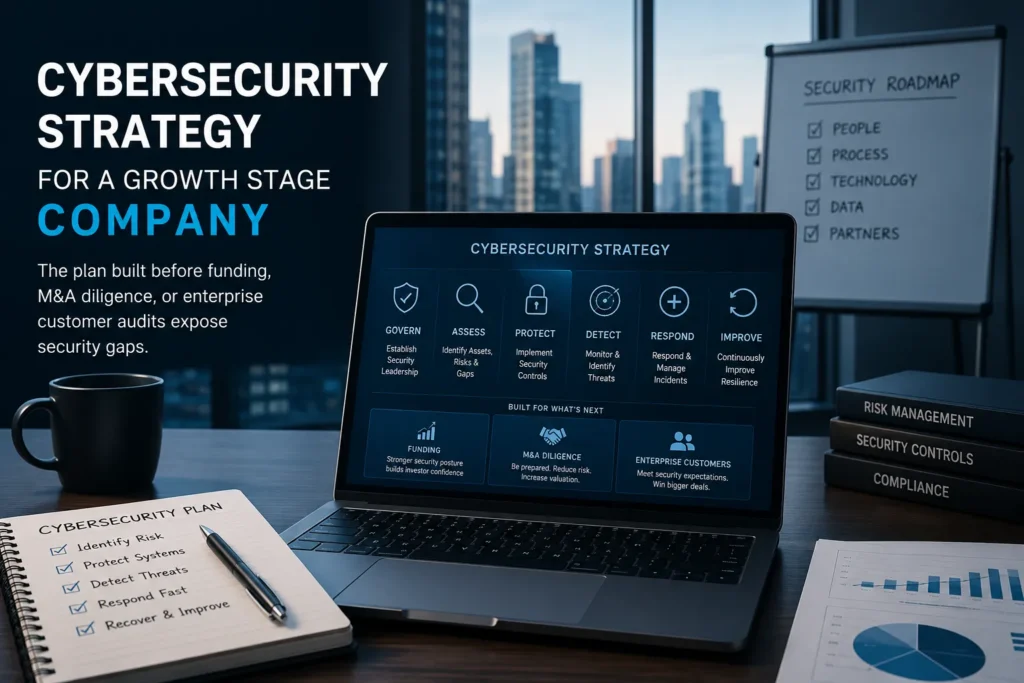
Quick answer: A cybersecurity strategy for a growth stage company is the plan that gets built before a funding round, an acquisition, a major enterprise customer, or rapid headcount growth turns a manageable security gap into a deal risk. The gaps that were tolerable at twenty employees become valuation and diligence problems at two hundred, and they tend to surface at the worst possible moment, when two or three other urgent priorities are competing for attention. Building the strategy ahead of these forcing events is far less expensive and disruptive than building one under deadline pressure while a deal is on the table.
Key Takeaways
- PE-backed companies face cybersecurity scrutiny at multiple points in the investment lifecycle: at acquisition diligence, at portfolio company review, and at exit. Security posture that cannot be documented and defended becomes a valuation issue.
- Enterprise customers increasingly require evidence of security maturity as a condition of doing business. A formal cybersecurity strategy and documented control framework is the foundation of the security documentation that enterprise sales cycles demand.
- Rapid headcount growth, geographic expansion, and technology platform changes all introduce security risks that outpace the ad-hoc security practices that served the organization at smaller scale. A strategy provides the architecture that scales with the business.
- Cyber insurance underwriters apply heightened scrutiny to growth-stage companies because rapid change increases risk. Organizations that can present a documented strategy and roadmap demonstrate the governance posture underwriters want to see.
- The cost of building a cybersecurity strategy at growth stage is a fraction of the cost of remediating the security gaps that M&A diligence, a failed audit, or a breach exposes at the wrong moment in the business lifecycle.
When Cybersecurity Becomes a Business Problem for Growth-Stage Companies
Most growth-stage companies build their technology infrastructure under startup constraints: move fast, add controls when they become necessary, and address security reactively when something goes wrong or when a customer asks. This approach works within limits, and those limits are usually reached somewhere between fifty and two hundred employees depending on the business model and the customers being served. The inflection point is typically triggered by one of several forcing events.
The first common trigger is an enterprise customer or procurement process. Enterprise customers above a certain size require vendors to complete security questionnaires, provide SOC 2 reports, or pass third-party security assessments as a condition of doing business. A growth-stage company that has not built a documented security program fails these assessments or produces responses to security questionnaires that are inconsistent, incomplete, or frankly inaccurate. The deal stalls or falls through, not because the product is inadequate but because the security posture cannot be documented.
The second trigger is M&A diligence, either as an acquisition target or as an acquirer evaluating a target. Security due diligence has become a standard component of M&A processes, and security gaps identified during diligence either reduce valuation, require remediation commitments that create post-close obligations, or, in serious cases, cause deals to fall through entirely. The cost of remediating security gaps under M&A diligence timeline pressure is substantially higher than the cost of building the program in advance.
What PE Firms Look for in Portfolio Company Security Posture
Private equity firms have developed increasingly specific expectations for portfolio company cybersecurity, driven partly by the operational risk that breaches at portfolio companies create and partly by the value impact that security gaps have at exit. The expectation is not that portfolio companies maintain enterprise-grade security programs. It is that they have a documented strategy, a measurable program, and governance oversight that demonstrates the security function is under management rather than left to chance.
At acquisition, diligence teams evaluate the target’s security posture against a set of risk factors: the maturity of identity and access controls, the existence of a documented incident response capability, the state of third-party risk management, the compliance posture against applicable regulations, and the overall governance of the security program. A target that can present a current-state assessment, a maturity roadmap, and a KPI framework demonstrates that security is being managed as a program. A target that cannot characterize its own security posture presents an unknown risk that diligence teams discount conservatively.
At portfolio review and exit, the same documentation is relevant. A portfolio company that has executed against its security roadmap, that can demonstrate measurable improvement in its security posture over the investment period, and that can present board-level governance materials showing active oversight commands a stronger position in exit diligence than one that has spent money on security without a plan or a record of what was achieved. This is the same governance record that supports board cyber governance reporting during the hold period, so the work done for diligence does double duty as ongoing oversight evidence.
How Rapid Growth Creates Security Risk
The security architecture adequate for twenty employees is typically not adequate for two hundred. Each growth transition, new employees, new office locations, new technology platforms, acquisitions of other small companies, introduction of enterprise customers with data handling requirements, creates new attack surface and new risk that the organization’s existing security practices may not address.
Identity and access management
At twenty employees, access management is manageable informally: most employees know each other, provisioning and de-provisioning is handled manually, and the relatively small number of systems makes oversight feasible without a formal program. At two hundred employees, informal access management becomes a serious vulnerability. Leavers retain access longer than they should. Contractors accumulate permissions that were never scoped appropriately. Privileged access is not consistently monitored. The security architecture needs to have scaled to meet this growth, and without a strategy that anticipated the scaling requirement, it typically has not.
Data classification and protection
Growth-stage companies accumulate sensitive data faster than they build the controls to protect it. Customer data, financial data, intellectual property, employee data, and partner data all require different handling under different regulatory regimes, and the complexity of managing data across all of these categories scales with the organization’s size and the breadth of its customer relationships. A data protection strategy built at growth stage, rather than retrofitted after a data breach or a failed compliance audit, costs a fraction of the remediation.
Third-party risk
As organizations grow, the number of third parties with access to their systems and data grows with them. SaaS vendors, contractors, managed service providers, and integration partners all represent potential entry points for an attacker who cannot get through the organization’s own perimeter. Enterprise customers and regulated industries require evidence that the organization manages its third-party risk. A third-party risk management program built as part of a cybersecurity strategy is easier to demonstrate to customers and auditors than one assembled reactively in response to a specific audit finding.
What a Cybersecurity Strategy Looks Like for a Growth-Stage Company
A cybersecurity strategy for a growth-stage company addresses three horizons simultaneously. The current-state horizon establishes the baseline: what exists, what is working, what is missing, and what is most urgently needed. The quick win layer surfaces the highest-impact, lowest-effort improvements that can be executed in the first ninety days without waiting for the full roadmap to be funded. The multi-year roadmap builds the program architecture the organization needs to support its growth objectives: the compliance certifications that enterprise customers require, the governance structure that boards and investors expect, and the security capabilities that protect the business as it scales. This is the same current-state, quick-win, multi-year structure that defines any cybersecurity strategy, scoped specifically to a company that is growing quickly rather than one that is standing still.
The strategy is specifically scoped to the growth trajectory of the business, not modeled on the security program of a mature enterprise. The initiatives that matter for a growth-stage company are different from those that matter for a large financial institution: speed to SOC 2 readiness, identity and access foundations that scale with headcount growth, data classification that supports enterprise customer requirements, and governance documentation that satisfies M&A diligence. Armour Cybersecurity’s cyber strategy and roadmap service has specific experience with growth-stage and PE-backed companies at this inflection point.
Frequently Asked Questions
At what company size should we formalize a cybersecurity strategy?
The trigger is not headcount; it is business context. A company with fifty employees that is selling to regulated enterprise customers, processing personal data at scale, or approaching a funding or M&A event needs a formal strategy sooner than a company with two hundred employees in a less regulated market. The practical answer is that the formalization should happen before the first forcing event, whether that is a significant enterprise sales process, a PE acquisition, or the first SOC 2 audit. Waiting until the forcing event means building the strategy under deadline pressure, which is more expensive and more disruptive than building it in advance.
Does a cybersecurity strategy have to be expensive?
The cost of the strategy engagement itself, typically six to eight weeks of consulting work, is a fraction of the cost of the gaps it identifies and prevents. The security investment that follows the strategy is better allocated than investment made without one because it is directed at the risks that matter most in the specific order that delivers the most risk reduction. Organizations that spend on security reactively frequently spend more in total than those that follow a strategy, because reactive spending tends to produce overlapping capability in some areas and persistent gaps in others. The strategy pays for itself through the efficiency of the investment it guides.
What is a SOC 2 report and why do growth-stage companies need it?
A SOC 2 (System and Organization Controls 2) report is an attestation produced by an independent auditor that an organization’s systems and controls meet defined criteria for security, availability, processing integrity, confidentiality, and privacy. It is the most widely required security certification for SaaS companies selling to enterprise customers in North America. Enterprise procurement teams use SOC 2 reports as a substitute for conducting their own security assessments of each vendor. A growth-stage SaaS company without a SOC 2 report faces a significant obstacle in enterprise sales cycles as it moves upmarket. A cybersecurity strategy that includes the path to SOC 2 readiness as a roadmap objective connects the security investment to direct revenue enablement.
How does a cybersecurity strategy affect cyber insurance terms?
Cyber insurance underwriters evaluate the quality of an applicant’s security program when setting premiums, coverage terms, and deductibles. Organizations that can present a documented strategy, a maturity roadmap, and evidence of ongoing governance oversight typically receive better terms than those that cannot characterize their security posture beyond a list of tools they have deployed. Underwriters are looking for evidence that security is managed as a program with leadership accountability, not addressed ad hoc. A formal cybersecurity strategy provides exactly this evidence. It is also the same documentation that helps you answer a cyber insurance underwriting questionnaire accurately and consistently, which is where many growth-stage applications run into trouble.
What should be in the first ninety days of a growth-stage cybersecurity program?
The first ninety days focus on the quick wins that deliver the most risk reduction for the least effort and cost. These typically include implementing multi-factor authentication across all critical systems and administrative accounts, establishing a formal offboarding process that ensures timely access revocation when employees or contractors leave, deploying endpoint protection across all company devices, implementing basic logging and alerting on critical systems, and documenting the ten to fifteen security policies that most compliance frameworks require as a baseline. These actions do not require a large budget or a complex program. They address the most common and most consequential security failures that growth-stage companies experience and create a documented baseline from which the multi-year roadmap builds.
The Bottom Line
The gaps that are tolerable at twenty employees become deal risks at two hundred, and they almost always surface at the worst moment: during a funding round, an acquisition, an enterprise customer’s security review, or a cyber insurance renewal. Growth-stage and PE-backed companies that wait for one of those forcing events end up building a security strategy under deadline pressure, which costs more and disrupts more than doing it in advance. A strategy scoped to the growth trajectory addresses three horizons at once, current state, ninety-day quick wins, and a multi-year roadmap, and it produces the documented posture that diligence teams, enterprise buyers, and underwriters all want to see. The work is the same either way; the only choice is whether it happens on your schedule or theirs. A structured cyber strategy and roadmap engagement builds that plan before the forcing event, so security becomes an asset in the deal rather than a liability discovered in diligence.
About the author
David Chernitzky is Co-Founder and CEO of Armour Cybersecurity, a Toronto-based cybersecurity firm founded by military intelligence veterans and advised by senior leaders from PwC, KPMG, Deloitte, EY, and Mandiant. Armour serves more than 260 organizations across 52-plus industries, including finance, healthcare, technology, energy, legal, and government, with a 97 percent client retention rate.