By David Chernitzky, CEO, Armour Cybersecurity · Serving private clients and family offices across North America · Last updated August 21, 2026
Quick Answer
Digital privacy and data removal for high-net-worth individuals starts with a fact most people underestimate: data brokers collect, aggregate, and sell personal information, and their databases hold home addresses, phone numbers, email addresses, family member names, property ownership records, vehicle registrations, estimated net worth, employer information, and decades of public records, available for purchase by anyone willing to pay a few dollars per record. For an HNWI, this is not an abstract privacy concern. It is the research layer behind every category of targeted attack: the personalized phishing message that references specific true details, the extortion campaign that threatens to expose a home address, the physical security threat enabled by a publicly listed residential address. Removing this information from broker databases, public records aggregators, and social media is the first layer of personal cybersecurity for high-net-worth individuals. It does not eliminate all risk, a resourced adversary can reconstruct removed information, but it raises the cost of reconnaissance and eliminates the casual attackers who rely on what is free and immediately accessible.
Key Takeaways
- Data brokers operate legally and openly. They aggregate personal information from public records, purchase data, voter registrations, property records, and court filings, then package and sell it. The information they sell is the starting point for targeted phishing, physical stalking, and identity-based fraud. Removing it does not require legal action; it requires systematic opt-out requests to each broker, followed by ongoing monitoring and re-submission as data re-populates.
- Doxxing is the deliberate exposure of private information to cause harm, harassment, or physical threat. For HNWIs it may mean publishing a home address to enable harassment, exposing private financial or family information for reputational damage, or sharing location and travel patterns to enable physical surveillance. Doxxing campaigns against HNWIs are frequently monetized through extortion, and the information that fuels them is often drawn straight from data broker databases and public records.
- Social media is a significant source of unintentional exposure. Family members’ posts collectively map the family’s location patterns, connections, properties, travel, and routines. Individual posts that seem innocuous, a photo at a regular weekend spot, a school or club mention, a restaurant check-in, combine into a surveillance profile attackers use to time and target their approach. A social media privacy review closes the specific sources of exposure across the family’s combined presence.
- Public records exposure is harder to eliminate but manageable. Property records, court filings, business registrations, and voter registrations are public by law in most jurisdictions. Some jurisdictions offer confidential voter registration or address-protection programs for documented threats. Business ownership can be restructured to remove personal names from public-facing registrations, and property held through appropriately structured entities can reduce the link between a residential address and an individual’s name. These measures reduce what the records reveal and how easily they link to the principal.
- Data removal is continuous, not one-time. Brokers re-aggregate from public records and other sources constantly, so information removed today frequently re-appears within months. Effective privacy protection requires ongoing monitoring of the broker landscape and periodic re-submission for information that has returned. A one-time project buys a short-term reduction; a continuous monitoring and removal program maintains it.
What Data Brokers Know About You Right Now
The data broker ecosystem
There are hundreds of data broker companies operating in North America, from large public companies to small specialty brokers targeting specific information categories. The major categories include people-search sites that publish aggregated profiles searchable by name, address, or phone number; marketing data brokers that sell contact lists and demographics; background check services that aggregate criminal, civil, financial, and employment records; and financial data brokers that sell estimated net worth, credit behavior, and property values. The information is not static; it is continuously updated from public records, social media, purchase data, and other brokers who resell their compilations.
For a high-net-worth individual, the broker profile typically includes current and historical residential addresses, phone numbers, email addresses, family members’ names and ages, property ownership for all properties, vehicle registrations, business ownership and directorship records, court case history, estimated net worth from property values and public filings, and social media links. This profile is accessible for a few dollars or, on many people-search sites, for free. An attacker researching a target spends a few minutes on these sites before crafting an approach. The information removes any need for inside knowledge; it is all publicly available.
How this information enables attacks
The most direct use of broker information is social engineering. A phishing message that contains the target’s correct home address, names family members correctly, and references a property the target actually owns is far more convincing than a generic approach. The recipient is more likely to believe the message is legitimate, whether it impersonates the property’s insurer, a real estate attorney, or a government agency. The true details create a false sense of authenticity.
Physical security threats are also directly enabled by residential address exposure. A principal whose home address is freely searchable is reachable by anyone with a grievance, a stalking motivation, or a plan to surveil travel patterns. Threats against family members, particularly children, may be based on school locations or residential addresses found through broker sites. For principals with public-facing roles, advocacy positions, or adversarial business decisions, the physical implication of address exposure is not hypothetical. Address removal and public-records restructuring that breaks the link between the principal’s name and residential address are the primary mitigations, and they are core to family digital safety when children are in scope.
What a Digital Privacy Program Delivers
Systematic data broker removal
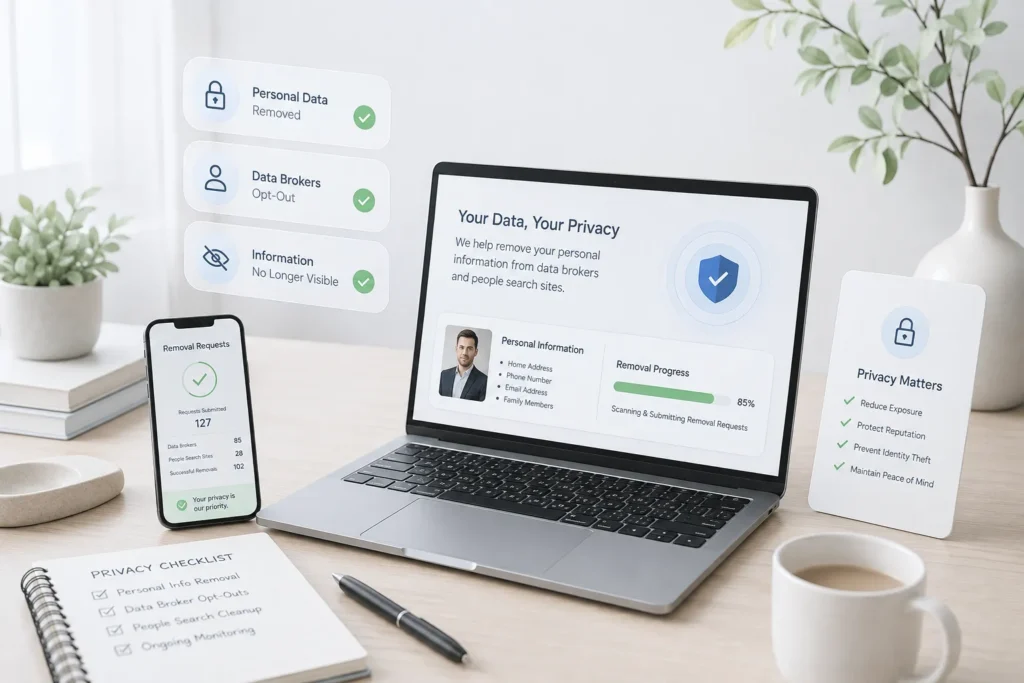
A digital privacy and data removal program begins with a comprehensive audit of the principal’s exposure across the major broker and people-search platforms: what information is publicly accessible, from which sources, and what the removal pathway is for each. Some brokers offer online opt-outs; others require written requests or proof of identity; many require re-submission on a schedule because the pipeline re-populates. The process is systematic and documented so the re-check and re-submission cadence is maintained over time rather than treated as a one-time exercise.
A recent development changes the mechanics for California residents. Under California’s Delete Act, the state’s Delete Request and Opt-Out Platform (DROP) launched to consumers on January 1, 2026, and as of August 1, 2026 registered data brokers are required to process its requests. DROP lets a California resident submit a single verified request that reaches every registered data broker in the state, more than 500 of them, rather than opting out one broker at a time. It does not cover every source (public-record and certain regulated data are exempt), and it applies to California residents specifically, but for those it covers it is the most efficient removal mechanism available. In Canada, PIPEDA governs consent and gives access and withdrawal rights, and Quebec’s Law 25 adds stronger provincial protections, though neither yet offers an equivalent one-request platform. A current program uses DROP where it applies and works broker-by-broker everywhere it does not.
The audit covers the principal, spouse, adult children, and any other family members whose exposure creates a pathway to the principal, plus business addresses and any properties whose ownership is publicly linked to the principal’s name. Priority removal targets are residential addresses, phone numbers, and family member names, since these are the categories most directly used in targeted attacks and physical-threat scenarios. Secondary targets include financial exposure information, vehicle registrations, and court or civil records usable for social engineering or reputational attack.
Social media privacy review
A social media privacy review assesses the combined exposure created by the online presence of the principal and all in-scope family members: privacy settings on every active account, content currently visible to the public or broad audiences, information that has accumulated over time in posts, location tags, and photo metadata, and the patterns that emerge from aggregating multiple family members’ accounts. It identifies the specific posts or settings that create meaningful exposure and recommends changes that reduce it without asking the family to abandon their online presence.
For family members who are active on social media, particularly younger ones for whom it is a normal part of social life, the review informs rather than restricts. Understanding which content creates the most exposure, location-tagging residential properties, naming specific schools or clubs that identify children’s locations, posting travel schedules in advance, lets family members make informed choices about what and how they share. Armour provides practical, specific guidance calibrated to each family member’s activity and the family’s overall risk profile.
Public records restructuring
Property records, business registrations, and other public filings that link the principal’s name to residential addresses or asset ownership can be restructured to reduce that linkage, in coordination with the principal’s legal and financial advisors. This work involves the principal’s attorneys and must be designed around their specific legal, tax, and estate structure. The cybersecurity role is to identify the public records that create the greatest exposure and communicate those findings to the right advisors so restructuring can be considered within the overall advisory relationship. It sits inside the broader cybersecurity for high-net-worth individuals program rather than standing alone.
Frequently Asked Questions
Is data broker removal legal?
Yes. Opting out and requesting deletion from data brokers is an administrative process supported by privacy law, not a legal fight. In the United States, the California Consumer Privacy Act gives residents deletion and opt-out rights, and as of 2026 California’s Delete Request and Opt-Out Platform (DROP) lets a resident submit one verified request that reaches every registered data broker in the state; brokers are required to begin processing DROP requests as of August 1, 2026. In Canada, PIPEDA governs consent and gives access and withdrawal rights, and Quebec’s Law 25 adds stronger provincial protections, though neither offers a single broker-deletion platform. The real challenge is the volume of brokers, the varying opt-out processes, and re-population over time, which is why ongoing management is more effective than a single removal effort.
How long does it take to see meaningful reduction in data broker exposure?
Initial removal submissions are processed by most major brokers within roughly 30 to 90 days, and the most impactful removals, from the largest people-search platforms, typically complete in that window. Smaller and specialty sites may take longer or require follow-up. Measurable reduction in searchable information is usually visible within 60 to 90 days of a comprehensive program beginning. The reduction is not permanent without ongoing monitoring and re-submission; information re-appears as data pipelines re-populate from source records, typically on a three to twelve month cycle depending on the broker and the source data.
Can information be completely removed from the internet?
Complete removal of all personal information is not achievable for most high-net-worth individuals, particularly those with public-facing roles, business histories, or significant media coverage. The practical goal is not erasure but meaningful reduction in what is freely and immediately accessible. Taking the number of sites that display the principal’s residential address from dozens to near zero, removing phone numbers and family member names from people-search platforms, and tightening social media privacy creates a significantly higher barrier to the casual and moderately motivated attacker. Determined, resourced adversaries can reconstruct removed information; the program is designed to deter opportunistic attacks and raise the cost of targeted reconnaissance, not to make the principal invisible to a state-level intelligence operation.
What is the difference between doxxing and a privacy breach?
A privacy breach is the unauthorized access or exposure of information, typically by an attacker who gains access to systems or data they were not authorized to see. Doxxing is the deliberate publication of private information, whether obtained through a breach or through legal aggregation of public records, with intent to cause harm, harassment, or physical threat. Both involve exposure of personal information, but the mechanism and intent differ. A digital privacy program addresses both by reducing the public availability of information that can be used in doxxing, through data broker removal and social media privacy management, and by monitoring for active doxxing or exposure events so the response can begin quickly. The monitoring component specifically watches for the principal’s information appearing in forums, dark web communities, or social media contexts where it is being shared or solicited for harmful purposes.
The Bottom Line
For a high-net-worth individual, the information for sale from data brokers is not a privacy nuisance; it is the reconnaissance file an attacker opens before doing anything else. Every convincing phishing lure, every doxxing threat, every case of physical surveillance starts with details that are, right now, a few clicks and a few dollars away. You cannot make that file disappear entirely, but you can shrink it dramatically and keep it shrunk: a systematic broker-removal program that now uses tools like California’s DROP where they apply, a social media review across the whole family, public-records restructuring with your advisors, and ongoing monitoring because the data comes back if no one is watching. Armour’s cybersecurity for high-net-worth individuals practice runs that program continuously, so reconnaissance stays expensive and the casual attacker moves on to an easier target.
About the author
David Chernitzky is the CEO and Co-Founder of Armour Cybersecurity, a Toronto-based firm that protects organizations and private clients across North America from advanced cyber threats. He brings more than 25 years of cybersecurity and military cyber intelligence experience, having served as an officer in an elite technology unit before co-founding Armour. Armour’s team of military-intelligence veterans and senior advisors serves 260+ clients across 52+ industries with a 97% client retention rate, and runs a dedicated HNWI practice built around the confidentiality private clients require. Learn more about Armour Cybersecurity.