By David Chernitzky, CEO, Armour Cybersecurity · Serving Toronto and organizations across North America · Last updated August 21, 2026
Quick Answer
Cyber insurance underwriting has changed materially over the past several years. What was once a questionnaire covering basic controls has become a rigorous assessment of security posture, and the expectation that insured organizations have a pre-established incident response retainer is now standard in mid-market and above policies. Carriers do not require this because it reduces the premium; they require it because organizations with retainers in place produce faster, lower-cost incident responses that result in smaller claims. At the underwriting stage, a documented retainer relationship is evidence that the insured is positioned to respond effectively. At claims time, a retainer that covers the responding firm provides the carrier with confidence in the response process and evidence that the insured took reasonable steps to contain the breach. An organization that engages a new IR firm for the first time during a claim, with no prior relationship and no onboarded context, is demonstrating to the carrier that incident response readiness was not a priority before the loss occurred.
Key Takeaways
- Cyber insurance underwriting increasingly evaluates incident response readiness as a distinct control category. Application questionnaires now commonly ask whether the organization has a documented incident response plan, whether an external IR firm is retained, whether the IR firm has been onboarded to the organization’s environment, and what the guaranteed response time is. Favorable answers to these questions affect both insurability and premium. Unfavorable answers may trigger coverage conditions, higher deductibles, or, at the extreme end of the underwriting spectrum, declination.
- Panel forensic firms are a feature of many cyber insurance policies that organizations frequently misunderstand. A policy with a panel forensic requirement means that when a covered incident occurs, the carrier’s designated forensic firm must be engaged rather than the organization’s preferred vendor. Understanding whether your policy has this requirement before an incident occurs, and whether your retainer firm is on the panel or whether the retainer relationship must be coordinated with the panel firm, is essential. Engaging the wrong firm at claims time can create coverage complications.
- Carriers reward documented IR readiness at renewal. An organization that can demonstrate at renewal that it has a signed IR retainer, that the retainer team has been onboarded to its environment, and that no incidents occurred during the term or that incidents were managed effectively provides the carrier with loss history evidence that supports favorable renewal terms. An organization that experienced a claim during the term without a retainer in place, and engaged IR for the first time during the claim, provides the opposite signal.
- The incident response relationship affects breach coach coordination. Most cyber insurance policies include breach coach coverage: the carrier assigns or approves an attorney who coordinates the legal aspects of the response, including regulatory notification obligations, communication strategy, and litigation risk management. The breach coach coordinates with the technical IR team. A pre-established IR retainer where the responding team is familiar with breach coach coordination produces smoother coordination than a cold-start engagement where the parties are meeting for the first time during an active incident.
- Documentation of the IR response produced by the retainer firm is what the carrier reviews at claims time. The post-incident report, the incident timeline, the containment and eradication log, the forensic report, and the evidence of notification and communication actions are the artifacts the carrier uses to assess the claim. A retainer firm that produces comprehensive, professional documentation as a standard deliverable of its response methodology produces the claims documentation the carrier expects. An improvised response without standard documentation creates gaps that complicate the claims process.
How Carriers Evaluate IR Readiness at Underwriting
What the application questions are actually asking
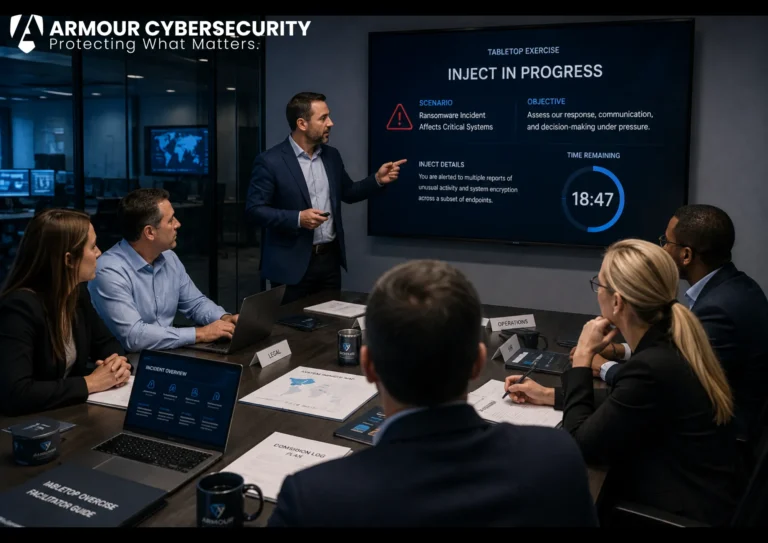
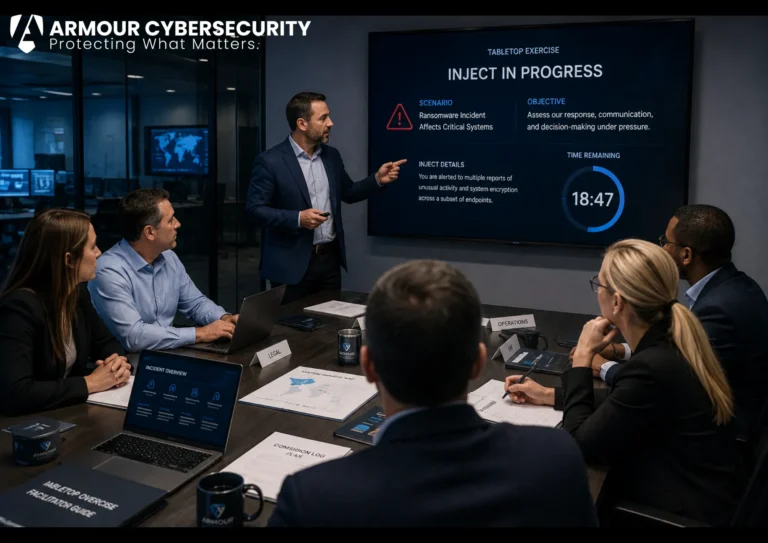
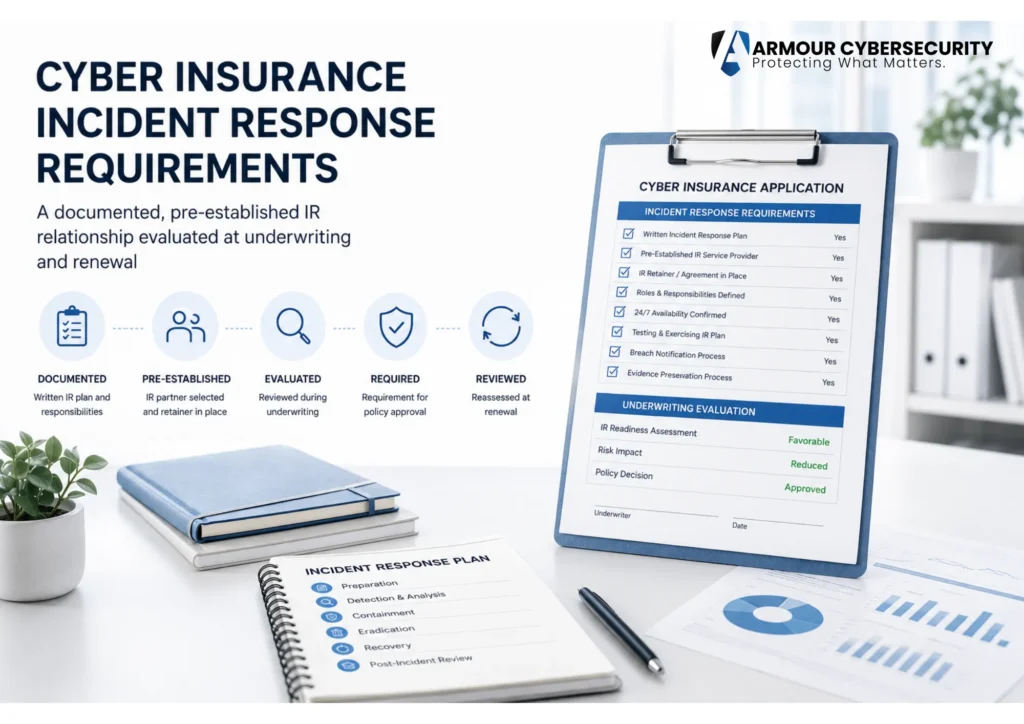
Cyber insurance applications have grown substantially more detailed over the past several years as carriers have refined their understanding of which controls are most predictive of claim frequency and severity. The incident response section of a typical mid-market application now includes questions about whether the organization has a written incident response plan (and when it was last tested or updated), whether a third-party IR firm is retained (and if so, which firm and what the response time guarantee is), whether the organization has ever engaged the IR firm in a tabletop exercise or simulation, and whether the IR firm has conducted a proactive assessment of the organization’s environment. Affirmative answers to all of these questions, backed by documentation, position the organization as a better-controlled risk than a competitor whose answers reflect a we-will-call-someone-if-something-happens posture.
Carriers do not ask these questions as a formality. The questions reflect actuarial analysis of loss data: organizations with pre-established IR relationships have shorter dwell times, faster, lower-cost incident responses, and smaller claims than organizations that engage IR for the first time during an active incident. The underwriter’s goal is to distinguish between organizations whose incident response posture is a control strength and organizations whose posture is a gap that will produce a larger claim when an incident occurs. A signed retainer with documented onboarding and a guaranteed response time is the clearest evidence available that the posture is a strength.
Panel forensic obligations: understanding your policy
Many cyber insurance policies, particularly those issued by major carriers, include provisions specifying that certain approved vendors must be used for forensic investigation following a covered incident. These panel forensic provisions exist because the carrier has negotiated rates and quality standards with the approved firms, and because using the approved firm ensures that the forensic process meets the documentation standards the carrier requires for claims processing. Organizations that engage a non-panel firm without carrier approval may find that the forensic costs are not covered, or that the forensic report does not meet the standards required for claims documentation.
Organizations with an IR retainer in place should confirm whether their retainer firm is on the carrier’s approved panel and whether the retainer relationship must be disclosed to the carrier prior to an incident. Some carriers require that retainer relationships with non-panel firms be disclosed at policy inception or at renewal. Others allow any qualified IR firm to be retained but require that the panel firm be notified when a covered incident is declared. Understanding the policy terms before an incident occurs, rather than discovering the panel provision during an active claim, is essential for avoiding coverage complications.
What Happens at Claims Time
The first calls when an incident occurs
Most cyber insurance policies require that the insured notify the carrier promptly when a covered incident is suspected or confirmed. Prompt notification is typically defined in the policy; some policies require notification within 24 to 72 hours of discovering that a potential covered event has occurred. Delayed notification can create coverage issues. The first calls when an incident is detected should therefore include the carrier or the breach coach line, alongside the IR retainer activation call. Organizations that have a retainer in place and have reviewed their notification obligations know exactly which calls to make and in what order. Organizations without a retainer are often so focused on finding IR capacity that the carrier notification is delayed.
The breach coach engaged by the carrier coordinates the legal aspects of the response from the first call. In most policies, the breach coach is the quarterback of the response: they coordinate with the technical IR team, advise on regulatory notification obligations, manage external communications, and provide privilege protection for the incident documentation where attorney-client privilege applies to the investigation. A technical IR team that is unfamiliar with breach coach coordination adds friction to this process. A team that has worked within breach coach coordination before, and that is familiar with the documentation standards the carrier expects, produces a smoother coordinated response.
The documentation the carrier reviews
The claims process for a cyber insurance policy is a documentation review. The carrier’s claims team reviews the forensic report to understand what happened, the containment and eradication log to assess whether reasonable steps were taken to limit the breach, the incident timeline to evaluate the response speed and decisions made, the notification documentation to confirm that regulatory obligations were met, and the post-incident report to understand what the total impact was and what improvements have been made. A retainer firm that produces comprehensive, standardized documentation as a standard deliverable of its response methodology provides exactly the evidence package the carrier needs. An improvised response, even a technically effective one, that does not produce structured documentation creates gaps that complicate the claims process and may require additional investigation to close.
Across the 260+ organizations Armour Cybersecurity protects in 52+ industries, the claims that settle cleanly are consistently the ones where the response produced an auditable record from the first hour, and the organizations that produced that record are almost always the ones that had the response relationship, and its documentation standards, in place before the incident rather than assembled during it.
Armour Cybersecurity’s zero dollar IR retainer produces all of these documentation deliverables as standard outputs of the response lifecycle: the incident triage report, the containment and eradication log, situational awareness briefings, the forensic investigation report, the post-incident report, and where the scope allows, customized playbooks and runbooks for future incident types. These deliverables are structured for use in insurance claims, regulatory reporting, and legal proceedings as required. The retainer model, with no upfront block-hour commitment and payment only on actual incident consumption, removes the budget barrier to establishing the relationship before a claim occurs.
Frequently Asked Questions
Will a Zero Dollar Retainer satisfy my carrier’s IR relationship requirement?
In most cases, yes. Cyber insurance carriers that require evidence of a pre-established IR relationship are looking for a signed agreement with a defined activation path, a documented response time guarantee, and evidence that the IR firm has been onboarded to the organization’s environment. A Zero Dollar IR Retainer satisfies all three criteria: it is a signed twelve-month agreement, it provides a guaranteed 24-hour remote response activation, and the onboarding workshop produces the documented asset and stakeholder inventory that demonstrates onboarding has occurred. Carriers and their counsel should review the specific terms to confirm alignment with any policy-specific requirements, particularly panel forensic provisions that may specify the approved vendor list.
Do I need to tell my carrier about the retainer before an incident?
Disclosure requirements vary by policy. Some policies require the insured to identify retained IR firms at policy inception or renewal. Others have no pre-incident disclosure requirement but require immediate notification of the carrier and breach coach when an incident occurs. Reading the relevant sections of your policy, specifically the definitions of covered incident, the notification requirements, and any panel forensic provisions, before an incident occurs is the only way to confirm your specific obligations. If the policy language is unclear, the broker who placed the coverage or the carrier’s underwriting team can clarify the requirement. Discovering a disclosure requirement during an active claim is significantly more disruptive than understanding it in advance.
What if my carrier has a panel forensic requirement and the retainer firm is not on the panel?
The appropriate response is to address this before an incident rather than during one. Options include confirming with the carrier whether the retainer firm can be added to the approved panel or whether a co-engagement model, where the panel firm leads forensics and the retainer firm supports the response, is acceptable. Some organizations with strong preferences for a specific IR firm negotiate the approved vendor list as part of the policy placement rather than accepting the carrier’s default panel. The broker who placed the coverage is the right resource for navigating this negotiation. What is not a viable option is discovering the panel requirement for the first time during an active claim and being forced to choose between engaging the required panel firm cold, without prior relationship or onboarded context, or engaging the preferred retainer firm and risking the forensic cost coverage.
How should we document our retainer relationship for the insurance application?
The documentation the carrier is typically looking for is the signed retainer agreement, which establishes the relationship and the response time guarantee; the onboarding documentation, which evidences that the IR firm has been engaged with and familiarized with the organization’s environment; and any tabletop exercise or simulation records if those have been conducted. The retainer agreement should be retained in the organization’s insurance and compliance documentation file alongside the cyber policy itself. At renewal, the renewal application should reference the retainer relationship and its status, including whether any incidents occurred during the term and, if so, how they were managed. This documentation builds the loss history narrative that supports favorable renewal terms over time.
The Bottom Line
Cyber insurance has quietly turned incident response readiness into an underwriting requirement. Carriers now ask whether you have a documented IR relationship, an onboarded firm, and a guaranteed response time, because their own loss data shows those organizations file smaller claims. The retainer you put in place does double duty: it wins better terms at underwriting and renewal, and it produces the forensic report, containment log, and timeline the carrier reviews at claims time. The organizations that struggle at claims time are the ones that met their IR firm during the loss and have no structured record to show for it. Armour Cybersecurity’s zero dollar IR retainer establishes that documented relationship with no upfront cost, so the readiness your carrier expects is in place before renewal, and the evidence your carrier reviews is in place before the claim.
About the author
David Chernitzky is the CEO and Co-Founder of Armour Cybersecurity, a Toronto-based firm that protects organizations across North America from advanced cyber threats. He brings more than 25 years of cybersecurity and military cyber intelligence experience, having served as an officer in an elite technology unit before co-founding Armour. Armour’s team of military-intelligence veterans and senior advisors serves 260+ clients across 52+ industries with a 97% client retention rate. Learn more about Armour Cybersecurity.