By David Chernitzky, CEO, Armour Cybersecurity · Serving Toronto and organizations across North America · Last updated August 21, 2026
Quick Answer
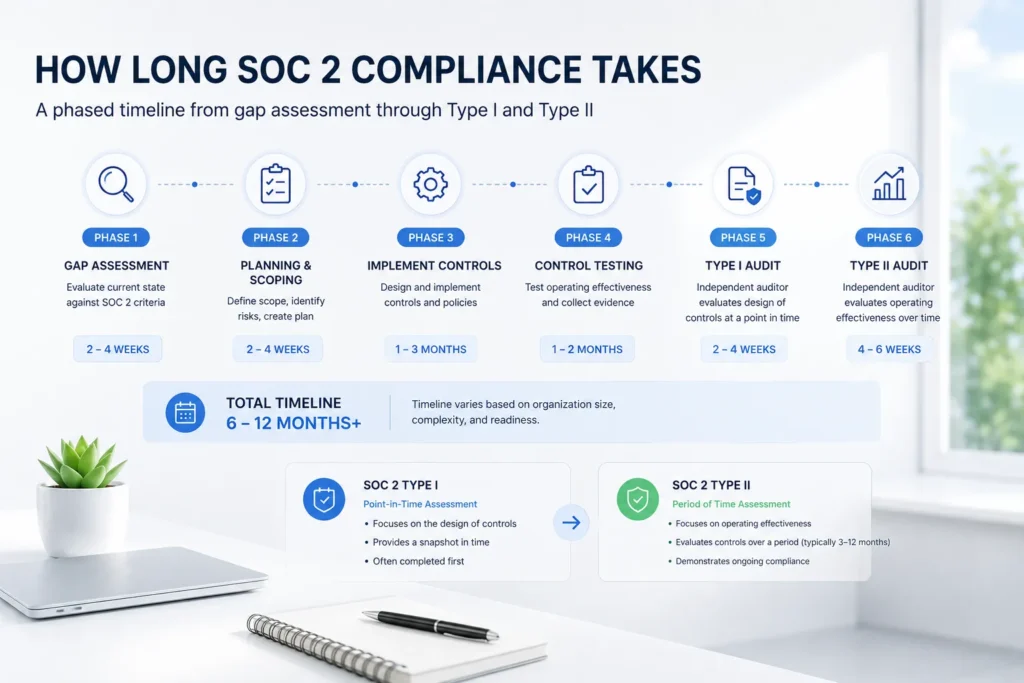
A SOC 2 Type I audit report can typically be obtained within 3 to 5 months from the start of a structured readiness program. SOC 2 Type II adds a 3 to 12 month observation period on top of that. With a structured engagement and dedicated internal resources, Armour Cybersecurity’s integrated compliance audit program gets organizations to audit-ready status in 4 to 6 weeks. The total timeline depends heavily on your starting security posture and the availability of key stakeholders.
Key Takeaways
- Gap assessment and readiness work typically takes 4 to 8 weeks depending on organizational size and starting posture.
- Remediation of identified gaps is the most variable phase. Organizations with mature controls remediate in weeks. Organizations starting from a low baseline may need 2 to 4 months.
- The formal Type I audit takes 3 to 5 weeks once the auditor engages. Type II requires a 3 to 12 month observation period before the audit can conclude.
- The most common cause of timeline delays is internal resource availability, not the complexity of the compliance requirements.
- Organizations with a customer contract deadline or investor requirement driving the timeline should start the readiness process immediately, before they believe they are ready, because the gap assessment reveals what is actually needed.
Why Does the SOC 2 Timeline Vary So Much?
Organizations seeking SOC 2 guidance frequently receive timeline estimates that range from two months to two years. Both ends of that range are real outcomes, but they describe very different organizational situations. Understanding what drives the timeline makes it possible to assess where your organization sits and what is required to accelerate.
The primary driver of timeline variance is the gap between the organization’s current security posture and what SOC 2 requires. An organization that has already implemented a mature security program, documented its policies, deployed endpoint protection, enabled multi-factor authentication across all systems, and built an incident response process is in a very different position than an organization that is implementing formal security controls for the first time. The gap assessment at the start of the process reveals the actual distance and the work required to close it.
The secondary driver is internal resource availability. SOC 2 requires dedicated time from engineering, IT, security, legal, and leadership teams. Organizations where these stakeholders are fully committed to product delivery and have no bandwidth allocated for compliance work will see timelines extend because remediation actions are deprioritized. The organizations that move fastest have named an internal compliance owner, allocated engineering time for security improvements, and engaged leadership in the process from the beginning.
Phase 1: Gap Assessment and Readiness (Weeks 1 to 6)
The gap assessment is the starting point of every SOC 2 engagement. An experienced compliance adviser conducts a structured review of the organization’s current security controls, policies, and processes against the AICPA Trust Service Criteria. This involves stakeholder interviews with engineering, IT, HR, legal, and leadership, documentation review of existing policies and procedures, and a technical review of systems in scope.
The output of the gap assessment is a control-by-control gap analysis showing which controls are fully implemented, which are partially implemented, and which are missing or inadequate. For each gap, the assessment provides a remediation recommendation with an estimated effort and cost. A compliance readiness score gives leadership a clear picture of where the organization stands relative to audit-ready status.
Armour Cybersecurity structures Phase 1 to complete within 3 to 4 weeks for a typical SMB or mid-market technology company. The timeline extends for larger organizations with more complex environments, more systems in scope, or more stakeholders who need to be interviewed. The deliverable is a remediation roadmap that drives Phase 2.
Phase 2: Remediation (Weeks 4 to 16 Depending on Gap Depth)
Remediation is the phase where gap findings are closed. This is the most variable phase of the SOC 2 journey and the one where most timelines are either made or broken. Organizations that begin remediation immediately after the gap assessment and dedicate consistent internal resources to the work can complete it in four to six weeks. Organizations that deprioritize remediation, assign it to staff who do not have bandwidth, or discover mid-remediation that additional infrastructure changes are needed may spend three to four months on this phase.
Common remediation activities include implementing multi-factor authentication across all critical systems, deploying endpoint detection and response on employee devices, formalizing a vulnerability management program with defined scanning frequencies and remediation timelines, writing and approving security policies that the organization actually follows, establishing a formal incident response process with defined roles and escalation paths, and implementing access review procedures that produce evidence at the required frequency.
Policy development is frequently underestimated in the remediation phase. SOC 2 requires documented policies for information security, access management, change management, incident response, risk management, vendor management, and business continuity, among others. Writing policies that accurately describe how the organization actually operates, obtaining management approval, and communicating them to staff takes time. Organizations that treat policy development as a documentation exercise separate from operational practice create policies that their teams do not follow, which generates Type II findings.
Phase 2 Readiness Check: Simulated Audit (Weeks 6 to 10)
Before engaging the formal auditor, Armour Cybersecurity conducts a readiness examination that simulates the evidence requests and review procedures of the actual audit. This proactive step identifies residual gaps in control implementation and evidence collection that would otherwise surface during the formal audit as findings.
The readiness check tests whether the organization can respond to auditor requests efficiently and completely. A common gap at this stage is evidence completeness: controls that are operating correctly but whose evidence is not being collected, organized, or retained in a way that supports auditor review. The readiness check reveals these gaps and provides specific guidance on what evidence to collect and how to present it.
Organizations that skip the readiness check and engage the formal auditor directly are taking a risk. Findings discovered during the formal audit extend the timeline and increase cost. Findings discovered in the readiness check are addressed before the clock starts on the formal audit.
Phase 3: Formal Audit (Weeks 8 to 16 from Engagement Start for Type I)
The formal Type I audit is conducted by an independent CPA firm. The auditor reviews the organization’s description of its system, tests the design of controls against the AICPA criteria, and issues a report expressing an opinion on whether the controls are suitably designed. For an organization that is genuinely audit-ready, the Type I audit typically takes three to five weeks from the start of auditor fieldwork to report issuance.
The audit timeline depends on how efficiently the organization can respond to evidence requests. Auditors submit information requests for policies, system configurations, vendor contracts, organization charts, and other documentation. The faster the compliance owner can pull and deliver that information, the faster the audit proceeds. Organizations that have organized their evidence according to the auditor-ready documentation guide from the readiness phase respond to requests in hours rather than days.
Adding the Type II Observation Period
SOC 2 Type II requires a defined observation period, typically three to twelve months, during which the auditor tests whether controls operated effectively. The observation period can begin as soon as controls are implemented and operating, which means it should start at the beginning of the remediation phase rather than after the Type I audit is complete.
An organization that begins its observation period at the start of remediation and completes a Type I audit at month four is three to four months into its Type II observation period by the time the Type I report is issued. If the observation period is six months, the Type II audit can begin at month seven. Total time from program start to Type II report: nine to ten months. Organizations that wait until after the Type I report to start their observation period add three to six months to the overall timeline unnecessarily.
What Can Shorten the Timeline?
The most effective way to shorten the SOC 2 timeline is to have a strong starting posture. Organizations that have already deployed MFA across all systems, implemented endpoint protection, documented incident response procedures, and established vendor risk management processes will have fewer gaps to remediate. The gap assessment for these organizations produces a shorter remediation roadmap, which compresses Phase 2.
Compliance automation platforms accelerate evidence collection and control monitoring. Tools that continuously monitor control status, collect evidence automatically, and generate audit-ready reports reduce the manual effort required during both the observation period and the formal audit. Armour Cybersecurity’s program integrates with leading compliance automation platforms to reduce the internal burden on your team.
Internal resource allocation is the controllable variable that most organizations underestimate. Naming a dedicated compliance owner, allocating defined engineering hours for remediation tasks, and engaging leadership to approve policies promptly all reduce the calendar time between gap identification and remediation completion. An organization where remediation tasks sit unassigned in a backlog for weeks is one where the timeline extends, not because the work is hard, but because it is not prioritized.
Across the 260+ organizations Armour Cybersecurity protects in 52+ industries, the SOC 2 timelines that blow out are rarely the ones with the hardest technical gaps. They are the ones where no single person owned the program, so remediation tasks waited in a backlog while the calendar kept moving, and the audit that could have closed in four months closed in ten.
Frequently Asked Questions
What is the fastest realistic path to a SOC 2 report?
For an organization with a reasonably mature security posture, the fastest path to a Type I report is approximately ten to twelve weeks: three to four weeks for gap assessment, four to six weeks for targeted remediation, and three to four weeks for the formal audit. Organizations starting from a lower baseline should expect sixteen to twenty weeks for Type I. Cutting corners on readiness to accelerate the formal audit almost always produces the opposite result through findings that require remediation and delay report issuance.
Can we pursue SOC 2 while also running a product launch or fundraising round?
Yes, but resource allocation is the critical constraint. SOC 2 readiness requires consistent time from engineering, IT, and leadership. If those resources are simultaneously committed to a product launch or investor due diligence process, remediation timelines will extend. The most effective approach is to start the gap assessment before the competing priority peaks, so the remediation roadmap is defined and sequenced before internal bandwidth tightens.
What if we have a customer deadline that is earlier than the realistic timeline?
The gap assessment should happen immediately. It reveals what is actually required and what can be achieved within the available timeline. Some customers will accept a Type I report with evidence of a Type II observation period in progress. Some will accept a security questionnaire response backed by documented control evidence even before a formal audit. Understanding exactly what the customer requires, and knowing which standard your customers require, often reveals more flexibility than the initial request implies.
Does the timeline change for HIPAA or PCI DSS compared to SOC 2?
HIPAA readiness typically takes three to four weeks for Phase 1, with remediation timelines similar to SOC 2 depending on starting posture. PCI DSS assessments are typically four to six weeks for readiness, with more complex technical remediation for organizations with significant cardholder data environment scope. ISO 27001 readiness runs four to six weeks. In an integrated engagement covering multiple frameworks, the total timeline is typically ten to thirty percent longer than single-framework engagements, not double, because of the shared control overlap.
The Bottom Line
The honest answer to how long SOC 2 takes is that the calendar is mostly in your hands. Type I runs three to five months and Type II adds a three to twelve month observation window, but within those ranges the deciding factors are your starting posture and whether someone actually owns the work. Start the gap assessment early, even before you feel ready, because it tells you the real distance; begin the Type II observation period the moment controls are live rather than after the Type I report; and give the program a named owner so remediation does not stall in a backlog. Armour Cybersecurity’s integrated compliance audit program gets organizations to audit-ready in 4 to 6 weeks and runs the process from gap assessment through independent audit, so the timeline is driven by a plan instead of by whatever bandwidth is left over.
About the author
David Chernitzky is the CEO and Co-Founder of Armour Cybersecurity, a Toronto-based firm that protects organizations across North America from advanced cyber threats. He brings more than 25 years of cybersecurity and military cyber intelligence experience, having served as an officer in an elite technology unit before co-founding Armour. Armour’s team of military-intelligence veterans and senior advisors serves 260+ clients across 52+ industries with a 97% client retention rate. Learn more about Armour Cybersecurity.