By David Chernitzky, CEO, Armour Cybersecurity · Serving Toronto and organizations across North America · Last updated August 21, 2026
Quick Answer
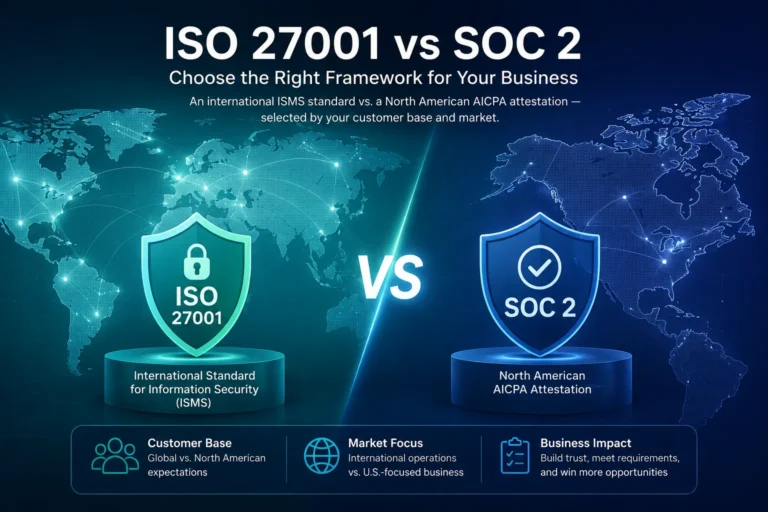
SOC 2 is the dominant standard for US-based SaaS and cloud service providers selling to enterprise buyers. ISO 27001 is the international standard, required for organizations operating in EU, UK, and other non-North American markets. The two standards share approximately 80 percent of the same underlying controls, which means a well-structured integrated compliance engagement can address both in a single readiness cycle rather than treating them as separate projects.
Key Takeaways
- SOC 2 is a US-centric AICPA framework that produces a confidential audit report shared with customers under NDA. It is market-driven and not a public certification.
- ISO 27001 is an internationally recognized certification that is publicly verifiable, valid for three years, and required for operating in EU, UK, and many international enterprise markets.
- The two standards share roughly 80 percent of their underlying control requirements. Organizations serving both US and international markets typically pursue them together.
- SOC 2 is scoped to the specific services your organization provides. ISO 27001 requires a formal Information Security Management System covering the organization’s defined scope.
- A properly structured integrated engagement addresses both standards from a shared control framework, avoiding duplication and reducing total cost and timeline.
What Problem Does Each Standard Solve?
Both SOC 2 and ISO 27001 exist to answer the same fundamental question from customers, partners, and regulators: can we trust that this organization manages information security responsibly? They answer that question in different ways, for different markets, through different mechanisms.
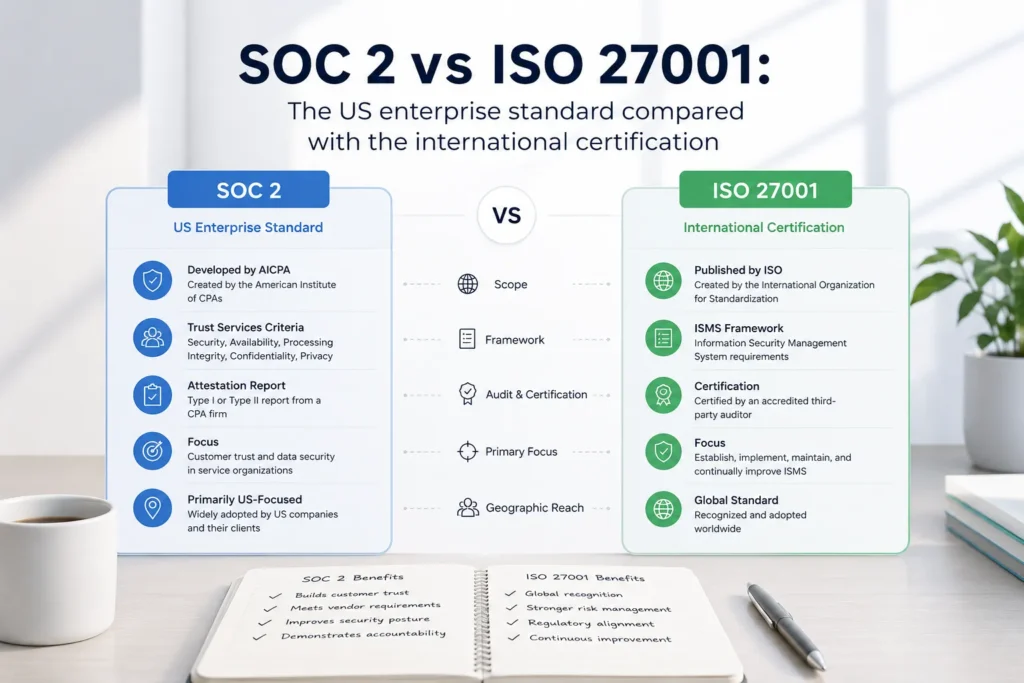
SOC 2 was created by the American Institute of Certified Public Accountants to address the needs of US enterprise buyers who needed a standardized way to assess the security of their SaaS and cloud vendors. Rather than each buyer conducting individual assessments of every vendor, a SOC 2 report from an independent CPA firm provides a standardized, professionally verified answer to the security question. The report is shared under non-disclosure agreement with customers who request it.
ISO 27001 was developed by the International Organization for Standardization and the International Electrotechnical Commission to address a global market need. It requires organizations to build and maintain a formal Information Security Management System: a documented, risk-based approach to managing information security that covers people, processes, and technology. ISO 27001 certification is granted by an accredited certification body after a formal audit, is publicly verifiable, and must be renewed through surveillance audits and three-year recertification cycles.
How Is the Audit Process Different?
SOC 2 is audited by an independent CPA firm. The AICPA controls who can issue SOC 2 reports, and the report format is standardized. The audit produces a written report that the organization shares with customers under NDA. There is no public registry of organizations that hold SOC 2 reports, and competitors cannot see your report unless you choose to share it. The report expires when it is no longer current, typically after twelve months for Type II, and must be renewed annually.
ISO 27001 is audited by an accredited certification body. Certification is recorded in a public registry and can be verified by anyone. The certificate is valid for three years, subject to annual surveillance audits that verify the management system continues to meet requirements. The public verifiability of ISO 27001 certification is one of its primary advantages in international markets: a procurement team in Germany or the UK can verify certification status independently without receiving a confidential report.
The practical implication is that ISO 27001 is often simpler to demonstrate in international enterprise sales cycles. Instead of distributing a confidential report, the vendor can point to a public certificate. SOC 2, while more trusted by US enterprise buyers, requires a more involved distribution process and is not publicly verifiable.
What Controls Do the Two Standards Require?
Both standards require organizations to implement controls across the same fundamental security domains: access management, risk assessment, change management, incident response, business continuity, vendor management, physical security, and security monitoring. The framing and specific requirements differ, but the underlying security hygiene that both standards assess is largely the same.
ISO 27001 requires the organization to build a formal management system, which means documented policies, a risk assessment process, a risk treatment plan, and evidence that the management system is operating and improving. The Annex A controls cover 93 specific areas organized into four categories: organizational controls, people controls, physical controls, and technological controls.
SOC 2 organizes requirements around the five Trust Service Criteria and the AICPA’s Common Criteria, which map to the COSO framework. The Security criterion, which is mandatory, covers access controls, system operations, change management, risk management, monitoring, and incident response. Additional criteria add requirements for availability, processing integrity, confidentiality, and privacy.
The 70 to 80 percent control overlap between the two standards is the reason that integrated engagements make financial and operational sense. An organization that implements SOC 2 controls correctly has already built most of what ISO 27001 requires. The incremental work to achieve ISO 27001 certification alongside SOC 2 is significantly less than pursuing it as a standalone project.
Which Standard Do Your Customers Actually Require?
The answer depends on where your customers are and what sector they operate in. US enterprise buyers, particularly in technology, financial services, and healthcare, almost universally require SOC 2 Type II. SOC 2 is embedded in US enterprise procurement processes, infosec review checklists, and vendor onboarding requirements. An organization that cannot provide a current SOC 2 report to a US enterprise buyer is at a significant disadvantage in the sales cycle.
European buyers, UK organizations post-Brexit, and enterprise customers in Asia-Pacific, Middle East, and other international markets are more likely to require or prefer ISO 27001 certification. The international recognition and public verifiability of ISO 27001 aligns with how procurement works outside North America. Some international buyers also accept SOC 2, particularly those with North American operations, but ISO 27001 is the baseline expectation in most non-US enterprise markets.
Canadian enterprise buyers present a mixed picture. Larger organizations with significant US business relationships or US parent companies tend to follow US procurement patterns and require SOC 2. Organizations that operate primarily in Canadian domestic markets or in regulated sectors with European relationships more commonly require ISO 27001 or accept either. Canadian government procurement increasingly aligns with frameworks like NIST and SOC 2, though ISO 27001 is widely recognized.
The practical answer for most growth-stage technology companies is to pursue SOC 2 first, because it unblocks US enterprise sales cycles, and to add ISO 27001 as a parallel or follow-on engagement when international market requirements become concrete. The integrated engagement model makes adding ISO 27001 alongside SOC 2 significantly more efficient than pursuing them sequentially.
What Does Each Engagement Actually Produce?
A SOC 2 engagement produces a formal audit report issued by an independent CPA firm. The report includes the service auditor’s opinion, a description of the system under review, management’s assertion about the controls, and the auditor’s findings. This report is distributed to customers under NDA and is the artifact that enterprise procurement teams review during vendor security assessments.
An ISO 27001 engagement produces a certificate of conformity issued by an accredited certification body, valid for three years. The certificate can be listed on the organization’s website, included in procurement responses, and verified publicly. The certification body issues a surveillance audit annually to verify the management system continues to operate, and a recertification audit every three years.
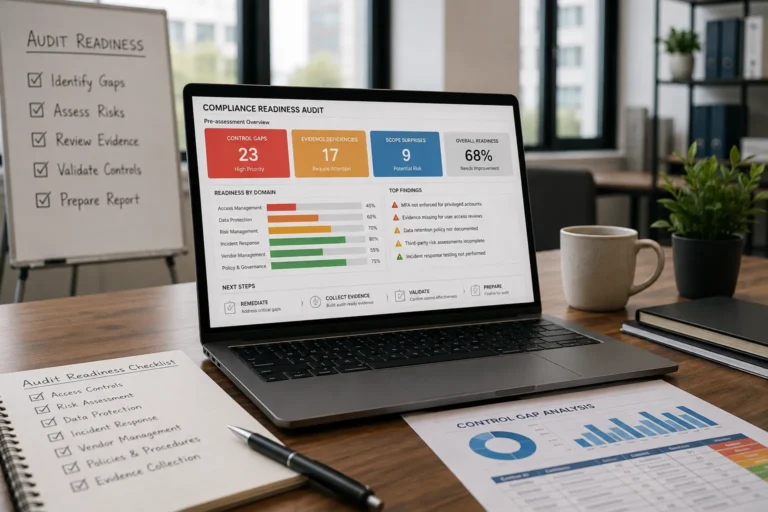
Both engagements benefit from a readiness phase before the formal audit. The readiness phase identifies gaps between the organization’s current state and the standard’s requirements, produces a remediation roadmap, and prepares the organization to respond to auditor requests efficiently. An organization that goes directly to audit without a readiness phase will typically encounter findings that delay certification and increase total cost.
How Does an Integrated Engagement Work?
An integrated SOC 2 and ISO 27001 engagement begins with a unified gap assessment against both standards simultaneously. Because the control requirements overlap significantly, a single stakeholder interview program and documentation review produces gap findings relevant to both frameworks. The remediation roadmap identifies which gaps affect SOC 2 only, which affect ISO 27001 only, and which affect both.
Remediation work is sequenced to address shared controls first. A single policy development effort produces documents that satisfy both frameworks. A single access management implementation addresses the access control requirements of both. The incremental work for the second framework is focused on the areas where requirements diverge, which is a fraction of the total effort required by two independent engagements.
Armour Cybersecurity structures its integrated compliance audit program to deliver both frameworks from a single readiness cycle, reducing total time, cost, and stakeholder burden compared to sequential independent engagements. The program covers all three phases from gap assessment through independent audit and certification support.
Across the 260+ organizations Armour Cybersecurity protects in 52+ industries, the companies that end up paying twice for compliance are almost always the ones that treated the second certification as a brand-new project a year later, rebuilding the same access reviews, the same policies, and the same evidence they already had, instead of mapping both standards to one control set from the start.
Frequently Asked Questions
Should we get SOC 2 or ISO 27001 first if we can only do one?
If your primary sales market is North America, start with SOC 2. It unblocks more US and Canadian enterprise sales cycles and is more immediately recognized by the procurement processes you are likely to encounter. If your primary market is Europe or if you are already in active procurement discussions with international buyers requiring ISO 27001, start there. If both markets matter, the integrated engagement route is the most efficient path.
Is ISO 27001 harder to maintain than SOC 2?
ISO 27001 has a more formal maintenance structure. Annual surveillance audits verify the management system continues to operate, and three-year recertification requires a full audit cycle. SOC 2 requires annual re-audit to maintain a current report. The ongoing effort is comparable. ISO 27001 requires more management system documentation and formal management review processes. SOC 2 requires continuous evidence collection across the observation period. Both require ongoing operational discipline, not just audit-time activity.
Can we use our SOC 2 controls as the starting point for ISO 27001?
Yes, and this is the most efficient approach. An organization that has completed SOC 2 readiness and implemented the required controls has addressed the majority of ISO 27001 Annex A requirements. The gap work for ISO 27001 then focuses on the formal management system elements that ISO 27001 specifically requires, including the documented ISMS scope, the formal risk assessment and treatment process, management review records, and the additional Annex A controls that fall outside the SOC 2 Trust Service Criteria. Armour conducts this gap mapping at the start of the integrated engagement.
What is the cost difference between pursuing them together versus sequentially?
Pursuing SOC 2 and ISO 27001 together through an integrated engagement typically costs 30 to 50 percent less than pursuing them sequentially. Sequential engagements duplicate the gap assessment, stakeholder interviews, evidence collection, and readiness work for each standard. Integrated engagements perform that shared work once and focus incremental effort on framework-specific gaps. The timeline savings are similarly significant: two sequential programs might span eighteen to twenty-four months, while an integrated program can achieve both certifications in twelve to sixteen months.
The Bottom Line
SOC 2 or ISO 27001 is not really a question about which standard is better; it is a question about where your customers are. SOC 2 is the report US enterprise procurement expects, shared under NDA and renewed yearly. ISO 27001 is the publicly verifiable certificate that international buyers look for, valid for three years. Because the two share roughly 80 percent of their controls, the organizations that need both waste money whenever they treat the second as a separate project instead of mapping both to one control set from the start. Armour Cybersecurity’s integrated compliance audit program delivers SOC 2 and ISO 27001 from a single readiness cycle, gap assessment through independent certification, with Big 4 advisory depth and military-trained advisors, so you earn the certification your market requires now without paying twice for the one it requires next.
About the author
David Chernitzky is the CEO and Co-Founder of Armour Cybersecurity, a Toronto-based firm that protects organizations across North America from advanced cyber threats. He brings more than 25 years of cybersecurity and military cyber intelligence experience, having served as an officer in an elite technology unit before co-founding Armour. Armour’s team of military-intelligence veterans and senior advisors serves 260+ clients across 52+ industries with a 97% client retention rate. Learn more about Armour Cybersecurity.