By David Chernitzky, CEO & Co-Founder, Armour Cybersecurity · Toronto-based, serving organizations across North America · Last updated July 28, 2026
Quick answer: Cybersecurity myths quietly cost small and midsize businesses real money. The five most damaging ones all share the same flaw: they assume attackers think the way you do. Below is the reality behind each myth, from “we are too small to target” to “security is a one-time purchase,” and the practical steps that close the gap.
Key Takeaways
- Attackers pick targets by opportunity, not size. Automated scanners find weak systems whether or not anyone singled you out.
- Antivirus alone misses fileless attacks, zero-days, and phishing. Layered defense catches what any single tool lets through.
- Most breaches involve a human element, so security has to reach every employee, not just the IT team.
- Having no credit card data does not make you safe. Credentials, internal access, and your supply-chain connections are all worth stealing.
- Security is an ongoing practice, not a one-time purchase. Threats change weekly, and defenses have to keep pace.
Cybersecurity myths are costing small and medium-sized businesses more than they realize. In 2026, cybercriminals are not just going after Fortune 500 giants. They exploit the blind spots of everyday companies that still believe it will not happen to them.
The reality is simple: cybersecurity is not just a technical issue, it is a business survival strategy. Yet too many organizations still operate on outdated assumptions that leave their systems and data exposed. Whether you handle security in-house or partner with a trusted cybersecurity services provider, clearing up these myths is the first step toward real protection.
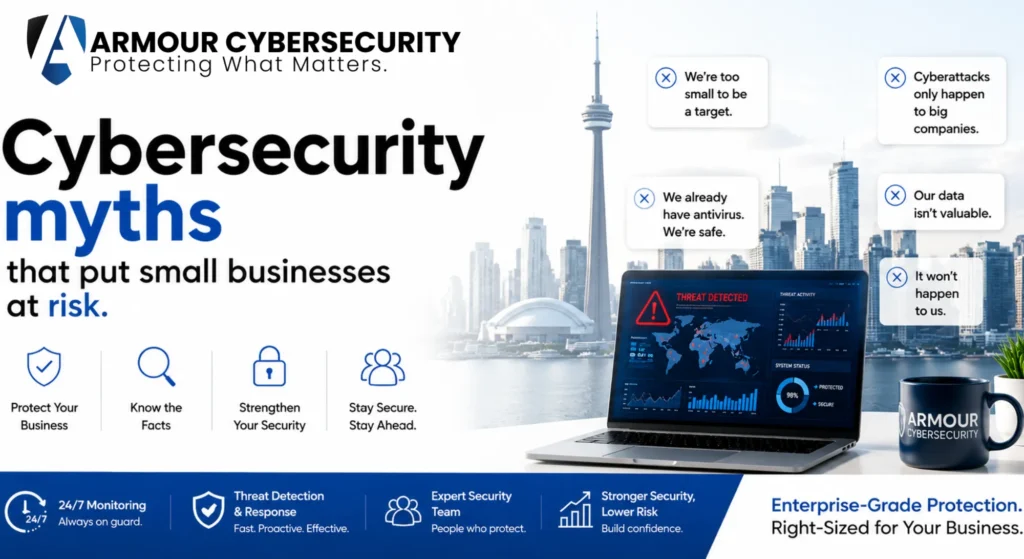
Below are five of the most common cybersecurity myths putting your business at risk, and what to do about each one.
Myth 1: “Small Businesses Are Not Targets”
Reality: Attackers do not care how big your company is. They care about opportunity. Verizon’s Data Breach Investigations Report consistently shows that a large share of breaches hit small and medium-sized businesses, which often lack the layered defenses, dedicated security teams, and monitoring that larger enterprises have in place.
Attackers also run automated scanning tools that sweep the internet for exposed systems. Your business does not need to be singled out to become a victim. If your website, email server, or remote access system has a weak spot, a bot will find it. IBM’s Cost of a Data Breach research has put the average breach at organizations with fewer than 500 employees at around $3.3 million, a devastating figure for most SMBs.
Action step:
- Run a cybersecurity posture assessment to find gaps before attackers do.
- Enforce Multi-Factor Authentication (MFA) across all accounts.
- Keep systems current with regular patching and updates.
- Maintain automated, tested backups, ideally stored offsite or in the cloud.
Even a modest investment in these basics, backed by managed cybersecurity services, sharply reduces your attack surface.
Myth 2: “Antivirus Alone Is Enough”
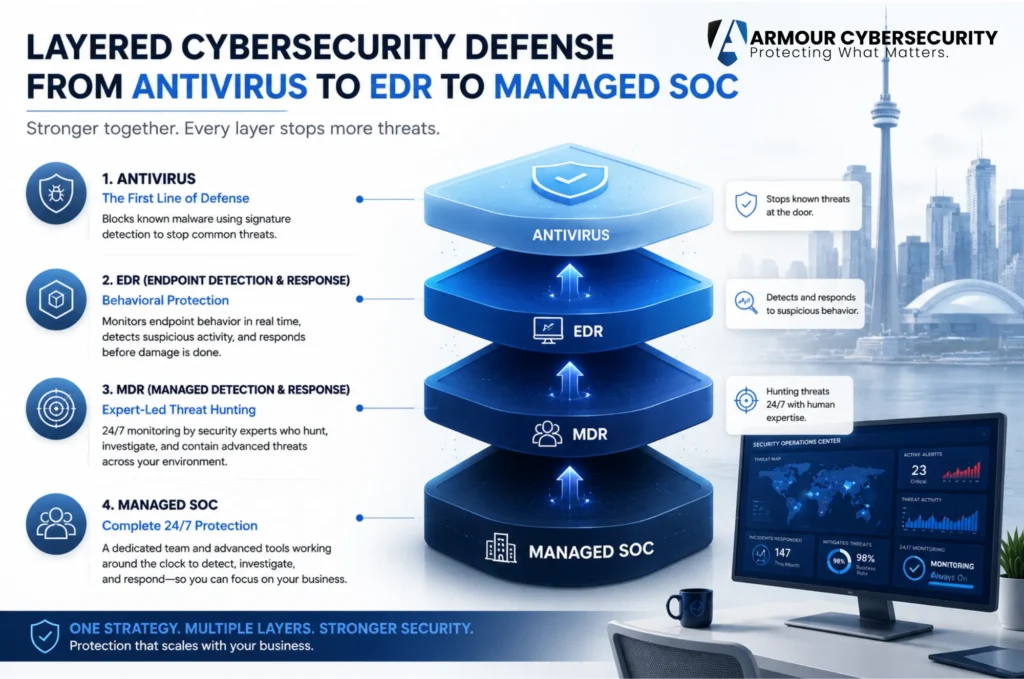
Reality: Traditional antivirus was built for a simpler era, one dominated by known malware signatures. Today’s threats are stealthier. Fileless attacks, zero-day exploits, and phishing-based intrusions slip past legacy antivirus completely. CISA has warned that attackers increasingly abuse legitimate software and processes, which makes signature-based tools far less effective on their own.
Action step:
- Adopt a layered, defense-in-depth approach.
- Use Endpoint Detection and Response (EDR) to catch what antivirus misses.
- Put firewalls and intrusion detection systems in place.
- Add continuous monitoring through SIEM and a managed SOC.
A layered model means threats get caught early, even when one defense fails.
Myth 3: “Cybersecurity Is Just IT’s Job”
Reality: Cybersecurity is a shared business responsibility, not an IT department checkbox. A single click from an untrained employee can lead to ransomware, data theft, or compliance penalties. Verizon’s 2024 DBIR found that 68% of breaches involved a non-malicious human element, whether error, misuse, or social engineering.
Action step:
- Provide organization-wide security awareness training at least quarterly.
- Get executives and board members treating cybersecurity as a strategic risk, not just a technical one.
- Build security into vendor management, insurance, and business continuity planning through ongoing advisory services.
Security culture starts at the top and has to reach everyone.
Myth 4: “We Do Not Store Sensitive Data, So We Are Safe”
Reality: Even if you do not store credit cards or health records, you are still a target. Attackers value employee credentials, internal access, intellectual property, and a path into your supply chain partners. Third-party and supply-chain attacks have climbed sharply. Verizon’s DBIR reported breaches involving a third party doubling to 30% in 2025, often using smaller firms as the entry point into larger networks.
This matters even more for high-net-worth and family office environments, where financial data, estate information, and sensitive personal records are handled daily, making even small operations prime targets.
Action step:
- Protect all data, not just customer information, with proper cloud security controls.
- Apply network segmentation and least-privilege access.
- Monitor for suspicious activity, even on low-traffic systems.
Attackers exploit what you overlook.
Myth 5: “Cybersecurity Is a One-Time Investment”
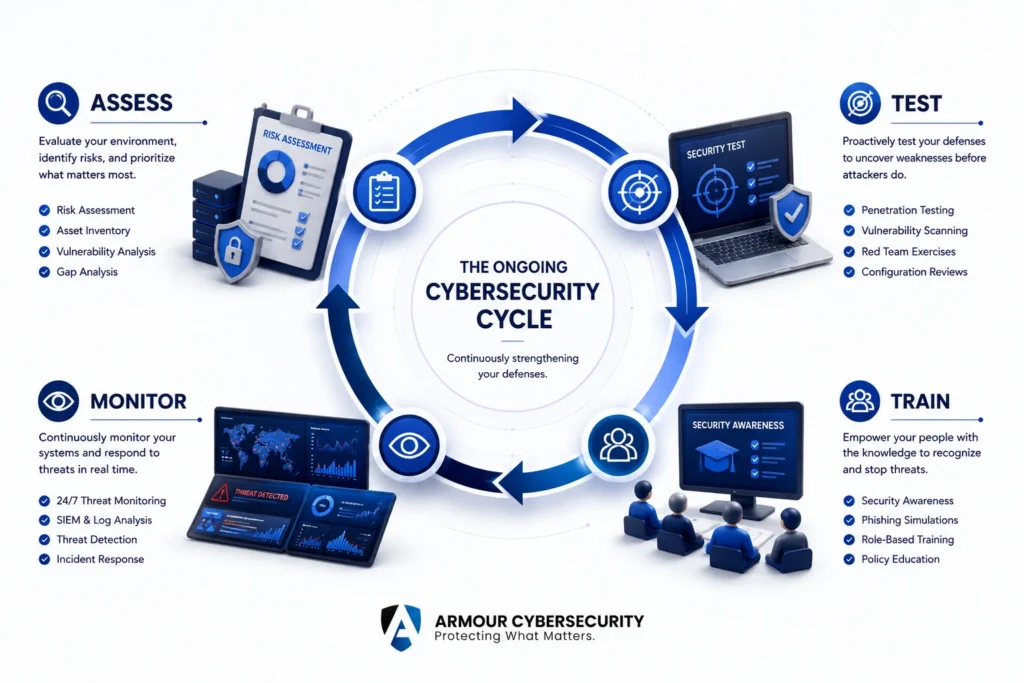
Reality: Cybersecurity is not a set-it-and-forget-it purchase. It is an ongoing practice. Threats change constantly, with new ransomware families and variants surfacing all the time. Complacency is the most expensive vulnerability of all.
Action step:
- Run annual security audits and quarterly vulnerability management reviews.
- Use regular penetration testing to find exploitable weaknesses before attackers do.
- Keep employee training and your incident response plan up to date.
- Stay current on new threats through trusted sources like CISA and MITRE ATT&CK.
Cybersecurity maturity is built on consistency, not convenience.
Frequently Asked Questions
Why do small businesses need cybersecurity?
Attackers see SMBs as low-hanging fruit, easier to breach yet full of valuable data. Sensitive information, from employee credentials to financial records to supply-chain access, exists in nearly every organization, which makes even the smallest business worth targeting.
What are the most common cybersecurity myths?
The big ones are that small businesses are not targets, that antivirus is enough, that cybersecurity is only IT’s job, that having no sensitive data means safety, and that a one-time investment is sufficient. Each one leaves a gap attackers can use.
How can a business improve cybersecurity quickly?
Start with MFA, endpoint protection, employee training, and regular backups. From there, cybersecurity consulting services can help you build a stronger, tailored program rather than a pile of disconnected tools.
Is cybersecurity expensive for SMBs?
Not compared to the cost of a breach. IBM’s Cost of a Data Breach research puts the average breach at a smaller organization at around $3.3 million, far more than the price of prevention.
The Bottom Line
Cybersecurity myths are silent liabilities. Believing you are too small, that antivirus is enough, or that you are not a target is exactly what gives attackers their edge. When a business shifts from reactive defense to proactive resilience, it stops being an easy target and starts becoming a trusted, secure partner. If you want to see where your gaps are, get in touch with Armour Cybersecurity to strengthen security, reduce risk, and stay ahead of evolving threats.
About the author
David Chernitzky is the CEO and Co-Founder of Armour Cybersecurity, a Toronto-based firm that protects organizations across North America from advanced cyber threats. He brings more than 25 years of cybersecurity and military cyber intelligence experience, having served as an officer in an elite technology unit before co-founding Armour. Armour’s team of military-intelligence veterans and senior advisors serves 260+ clients across 52+ industries with a 97% client retention rate.