By David Chernitzky, CEO, Armour Cybersecurity · Serving Toronto and organizations across North America · Last updated August 28, 2026
Quick Answer:
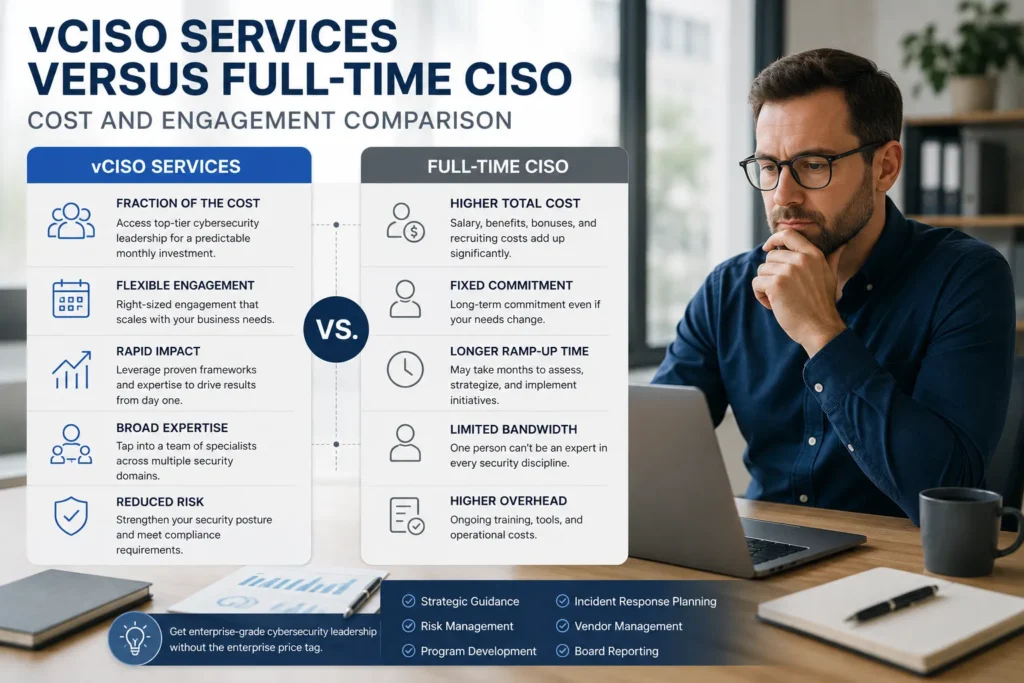
A full-time Chief Information Security Officer at a mid-market organization costs $250,000 to $400,000 or more in total compensation annually, requires six to nine months to recruit, and may move on within a couple of years as the market for experienced security leadership remains extremely competitive. Most SMBs and growth-stage companies need the function a CISO provides but not the headcount economics that come with the hire. Armour Cybersecurity’s fractional vCISO service delivers that function at an engagement level and cost that scales to what the organization actually needs.
Key Takeaways
- The CISO function covers security governance, risk reporting to the board, compliance programme ownership, security roadmap development, team management, and vendor oversight. Most organizations need all of these. Very few need them delivered by a single full-time executive.
- A fractional vCISO provides the CISO function at a defined engagement level, typically measured in days per month, at a cost that represents a fraction of a full-time hire.
- The vCISO fills the gap that many organizations discover when boards, cyber insurers, enterprise customers, or regulators ask for the named security leader responsible for the programme and there is no one to name.
- A vCISO engagement is not a temporary solution while you hire. For the majority of SMBs and mid-market organizations, it is the right permanent answer to the security leadership question.
- The vCISO connects the security programme to the board, builds the governance structure, owns the compliance programme, and provides the strategic direction that an IT team without senior security leadership cannot produce on its own.
What Does a CISO Actually Do That Is So Hard to Replace?
The title suggests a single role, but the CISO function covers a range of responsibilities that span the organization vertically from the board to the technical team, and horizontally across legal, compliance, HR, and operations. A CISO translates technical security risk into business language for board and leadership reporting. The CISO owns the organization’s risk management framework and ensures that security investments are allocated based on risk priority rather than IT preference. The CISO manages the compliance programme, ensuring that the organization meets its obligations across all applicable frameworks. The CISO oversees vendor and third-party security risk. The CISO represents the organization in customer security reviews, regulatory interactions, and incident response.
Across the 260+ organizations Armour Cybersecurity protects in 52+ industries, the security-leadership gap looks the same at most of them: a capable IT team, real security tools, and no one senior enough to answer the board, the insurer, or the enterprise customer when they ask who owns cyber risk. The reason these responsibilities are hard to substitute with an IT manager or a security engineer is not technical expertise, which many IT professionals have in abundance. It is seniority, strategic perspective, and the ability to operate effectively at board level. An IT manager who is excellent at managing infrastructure and security tools is not necessarily able to produce a board risk report that connects security investments to business outcomes, lead a negotiation with an enterprise customer’s chief information security officer, or own a regulatory notification decision under the pressure of a live incident.
The gap between what the organization needs from its security leadership and what it currently has is the gap the vCISO fills. It is not a gap that additional security tools or a larger IT team fills. It is a leadership and governance gap, and the vCISO is specifically designed to address it.
What Armour Cybersecurity’s vCISO Service Provides
The vCISO engagement provides named senior security leadership at a defined engagement level, typically four to twelve days per month depending on programme complexity and organizational need. The vCISO owns the information security programme, reports to the executive team and board, and is the accountable senior security leader for every internal and external purpose. When a customer questionnaire asks for the name and contact of the CISO responsible for the security programme, the vCISO is the answer. When the board asks who is responsible for cyber risk, the vCISO is the answer.
Board advisory is a core component of the vCISO engagement. Boards are increasingly expected to demonstrate oversight of cyber risk, and board members who lack cybersecurity expertise need a trusted adviser who can translate the threat landscape and the organization’s security posture into terms that enable informed governance decisions. Armour’s vCISO produces board-ready risk reporting that gives directors what they need to fulfil their oversight obligations without requiring them to develop technical expertise they do not have.
Cyber strategy and roadmap development gives the organization the multi-year security plan that provides direction to the IT team, clarity to leadership on investment priorities, and evidence to auditors and customers that the security programme is managed strategically rather than reactively. A security roadmap built by Armour’s vCISO is grounded in the organization’s actual risk profile, calibrated to its budget reality, and sequenced to deliver the highest-priority improvements first.
Governance, Risk and Compliance services under the vCISO umbrella provide the documented programme that regulators, auditors, and enterprise customers require. The policy library, the risk register, the vendor management programme, the compliance audit readiness, and the evidence collection processes that sustain a SOC 2 or ISO 27001 certification are all owned and driven by the vCISO, with Armour’s GRC team providing the execution support.
Armour 360 as the operational layer means the vCISO is governing a programme that is actually running rather than directing a team that lacks the tools to execute. The managed security service, covering endpoint protection, email security, and threat monitoring, is what the vCISO directs operationally. The combination of strategic governance through the vCISO and operational management through Armour 360 gives the organization a complete security programme without a full-time security headcount.
What Does the vCISO Answer That a Full-Time Hire Does Not?
Beyond cost, the vCISO model solves problems that a full-time hire creates. A full-time CISO at an SMB is a single individual who brings one background, one set of industry experiences, and one professional network to the role. When that individual leaves, the organization loses continuity and faces a six-to-nine month recruitment process during which the security programme is leaderless. The risk of key-person dependency is real and consistent.
Armour Cybersecurity’s vCISO engagement provides access to a team of senior security professionals behind the named vCISO. When the engagement requires expertise in a specific framework, a specific industry regulation, or a specific technical domain, the vCISO draws on the broader Armour team. The organization benefits from collective expertise that no individual hire can match.
The vCISO engagement is also scalable. As the organization grows and its security programme matures, the engagement level increases. As the programme stabilizes, it decreases. The cost of security leadership scales with the actual demand rather than being fixed at the salary of a full-time hire regardless of whether the programme needs a full-time executive in any given quarter.
When Does a Full-Time CISO Make Sense?
A full-time CISO makes sense when the security programme has grown to a scale and complexity that genuinely requires full-time executive leadership. Organizations with dedicated security teams of five or more people, highly regulated environments with constant compliance demands across multiple frameworks, or security programmes that are core to the competitive position of the business may reach a point where a full-time CISO is the right answer. Armour’s vCISO clients that reach this point typically use the vCISO engagement to hire and onboard the full-time CISO, transferring institutional knowledge and programme continuity rather than starting from scratch.
Frequently Asked Questions
Will our enterprise customers accept a vCISO instead of a full-time CISO?
Yes. Enterprise security questionnaires ask for a named accountable security leader, not for a full-time employee. A vCISO who is named, contactable, and available to participate in customer security reviews satisfies this requirement in the same way a full-time CISO does. Armour’s vCISO clients regularly present their vCISO in enterprise procurement processes, including conversations with large enterprise infosec teams.
How quickly can the vCISO engagement get started?
Armour Cybersecurity structures vCISO engagements to begin within two to three weeks of contract execution. The first engagement phase covers a current-state assessment of the existing security programme, stakeholder introductions, and an initial board or leadership briefing. The security roadmap is typically delivered within the first sixty days.
What if we have a specific compliance deadline driving the need for security leadership?
Compliance deadlines are one of the most common reasons organizations engage a vCISO on an accelerated basis. The vCISO takes ownership of the compliance programme immediately, coordinates with the relevant certification bodies or audit firms, and drives the readiness process to meet the deadline. Armour’s integrated compliance audit programme is designed to work hand-in-glove with the vCISO engagement for exactly this scenario.
The Bottom Line
The choice is not between a full-time CISO and no security leadership. It is between paying full-time executive economics for a function most organizations do not need full-time, and engaging that same function at the level the programme actually requires. A fractional vCISO gives you a named, accountable security leader for the board, the insurer, and the enterprise customer, backed by a full team rather than a single hire, and scaled to your real demand. For most SMBs and mid-market organizations, that is not a stopgap. It is the right answer. Armour Cybersecurity provides that leadership through its vCISO service.
About the author
David Chernitzky is the CEO and Co-Founder of Armour Cybersecurity, a Toronto-based firm that protects organizations across North America from advanced cyber threats. He brings more than 25 years of cybersecurity and military cyber intelligence experience, having served as an officer in an elite technology unit before co-founding Armour. Armour’s team of military-intelligence veterans and senior advisors serves 260+ clients across 52+ industries with a 97% client retention rate. Learn more about Armour Cybersecurity.