Quick answer: A red team simulates a real attacker to test how far they can get. A blue team defends and detects. A purple team is the operating model that puts them together so every simulated attack ends in a measurable improvement. The right choice depends on your goal: red team for realism and business impact, blue team for detection and response readiness, purple team for continuous, validated improvement.
Key Takeaways
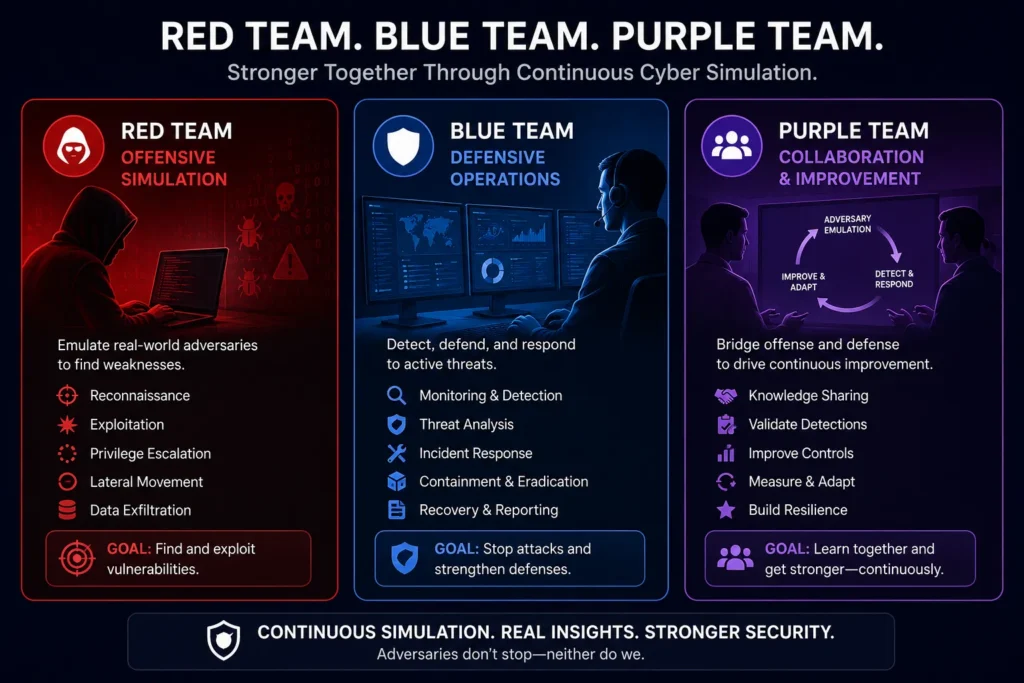
- Red team = offence. Simulates a real adversary, emphasising stealth and business impact, to test how far an attacker can get.
- Blue team = defence. The people and tools that detect, respond to, and contain attacks.
- Purple team = collaboration. An operating model where red and blue share findings in real time so each exercise ships a concrete fix.
- “Run a red team” is not a strategy. The right simulation depends on what you are trying to prove: executive confidence, SOC performance, or control validation.
- The goal is measurable risk reduction, not a PDF report that becomes shelfware.
The Three Teams, Defined
The colours describe roles, not departments. A red team plays the attacker, using real adversary tactics to compromise your environment and reach an objective, often quietly. A blue team plays the defender, running the detection, alerting, and response that should catch those attacks. A purple team is not usually a separate group at all; it is the practice of red and blue working together so every simulated attack step ends in either a confirmed detection or a shipped fix.
All three overlap with, but are distinct from, a standard penetration test. A pen test finds vulnerabilities; a red team tests whether your people and processes actually catch an attacker exploiting them.
When to Use Each
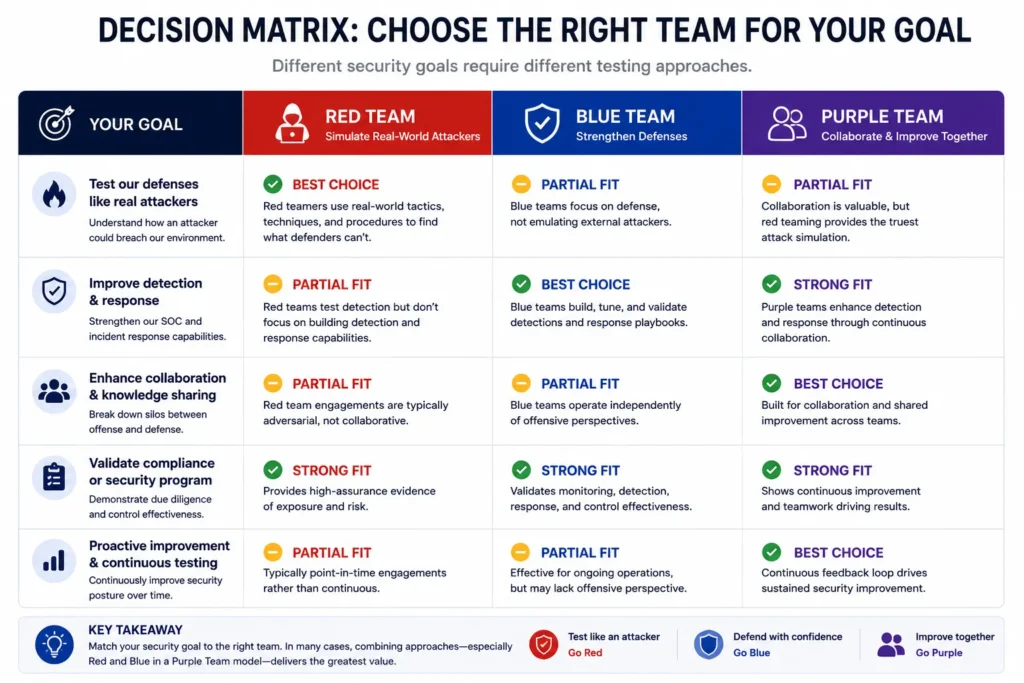
- Choose a red team when you need to test full-chain realism and business impact: can an attacker actually reach your crown jewels, across people, process, and technology? Best run periodically or after a major change.
- Choose a blue team focus when you need to prove detection and response readiness: logging, alerting, escalation, and playbooks. This is where 24/7 managed SOC monitoring and endpoint detection and response are validated.
- Choose purple teaming when you want continuous improvement: run cycles that build validated detection coverage, turning each exercise into measurable gains rather than a one-off test.
Purple as an Operating Model
The most effective approach is not choosing one team forever, it is sequencing them. Start with blue-team readiness so you can actually observe what happens. Run purple-team cycles monthly or quarterly to build and validate detection coverage. Run a full red-team engagement annually, or after a major change, to test realism end to end. Pairing these with a breach readiness assessment ties the technical findings to how your business would actually respond under pressure.
Across 260+ client engagements in 52+ industries, the simulations that actually reduce risk are the ones tied to a follow-up loop, where findings become tracked, retested fixes, not the ones that end in a slide deck.
Making It Count, Not Shelfware
The classic failure is a brilliant red-team report that no one acts on. Avoid it by treating every exercise as the start of a loop: turn findings into tickets, assign owners, retest, and trend progress over time. A simulation that does not change what you do next was theatre, not testing. Armour’s cyber simulation exercises are built around that loop, so the outcome is validated risk reduction you can show your board.
The Bottom Line
Red, blue, and purple are not competing choices; they are complementary tools for different questions. Decide what you need to prove first, then pick the exercise that proves it, and make sure every engagement ends in a change you can measure. That is the difference between spending on security theatre and buying down real risk.
Frequently Asked Questions
What is the difference between a red team and a penetration test?
A: A penetration test finds and reports vulnerabilities in a defined scope. A red team goes further: it simulates a real adversary, often stealthily, to test whether your people, processes, and technology actually detect and stop an attack in progress. Pen testing asks “what’s weak?”; red teaming asks “would we catch it?”
What does a purple team do?
A: A purple team is the collaboration between offence (red) and defence (blue). Rather than a separate group, it is an operating model where attackers and defenders share findings in real time, so every simulated attack step ends in either a confirmed detection or a shipped detection-engineering fix. It turns testing into continuous improvement.
How often should we run cyber simulations?
A: A practical cadence: build blue-team readiness first, run purple-team cycles monthly or quarterly to grow validated detection coverage, and run a full red-team engagement annually or after a major change. The frequency matters less than turning every exercise into tracked, retested improvements.
Which simulation is right for my business?
A: It depends on your goal. Choose red team for realism and business-impact testing, blue-team focus for detection and response readiness, and purple teaming for continuous, measurable improvement. Many organisations sequence all three rather than picking one.
About the Author
David Chernitzky is the CEO and Co-Founder of Armour Cybersecurity, a Toronto-based firm that protects organizations across North America from advanced cyber threats. He brings more than 25 years of cybersecurity and military cyber intelligence experience, having served as an officer in an elite technology unit before co-founding Armour. Armour’s team of military-intelligence veterans and senior advisors serves 260+ clients across 52+ industries with a 97% client retention rate.