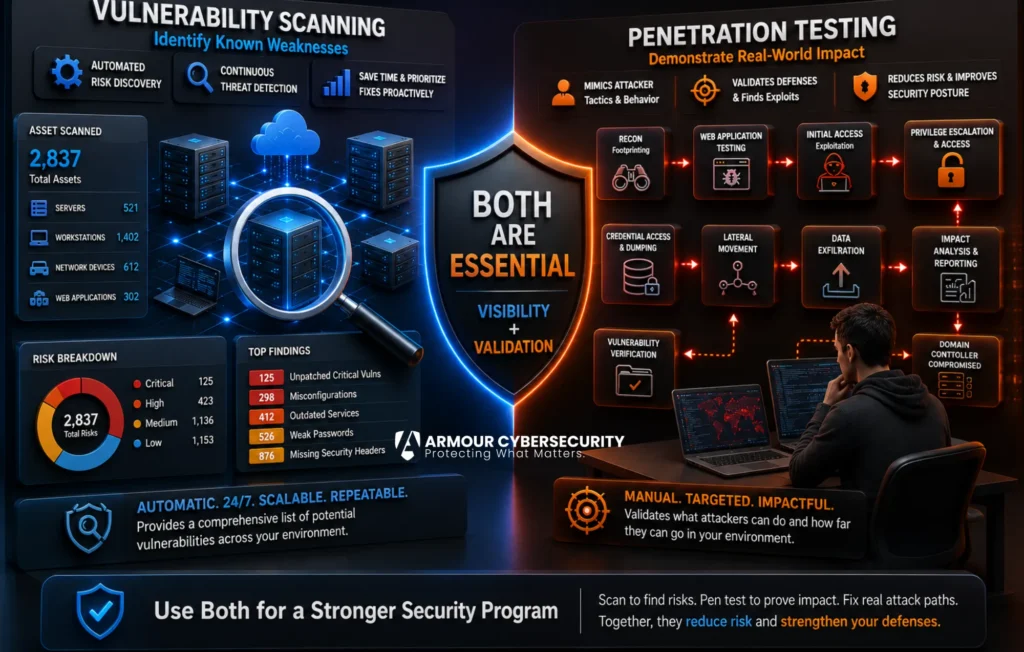
Ask ten people in an IT department what the difference is between vulnerability scanning and penetration testing, and you are likely to get ten different answers — several of which will be wrong. These two practices are frequently conflated, often used interchangeably, and regularly misunderstood by the people responsible for procuring them. That misunderstanding has real consequences: organizations that confuse the two end up with security programs that have significant blind spots.
Both vulnerability scanning and penetration testing are essential components of a mature security testing strategy. They are complementary, not interchangeable, and understanding the difference is the foundation of knowing which to use, when, and why.
What Is Vulnerability Scanning?
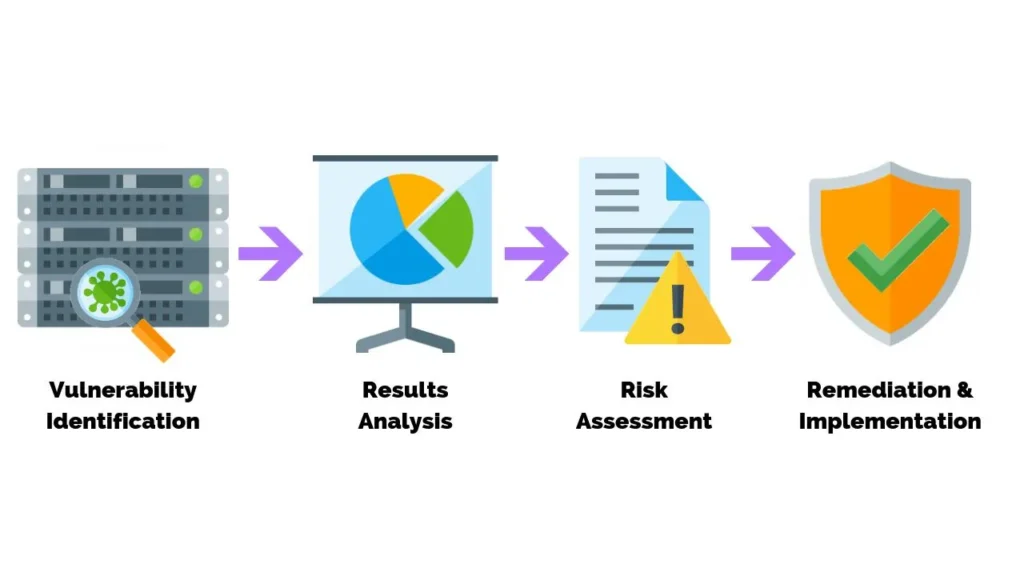
A vulnerability assessment through automated scanning is a process that systematically checks systems, networks, and applications against databases of known security weaknesses. A scanning tool connects to target systems, interrogates their configurations and software versions, and reports any findings that match known vulnerability signatures.
The output is a list: these systems are running outdated software, these ports are exposed unnecessarily, these services have known security flaws, these configurations deviate from security baselines. Vulnerability scans are fast — they can cover thousands of assets in hours — and when run regularly, they provide excellent visibility into how the security health of an environment changes over time.
Common vulnerability scanning tools analyze for issues such as unpatched operating systems and applications, misconfigured services and network devices, weak or default credentials on network devices, exposed administrative interfaces, missing security headers in web applications, and insecure encryption configurations.
Vulnerability scanning is typically an ongoing activity. Many organizations run scans weekly or monthly, and some integrate scanning into their development pipelines so that new code is evaluated for known weaknesses before it ever reaches production.
What Is Penetration Testing?
Professional penetration testing services take a fundamentally different approach. Rather than automatically cataloging what might be wrong, a penetration tester actively tries to exploit vulnerabilities to determine what an attacker could actually accomplish.
A skilled pen tester brings human judgment, creativity, and adversarial thinking to the assessment. They chain multiple weaknesses together, test how different systems interact, probe for business logic flaws that no automated tool would detect, and evaluate whether security controls respond appropriately when an attack is in progress.
Penetration testing is typically a time-boxed engagement — a project with defined scope, objectives, and deliverables. It results in a detailed report that includes not just a list of findings but evidence of exploitation, analysis of business impact, and specific remediation recommendations.
Where a vulnerability scan tells you that your front door might be unlocked, a penetration test walks up, tries the handle, steps inside, and tells you exactly how far an attacker could go once they were in.

The Key Differences Between the Two
Understanding the distinctions in methodology, depth, and output helps organizations make informed decisions about their security testing programs.
Automation vs. Human Expertise
Vulnerability scanning is almost entirely automated. Tools run on a schedule, process results algorithmically, and generate reports without human interpretation. Penetration testing is led by human experts who make judgment calls, adapt their approach based on what they discover, and explore avenues that no automated tool is programmed to pursue.
Breadth vs. Depth
Vulnerability scanning is optimized for breadth. It covers large numbers of assets quickly, giving organizations a comprehensive view of their known weakness inventory. Penetration testing is optimized for depth. It focuses on a defined scope and examines it in detail, including the ways vulnerabilities combine and interact in ways that only reveal themselves under active exploitation.
Identifying vs. Exploiting
Vulnerability scans identify potential weaknesses. Penetration tests attempt to exploit them. This distinction is more significant than it sounds. Many vulnerabilities that appear low or medium severity in isolation become critical when a tester discovers they can be combined to achieve a high-impact outcome. Scans miss this because they assess each finding independently — which is why a full cybersecurity risk assessment requires human-led testing, not just automated tools.
Continuous vs. Periodic
Vulnerability scanning runs continuously or on a frequent schedule. It is an ongoing monitoring capability. Penetration testing is periodic — typically annual at minimum, or triggered by specific events such as deploying a new application, experiencing a security incident, or preparing for a compliance audit.
Output Format
Vulnerability scans produce automated reports listing every finding with a severity rating. These reports can be hundreds of pages long and require security expertise to prioritize effectively. Penetration testing produces a narrative report that documents attack paths, exploitation evidence, business risk context, and remediation priorities — designed to be understood by both technical teams and executive stakeholders.
Why Vulnerability Scanning Alone Is Not Enough
Organizations that rely exclusively on vulnerability scanning often develop a false sense of security. Because scans produce long lists of findings — many of them low severity — it is tempting to assume that addressing the most critical items means you are protected.
The problem is that vulnerability scanners cannot evaluate context. They do not know that your backup administrator account has the same password it was set with five years ago. They do not know that a low-severity misconfiguration on a development system provides a pathway to your production database. They cannot assess whether an attacker who gained access to one system could use it as a pivot point to compromise ten more.Penetration testing closes this gap by bringing human adversarial judgment to the question of real-world exploitability. Findings from penetration tests frequently include vulnerabilities that scanning tools assessed as low priority — but that in practice represented significant risk because of how they combined with other weaknesses in the environment. Ongoing vulnerability management ties both approaches together, ensuring findings are tracked and remediated before they compound.
Why Penetration Testing Alone Is Not Enough Either
The converse is also true. Organizations that conduct annual penetration tests without running ongoing vulnerability scans have a different but equally significant blind spot.
A penetration test captures a snapshot of security posture at a single point in time. In the months that follow, new vulnerabilities are discovered, patches are missed, configurations drift, new systems are deployed, and the environment changes in ways that could introduce new weaknesses all of which underscores the importance of incident response planning alongside regular testing. Without ongoing scanning, none of this is visible until the next penetration test — which could be twelve months away.
Continuous vulnerability scanning ensures that the environment does not regress significantly between penetration tests, and that newly discovered vulnerabilities are caught and addressed promptly.

Building a Comprehensive Security Testing Strategy
The most effective security testing programs combine both approaches in a coordinated way. Continuous vulnerability scanning provides the ongoing visibility needed to catch new weaknesses as they emerge. Periodic penetration testing provides the depth of analysis needed to understand how those weaknesses could be exploited and what their real-world impact would be.
Together, they answer different but equally important questions. Vulnerability scanning answers: where are our known weaknesses right now? Penetration testing answers: if an attacker tried to exploit our environment today, how far could they get?
Organizations that implement both are significantly better positioned than those relying on either in isolation. They have both the breadth to maintain a clear picture of their vulnerability inventory and the depth to understand their actual risk exposure.
Getting Started with Security Testing
Armour Cybersecurity provides both vulnerability assessment services and professional penetration testing for organizations across Canada. Whether you are establishing a security testing program for the first time or looking to strengthen an existing one, our cybersecurity consulting services can help you design an approach matched to your environment, risk profile, and compliance requirements.
Understanding your security posture is the foundation of every effective cybersecurity program. Visit armourcyber.io to learn how our security testing services can help your organization identify and address vulnerabilities before attackers find them.