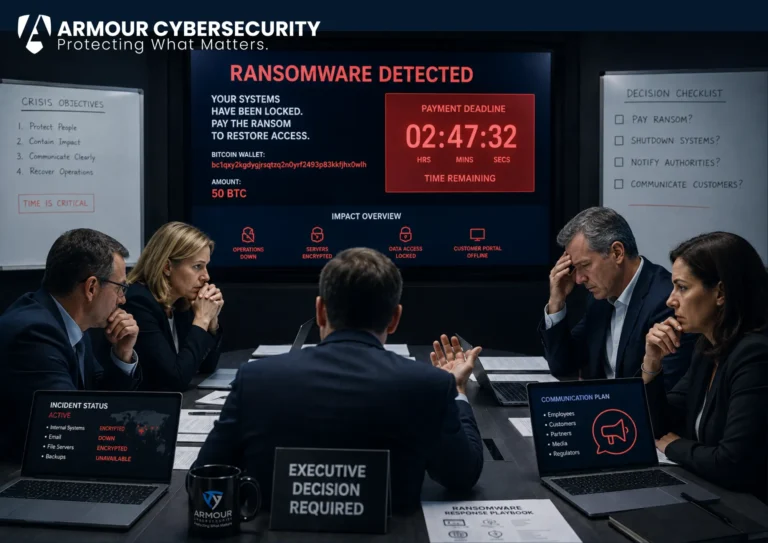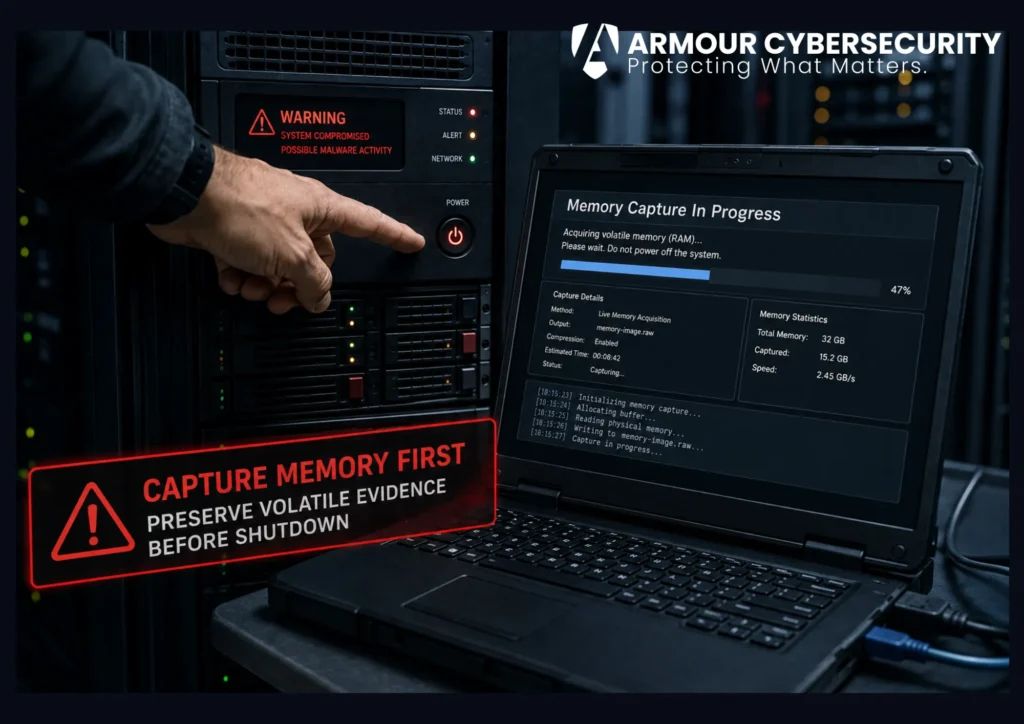
| Quick Answer Digital forensic evidence is fragile. The most valuable evidence in a cyber breach, the evidence that answers how the attacker got in, what tools they used, and what data they touched, often exists only in system memory and disappears permanently when a compromised system is rebooted or shut down. The first actions taken after an incident is detected either preserve this evidence or destroy it, and which outcome occurs depends on whether forensic discipline was applied from the first response. |
Key Takeaways
- Volatile evidence, including running processes, active network connections, encryption keys, and malware operating in memory, exists only while a system is running. It is gone permanently the moment the system is shut down or rebooted.
- The most common forensic evidence destruction is not malicious. It happens when well-intentioned IT staff reboot a compromised system to restore normal operation before anyone has captured a memory image.
- Live forensic acquisition captures a memory image and other volatile evidence before any system action is taken. This single step preserves evidence that disk-based forensics cannot recover after shutdown.
- Other common evidence destruction patterns include logging into a compromised system with administrative credentials, deleting suspected malware files before they are analyzed, and allowing logs to roll over before they are collected.
- Organizations with documented first-response forensic procedures preserve significantly more evidence than those responding without them, which translates into better investigation outcomes, stronger insurance claims, and clearer regulatory submissions.
Forensic evidence preservation in a cyber incident is decided in the first minutes, usually before a forensic specialist is even in the room. The instinct during a breach is to make the problem stop, reboot the machine, log in to look around, delete the suspicious file, and that instinct quietly destroys the evidence you will need for the incident response investigation, the insurance claim, and any legal fallout. This is what volatile evidence is, why it vanishes, and what a disciplined first response does to save it.
| By the NumbersBreaches run about 241 days on average before they are identified and contained. The longer that window, the more the first response has to preserve. The global average breach cost $4.44M ($10.22M in the US). Source: IBM Cost of a Data Breach Report 2025.Memory evidence has no recovery path. Once a compromised system is powered off or rebooted, running processes, live network connections, and in-memory malware are gone for good. There is no forensic tool that reverses it.Modern intrusions increasingly run in memory. Fileless and living-off-the-land techniques leave little or nothing on disk, so a memory capture is often the only place the attacker’s activity survives. |
What Is Volatile Evidence and Why Does It Disappear?
A running computer system maintains two fundamentally different types of data: persistent data stored on disk, which survives power cycles, and volatile data held in system memory (RAM), which exists only while the system is running and power is applied to the memory. When power is removed, either through a deliberate shutdown or an unexpected power loss, the contents of RAM are gone. There is no recovery path. The data has not been deleted in a way that forensic tools can reverse; it has simply ceased to exist as a physical state.
In the context of a cyber incident, volatile evidence is often the most valuable evidence available. Sophisticated attackers increasingly operate using techniques designed to minimize disk artifacts, running malicious code entirely in memory, using legitimate system tools for malicious purposes, and cleaning up files after use. For these attacks, if the system is shut down before memory is captured, the primary evidence of what the attacker did and how they did it no longer exists in any recoverable form.
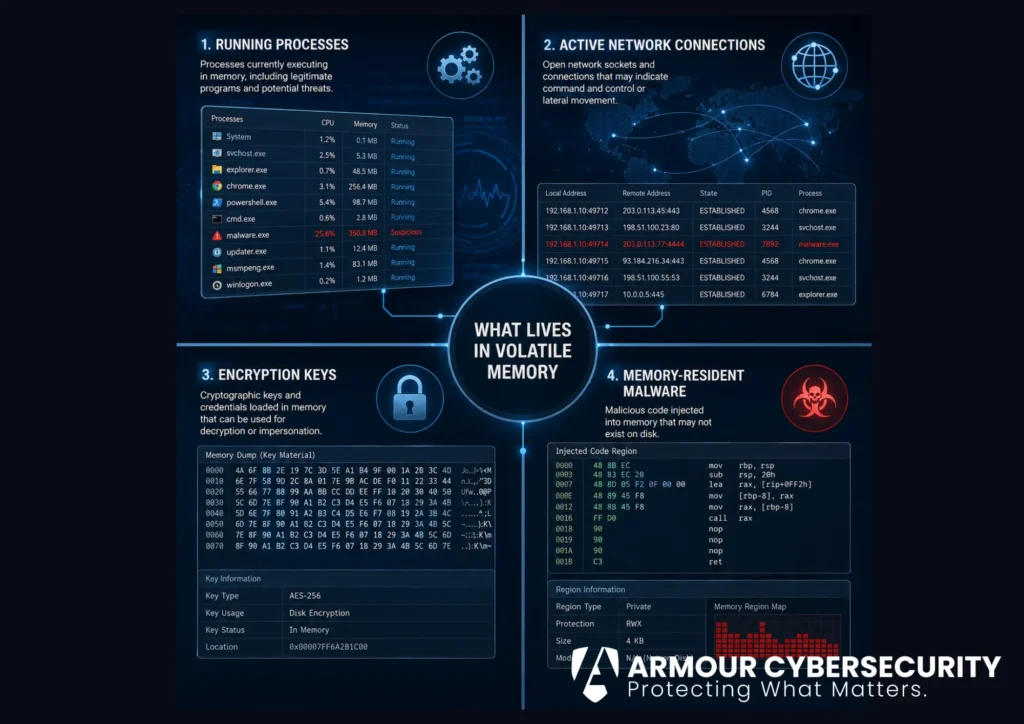
What Volatile Evidence Contains
Running processes and their memory
The list of processes running at the time of the incident, and the memory contents of those processes, reveals what software was executing. Malware that injects itself into legitimate process memory, a common technique for evading endpoint security tools, appears in process memory analysis even when no malicious files exist on disk. The process memory of the attacker’s tools may contain configuration data, command-and-control addresses, decryption keys, and the content of data being processed at the time of capture.
Active network connections
The network connection table of a live system shows every active and recently closed network connection: the remote addresses the system was communicating with, the ports in use, and the processes responsible for each connection. Active command-and-control connections to attacker infrastructure, data exfiltration sessions in progress, and lateral movement connections to other systems are all visible in the network connection state of a live system, and gone after shutdown.
Encryption keys
Encryption keys used for active sessions, including HTTPS connections, VPN tunnels, encrypted storage volumes, and ransomware encryption in progress, exist in system memory while those sessions and processes are running. Memory forensics can extract these keys in some circumstances, allowing investigators to decrypt traffic captures or encrypted files that would otherwise be inaccessible. This is particularly significant in ransomware investigations, where recovering encryption keys from memory can enable decryption without payment.
Malware artifacts in memory
Memory-resident malware, code injected into legitimate process memory, shellcode executing without a disk file, and reflectively loaded libraries all leave artifacts in memory that disk forensics cannot find, because they have no corresponding disk file. Memory analysis extracts and analyzes these artifacts, identifying the malware’s capabilities, persistence mechanisms, and indicators of compromise. Without memory capture, investigations of memory-resident malware are effectively blind to the most important evidence of what the attacker deployed.
What Are the Most Common Evidence Destruction Patterns?
Evidence destruction in cyber incidents is almost always unintentional. It happens because the people responding are trying to fix the problem rather than preserve the evidence, and they are doing what their training and instinct tell them to do. Understanding these patterns is the basis for the first-response procedures that prevent them.
Rebooting to restore normal operation
The most common evidence destruction: a system is behaving abnormally, an IT staff member or user reboots it trying to resolve the problem, and the reboot clears the memory. Everything that was in RAM before the reboot is gone. If the system also had memory-resident malware, the malware is cleared from memory along with the evidence. The system may appear to have returned to normal, while the investigation that follows is left working with disk artifacts only, potentially missing the most important evidence of how the attacker operated.
Across the 260+ organizations Armour serves in 52+ industries, the single most common way evidence is lost is not an attacker covering their tracks. It is a well-meaning IT person rebooting the affected machine to make it work again, an hour before anyone thinks to capture memory. The attack is rarely what destroys the evidence. The response is.
Logging into the compromised system to investigate
When IT staff log into a compromised system using administrative credentials to investigate, the act of logging in modifies evidence. File access timestamps on system files are updated. The administrator’s credentials are processed by the compromised system, potentially exposing them to credential-harvesting malware. The system audit log records the administrator’s activity, mixing it with the attacker’s activity in a way that makes later analysis more difficult. Forensic first-response procedures minimize interaction with the live system before acquisition is complete.
Deleting suspected malware files
When a suspicious file is identified, the instinct is to delete it. Deletion removes the file from disk before it can be analyzed. Malware analysis of the file would have revealed its capabilities, identified indicators of compromise, and informed the eradication process. Without the file, the investigation is working from what the malware did rather than what it was, which limits both the completeness of eradication and the richness of the evidence available for legal and insurance purposes.
Allowing logs to roll over
System and network logs have retention limits. When those limits are reached, the oldest entries are overwritten. An incident that goes undetected for days or weeks may reach the investigation phase to find that the earliest logs, covering the initial access and the attacker’s early activity, have already been overwritten. Forensic first response includes immediately collecting logs from all relevant systems and network devices before they expire, even before the scope of the investigation is fully understood.
What First-Response Forensics Does Differently
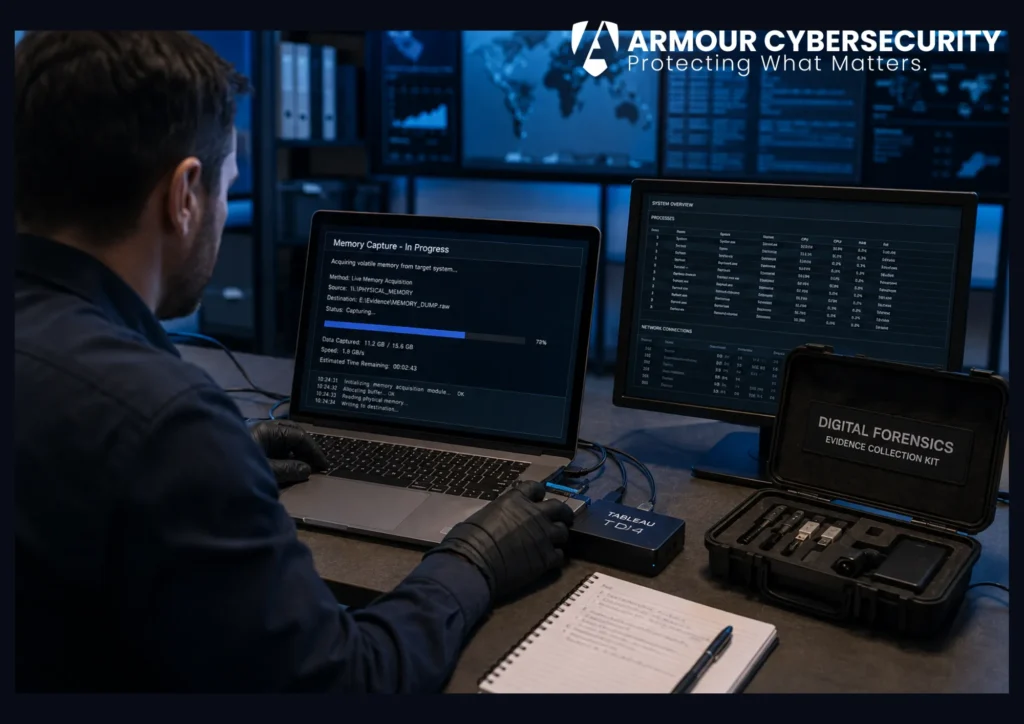
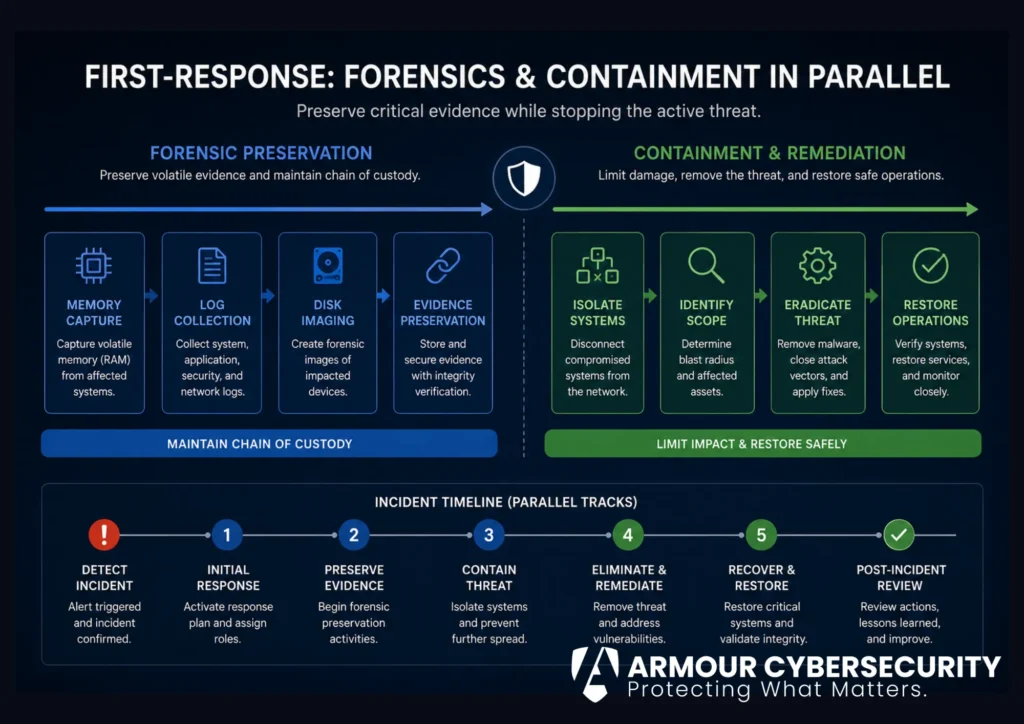
First-response forensics applies a defined procedure to the first actions taken after an incident is detected, specifically to preserve volatile evidence before any other action that might destroy it. The memory image is captured before the system is shut down, isolated, or remediated. Network connection state is documented before isolation changes it. Logs are collected before they can roll over. Running processes are documented before they are terminated.
This procedure runs in parallel with containment, not sequentially. The forensic acquisition does not delay the response; it adds a preservation step to the first actions taken. A well-trained first-response team captures memory and documents the system state in minutes while simultaneously preparing the isolation actions that will follow.
Armour Cybersecurity’s technical forensics team provides first-response forensic support as part of incident response engagements, so volatile evidence is preserved from the first minute of the investigation. The team covers live system forensics across all major platforms, with memory capture, network state documentation, and contemporaneous documentation of every action taken from first contact. The most reliable way to be ready for that first minute is to have rehearsed it: a cyber simulation exercise puts the reboot-versus-preserve decision in front of your team before a real incident forces it.
Where Forensics Fits in Armour’s Managed Services
First-response forensics is one pillar of Armour’s managed cybersecurity services, working next to a managed Security Operations Center whose logs are often the first evidence collected, a breach readiness assessment that checks whether your IR plan actually protects evidence, cyber insurance advisory to turn preserved evidence into a defensible claim, and the all-in-one Armour 360 managed program. Containment stops the bleeding. Preservation keeps the proof.
The Bottom Line
The evidence that decides your insurance claim and your legal position is often gone within minutes of detection, destroyed not by the attacker but by a helpful reboot. The fix is not more technology; it is a first response that captures memory before it touches anything else. Armour’s technical forensics service is built to own that first minute, so the proof of what happened survives long enough to matter.
| Across the 260+ organizations Armour serves in 52+ industries, the single most common way evidence is lost is not an attacker covering their tracks. It is a well-meaning IT person rebooting the affected machine to make it work again, an hour before anyone thinks to capture memory. The attack is rarely what destroys the evidence. The response is. |
Frequently Asked Questions
What is forensic evidence preservation in a cyber incident?
Forensic evidence preservation in a cyber incident is the practice of capturing and protecting the evidence of an attack before any action destroys it, starting with the volatile evidence that exists only in a running system’s memory. In practice it means capturing a memory image, documenting network connections, and collecting logs before the affected system is rebooted, isolated, remediated, or logged into. It matters because the evidence that answers the hardest questions, how the attacker got in, what they ran, and what they took, is often the evidence that disappears first, and once it is gone there is no recovery path.
Is memory forensics possible if the system was already shut down before we called?
If the system has been shut down, the volatile memory contents are gone and cannot be recovered. Forensic investigation of the shut-down system is limited to disk artifacts: files, logs, registry entries, browser history, application data, and the artifacts that persistent malware left on disk. This can still produce meaningful findings, though the investigation is working with an incomplete picture. For future incidents, the most important preventive measure is documenting in the IR plan that no system should be shut down or rebooted before forensic memory capture is performed.
What is a write-blocker and why is it used in forensic acquisition?
A write-blocker is a hardware or software tool that sits between a forensic investigator and the storage media being acquired, preventing any data from being written to the source media during acquisition. Without one, connecting storage media to a computer typically causes the operating system to write to the media: updating last-accessed timestamps, writing temporary files, or indexing contents. Those writes alter the evidence. A write-blocker prevents this, ensuring the acquired data is an exact, unaltered copy of what was on the media at the time of acquisition. Hash verification then confirms the copy matches the original bit for bit.
Can forensics recover data from wiped drives?
It depends on the wiping method. A single-pass overwrite of a modern SSD effectively destroys the data, because SSDs do not retain recoverable remnants the way older spinning drives could. On traditional hard drives, simple deletion leaves data recoverable because only the file system entry is removed, not the data itself, while a thorough forensic wipe makes recovery impractical. In insider-threat cases where evidence may have been wiped, the forensic question is often not whether the data can be recovered but whether artifacts of the file’s prior existence, including metadata, log entries, and backup snapshots, can establish what it contained.
How does log retention affect forensic investigations?
Log retention is one of the most significant constraints on forensic investigations. System logs, network device logs, cloud audit trails, and application logs all have retention limits that determine how far back the investigation can see. Incidents where the attacker had extended dwell time before detection are frequently limited in their historical investigation by log retention. Organizations that discover their retention was insufficient after an incident typically extend it as part of post-incident improvements. Forensic readiness assessments evaluate log retention as part of the overall investigation-preparedness picture.
What should we do right now to improve our forensic readiness?
Three improvements make the largest difference. First, document in your incident response plan that no compromised system should be shut down or rebooted before forensic memory capture is performed. Second, review and extend log retention across endpoint, network, and cloud platforms to at least ninety days for security-relevant events. Third, establish a relationship with a forensic response team before an incident occurs, through a retainer or a pre-qualified emergency arrangement, so the first call in an incident reaches a team that can give immediate forensic guidance rather than a new vendor being found under crisis conditions.
About the Author
David Chernitzky is the CEO and Co-Founder of Armour Cybersecurity, a Toronto-based firm that protects organizations across North America from advanced cyber threats. He brings more than 25 years of cybersecurity and military cyber intelligence experience, having served as an officer in an elite technology unit before co-founding Armour. Armour’s team of military-intelligence veterans and senior advisors serves 260+ clients across 52+ industries with a 97% client retention rate.