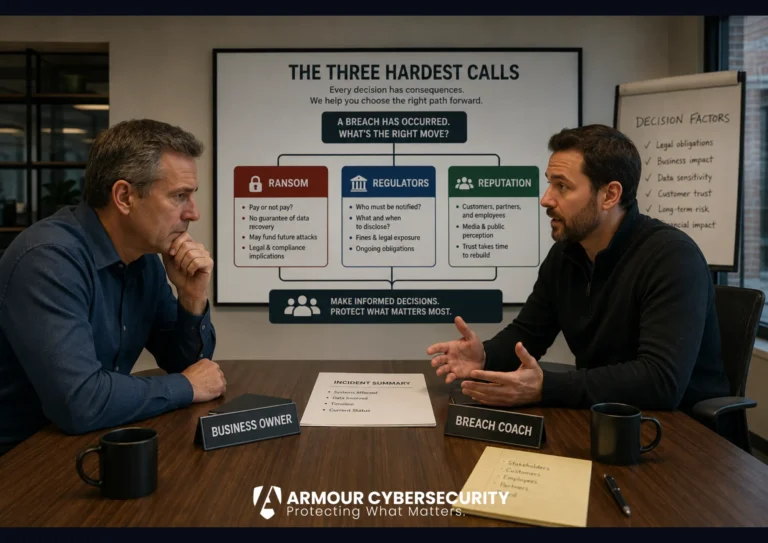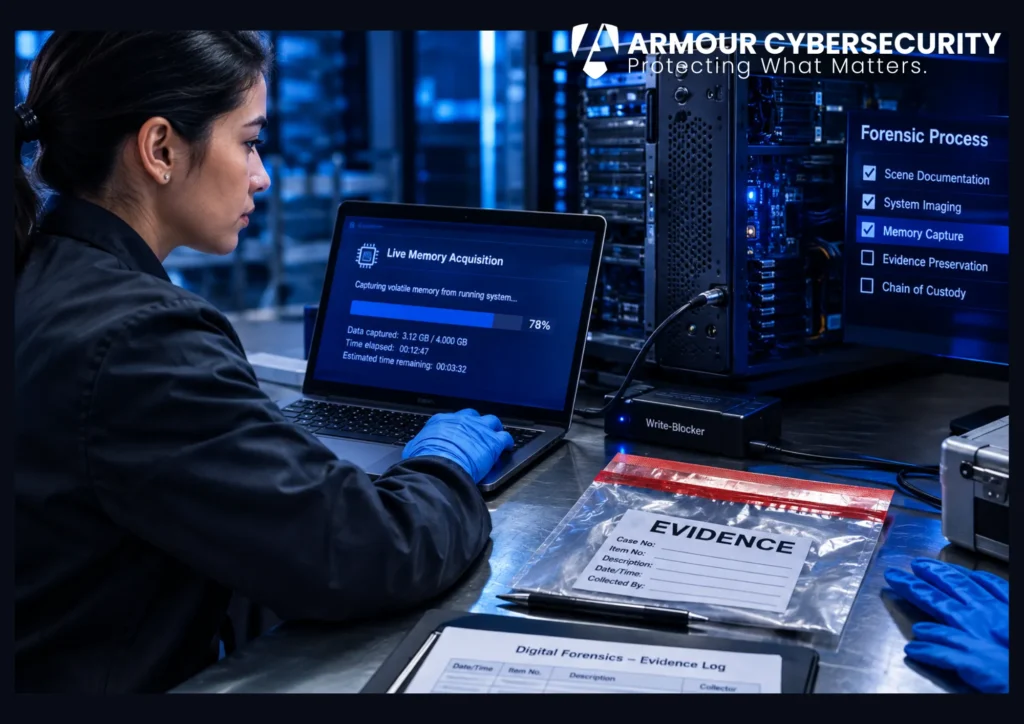
| Quick Answer Digital forensics is the discipline of recovering, preserving, and investigating evidence from digital systems after a security incident, insider event, or other matter that may require formal investigation. The findings answer the hard questions: what happened, how the attacker got in, what data was accessed or taken, and how long the attacker was present. When handled to proper evidential standards, forensic findings support insurance claims, regulatory submissions, and legal proceedings. |
Key Takeaways
- Digital forensics is a recognized branch of forensic science governed by international standards including ISO 27037 through 27043 and the ACPO principles. Evidence not handled to these standards may be excluded from legal proceedings or rejected by insurance carriers.
- The most critical forensic actions happen in the first minutes of a response. Volatile evidence in system memory, running processes, active network connections, and encryption keys in use disappears permanently when a system is shut down or rebooted.
- Forensic investigation answers questions technical response alone cannot: the exact attack vector, the full scope of data access, the duration of attacker presence, and whether any persistence mechanisms survive recovery.
- Internal IT teams investigating without forensic discipline frequently destroy the evidence they are trying to find. Common errors include logging into compromised systems, rebooting without memory capture, and not documenting the chain of custody.
- Forensic findings documented to criminal standards are usable in insurance claims, regulatory submissions, civil litigation, and law enforcement referrals. Findings from non-standard investigations are not.
Digital forensics services for business exist for the moment after containment, when the pressing question stops being how to stop the attack and becomes proving what it did. When a breach triggers an incident response, the technical team’s job is to contain and recover. Forensics runs alongside it to answer the questions that insurers, regulators, and courts will ask later: how the attacker got in, what they touched, what they took, and how long they were inside. Get the evidence handling right and those answers hold up. Get it wrong and they can be thrown out.
| By the NumbersBreaches take about 241 days on average to identify and contain. Forensics is what reconstructs that timeline and the scope insurers and regulators require. The global average breach cost $4.44M ($10.22M in the US). Source: IBM Cost of a Data Breach Report 2025.Admissible evidence has a standard. ISO 27037 through 27043 and the ACPO principles define how digital evidence must be identified, acquired, preserved, and documented. Work that ignores them can be excluded or rejected.The most valuable evidence disappears first. Memory contents, running processes, live network connections, and in-use encryption keys are gone permanently the moment a system is shut down or rebooted. |
What Is Digital Forensics?
Digital forensics is the application of scientific methods to the recovery, preservation, and investigation of evidence from digital systems. It is a recognized branch of forensic science with standards developed over three decades of application in criminal investigations, civil litigation, and corporate security incidents. The International Organization for Standardization has published a series of standards specifically covering digital evidence (ISO 27037 through 27043) that define how evidence should be identified, collected, preserved, analyzed, and documented to maintain its evidential integrity.
The application of forensics to cyber security incidents is called incident response forensics or cyber forensics. When a business is breached, digital forensic investigation answers questions the technical response team alone cannot resolve: What was the initial point of entry? How long was the attacker present before detection? Which specific systems and files were accessed? What data was exfiltrated, and to where? Are there persistence mechanisms that survived containment and recovery? These questions matter not just for understanding the incident but for the legal, regulatory, and insurance processes that follow.
Why Do Forensic Standards Matter?
The value of forensic evidence depends entirely on the rigor with which it was collected and preserved. Evidence that cannot demonstrate an unbroken chain of custody, that was collected using methods that could have altered its content, or that was analyzed without peer review is vulnerable to challenge in legal proceedings, regulatory inquiries, and insurance claim investigations. When evidence is challenged and excluded, the investigation’s conclusions lose their foundation.
The practical consequences of non-standard forensic handling are documented across cases that have reached litigation. Evidence excluded because a system was logged into before imaging, altering timestamps and file metadata. Findings rejected by an insurance carrier because the acquisition methodology was not documented. A regulatory investigation complicated because the organization could not demonstrate that its own investigation had not altered the evidence. These outcomes are avoidable when forensic work is conducted to proper standards from the first action.
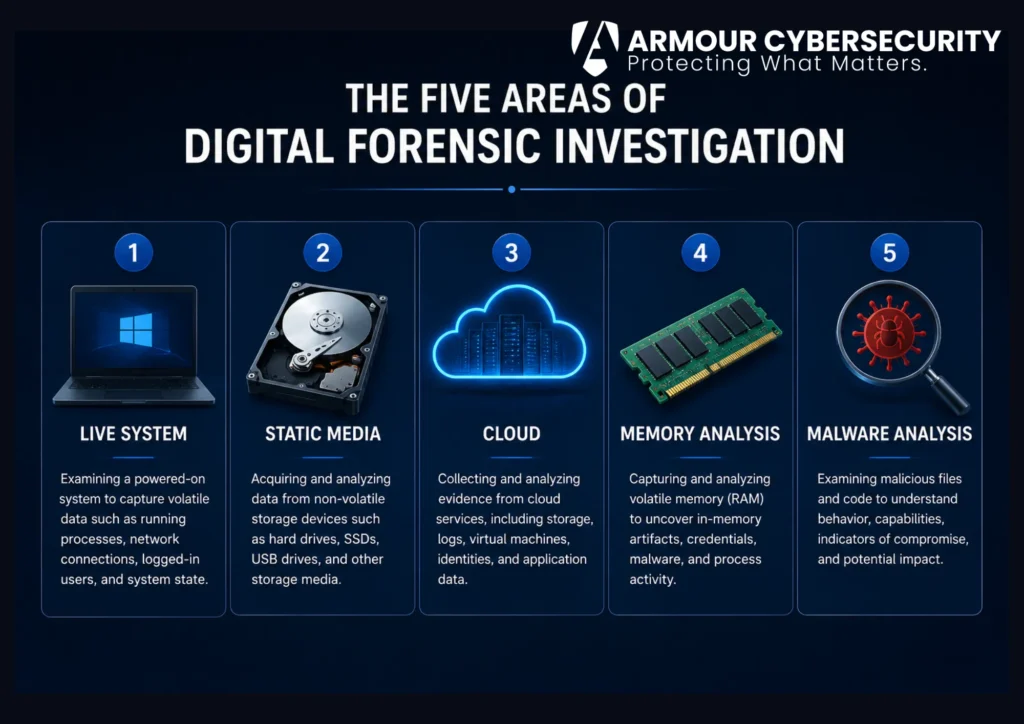
What Does a Digital Forensic Investigation Actually Cover?
Live system forensics
Live system forensics involves collecting evidence from servers, desktops, and laptops while they are running, specifically to capture volatile evidence that exists only in memory. A running system contains active processes, network connection states, logged-in sessions, encryption keys in use, and malware artifacts that may not leave any trace on the disk. When the system is shut down or rebooted, all of this evidence is lost permanently. Live forensic collection captures a memory image before any power-down action is taken, preserving evidence that disk-based investigation cannot recover after the fact.
Across the 260+ organizations Armour serves in 52+ industries, the forensic engagements that go smoothly are rarely the ones facing the most sophisticated attacker. They are the ones where whoever responded first had the discipline to capture memory before powering anything down, because the evidence that answers the hardest questions is almost always the evidence that vanishes first.
Static media forensics
Static forensics involves acquiring evidence from storage media: hard drives, solid-state drives, USB devices, and backup media. Acquisition uses forensically sound techniques including write-blockers, which prevent any data from being written to the source media during acquisition, and hash verification, which creates a cryptographic fingerprint of the acquired data that can be used to prove the copy has not been altered. These techniques maintain evidential integrity in a way that standard file copying does not.
Cloud forensics
Cloud environments present distinct forensic challenges because the underlying infrastructure is shared and managed by the cloud provider. Evidence in cloud environments takes the form of audit logs, identity and access events, configuration change records, and data access logs that are available for defined retention periods through the provider’s platform. Cloud forensics requires knowledge of what evidence is available in each platform, how to acquire it before it expires, and how to interpret cloud-native log formats in the context of an investigation.
Memory analysis
Memory analysis is a specialist forensic discipline that extracts and interprets the contents of a system’s RAM captured during live forensics. Memory images contain running processes, network artifacts showing what connections were active at the time of capture, injected code used by malware to operate without touching the disk, and encryption keys for encrypted communications and storage. Memory analysis can identify sophisticated malware that leaves no disk artifacts and would be invisible to any investigation that does not include a memory capture.
Malware analysis and reverse engineering
When malicious software is identified during an investigation, malware analysis determines what it does, how it achieves persistence, what data it accesses or exfiltrates, and what indicators of compromise it leaves behind. Static analysis examines the malware code without executing it. Dynamic analysis executes the malware in a controlled environment to observe its behavior. Reverse engineering reconstructs the malware’s logic at the code level. The findings inform both the eradication process and the detection rules needed to identify future instances of the same or similar tools.
What Does a Forensic Investigation Produce?
A forensic investigation produces documentation structured for the specific use the engagement was scoped to support. For a cyber insurance claim, the forensic report provides the evidence base for the scope determination, the attack vector analysis, and the data access and exfiltration findings the carrier needs to assess the claim. For regulatory submissions, the report provides the factual basis for the breach notification and the investigation documentation regulators expect to review. For legal proceedings, the report and the underlying evidence, often coordinated with breach counsel, are structured to meet the evidential standards courts require.
Every action taken during the investigation is documented contemporaneously. The chain of custody records every transfer of evidence from acquisition through analysis to the final report. The acquisition documentation records the specific methods and tools used for each piece of evidence. The investigation report covers methodology, evidence collected, analysis performed, findings, and conclusions, and all work is peer-reviewed before delivery. Armour Cybersecurity’s technical forensics service delivers this full documentation package, produced to criminal evidential standards whether or not criminal proceedings are anticipated.
Where Forensics Fits in Armour’s Managed Services
Forensics is one pillar of Armour’s managed cybersecurity services, and it works best next to the capabilities that feed it evidence and act on its findings: a managed Security Operations Center whose logs are often the first evidence a forensic team reaches for, cyber threat intelligence that puts an attacker’s tools in context, vCISO leadership to own the remediation the findings recommend, and the all-in-one Armour 360 managed program. Detection surfaces the incident. Forensics proves what it did.
The Bottom Line
When a breach happens, the technical team’s instinct is to fix and move on, and that instinct destroys the evidence you will need for the claim, the regulator, and any legal fallout. Digital forensics preserves that evidence to a standard that holds up, and it starts before the first system is powered down. If your business would struggle to prove what an attacker actually did, Armour’s technical forensics service is built to answer that question before anyone else asks it.
| Across the 260+ organizations Armour serves in 52+ industries, the forensic engagements that go smoothly are rarely the ones facing the most sophisticated attacker. They are the ones where whoever responded first had the discipline to capture memory before powering anything down, because the evidence that answers the hardest questions is almost always the evidence that vanishes first. |
Frequently Asked Questions
What are digital forensics services for business?
Digital forensics services for business are professional engagements that recover, preserve, and investigate evidence from a company’s digital systems after a cyber incident, insider event, or dispute, to evidential standards that hold up under scrutiny. They answer what happened, how the attacker got in, what data was accessed or taken, and how long the attacker was present, and they produce a documented report suitable for insurance claims, regulatory submissions, and legal proceedings. The defining feature versus a standard IT investigation is that every action is performed and documented so the findings cannot be challenged as altered or unreliable.
How is digital forensics different from standard IT investigation?
Standard IT investigation focuses on resolving the problem: understanding what happened, restoring systems, and preventing recurrence. It does not necessarily follow evidence preservation standards, document chain of custody, or use forensically sound acquisition methods. Digital forensics applies scientific standards to evidence collection and preservation specifically so the findings can withstand scrutiny in legal, regulatory, and insurance contexts. The same information may be gathered in both, but only the forensic investigation produces evidence that holds up under challenge.
What is chain of custody and why does it matter?
Chain of custody is the documented record of every person who has handled a piece of evidence, every transfer between people or locations, and every action taken with the evidence from collection through the final report. It demonstrates that the evidence presented is the same evidence collected, that no one has altered it, and that it has been protected from tampering throughout. Without a documented chain of custody, opposing parties in legal proceedings can challenge whether the evidence accurately represents what was originally found.
Can forensic evidence be collected from cloud services?
Yes, though the process differs significantly from on-premises forensics. Cloud providers retain audit logs, identity events, configuration history, and data access records for defined periods that vary by platform and tier. Forensic acquisition of cloud evidence involves accessing these records through provider APIs and management consoles, documenting exactly what was retrieved, from which platform and account, at what time, using what credentials. Cloud evidence retention periods can be short, so acquisition needs to happen early, before logs expire.
What happens if we have already rebooted or reimaged the compromised systems?
Rebooting eliminates volatile evidence in memory permanently. Reimaging overwrites the original system state entirely. If these actions have been taken before forensic acquisition, the investigation is limited to evidence that survives: disk artifacts not overwritten by reimaging, network device logs, cloud audit trails, and any backup or snapshot data from before the incident. The investigation can still produce useful findings from these sources, though the scope and confidence of conclusions may be more limited. For future incidents, memory capture before any system action should be the first forensic step.
How long does a forensic investigation take?
A focused single-device investigation can complete within a few days. A multi-device, multi-platform investigation typically runs two to four weeks. Complex investigations involving multiple cloud platforms, large data sets, or specialized analysis such as memory analysis, malware reverse engineering, or mobile device forensics can extend further. Scope and timeline are confirmed during engagement intake, with milestones and reporting cadence agreed before work begins. Where insurance or regulatory timelines create urgency, the investigation is prioritized to address those outputs first.
About the Author
David Chernitzky is the CEO and Co-Founder of Armour Cybersecurity, a Toronto-based firm that protects organizations across North America from advanced cyber threats. He brings more than 25 years of cybersecurity and military cyber intelligence experience, having served as an officer in an elite technology unit before co-founding Armour. Armour’s team of military-intelligence veterans and senior advisors serves 260+ clients across 52+ industries with a 97% client retention rate.