By David Chernitzky, CEO, Armour Cybersecurity · Serving Toronto and organizations across North America · Last updated August 26, 2026
Quick Answer
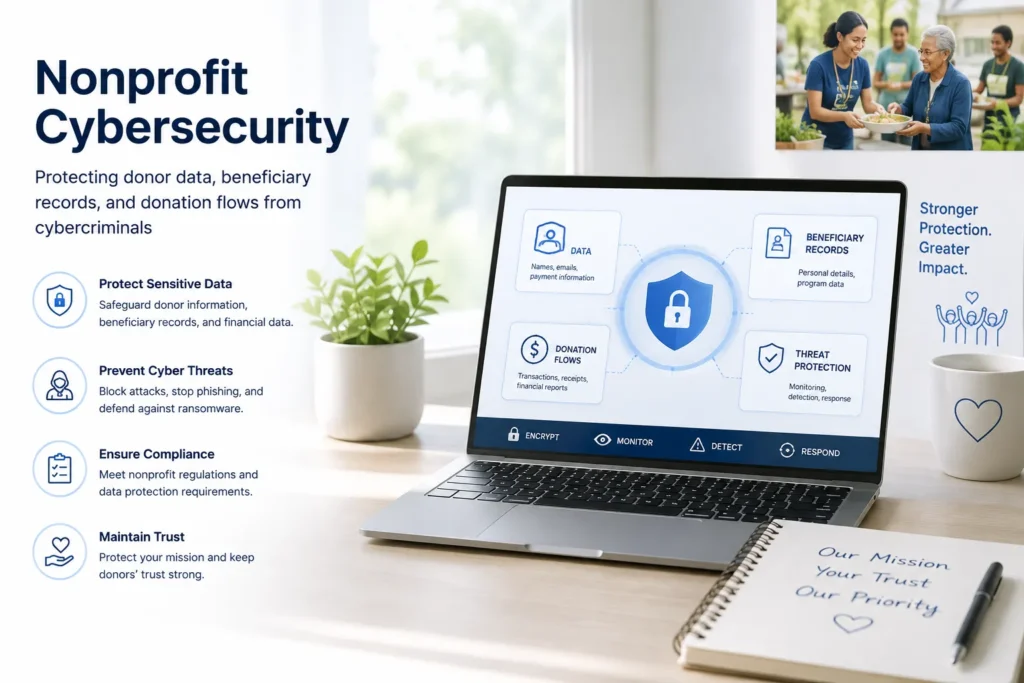
Nonprofits and NGOs are targeted for the same reason as any organization: they hold data and money that attackers want. Donor lists with high-net-worth giving histories, beneficiary records containing sensitive personal information, and financial flows through donation platforms and grant payments are all attractive targets. What makes the sector particularly vulnerable, and what nonprofit cybersecurity has to close, is the gap between the sensitivity of that data and the security investment that most organizations have made to protect it.
Key Takeaways
- Nonprofits hold donor data, beneficiary records, and financial flows that are directly valuable to criminal groups and, for internationally active NGOs, to state-aligned actors.
- The assumption that nonprofits are not worth attacking is false and demonstrably wrong. Cybercriminals select targets based on data value and security posture, not tax status.
- Reputational damage following a breach is disproportionately harmful to nonprofits because donor trust is the foundation of fundraising capacity.
- Volunteers, seasonal staff, and high staff turnover create access management challenges that many nonprofits have not fully addressed technically.
- International NGOs working in human rights, journalism, refugee services, or politically sensitive areas face targeted threats from state-aligned actors that go beyond conventional cybercrime.
The Misconception That Nonprofits Are Not Targets
Many nonprofit leaders operate on the assumption that their organizations are not interesting to attackers. The reasoning is intuitive: we are a charity, we have limited funds, there is nothing here worth stealing. This assumption is consistently wrong, and it creates the security posture gap that attackers exploit.
Cybercriminals do not distinguish between for-profit and nonprofit organizations when assessing targets. They assess the value of the data an organization holds, the financial flows that pass through it, and the difficulty of compromising its systems. On all three dimensions, many nonprofits present an attractive opportunity. High-value donor lists, beneficiary records containing sensitive personal and sometimes safety-critical information, and donation platforms processing significant payment volumes are all targets that criminals have demonstrated consistent interest in.
The organizations that hold the most sensitive data are not always the ones with the strongest security. A large hospital system or a financial institution has invested heavily in cybersecurity because the regulatory and reputational consequences of a breach are well understood and immediate. A community foundation or an international NGO may hold equally sensitive data in a less hardened environment, which is precisely what makes them attractive to attackers who prefer lower-resistance targets.
What Do Attackers Want From Nonprofits?
Donor Data and High-Net-Worth Records
Donor databases are among the most valuable assets a nonprofit holds from an attacker’s perspective. A major gifts donor list contains names, contact information, giving histories, and in many cases wealth indicators and personal relationship details that development officers use to cultivate relationships. This information has direct value for fraud, targeted phishing campaigns, extortion, and resale on criminal markets.
High-net-worth donors who give to multiple organizations are particularly attractive. Their giving records, combined with personal details gathered from multiple breached sources, enable highly targeted fraud campaigns. An attacker who knows a donor gave significantly to several charities has the context to construct credible impersonation scenarios that exploit the donor’s established giving patterns.
Beneficiary and Service-Recipient Records
Organizations that serve vulnerable populations, including those providing healthcare navigation, immigration support, domestic violence services, housing assistance, or mental health programmes, hold beneficiary records that are sensitive beyond their informational value. For individuals in difficult circumstances, exposure of their service relationship with a particular nonprofit can have safety, legal, or personal consequences that go well beyond identity theft.
This category of data creates an ethical obligation to protection that mirrors the legal obligation. A breach that exposes the names of individuals receiving domestic violence services, or the immigration status of community service recipients, can cause direct harm to the individuals involved. The organization’s duty of care to its beneficiaries extends to the security of the records that document their service relationship.
Financial Flows and Payment Infrastructure
Donation platforms, grant payment systems, and operational financial accounts move significant funds through many nonprofits. Business email compromise attacks that impersonate executive directors or board members to redirect donations, intercept grant payments, or divert vendor payments are a consistent threat pattern against the sector. The authority structure of nonprofits, where executive directors have significant financial decision-making power and boards meet infrequently, creates conditions that BEC attacks are designed to exploit.
Why Are Volunteers and Staff Turnover a Specific Risk?
Most nonprofit organizations rely on volunteers for a significant portion of their operational capacity. Volunteers receive access to email systems, donor management platforms, case management software, and other operational tools that they need to do their work. Unlike permanent employees, volunteers may not receive the same security onboarding, may use personal devices for organizational work, and may have their access revoked inconsistently or not at all when their volunteer engagement ends.
High staff turnover, common in the nonprofit sector due to compensation constraints and the emotional demands of mission work, creates a related access management challenge. Departing staff who retain access to donor management systems, email accounts, or financial platforms represent a persistent exposure that grows with each staff transition that is not fully closed out. A former development officer who retains access to a major gifts database, or a departed finance manager whose credentials are still valid on accounting software, is a vulnerability that persists until the access is revoked.
The technical solution to both problems is structured identity lifecycle management: consistent onboarding that establishes role-based access from day one, time-bounded credentials for volunteers that expire automatically at the end of their engagement, multi-factor authentication that prevents credential reuse, and prompt offboarding that revokes all access at departure. These are not expensive controls. They require process discipline and the right tools, both of which are achievable within nonprofit budget constraints.
What Is the Reputational Dimension of a Nonprofit Breach?
For a nonprofit, the reputational consequences of a data breach are disproportionate to those faced by commercial organizations. Donor trust is not just a reputational asset. It is the foundation of fundraising capacity. A donor who learns that their personal information and giving history were exposed because the organization did not implement basic security controls will question whether their future donations are being stewarded responsibly. That question directly affects the organization’s ability to fund its mission.
Major donors and institutional funders apply additional scrutiny. A foundation that learns a grantee experienced a data breach may require security attestation before renewing a grant. A government funder that includes cybersecurity requirements in grant agreements and learns of a breach may impose conditions or withhold funding pending remediation. The reputational damage does not stay contained to the immediate incident. It follows the organization into every subsequent donor and funder relationship.
What About International NGOs and Nation-State Threats?
NGOs operating in human rights, journalism, refugee support, conflict zone operations, or politically sensitive advocacy face a threat category that goes beyond conventional cybercrime. State-aligned actors have consistently targeted organizations whose work is inconvenient to particular governments. The tools and techniques used in these campaigns, spearphishing of key staff, mobile device compromise, infiltration of field communications, and surveillance of contacts and beneficiaries, are more sophisticated than typical criminal attacks and motivated by operational intelligence rather than financial gain.
For internationally active NGOs, the threat model must account for the locations where staff work, the communication channels used for sensitive operational discussions, and the security of devices that travel to or operate in high-risk environments. Standard enterprise security controls are a necessary foundation, but they are not sufficient for organizations that face targeted campaigns from well-resourced state actors. Operational security guidance for field staff, secure communication tools, and threat intelligence monitoring tailored to the organization’s geopolitical exposure are additional layers that the threat model requires.
How Does Professional Cybersecurity Address Nonprofit-Specific Risks?
A cybersecurity programme built for nonprofits and NGOs addresses the sector-specific risk profile: donor data protection calibrated to the sensitivity of major gifts records, beneficiary data security that accounts for the safety implications of exposure, volunteer-aware access management that handles high turnover and irregular engagement patterns, and financial control monitoring that detects BEC attempts against donation and grant payment workflows.
Armour Cybersecurity structures nonprofit engagements to mission, risk, and budget rather than applying enterprise programme economics to organizations that cannot absorb them. Its nonprofit cybersecurity services cover endpoint protection, email security, and monitoring at a scale and price point that works within nonprofit budget realities, and the fractional vCISO provides the senior cybersecurity leadership that boards and funders expect without the cost of a full-time hire.
Across the 260+ organizations Armour Cybersecurity protects in 52+ industries, the nonprofits that never turn a breach into a funding crisis are not the ones with the biggest security budgets. They are the ones who accepted early that their donor list and their beneficiary records are exactly what an attacker wants, and then did the unglamorous things well: MFA on the donor platform and every mailbox, access that ends the day a volunteer or staff member leaves, callback verification before any wire moves, and a board that has actually been briefed on what a breach would cost the mission, so security becomes part of stewardship rather than an afterthought discovered during an incident.
Frequently Asked Questions
We are a small community organization. Are we really at risk?
Size is not the primary factor that determines whether an organization is targeted. The value of the data held and the ease of compromise are more relevant. A small community foundation with a major gifts donor list may hold data that is more attractive to an attacker than the data held by a larger organization with stronger security. Ransomware operators specifically target smaller organizations where recovery capabilities are limited and the pressure to pay is greater. The question is not whether you hold valuable data, but whether you have taken reasonable steps to protect it.
Our board does not understand cybersecurity. How do we brief them?
Board members of nonprofits are typically mission-focused community leaders, not technical professionals. Effective board briefings on cybersecurity translate technical risk into mission and reputational terms: a breach of donor data would affect our fundraising capacity in these ways, a ransomware attack would disrupt our programmes for this many weeks, our cyber insurance would not cover a loss if we cannot demonstrate these controls. Armour’s vCISO service includes board-ready reporting developed specifically for nonprofit governance audiences.
What is the minimum we need to do to protect donor data?
The minimum effective controls for donor data protection are multi-factor authentication on donor management platforms and email accounts, encryption of donor data in the platforms where it is stored, access limited to staff who genuinely need it for their roles, prompt revocation when staff or volunteers leave, and a basic incident response plan that defines who to call and what to do if a breach is suspected. These controls are achievable within most nonprofit budgets and address the majority of the common attack patterns against donor data.
How do we protect beneficiaries whose personal safety could be affected by a breach?
Beneficiary records that carry safety implications require elevated controls proportionate to the risk. Access should be restricted to the minimum number of staff who need it for service delivery. Data should be stored in encrypted form with audit logging that tracks who accessed what and when. Sensitive case files should not be stored in general-purpose shared drives or email attachments. For organizations serving populations where exposure creates safety risk, a data minimization review that assesses whether all currently collected data is necessary is often the right starting point.
The Bottom Line
The belief that a charity is too small or too mission-driven to be worth attacking is exactly the belief attackers count on. Nonprofits hold donor lists, beneficiary records, and donation and grant flows that are as valuable as anything in the commercial world, often in a less hardened environment, and for some NGOs the adversary is not a criminal after money but a state-aligned actor after the organization’s contacts and operations. The consequences land harder here too, because a breach does not just cost money, it costs the donor trust that funds the mission. None of this requires an enterprise budget to defend. It requires the sector-specific basics done consistently: protected donor and beneficiary data, volunteer-aware access that ends on departure, verified financial workflows, and a board that understands the stakes. Armour Cybersecurity helps nonprofits, charities, and NGOs build budget-aware nonprofit cybersecurity services that protect donor data, beneficiary records, and mission operations, so protecting the people who depend on the organization becomes part of how it earns their trust.
About the author
David Chernitzky is the CEO and Co-Founder of Armour Cybersecurity, a Toronto-based firm that protects organizations across North America from advanced cyber threats. He brings more than 25 years of cybersecurity and military cyber intelligence experience, having served as an officer in an elite technology unit before co-founding Armour. Armour’s team of military-intelligence veterans and senior advisors serves 260+ clients across 52+ industries with a 97% client retention rate. Learn more about Armour Cybersecurity.