By David Chernitzky, Co-Founder and CEO, Armour Cybersecurity | Serving organizations across Canada, the US, and beyond | Last updated August 19, 2026
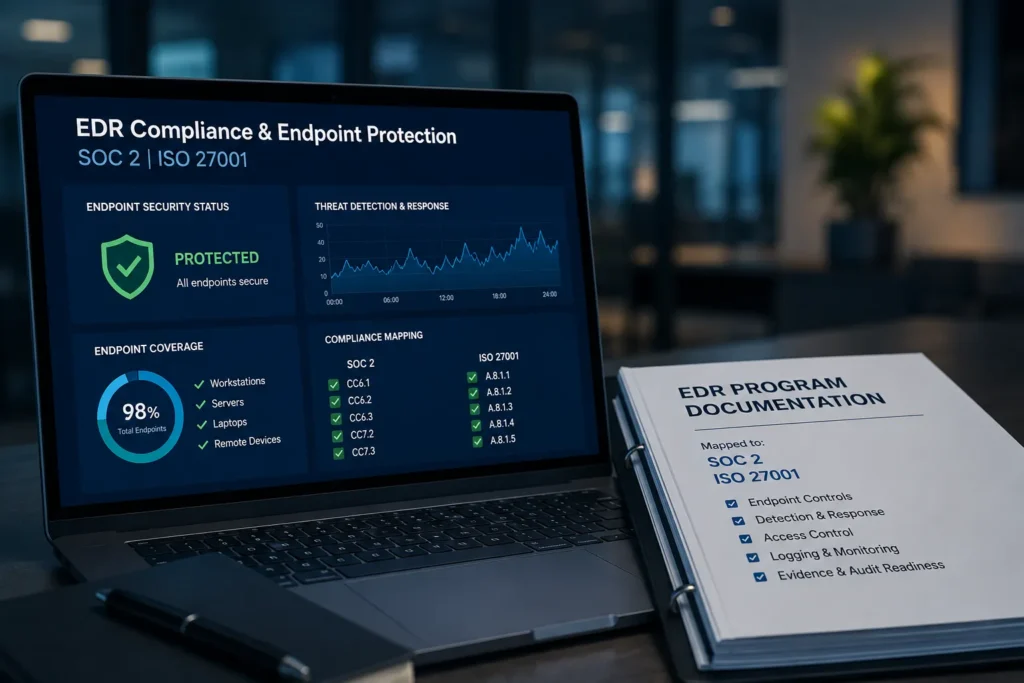
Quick answer: EDR compliance comes down to one thing: a properly deployed and documented EDR program satisfies the advanced endpoint protection requirements across every major compliance framework, from SOC 2 and ISO 27001 to HIPAA, PCI DSS, and CMMC. It is not enough to have the platform installed; auditors evaluate whether detection rules are configured and tuned, whether administrators can demonstrate how alerts are investigated, whether response procedures are documented, and whether coverage extends to all in-scope endpoints. The compliance value of EDR comes from the operational program, not the license. An EDR deployment that produces a compliance mapping of controls to framework requirements, with documented policies and an audit-ready evidence record, satisfies the endpoint security requirements of SOC 2, ISO 27001, HIPAA, PCI DSS, CMMC, and the CIS Controls.
Key Takeaways
- Compliance frameworks have moved past requiring antivirus. SOC 2, ISO 27001, HIPAA, PCI DSS, CMMC, and the CIS Controls all include requirements for endpoint protection that go beyond signature-based malware detection. The specific language varies by framework, but the common thread is advanced endpoint protection with behavioral detection, logging, and documented response capability. EDR is the control that satisfies these requirements when deployed and operated correctly.
- Auditors assess operational maturity, not platform presence. Having an EDR license and a working agent does not satisfy the endpoint protection requirements of any compliance framework. Auditors look for evidence that policies are configured, detection rules are tuned, alerts are being investigated, response procedures exist and are followed, and coverage extends to all systems in scope. The documentation and evidence record that a structured EDR program produces is what makes the compliance case.
- Compliance mapping is a deliverable, not an afterthought. Every EDR engagement should produce a documented mapping of the deployed controls to the framework requirements applicable to the organization. This mapping is the document the auditor reviews to verify that endpoint protection requirements are satisfied, and it is the basis for the audit evidence request that follows. Building the compliance mapping into the deployment engagement rather than reconstructing it before each audit is the difference between audit readiness and audit scramble.
- CIS Controls v8 provides the most actionable endpoint security benchmarks. The CIS Controls are organized into implementation groups that allow organizations to prioritize the most impactful controls based on their size and maturity. Controls 4 (Secure Configuration), 10 (Malware Defenses), and 13 (Network Monitoring and Defense) are directly addressed by EDR. The CIS Benchmarks for specific EDR platforms provide the configuration standards against which auditors can verify that the platform is deployed correctly.
- CMMC Level 2 and above require advanced endpoint protection that signature-based antivirus cannot satisfy. The CMMC requirements for malicious code protection (SI.L2-3.14.2), security alerts and advisories (SI.L2-3.14.3), and security monitoring (SI.L2-3.14.6 and 3.14.7) together require behavioral detection, alerting, and investigation capabilities that map directly to EDR functionality. Defense contractors pursuing CMMC Level 2 certification need a properly deployed and documented EDR program.
Framework by Framework: What EDR Addresses
The through-line across all six frameworks is the same: endpoint security compliance is earned by an operating program, not a purchased platform. If your endpoint layer is still running signature-based antivirus, what EDR is and why antivirus is no longer enough explains the capability gap these frameworks are now written around; this article maps that capability to the specific controls.
SOC 2
SOC 2 Trust Services Criteria CC6.8 requires that the entity implements controls to prevent or detect and act upon the introduction of unauthorized or malicious software. The criterion explicitly addresses the need for controls against malicious software including viruses and other threats, and it requires that the organization has procedures for identifying, testing, approving, and implementing changes to prevent the introduction of such software. A deployed and tuned EDR satisfies CC6.8 when the auditor can verify that the platform is deployed across in-scope systems, that detection rules are configured and maintained, and that the organization has documented procedures for responding to malware detections.
CC7.2 requires that the entity monitors system components and the operation of those components for anomalies that are indicative of malicious acts, natural disasters, and errors affecting the entity’s ability to meet its objectives. EDR’s continuous behavioral monitoring directly addresses this criterion. The evidence the auditor typically requests for CC7.2 includes the EDR deployment scope (which systems are covered), sample alert records showing that monitoring is active and alerts are being generated and investigated, and documented response procedures. An EDR engagement that includes compliance mapping structures this evidence for direct use during the SOC 2 audit.
ISO 27001
ISO 27001:2022 Annex A A.8.7 requires controls against malware, specifying that protection against malware shall be implemented and supported by appropriate user awareness. The control requires detection and recovery controls combined with appropriate user awareness. A.8.16 requires monitoring of activities to detect anomalous behavior and security events, which maps to EDR’s continuous behavioral monitoring capability. A.5.26 requires response to information security incidents, which maps to EDR’s response capability and the documented incident response procedures that a properly structured EDR program produces.
ISO 27001 auditors evaluate both the existence of controls and the evidence that they are operating effectively over the audit period. For EDR, this means the auditor will request evidence of the deployment scope, a sample of alerts and the corresponding investigation records, documentation of the detection rule configuration and the rationale for policy decisions, and evidence of periodic review and update of the endpoint protection controls. The compliance mapping and audit evidence record produced by an EDR engagement satisfy these evidence requests without requiring the organization to reconstruct the record from system logs immediately before the audit.
HIPAA
The HIPAA Security Rule requires covered entities and business associates to implement policies and procedures to protect electronic protected health information (ePHI) from malicious software under 45 CFR 164.308(a)(5)(ii)(B). The workstation security standard at 45 CFR 164.310(b) and (c) requires that policies and procedures specify the proper functions to be performed on workstations and the manner in which those functions are to be performed and the physical attributes of the surroundings of specific workstations. EDR addresses these requirements by providing the malware protection controls and workstation monitoring capability that the HIPAA Security Rule requires.
EDR HIPAA compliance turns on documented policies and demonstrated implementation, which is exactly where HIPAA enforcement focuses. A healthcare organization that deploys EDR but has no policy governing how the platform is configured, how alerts are investigated, or what happens when malware is detected is not in compliance even if the platform is technically functioning. The policy documentation, response procedures, and administrator training deliverables from an EDR engagement are the compliance artifacts that demonstrate that the organization has not just deployed a tool but has implemented the required administrative, technical, and physical safeguards as an operational program.
PCI DSS
PCI DSS v4.0 Requirement 5 covers protection of all system components against malware. Requirement 5.3.3 requires anti-malware solutions for removable electronic media. Requirement 5.3.4 requires logging of anti-malware solution audit logs, and 5.3.5 requires that anti-malware mechanisms cannot be disabled or altered by users. Requirement 5.4.1 addresses phishing and social engineering protection. Modern EDR platforms satisfy all of these requirements and go substantially beyond the minimum threshold by providing behavioral detection, forensic telemetry, and response capability that traditional antivirus cannot.
PCI DSS also requires that the scope of protection covers all system components in the cardholder data environment. An EDR deployment that covers laptops and workstations but misses servers in the cardholder data environment does not satisfy the PCI DSS requirement for those servers. The endpoint posture assessment that initiates an EDR engagement maps coverage against the cardholder data environment scope and ensures that the deployment plan closes all coverage gaps before the PCI DSS assessment.
CMMC
Cybersecurity Maturity Model Certification Level 2 maps to NIST SP 800-171, whose System and Information Integrity family (3.14) includes multiple practices that together require EDR-level capability. SI.L2-3.14.2 requires protection from malicious code at designated locations within organizational systems. SI.L2-3.14.4 requires that malicious code protection mechanisms are updated when new releases are available. SI.L2-3.14.5 requires periodic scans of organizational systems and real-time scans of files from external sources. SI.L2-3.14.6 requires monitoring of organizational systems, including inbound and outbound communications traffic, to detect attacks and indicators of potential attacks. SI.L2-3.14.7 requires identification of unauthorized use of organizational systems. Together, these practices require a behavioral detection and monitoring capability that signature-based antivirus alone does not satisfy.
This is where CMMC endpoint protection separates compliant contractors from failed assessments. Defense contractors pursuing CMMC certification who deploy only traditional antivirus will fail the assessment against the monitoring and detection practices. An EDR program deployed to the required scope, with documented policies, tuned detection rules, and a demonstrated monitoring and response capability, satisfies the CMMC endpoint protection requirements and produces the System Security Plan documentation that the CMMC assessment process requires. Armour Cybersecurity maps every EDR deployment to the applicable framework requirements and produces the compliance documentation structured for direct use in certification assessments.
Frequently Asked Questions
What documentation do auditors actually request for endpoint protection?
The specific evidence requests vary by framework and auditor, but the common set across SOC 2, ISO 27001, HIPAA, and PCI DSS includes: the endpoint protection policy document describing what controls are required and how they are implemented; the deployment scope documentation showing which systems are covered by the EDR and how coverage gaps are tracked and addressed; sample alert records from the audit period showing that monitoring is active and alerts are being generated; investigation records for a sample of significant alerts showing that the organization reviews and responds to detections; documented response procedures for malware incidents; evidence of periodic review and update of the endpoint protection controls; and the compliance mapping showing how the deployed controls satisfy the applicable framework requirements. That mapping is exactly the kind of artifact a multi-framework compliance program is built to produce once and reuse across audits. An EDR engagement that produces all of these artifacts as standard deliverables is audit-ready from the day deployment completes rather than requiring a documentation scramble before each audit.
Does having EDR mean we will pass our SOC 2 or ISO 27001 audit?
Having a properly deployed and documented EDR program satisfies the endpoint protection requirements of both frameworks. Whether you pass the audit overall depends on whether all other applicable requirements are also satisfied. Endpoint protection is one control domain among many; the auditor evaluates the full set of applicable criteria or Annex A controls. EDR addresses the malware protection, system monitoring, and incident response criteria that directly relate to endpoint security. It does not address the access management, change management, cryptography, asset management, or business continuity requirements that are also evaluated in SOC 2 and ISO 27001 audits. A comprehensive compliance readiness assessment evaluates all applicable requirements and identifies the gaps that need to be addressed across all control domains before the certification audit.
Do we need to document our EDR policies separately from vendor documentation?
Yes. Vendor documentation describes how the platform works; your policies describe how your organization uses it. Auditors need organizational policies that specify the scope of EDR deployment, the detection rule configuration rationale, the procedures for investigating alerts, the response procedures for confirmed incidents, the criteria for escalating alerts to incident response, and the review and update cycle for detection rules and policies. The vendor’s product documentation does not substitute for organizational policy because it does not reflect the decisions your organization has made about how the platform is configured and operated for your specific environment. An EDR engagement produces these organizational policy documents as deliverables.
Our EDR has been deployed for two years but we have no documentation. What do we do?
A documentation retrospective is the most practical approach. An endpoint posture assessment evaluates the current deployment, documents the existing configuration, identifies gaps in coverage and policy maturity, and produces the compliance mapping and policy documentation that the deployment lacks. This is faster than starting over with a new platform and delivers the audit-ready documentation without disrupting the existing deployment. It is also usually cheaper than the cost of a failed audit, and it is the same gap-closing work a proper EDR deployment program would have built in from the start. In parallel, alert investigation records from the past audit period may need to be reconstructed from system logs if the EDR platform retains telemetry history, or the auditor may accept a statement of current practices with forward-looking evidence collection if the historical record is not available. The posture assessment provides the foundation for the compliance documentation program going forward regardless of the historical record situation.
The Bottom Line
The frameworks stopped accepting “we run antivirus” years ago. SOC 2 CC6.8 and CC7.2, ISO 27001’s A.8.7, A.8.16, and A.5.26, the HIPAA Security Rule, PCI DSS Requirement 5, the CMMC System and Information Integrity practices, and CIS Controls 4, 10, and 13 all ask for behavioral detection, monitoring, logging, and a documented response capability, which is a description of EDR done properly. The catch is that the platform alone proves nothing to an auditor. What passes the audit is the operational program around it: tuned detection, coverage across every in-scope system, alert investigation records, response procedures, and a control-to-framework mapping that shows exactly how the deployment satisfies each requirement. A structured EDR deployment that produces that mapping and evidence record as standard deliverables turns endpoint compliance from a recurring scramble into a byproduct of running the program.
About the author
David Chernitzky is Co-Founder and CEO of Armour Cybersecurity, a Toronto-based cybersecurity firm founded by military intelligence veterans and advised by senior leaders from PwC, KPMG, Deloitte, EY, and Mandiant. Armour serves more than 260 organizations across 52-plus industries, including finance, healthcare, technology, energy, legal, and government, with a 97 percent client retention rate.