For years, “AI in cybersecurity” mostly meant smarter spam filters and faster alert triage. That era is over. In 2026, an AI model crossed a line that changes the math for every organization: it started finding serious, previously unknown security flaws — at scale, on its own, in the software the entire world runs on. The question is no longer whether AI will reshape cyber defense. It’s whether your security program can move fast enough to survive the shift.
What Actually Happened
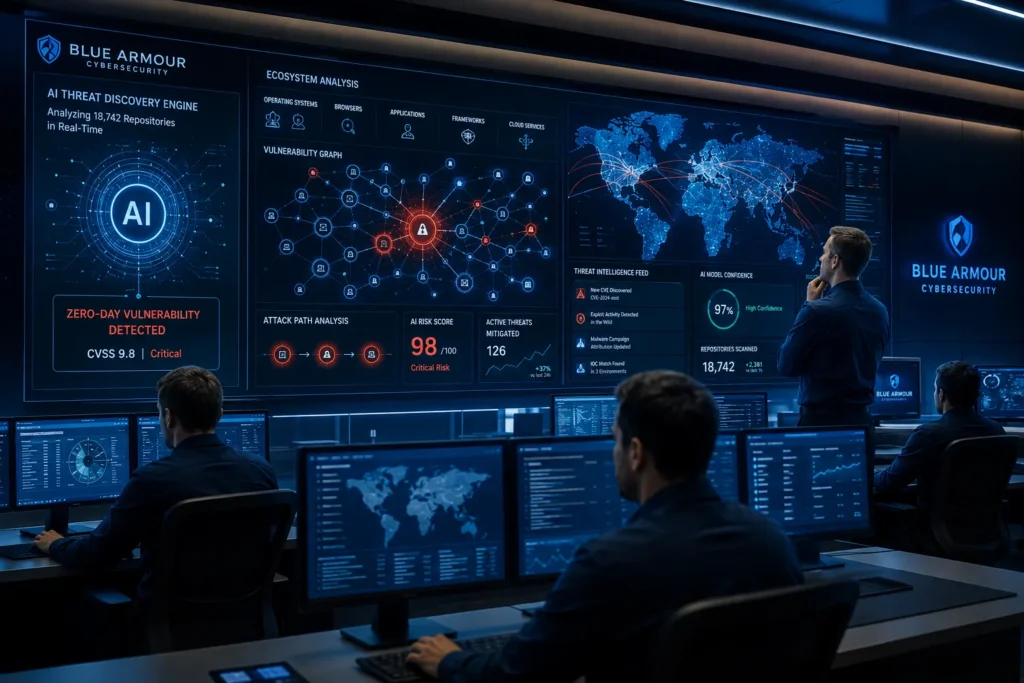
Anthropic’s Claude Mythos Preview identified thousands of zero-day vulnerabilities — flaws no one knew existed — many of them critical, across every major operating system and every major web browser, plus a long list of other widely used software. These weren’t obscure edge cases. In one instance the model uncovered a 27-year-old vulnerability in OpenBSD, an operating system famous for being one of the most hardened on earth. In another, it autonomously found and exploited a 17-year-old remote-code-execution flaw in FreeBSD’s NFS server that would hand an unauthenticated attacker complete root control.
What makes this a turning point isn’t a single clever bug. It’s that these capabilities weren’t specially trained in — they emerged as a byproduct of general improvements in code understanding, reasoning, and autonomy. And here’s the uncomfortable part: the same skill that lets an AI patch a vulnerability lets it exploit one. Anthropic released Mythos only to a limited group of critical-infrastructure defenders and open-source maintainers, through an effort called Project Glasswing, precisely to give the good guys a head start before models with similar power become broadly available.
Why This Changes the Rules
Cybersecurity has always been a race between how fast flaws are discovered and how fast they’re fixed. AI just slammed the accelerator on the discovery side — for everyone. Three things change immediately.
First, the “patch gap” is closing to near-zero. Historically, defenders had days or weeks between a vulnerability becoming known and attackers weaponizing it. When AI can discover and exploit flaws autonomously, that grace period compresses dramatically, and slow patching stops being an inconvenience and becomes an open door. Second, “old and stable” no longer means “safe” — a 27-year-old flaw in hardened software means decades-old assumptions are being re-examined at machine speed. Third, the advantage goes to whoever is faster; for now that capability sits with defenders, but it will diffuse, and the organizations that win are the ones that use this window to get ahead.
There’s a second front, too: your own teams are almost certainly adopting AI tools right now, and doing that safely is part of the same race — which is exactly what a secure AI adoption program is built to handle. In short, AI didn’t just hand attackers a new weapon or defenders a new shield. It sped up the entire clock, and a security program built for a slower world will feel that pressure first.
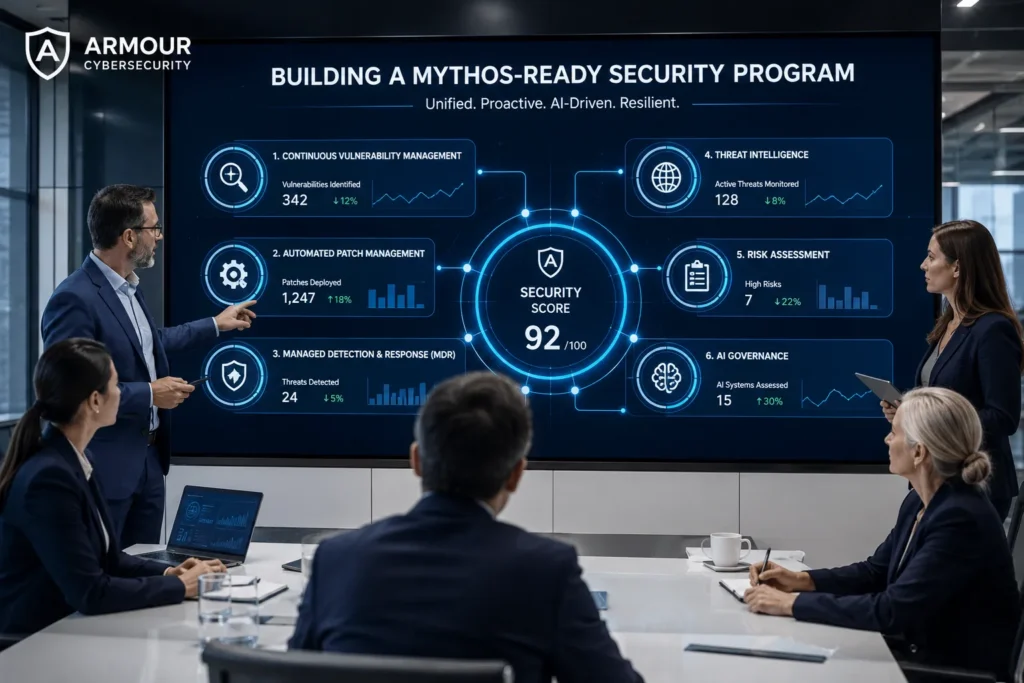
What a “Mythos-Ready” Security Program Looks Like
Being “Mythos-ready” doesn’t require exotic technology. It requires speed and coordination across a few fundamentals — the same fundamentals that have always mattered, now with far less tolerance for lag. None of it is exotic; it is the disciplined execution of well-understood basics, run at a faster tempo than most organizations are used to.
1. Continuous, prioritized vulnerability management
You can’t patch what you can’t see, and you can’t patch everything at once. A modern program continuously scans for weaknesses and ranks them by real-world risk, so the most dangerous, most exploitable flaws get fixed first. In an AI-accelerated world, vulnerability management shifts from a quarterly chore to an always-on discipline — the single highest-leverage change most organizations can make right now.
2. Fast, disciplined patching
Discovery is only half the equation. If your organization takes weeks to deploy critical patches, none of the AI-driven early warning helps. Tighten the process: know your assets, automate updates where you safely can, and have a defined path to push emergency fixes fast when a critical flaw lands.
3. Detection and response for what slips through
No program prevents everything, so assume some attacks will land — and shorten the time to catch and contain them. Continuous managed detection and response watches for the signs of active exploitation around the clock, so a break-in becomes a contained event rather than a slow, silent compromise that plays out over weeks before anyone notices.
4. Intelligence that keeps you current
AI changes the threat landscape weekly, not annually. Keeping your defenses tuned to what’s actually being exploited right now — not what mattered last quarter — is what stops your team from spending scarce time on theoretical risks while the real ones go unaddressed and unpatched.
5. A clear starting line
If you don’t know where your biggest exposures are, start there. A focused cybersecurity risk assessment maps your assets and gaps, so your effort — and budget — goes to the weaknesses an AI-powered attacker would find first, instead of being spread evenly across things that don’t matter.
The Organizations Most at Risk
An accelerated threat clock hits hardest wherever defenses are thin and budgets are tight. Small and mid-sized businesses, and especially resource-constrained sectors, face the same AI-empowered adversaries as the largest enterprises — with a fraction of the staff to keep up. That asymmetry is the whole problem: the attacker tooling keeps getting cheaper and faster, while the defender budget and hours stay flat, and the gap between well-resourced and under-resourced organizations is about to widen unless the smaller ones act deliberately. Nonprofits are a clear example: they hold sensitive donor and beneficiary data, often run on lean IT, and are frequently targeted precisely because attackers assume they’re under-protected. Purpose-built cybersecurity for nonprofits — and for any lean organization facing evolving AI-driven threats — is about getting enterprise-grade speed without an enterprise-grade team.
The common thread: you don’t need to match a well-funded attacker tool for tool. You need to close the obvious doors quickly, watch the ones you can’t close, and have a plan for when something gets through.
Don’t Fear AI — Get Ahead of It
It’s easy to read a story about an AI finding thousands of zero-days and feel like the ground is shifting under you. But the same technology re-examining decades-old software is also the technology that will help defenders patch it faster than ever. The winners in this new era won’t be the organizations with the biggest security budgets — they’ll be the ones that moved first, tightened their fundamentals, and treated speed as a security control in its own right. The window to get ahead is open now, while this capability sits with defenders. It won’t stay open forever.
Frequently Asked Questions
What is Claude Mythos, and why does it matter for security?
Claude Mythos Preview is an AI model from Anthropic that demonstrated the ability to autonomously find serious, previously unknown vulnerabilities across major operating systems, browsers, and other widely used software. It matters because it signals a step-change: AI can now discover — and potentially exploit — flaws at a scale and speed that traditional processes weren’t built to keep up with. Feeding good cyber threat intelligence into your defenses is one way to stay current as that landscape shifts from week to week.
Does this mean attackers already have this capability?
Not directly — Anthropic released Mythos only to a limited group of defenders and open-source maintainers to give protection a head start. But advanced AI capabilities tend to spread over time, so the responsible assumption is that comparable tools will eventually be available more broadly. That’s exactly why the time to strengthen your program is now, during the defender’s head start.
We’re a small organization. Is being “Mythos-ready” realistic for us?
Yes. You don’t need a large in-house team — you need the right priorities and, often, a partner. Focus first on the highest-impact steps (know your assets, patch critical flaws fast, monitor for what slips through), and make sure a serious incident won’t catch you flat-footed by lining up incident response services before you ever need them. A managed approach delivers enterprise-grade speed and expertise without enterprise-grade headcount.
Where do we start?
Start by finding out where you stand. A risk assessment shows you which exposures an AI-powered attacker would reach first, so you can fix what matters most before anyone else finds it. From there, tighten patching, add continuous monitoring, and build a response plan — or fold all of it into one program. For organizations that would rather not run it in-house, a fully managed engagement brings the intelligence, monitoring, and response together under one roof, so nothing falls through the gaps between separate tools and vendors, and one accountable team owns the outcome when it matters most.
Build a Mythos-Ready Program Before Attackers Catch Up
AI just changed the rules. Armour Cybersecurity helps organizations of every size stay ahead of AI-driven threats through fully Managed Security Services that move at the speed the moment demands. Download our free whitepaper for a practical blueprint to a Mythos-ready security program, or talk to our team about where to start.