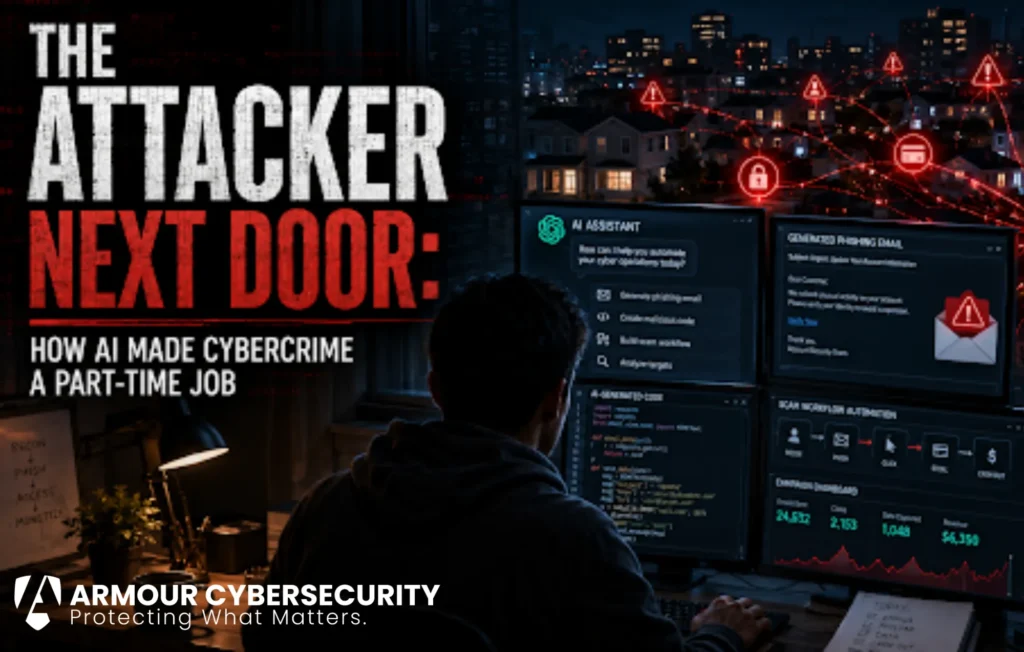
How AI Made Cybercrime a Part Time Job
AI has eliminated the technical skill required to launch a sophisticated cyberattack. Here’s what that means for your Canadian business and exactly what to do about it.
There’s a conversation happening in boardrooms right now: “We’re a mid sized company. We don’t have anything worth stealing. Why would anyone target us?” It’s the wrong question and in 2026, it’s a dangerous one.
The reason most small and medium businesses historically avoided serious cyberattacks wasn’t that they were well protected. It was that attacking them wasn’t worth the effort. Sophisticated hacks required skilled hackers. Skilled hackers had limited time. They went after big targets.
That equation no longer holds.
AI Didn’t Just Make Hackers Better. It Made Everyone a Hacker.
In early 2025, three teenagers ages 14, 15, and 16, with zero coding background used ChatGPT to build an automated attack tool that hit a major telecom’s system over 220,000 times. They spent the money on gaming consoles.
A few months later, a single actor using AI powered coding tools ran an extortion campaign against 17 organizations in one month building malware, sorting stolen files, analyzing victim financials, and writing personalized ransom demands. All with AI. All alone.
And in a widely cited case from Algeria, an amateur with no prior hacking history built functional ransomware using publicly available AI tools and successfully hit 85 targets in his first month of operation.

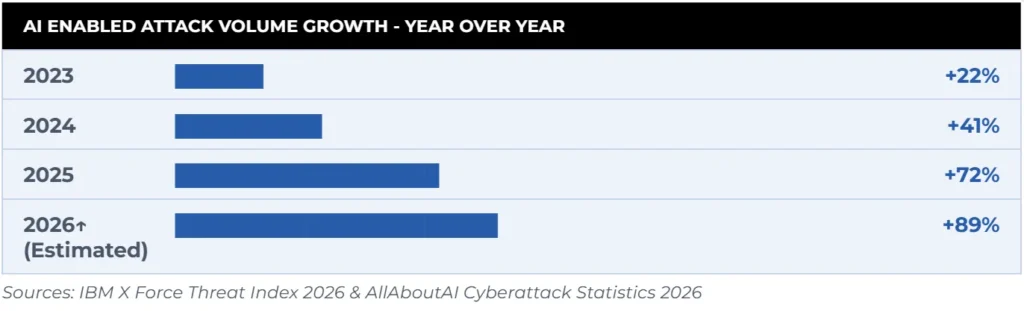
The New Attack Toolkit: What You’re Actually Up Against
1 AI Generated Phishing That Passes Every Smell Test
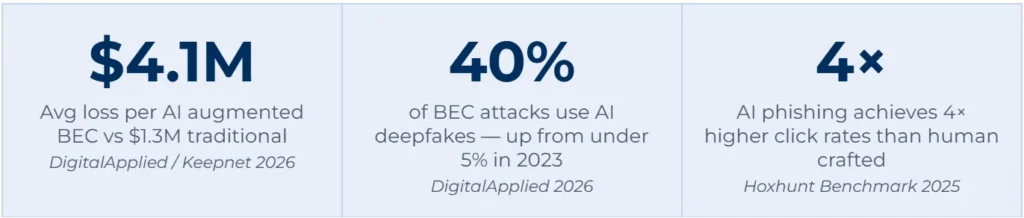
The telltale signs of a phishing email misspellings, awkward phrasing, suspicious formatting are largely gone. Hoxhunt’s data shows AI was ~24% more effective than human red teams (KnowBe4 Phishing Threat Trends 2025). They are grammatically perfect, contextually relevant, and personalized using data scraped from LinkedIn, your website, and public records. Vishing (voice phishing) surged 442% from the first to second half of 2024 alone.
2 Deepfake CEO Fraud Now Targeting Mid Market Companies
In January 2024, engineering firm Arup lost $25.6 million USD after an employee was directed on a video call by what appeared to be the CFO to authorize fifteen transfers. The CFO was AI generated. By Q1 2026, 40% of Business Email Compromise attacks used AI deepfakes, up from under 5% in 2023.
3 Vulnerabilities Exploited Before You Can Patch
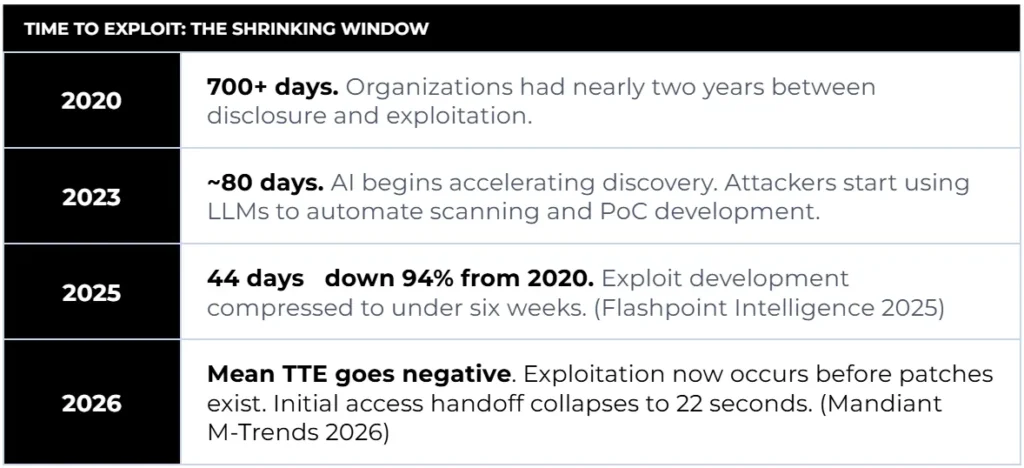
In 2020, the average time between a vulnerability being disclosed and exploited was over 700 days. By 2025, it had fallen to 44 days. Mean time-to-exploit has gone negative — attackers now exploit vulnerabilities before patches are publicly available (Mandiant M-Trends 2026).
What Happens After a Breach , The Aftermath Nobody Talks About
When an attack makes the news, coverage focuses on the incident itself. What gets far less attention is what happens to the business in the weeks and months that follow.
“40% of small businesses say a cyberattack costing $100,000 or less would put them out of business permanently.”
— Astra Security, 2025
Operations grind to a halt. Most SMBs have no incident response plan. For a company doing $5M annually, even five days of downtime can represent a six-figure loss before a single recovery cost is counted. The average downtime from a ransomware attack is 21 days; organizations without tested recovery plans can face disruption lasting a month or more. (Sophos State of Ransomware 2025).
Clients leave and don’t come back. A significant majority of consumers stop doing business with a company that experienced a breach. For law firms, accounting practices, healthcare providers, or financial services firms, this is existential.
The regulatory clock starts immediately. Breach notification laws exist in virtually every major jurisdiction. GDPR (EU/UK) requires notification within 72 hours. PIPEDA (Canada), US state laws, and Australia’s NDB scheme all carry significant fines and civil liability.
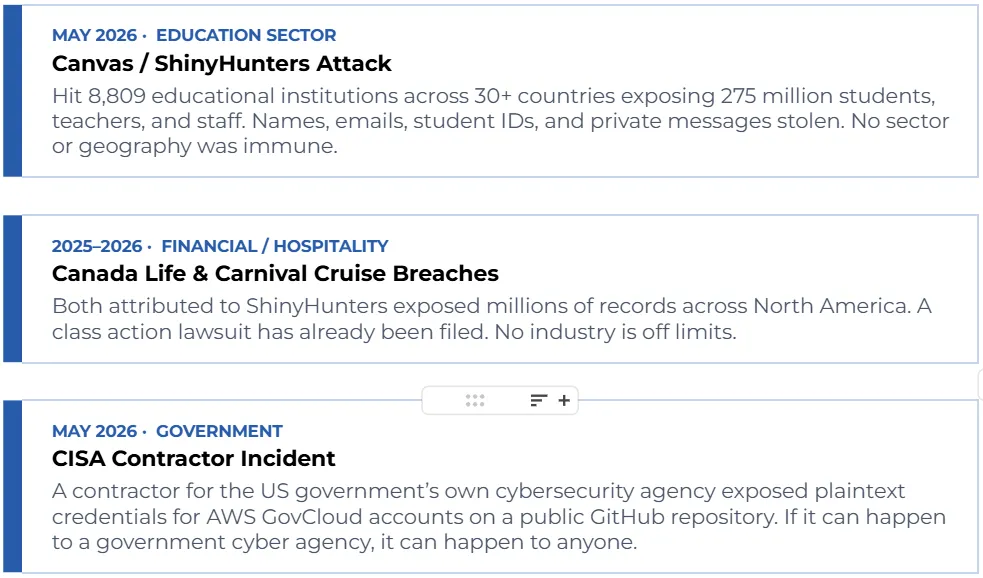
Real World Attacks: What’s Happening Right Now
These are not hypothetical scenarios. These are confirmed incidents from the past 90 days.
7 Practical Steps to Protect Your Business Starting Now
The majority of successful AI assisted attacks exploit preventable gaps. Here’s where to focus first.
| 1. Enable MFA Everywhere — No Exceptions Identity based attacks account for ~30% of all intrusions. MFA on email, banking, CRM, cloud storage, and remote access eliminates the majority of credential attacks in a single step. |
| 2. Train Staff to Spot AI Generated Attacks Run quarterly phishing simulations using AI generated content. Perfect grammar and personal context are no longer signs of a legitimate email. Make “verify before you act” a company reflex. |
| 3. Dual Approval for All Financial Actions Any wire transfer or change to banking details must require out of band confirmation a callback to a known number or written approval from a second person. This stops deepfake CEO fraud cold. |
| 4. Audit Every Third Party Vendor List every platform with access to your data. Ask: What is your breach notification policy? When were you last audited? If they can’t answer, that’s your answer. |
| 5. Build an Incident Response Plan Now Who do we call? What do we shut down first? Who notifies clients? Where are our backups? A basic IRP requires clarity, not budget. Run a tabletop exercise once a year. |
| 6. Patch Exploited Vulnerabilities Within 48 Hours Use CISA’s Known Exploited Vulnerabilities catalog, updated daily: cisa.gov/known exploited vulnerabilities catalog |
| 7. AI Detection and Monitoring Tooling Provides organizations with the ability to identify, monitor, and manage AI adoption and usage across systems and applications |
| BOTTOM LINE SMBs can no longer fly under the radar. AI has lowered the cost of attacking your business to near zero. The businesses that will navigate this aren’t the ones with the largest budgets, they’re the ones that took the basics seriously, built a culture of vigilance, and had a plan ready. |
Frequently Asked Questions
How are AI powered cyberattacks different from traditional attacks?
AI powered attacks are faster, more personalized, and require no technical skill to launch. They include AI generated phishing emails with 4× higher click rates, deepfake CEO fraud via live video call, and automated tools that exploit vulnerabilities within 24 hours of public disclosure compared to 700+ days just six years ago.
Are small businesses in Canada being targeted by AI powered cyberattacks?
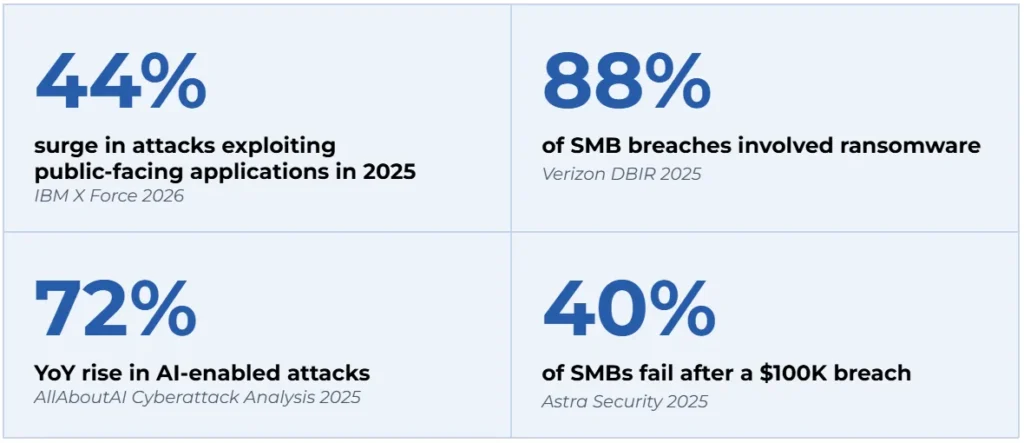
Yes, and disproportionately. Ransomware was involved in 88% of SMB breaches globally in 2025 (Verizon DBIR), vs 39% at large enterprises. The Canvas/ShinyHunters attack in May 2026 alone hit 8,809 institutions across 30+ countries. No industry or geography is immune.
What is AI powered Business Email Compromise (BEC)?
AI powered BEC uses deepfake audio, video, or AI generated text to impersonate executives and trick employees into authorizing fund transfers. By Q1 2026, 40% of BEC attacks used AI deepfakes, up from under 5% in 2023. Average losses now exceed $4.1 million per incident.
What is the single most important cybersecurity protection step for SMBs?
Enable multi factor authentication (MFA) on all accounts and implement dual approval for all financial transactions. These two controls address the most common attack vectors, credential theft and CEO fraud, at minimal cost and complexity.
How quickly must Canadian businesses report a data breach under PIPEDA?
Under PIPEDA, businesses must report breaches posing a real risk of significant harm as soon as feasible. The EU/UK GDPR requires notification within 72 hours. Class action exposure and regulatory fines apply in all major jurisdictions. The clock starts the moment a breach occurs.
What is the average cost of a cyberattack on a small business?
40% of small businesses say a cyberattack costing $100,000 or less would put them out of business permanently (Astra Security, 2025). Average ransomware recovery takes 287 days. For AI augmented BEC, average losses exceed $4.1 million per incident.
Sources & Further Reading
- IBM X Force Threat Intelligence Index 2026 – IBM Security, February 2026
- Verizon 2025 Data Breach Investigations Report (DBIR)
- Mandiant M Trends 2026 – Google Cloud / Mandiant
- 55 Small Business Cyber Attack Statistics 2026 – Astra Security
- Deepfake Statistics & Trends 2026 – Keepnet Labs
- AI Deepfake Attacks Surge: 40% of Email Compromise – Digital Applied 2026
- N Day Vulnerability Exploitation Trends – Flashpoint Intelligence
- Canvas Cyberattack – Canadian Universities Affected – CBC News, May 2026
- Canada Life Data Breach 2026 – Settlement Alerts Canada
- CISA Known Exploited Vulnerabilities Catalog – cisa.gov/known exploited vulnerabilities catalog
| READY TO FIND YOUR GAPS? Is Your Business Ready for AI Powered Threats? Get a complimentary cybersecurity assessment and find your gaps before an attacker does. Book a Free Assessment → armourcyber.io/contact (+1) 866 803 0700 |