Quick answer: SOC 2, PCI DSS, ISO 27001, HIPAA, CMMC, and most cyber insurance policies require documented evidence of ongoing vulnerability management. That means asset inventory, recurring scan reports, prioritized remediation worklists, and evidence that findings are actually fixed. A managed program produces all of these as standard deliverables. A stack of quarterly PDFs typically does not.
Key Takeaways
- Every major security compliance framework includes vulnerability management as a required control or evidence category.
- Auditors distinguish between organizations with point-in-time scans and those with continuous managed programs. The documentation requirements reflect that distinction.
- Cyber insurance carriers are actively tightening vulnerability management requirements at underwriting and renewal, with pricing and coverage availability tied to program maturity.
- A managed vulnerability program produces compliance-ready documentation as a standard output, not as a pre-audit scramble.
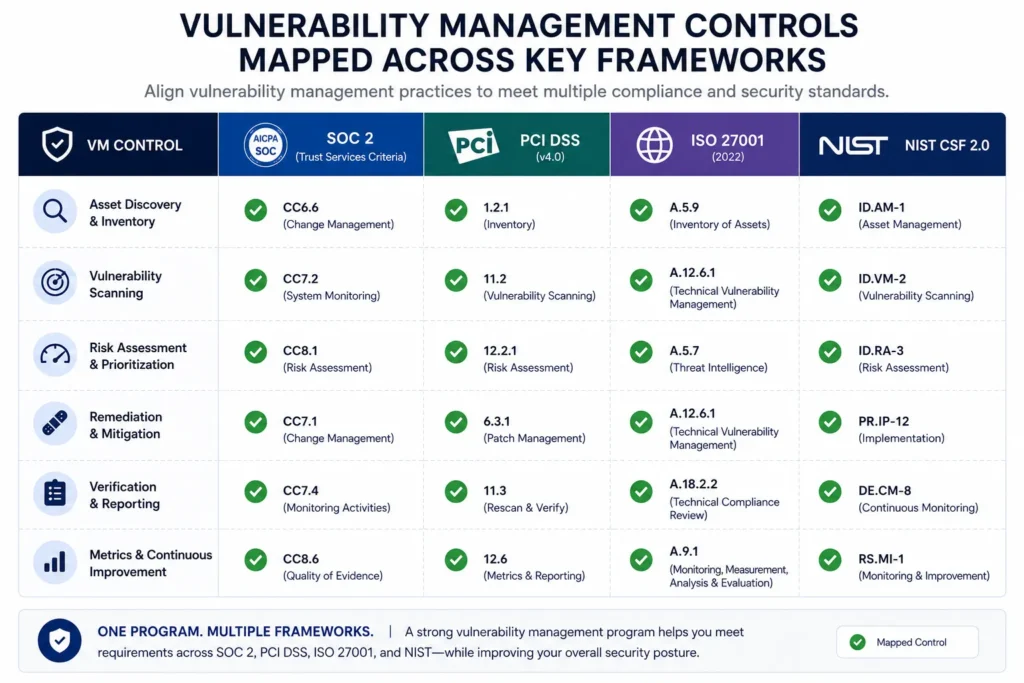
- Meeting multiple frameworks with one program is achievable. The underlying controls and evidence overlap significantly across SOC 2, ISO 27001, PCI DSS, and NIST CSF.
Why Do Compliance Frameworks Require Vulnerability Management?
Every major security framework is built around a core principle: organizations must know what weaknesses exist in their environment and must have a systematic process for addressing them. This principle appears in different forms across frameworks, but the underlying requirement is consistent. You cannot claim to manage security risk if you do not know what vulnerabilities exist in your systems, and you cannot demonstrate that you manage them if you have no documented process for tracking remediation. This is the discipline behind a structured vulnerability management program.
For SMBs pursuing certification or operating under regulatory obligations, this is not an abstract requirement. Auditors test it directly. They request asset inventories, scan reports, remediation records, and evidence that high-severity findings were addressed within defined timeframes. Organizations that cannot produce this documentation, or that produce quarterly scan reports with no evidence of remediation activity, receive findings that affect the audit outcome and, in some cases, the certification itself.
What Does SOC 2 Require for Vulnerability Management?
SOC 2 evaluates controls against five trust service criteria: security, availability, processing integrity, confidentiality, and privacy. The security criterion, which is required for every SOC 2 report, includes controls around vulnerability management under the common criteria CC7.1 and related sections.
Specifically, auditors evaluate whether the organization monitors for system vulnerabilities, implements detection procedures to identify vulnerabilities, and remediates vulnerabilities within defined timeframes. For a SOC 2 Type II report, which covers controls operating effectively over a period of at least six months, auditors will sample evidence from across that period. They are not looking for one scan report. They are looking for evidence of a program operating continuously throughout the audit window.
The evidence they typically request includes: a current asset inventory, recurring scan reports showing coverage across in-scope systems, a remediation process with documented timelines and ownership, and records showing that identified vulnerabilities were addressed. A managed vulnerability program produces all of these as standard deliverables. An organization running ad hoc quarterly scans with no tracking process will struggle to assemble this evidence from a scattered file system.
What Does PCI DSS Require for Vulnerability Management?
Payment Card Industry Data Security Standard requirements are among the most prescriptive for vulnerability management. PCI DSS v4.0 includes multiple requirements directly:
- Requirement 6.3: All system components must be protected from known vulnerabilities through patching and software updates, with critical patches deployed within one month of release.
- Requirement 11.3: Internal and external vulnerability scans must be performed at minimum quarterly, with critical vulnerabilities remediated before passing the next scan.
- Requirement 11.3.2: External vulnerability scans must be performed by a PCI-approved scanning vendor.
- Requirement 12.3: Risks to cardholder data must be formally assessed with documented remediation plans.
The practical implication is that PCI DSS requires not just scanning but a documented process for tracking and remediating findings, with evidence that critical vulnerabilities are addressed within defined windows. PCI DSS also requires regular penetration testing alongside scanning. A managed program that tracks remediation to verified closure is aligned to these requirements by design. A quarterly scan with no remediation tracking typically fails the audit evidence test even if the scan itself was completed on schedule.
What Does ISO 27001 Require?
ISO 27001 requires organizations to manage technical vulnerabilities as part of its control set, specifically under Annex A Control 8.8 in the 2022 revision. The control requires the organization to obtain timely information about technical vulnerabilities, evaluate exposure, and take appropriate action to address risk.
The standard also requires a management of technical vulnerabilities procedure that defines timelines for patching, roles and responsibilities for remediation, and a process for testing and verifying that patches were applied effectively. The procedure must be documented and operating. Auditors test that the procedure is being followed, not just written.
For SMBs pursuing ISO 27001 certification, a managed vulnerability program provides the technical controls, the documented procedure, and the evidence of operation that auditors require. The monthly and quarterly reports produced by the program serve directly as audit evidence, and slot neatly into a broader compliance readiness effort.
What Do Cyber Insurance Carriers Require?
Cyber insurance underwriting has changed substantially over the past few years. Following significant loss years driven by ransomware, carriers have hardened their underwriting requirements and are asking more specific questions about security controls. Vulnerability management is consistently one of the areas of focus.
Carrier questionnaires now commonly ask: How frequently are vulnerability scans conducted? What percentage of your assets are covered? What is your process for remediating critical findings, and within what timeframe? Do you have documented evidence of your remediation cadence available for review?
Organizations that cannot answer these questions with documented evidence face higher premiums, sublimits on coverage, or exclusions for incidents involving known unpatched vulnerabilities. Some carriers now require access to scan reports or remediation records as part of renewal. Working with a cyber insurance advisory partner, alongside a managed vulnerability program, produces this documentation as a standard output rather than requiring the organization to assemble it retroactively when the carrier asks.
Can One Program Satisfy Multiple Frameworks Simultaneously?
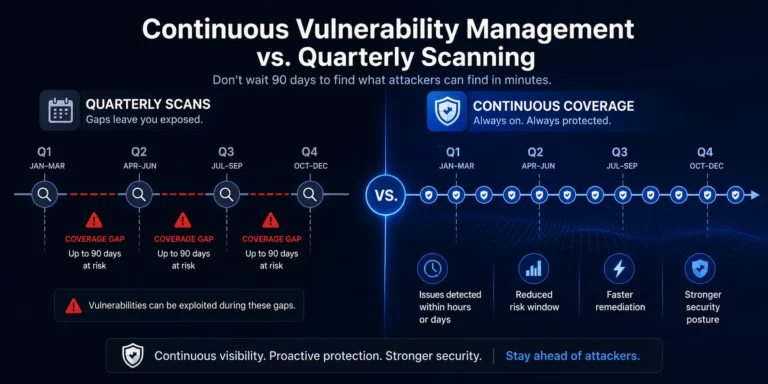
Yes, and this is one of the practical advantages of a well-structured managed program. The underlying controls for vulnerability management are substantially consistent across SOC 2, ISO 27001, PCI DSS, NIST CSF, CMMC, and HIPAA. The differences are primarily in specific timelines, documentation formats, and reporting structures rather than in the fundamental discipline. That overlap is exactly why point-in-time scanning falls short, a gap covered in depth in our guide to continuous versus quarterly vulnerability management.
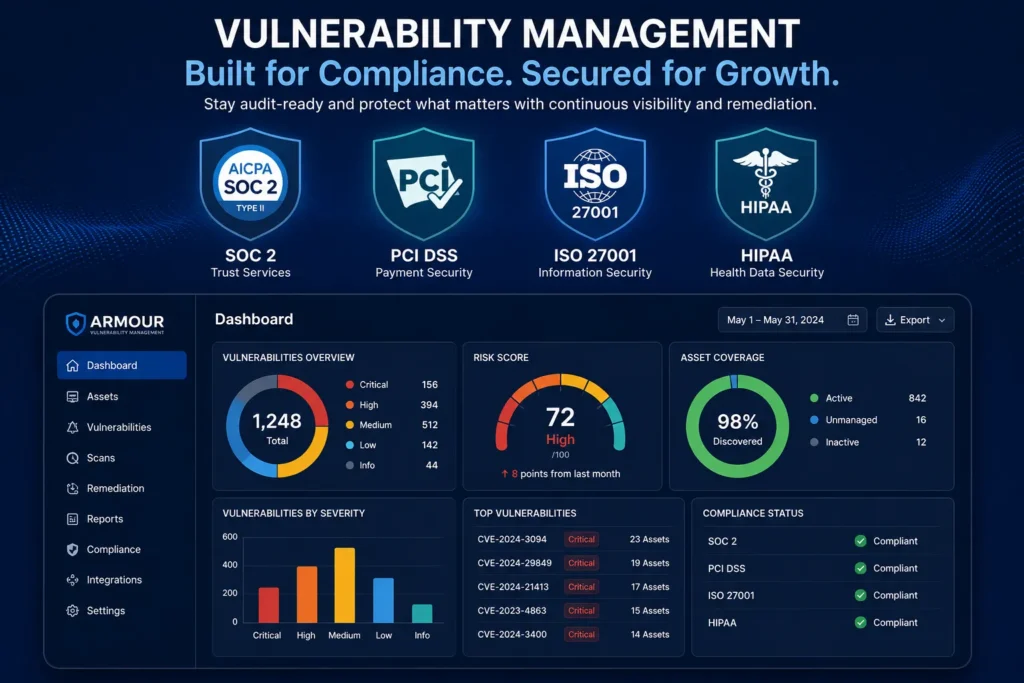
Armour Cybersecurity’s vulnerability management program uses a framework-agnostic methodology mapped to the requirements of whichever standards apply to the organization. Monthly and quarterly reports can be structured to align with specific framework language, and the evidence produced covers the requirements of multiple frameworks simultaneously. An organization pursuing SOC 2 certification while also satisfying PCI DSS requirements and renewing its cyber insurance policy does not need three separate programs. One continuous managed program, properly structured, satisfies all three.
For SMBs navigating compliance for the first time, the vulnerability management program also provides a foundation for the broader governance and compliance program. The asset inventory, risk register, and documented controls produced by the program are inputs to the governance work required by ISO 27001 and SOC 2, reducing duplicate effort. It integrates directly into an integrated compliance audit program where several frameworks are pursued together.
Armour supports 260+ clients across 52+ industries through audits and insurance renewals, and the single most common gap we see is not a missing scan. It is missing evidence that findings were actually remediated and verified.
The Bottom Line
Compliance is no longer satisfied by a scan report in a folder. Auditors and carriers now want evidence of an ongoing program: assets, cadence, prioritization, and proof that findings were fixed. Build that once, and it serves SOC 2, PCI DSS, ISO 27001, HIPAA, CMMC, and your insurance renewal at the same time. Armour’s managed vulnerability management produces that evidence as a standard deliverable, structured to the frameworks that apply to you.
Frequently Asked Questions
What evidence does an auditor typically request for vulnerability management?
A: Auditors commonly request: a current asset inventory showing all in-scope systems, scan reports from the audit period showing recurring coverage, a remediation process document defining timelines and ownership, records showing remediation activity against specific findings, and evidence of follow-up scanning confirming that critical findings were resolved. The exact requirements vary by framework and auditor, but these categories are consistent across SOC 2, ISO 27001, and PCI DSS engagements.
How does HIPAA relate to vulnerability management for healthcare businesses?
A: The HIPAA Security Rule requires covered entities and business associates to implement procedures to guard against and detect malicious software, as well as to regularly review information system activity. While HIPAA does not specify vulnerability scanning explicitly, auditors and Department of Health and Human Services guidance both treat vulnerability management as a required element of a compliant security program. The evidence produced by a managed program supports HIPAA compliance documentation.
What is CMMC and what does it require for vulnerability management?
A: CMMC, the Cybersecurity Maturity Model Certification, is required for organizations in the U.S. defense industrial base. It incorporates vulnerability management requirements from NIST SP 800-171, including periodic scanning, remediation of vulnerabilities in accordance with defined risk assessments, and updates to scanning tools. CMMC Level 2 requires documented practices and policies for vulnerability management that can be assessed by a third-party organization.
Will having a vulnerability management program reduce our cyber insurance premium?
A: In many cases, yes. Carriers view continuous vulnerability management with documented remediation as a risk reduction factor that supports lower premiums and broader coverage. The specific impact depends on the carrier, the current premium, and the overall security posture of the organization. The more significant financial benefit is typically avoiding premium increases or coverage restrictions that carriers impose on organizations that cannot demonstrate adequate vulnerability management.
How quickly do we need to remediate critical vulnerabilities under PCI DSS?
A: PCI DSS v4.0 requires critical patches to be deployed within one month of release. For vulnerabilities with CVSS scores of 9.0 and above, the practical expectation from assessors is typically faster, often within two weeks when exploits are publicly available. The program must be able to demonstrate, with documented evidence, that high-severity findings are being addressed within these windows.
About the Author
David Chernitzky is the CEO and Co-Founder of Armour Cybersecurity, a Toronto-based firm that protects organizations across North America from advanced cyber threats. He brings more than 25 years of cybersecurity and military cyber intelligence experience, having served as an officer in an elite technology unit before co-founding Armour. Armour’s team of military-intelligence veterans and senior advisors serves 260+ clients across 52+ industries with a 97% client retention rate.