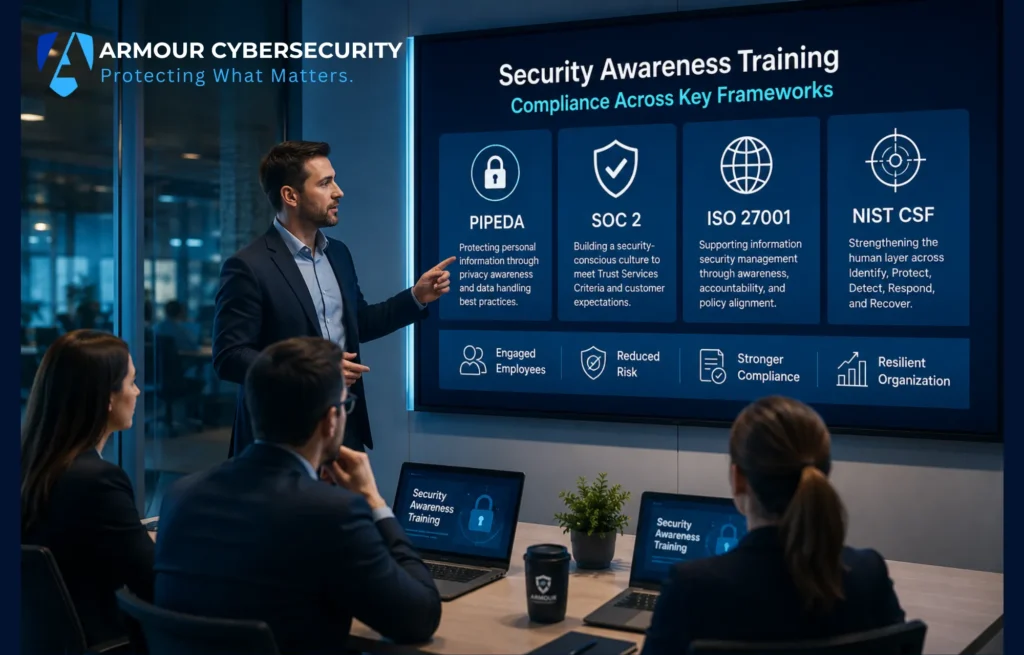
Quick answer: PIPEDA, SOC 2, ISO 27001, and NIST CSF all require security awareness training, and all four have moved in the same direction: toward continuous, role-based, documented programs and away from once-a-year completion tracking. SOC 2 Type II and ISO 27001:2022 in particular require evidence that the program operated and was updated over time, which an annual course cannot provide.
Key Takeaways
- All four frameworks require awareness training, and all four now expect it to be continuous and documented, not annual.
- SOC 2 Type II covers a 12-month period, so it requires evidence the program operated throughout, not a single event.
- ISO 27001:2022 (Clause 7.3 and Annex A 6.3) explicitly requires ongoing, role-appropriate awareness that is updated regularly.
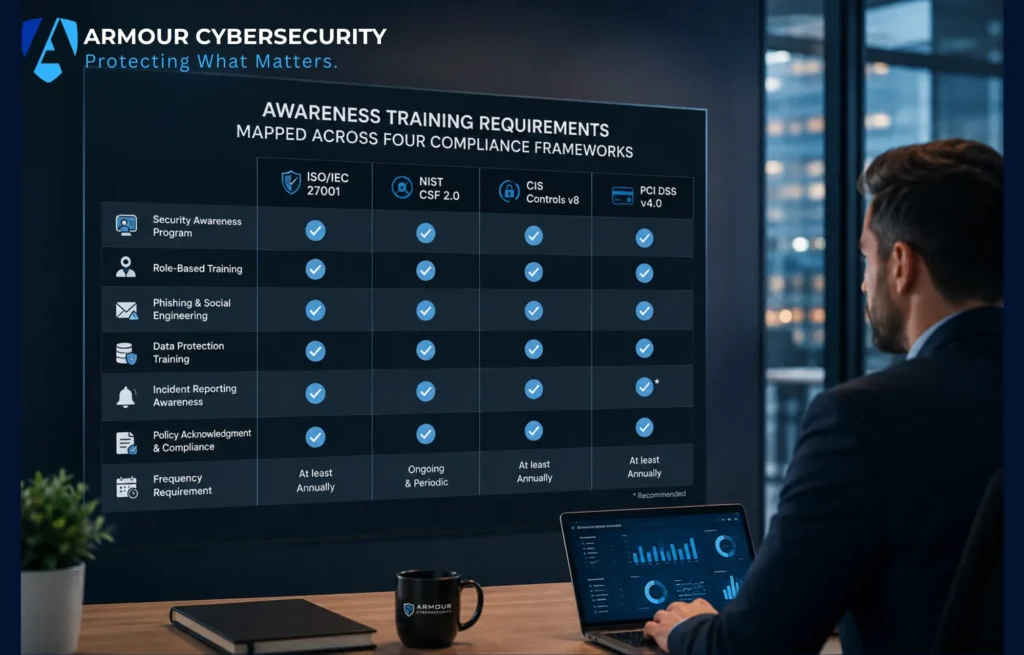
- The four frameworks converge: continuous, role-differentiated, evidenced over time, and updated to current threats.
- One well-designed managed program satisfies all four and produces the audit evidence as a byproduct.
Compliance is a floor, not a ceiling. But understanding exactly what the floor requires matters, both for organizations building a program for the first time and for those trying to determine whether their existing program will survive an audit.
The four frameworks that govern security awareness obligations for most North American mid-market organizations, PIPEDA, SOC 2, ISO 27001, and NIST CSF, each address human-risk controls differently. What they share is a direction of travel: toward continuous, documented, and demonstrably effective programs, and away from once-a-year completion tracking, the same shift behind a modern continuous awareness program.
PIPEDA: The Privacy Obligation Has a Security Dimension
Canada’s Personal Information Protection and Electronic Documents Act does not prescribe specific technical controls, but its accountability principle, Principle 1 of Schedule 1, requires organizations to implement policies and procedures to protect personal information, and to make those policies and procedures known to their employees.
The Office of the Privacy Commissioner’s enforcement decisions and guidance documents make the connection explicit: organizations that experience a data breach attributable to an employee’s failure to recognize a phishing attack, improperly handle personal data, or follow documented security procedures face findings of non-compliance with PIPEDA’s safeguards principle, regardless of whether they ran annual training.
What regulators look for in a PIPEDA-compliant awareness program is not a completion certificate. It is evidence that the organization has taken reasonable and ongoing steps to ensure employees understand their obligations with respect to personal information, and that the program is reviewed and updated as the threat environment changes.
What auditors want to see
Documented training policy covering all employees who handle personal information, evidence of role-based content for high-exposure roles, records of training completion and simulation results, and documentation of the process for updating content when obligations or threats change.
SOC 2: Continuous Control Effectiveness Is the Standard
SOC 2 is a trust services criteria framework, not a prescriptive standard. The criteria most directly relevant to security awareness sit under CC1 (Control Environment) and CC2 (Communication and Information), with additional implications under CC6 (Logical and Physical Access Controls) and CC9 (Risk Mitigation).
CC1.4 requires the organization to demonstrate a commitment to competence, including ensuring that employees understand their role in the internal control environment. CC2.2 requires the organization to communicate internal control responsibilities to those responsible for executing them. For a SOC 2 Type II audit, which covers a twelve-month observation period, these criteria require evidence of ongoing awareness activity, not a single annual event.
The Type II distinction is critical. A Type I audit assesses whether controls exist at a point in time. A Type II audit assesses whether controls operated effectively over the observation period. An annual training course, by definition, satisfies the Type I bar and fails the Type II bar for most controls that require continuous operation, which is why continuous programs increasingly pair with formal compliance readiness.
SOC 2 auditors reviewing an awareness program want to see: a documented training program with defined scope and frequency, evidence of completion rates and simulation results across the observation period, records of remediation for employees who failed phishing simulations repeatedly, and evidence that the program was reviewed and updated during the period.
SOC 2 Type II requires evidence of continuous control operation across a 12-month period. A once-a-year course satisfies Type I, not Type II.
ISO 27001:2022 Annex A 6.3 and Clause 7.3 require ongoing, role-appropriate awareness that is updated regularly, not just initial training.
NIST CSF 2.0 the new Govern function raises the oversight and accountability bar that awareness (PR.AT) programs must now answer to.
ISO 27001:2022: Awareness Is Explicitly Continuous
ISO 27001:2022 addresses security awareness directly in two places: Clause 7.3 (Awareness) and Annex A Control 6.3 (Information Security Awareness, Education and Training). The 2022 revision, now the operative certification basis, strengthened the language around awareness to make clear that it is an ongoing organizational obligation, not a periodic event.
Clause 7.3 requires that persons doing work under the organization’s control are aware of the information security policy, their contribution to the effectiveness of the information security management system, and the implications of not conforming with ISMS requirements. Annex A 6.3 requires that security awareness, education and training be appropriate to job function and be updated regularly.
The phrase “updated regularly” has been interpreted by certification bodies to mean that the program must demonstrate substantive content updates, not just the same annual module with a refreshed date stamp. Organizations seeking or maintaining ISO 27001 certification need evidence that their awareness program was reviewed, updated to reflect current threats, and delivered in a manner appropriate to the roles receiving it.
Common audit findings under ISO 27001
Certification auditors routinely flag the following as nonconformities in awareness programs: training content not updated in more than twelve months, no evidence of role differentiation in content delivery, absence of simulated phishing or equivalent exercises, no documented process for addressing employees who fail repeated tests, and completion records that cannot be tied to a specific version of the training content.
NIST CSF 2.0: Awareness Under a Stronger Governance Lens
The 2024 update to the NIST Cybersecurity Framework introduced a sixth function, Govern (GV), that elevated risk governance to a first-class organizational responsibility alongside Identify, Protect, Detect, Respond, and Recover. Security awareness and training itself sits under the Protect function as PR.AT (Awareness and Training), but the new Govern function reframes how that control is expected to be overseen.
The placement of Govern at the top of the framework is deliberate. NIST is signaling that awareness is not a purely operational security activity. It is a control that should receive board-level attention, documented policy, and executive accountability under the organization’s governance structure, rather than being delegated and forgotten.
The subcategories under PR.AT require awareness and training for all workforce members, role-based training for those with privileged access or elevated responsibilities, and, read alongside the Govern function, documented oversight of how awareness gaps are identified and addressed. The framework explicitly anticipates simulation exercises and ongoing reinforcement as components of a mature awareness program, informed by current cyber threat intelligence.
What All Four Frameworks Have in Common
Despite their different origins and scope, PIPEDA, SOC 2, ISO 27001, and NIST CSF converge on the same structural requirements for a defensible security awareness program: the program must be continuous, not episodic; it must be role-differentiated, not uniform; it must produce documented evidence of effectiveness over time; and it must be reviewed and updated to reflect the current threat environment.
An awareness program that satisfies all four frameworks simultaneously is not a theoretical construct. It is a well-designed managed program that generates compliance evidence as a byproduct of doing the security work correctly, and it slots into a broader integrated compliance audit program. Organizations that try to build four separate compliance responses to four separate frameworks typically end up with more administrative overhead and weaker security outcomes than those that build one continuous program mapped to all four from the outset. The same measurement discipline that proves awareness training ROI also produces the audit trail.
Preparing for the Audit Conversation
When an auditor, whether a SOC 2 assessor, an ISO 27001 certification body, an OPC investigator, or a NIST-based government contractor review, asks for evidence of your security awareness program, the conversation goes better if you can produce: a documented program scope and policy, monthly phishing simulation results with per-user and per-department data, evidence of teachable moment delivery and repeat-clicker escalation, role-based training completion records, content update logs, and a risk score trend showing measurable improvement. Governance ownership of that evidence is exactly what a vCISO provides.
A well-managed program generates every one of those artefacts automatically. The audit preparation conversation changes from “what do we have” to “which format does the auditor prefer.”
Armour supports 260+ clients across 52+ industries through SOC 2, ISO 27001, and PIPEDA reviews, and the most common awareness finding is never a missing course. It is missing evidence that the program ran continuously and was updated during the period.
The Bottom Line
Every framework that matters for North American mid-market organizations now expects the same thing: a continuous, role-based, documented awareness program that can prove it worked over time. Build four separate compliance responses and you get overhead and gaps. Build one continuous program mapped to all four and the audit evidence is a byproduct. Armour’s managed cyber awareness training is mapped to PIPEDA, SOC 2, ISO 27001, and NIST CSF from day one. Schedule a discovery call to discuss your compliance obligations and audit timeline.
Awareness training rarely works alone. It is one pillar of Armour’s managed cybersecurity services, operating alongside a managed Security Operations Center for detection, cyber threat intelligence on live adversary behaviour, vulnerability management for the technical layer, vCISO leadership for governance, and the all-in-one Armour 360 managed program.
Frequently Asked Questions
Does PIPEDA require security awareness training?
A: PIPEDA does not prescribe specific technical controls, but its accountability principle requires organizations to implement policies to protect personal information and make them known to employees, and its safeguards principle requires reasonable protection. The Office of the Privacy Commissioner treats a breach caused by an employee’s failure to follow security procedures as a compliance failure, so ongoing, documented awareness training is effectively required in practice.
What does SOC 2 require for security awareness training?
A: SOC 2’s relevant criteria sit mainly under CC1 (Control Environment) and CC2 (Communication and Information). For a SOC 2 Type II report, which covers a 12-month observation period, auditors need evidence that awareness activity operated continuously through the period: a documented program, completion and simulation results across the window, remediation records for repeat failures, and evidence the program was reviewed and updated. A single annual course typically fails the Type II bar.
Does ISO 27001 require ongoing security awareness training?
A: Yes. ISO 27001:2022 addresses awareness in Clause 7.3 and Annex A Control 6.3, and the 2022 revision strengthened the expectation that awareness is continuous and role-appropriate, updated regularly rather than repeated as the same annual module. Certification bodies interpret “updated regularly” to require substantive content changes, and routinely flag stale or undifferentiated training as a nonconformity.
Can one awareness program satisfy PIPEDA, SOC 2, ISO 27001, and NIST CSF at once?
A: Yes, and it is usually the better approach. All four converge on the same structural requirements: continuous, role-differentiated, evidenced over time, and updated to current threats. A single managed program mapped to all four from the outset produces the evidence each framework needs as a byproduct, with less overhead and stronger security than building four separate compliance responses.
What evidence do auditors want for a security awareness program?
A: Commonly: a documented program scope and policy, monthly phishing simulation results with per-user and per-department data, evidence of teachable-moment delivery and repeat-clicker escalation, role-based completion records, content update logs, and a risk-score trend showing measurable improvement over time. A well-managed continuous program generates all of these automatically rather than assembling them before an audit.
About the Author
David Chernitzky is the CEO and Co-Founder of Armour Cybersecurity, a Toronto-based firm that protects organizations across North America from advanced cyber threats. He brings more than 25 years of cybersecurity and military cyber intelligence experience, having served as an officer in an elite technology unit before co-founding Armour. Armour’s team of military-intelligence veterans and senior advisors serves 260+ clients across 52+ industries with a 97% client retention rate.