By David Chernitzky, CEO, Armour Cybersecurity · Serving organizations across North America · Last updated August 2026
| Quick Answer Most boards receive their entire view of cyber risk from one source: the CISO. That single-source arrangement means the same person who owns the security program also frames the board’s understanding of it.An independent cybersecurity board advisor gives directors a second voice that reports to the board, not to management. It provides external benchmarking, financial risk framing, and the governance challenge that effective oversight requires. |
Key Takeaways
- Single-source board briefings are a structural governance weakness. When the board’s entire view of cyber risk comes from the CISO, the board has no way to independently evaluate whether management’s characterization is accurate, complete, or framed to serve governance.
- Independent advisory is not an indictment of the CISO. A strong CISO runs a strong program. Independent advisory gives the board an outside view of that program, the way an external auditor gives the audit committee an outside view of financial management.
- The board advisor operates at the governance layer, not the technical layer. The role is to translate posture into risk language, provide comparative benchmarks, and frame the questions directors should be asking, not to manage security.
- Independent oversight matters most in two moments: when the board is judging whether the CISO’s risk picture is complete, and when a material incident has occurred and the board needs to evaluate management’s response without relying solely on management’s account.
- The standard regulators and shareholders now apply to boards resembles the standard for financial oversight: not just that management reported, but that the board independently evaluated what was reported.
An independent cybersecurity board advisor solves a problem most boards do not realize they have: their entire understanding of cyber risk is filtered through the one executive who also owns the outcome. This is not about distrust, it is about structure, the same reason audit committees rely on external auditors rather than the CFO’s word alone. Pairing an independent voice with strong internal leadership is what turns a board briefing into genuine board cyber governance.
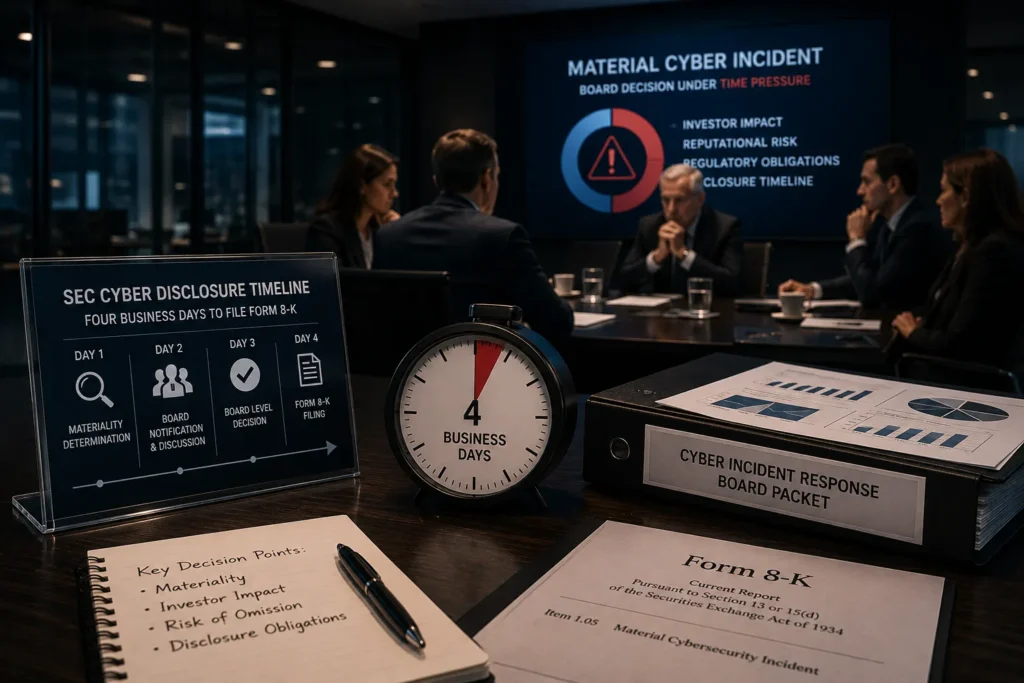
| By the Numbers$4.44M. The global average cost of a data breach in 2025, rising to $10.22M in the United States, the scale that makes cyber a board-level financial risk, not an IT line item. Source: IBM Cost of a Data Breach Report 2025.4 business days. The SEC window for a public company to disclose a material cyber incident, the speed at which a board must be able to evaluate management’s account of an incident. Source: SEC final rule, 2023.~60%. The share of breaches involving a human element, a reminder that cyber risk is an organizational and governance problem, not only a technical one. Source: Verizon 2025 Data Breach Investigations Report. |
The Structural Problem with CISO-Only Board Briefings
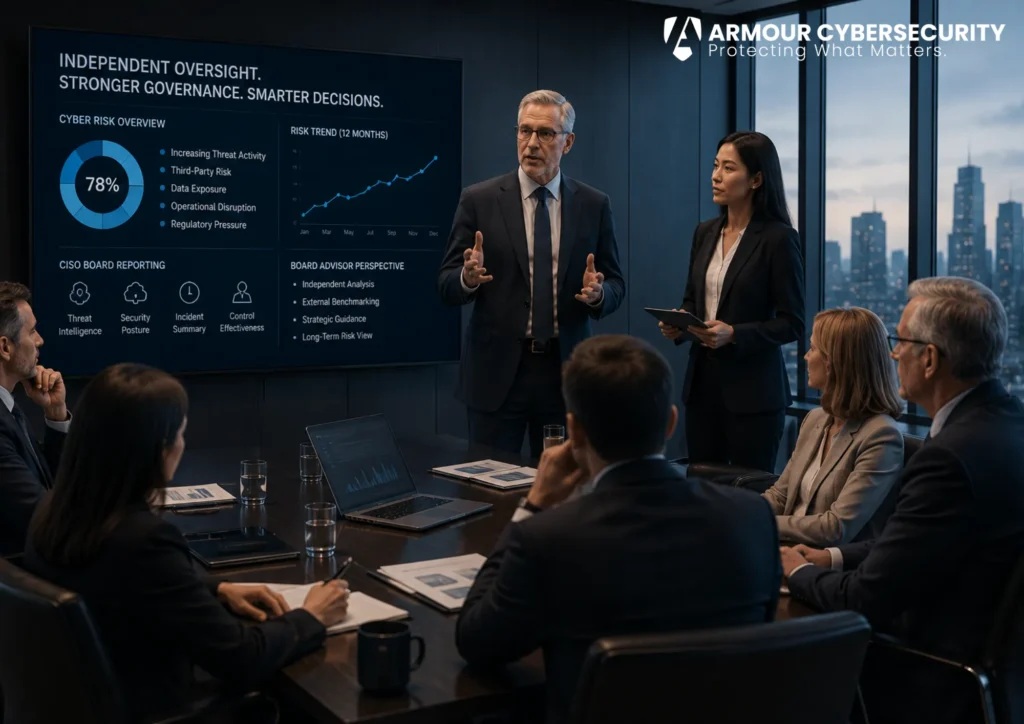
The typical board cyber briefing follows a familiar pattern. The CISO, or sometimes the CIO, prepares a presentation covering recent incidents, security metrics, ongoing projects, and an assessment of risk. The board listens, asks a few questions from the limited technical vantage point directors typically occupy, and concludes. The CISO leaves having briefed the board. The board leaves having received the briefing. Whether what the board heard was the complete picture, whether the risk characterization was accurate, whether the framing served the board’s governance function or management’s communication preferences, these questions remain unexamined.
This is not a criticism of CISOs. It is a description of the structural limitation of single-source briefings. In financial governance, the audit committee does not rely solely on the CFO’s account of the organization’s financial position; external auditors provide an independent view, and the committee can hear a perspective that is not filtered through management’s interest in presenting favorable information. No equivalent mechanism exists in most boards’ cyber governance. The CISO is the only voice in the room, and directors lack the technical depth to challenge the narrative independently.
What Independent Cyber Advisory Actually Does
Independent cyber advisory is not about finding fault with the CISO or suggesting management is dishonest. Most CISOs are highly capable professionals who report accurately on their programs. The value of independent advisory is not that it catches dishonest CISOs. It is that it gives the board a view of the risk picture that does not flow exclusively through management.
External benchmarking
An advisor who works across many organizations has comparative data the internal CISO does not. How does this organization’s security investment compare to peers of similar size and sector? Are the metrics management presents consistent with industry norms, or do they suggest gaps the briefing does not address? What are organizations at comparable maturity doing differently? That context is invisible to a board that hears only from its own management team.
Financial risk framing
The CISO’s natural language is technical: vulnerability counts, patch rates, control maturity scores, detection coverage. These are meaningful to security professionals but do not translate directly into the language the board uses to govern. The board governs risk in financial terms: the expected loss if a risk materializes, how it compares to other enterprise risks, and whether the investment is proportionate to the exposure. Independent advisory translates technical posture into that financial framing.
The questions management may not be asking
The advisor is not constrained by the boundaries of the CISO’s role. An independent voice can raise questions management’s structure makes awkward to surface: whether the security function has the resources and independence to do its job, whether the board’s risk appetite is actually reflected in investment decisions, whether the regulatory posture is adequate given the organization’s real obligations, and whether the incident response capability has been tested to a standard the board should accept. These are governance questions, and they belong at the board table.
Closed-session access
The advisor can brief directors in closed session, without management present. That creates a channel for directors to discuss cyber risk candidly, surface concerns about management’s approach or the completeness of what they have received, and get an independent assessment free of the dynamic that attends management’s presence. Audit committees use closed sessions with external auditors for exactly this reason; applied to cyber oversight, it gives directors the independence genuine governance requires.
How the Board Advisor and CISO Work Together
The relationship is complementary, not adversarial. The CISO continues to run the security program and present management’s view. The advisor provides independent perspective, context, and challenge. Together they give the board a complete picture: management’s account of the program and an independent view of the risk.
In practice, the advisor typically meets with the CISO and security team as part of the quarterly engagement, reviews the materials management will present, and identifies the questions and context directors will need. The advisor then brings that independent perspective to the board session. The arrangement works best when the CISO sees independent advisory as support for the board’s oversight rather than scrutiny of the CISO personally, and it pairs naturally with a vCISO who runs the program from inside management while the advisor oversees from outside it.
When Independent Oversight Matters Most
The value is consistent across the quarterly cadence, but it is most visible in two moments. The first is when the board is assessing whether its understanding of the risk picture is complete. A board that has relied exclusively on management briefings has no external reference point for judging whether what it has been told reflects the organization’s actual exposure. An independent advisor provides that reference point.
The second is a material incident. When a breach occurs, the board turns to management for what happened, how serious it is, and what is being done, at the exact moment management is under pressure to contain the incident, manage communications, engage legal counsel, and brief the board. The completeness of management’s account in the first hours is constrained by all of those pressures. An advisor who already knows the organization’s posture, has a standing relationship with the board, and has no stake in management’s account can provide independent context precisely when it matters most.
Where This Fits in Armour’s Services
Armour’s board advisory operates at the governance layer, reporting to the board or audit committee and providing the independent perspective, financial risk framing, and structured quarterly cadence that turns board cyber briefings from management updates into active governance. It complements, rather than replaces, the advisory and vCISO work that supports management directly.
The Bottom Line
A strong CISO and an independent board advisor are not competing choices; they are the two halves of real oversight. The boards with the fewest regrets after a serious incident are the ones that had an outside reference point in the room before it happened. If your board wants a second, independent voice on cyber risk, Armour’s board advisory services are built to provide exactly that.
Frequently Asked Questions
What is an independent cybersecurity board advisor?
An independent cybersecurity board advisor is a cyber-risk advisor who reports to the board or a board committee rather than to management. Unlike the CISO, who owns and runs the security program, the advisor’s role is oversight support: translating technical posture into financial risk terms, providing external benchmarks, framing the governance questions directors should ask, and giving the board a view of cyber risk that does not flow exclusively through the management team being overseen.
How is a board advisor different from a vCISO?
A vCISO is a fractional executive who operates inside the organization, running or supporting the security program as part of management. A board advisor operates outside management, reporting to the board or a board committee. The vCISO’s client is management; the board advisor’s client is the board. Many organizations engage both, the vCISO runs the program and the board advisor provides the independent oversight layer. The roles are complementary and non-overlapping.
Does the board advisor attend every board meeting?
The standard cadence is quarterly, aligned with the board’s schedule, with a structured briefing at each session covering risk posture, regulatory developments, and the governance questions to address that quarter. Between sessions, the advisor is available for ad-hoc support when a material incident, regulatory change, M&A activity, or similar event needs independent counsel. Between-session frequency varies by organization and circumstances.
What happens if the board advisor’s assessment conflicts with the CISO’s?
Divergence between the advisor’s independent assessment and management’s account is exactly what independent advisory is designed to surface. When it happens, the board’s job is to understand the basis for the difference, ask management to address the identified gaps, and ensure the governance record reflects the board’s active engagement with the discrepancy. That is governance working correctly. A board that receives only management’s account has no way to know whether its understanding is complete or partial.
How do we make the case to the board for engaging an independent advisor?
The case rests on three pillars. Governance adequacy: regulatory expectations for board cyber oversight have risen, and a board that cannot show active, independent oversight faces growing exposure. Risk management: the financial consequence of a material breach warrants the same independent oversight the board applies to financial risk. Practical value: a board that receives structured, financially framed quarterly briefings from an independent advisor makes better decisions than one relying on management updates alone. The cost is modest relative to the value and the exposure it helps manage.
What should we look for when selecting a board cyber advisor?
The most important criteria are governance fluency and independence. The advisor needs to understand how boards work and how to translate technical risk into the language directors use, not just how security programs are built. Independence means no financial interest in the organization’s security-vendor decisions and no reporting line to management. Sector experience matters when the regulatory environment is complex. References from other boards the advisor has served are the most reliable signal of how the relationship works in practice.
About the Author
David Chernitzky is the CEO and Co-Founder of Armour Cybersecurity, a Toronto-based firm that protects organizations across North America from advanced cyber threats. He brings more than 25 years of cybersecurity and military cyber intelligence experience, having served as an officer in an elite technology unit before co-founding Armour. Armour’s team of military-intelligence veterans and senior advisors serves 260+ clients across 52+ industries with a 97% client retention rate.