When security professionals analyze how the majority of cyberattacks unfold, a consistent pattern emerges: compromised identities. Whether through phishing, credential stuffing, password reuse, or insider threats, attackers frequently gain access to organizational systems not by defeating technical controls but by impersonating legitimate users. Once an attacker is operating under a valid identity, many traditional security tools become functionally blind to them.
Identity and Access Management (IAM) is the discipline of ensuring that the right people can access the right resources under the right conditions, and that everyone else cannot. In an era where organizational data and applications are distributed across cloud platforms, remote workforces, partner systems, and mobile devices, managing digital identities has become one of the most critical and complex aspects of cybersecurity.It is a core pillar of any robust managed cybersecurity services program.
This article examines what IAM is, how it works, why it matters, and what a strong identity security program looks like in practice.
Why Identity Has Become the New Security Perimeter
For decades, cybersecurity strategy was built around the concept of a network perimeter — a clear boundary between the inside of the organization, which was trusted, and the outside, which was not. Firewalls, VPNs, and network access controls enforced this boundary. If you were inside the perimeter, you were presumed to be legitimate.
That model has largely collapsed. Organizations now run applications on cloud platforms that sit outside any traditional perimeter. Employees work from home, on personal devices, over networks that IT does not control. Partners and contractors need access to specific internal systems. Sensitive data moves constantly between environments.
In this reality, where is the perimeter? The answer, increasingly, is identity. The user account — or more precisely, the verified identity behind it — is the primary control point for access. If identity management is weak, every other security control is potentially bypassed. If it is strong, the attack surface shrinks dramatically even in a complex, distributed environment. Identifying those gaps starts with a thorough cybersecurity risk assessment.

The Core Components of an IAM System
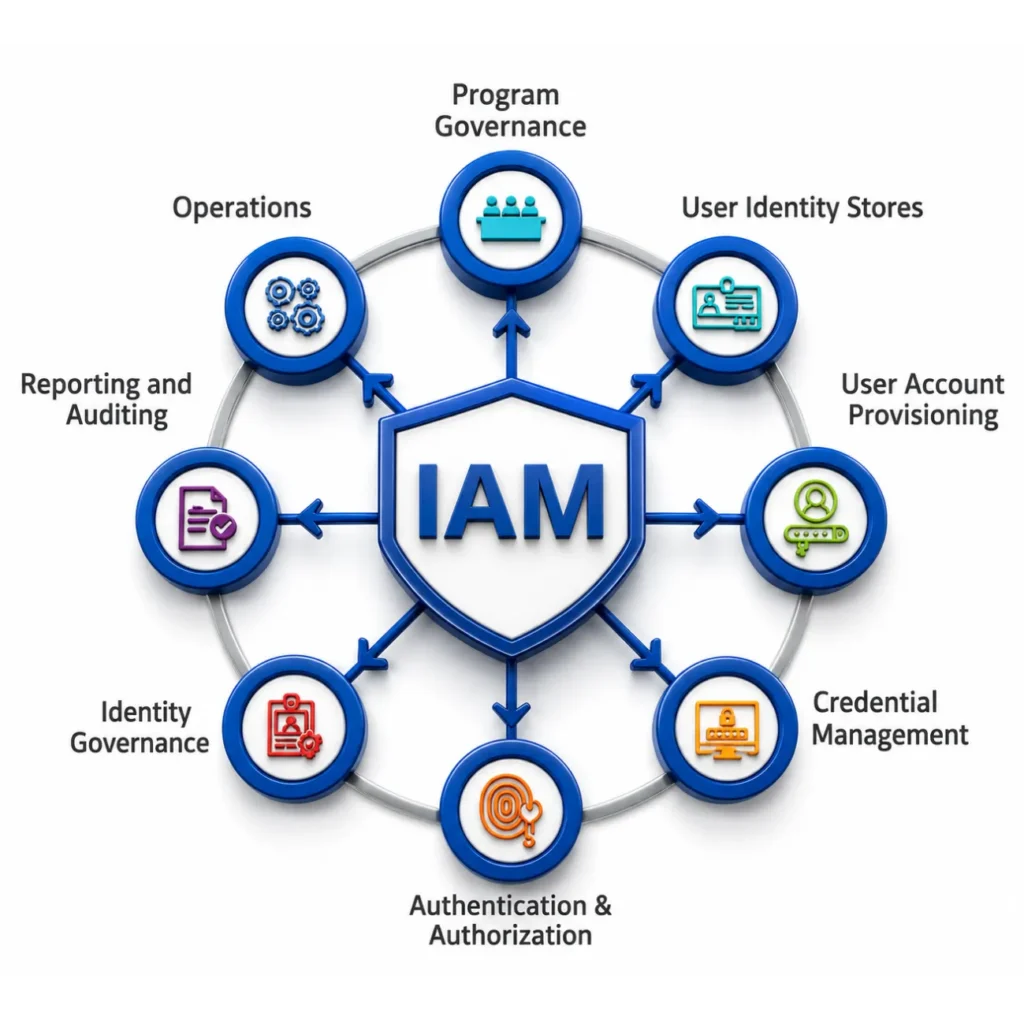
IAM is not a single product or technology but a framework of policies, processes, and tools that work together. Understanding the key components helps clarify what a mature IAM program actually includes.
Authentication
Authentication is the process of verifying that users are who they claim to be. Passwords alone have proven insufficient — they can be guessed, stolen, reused, or phished. Strong authentication requires additional verification factors, making it much harder for attackers to impersonate legitimate users even if they obtain credentials.
Multi-factor authentication (MFA) adds a second layer of verification — typically something the user has, like a code from an authenticator app or a hardware token, in addition to something they know, like a password. MFA consistently ranks among the single most effective security controls available, blocking the vast majority of automated credential-based attacks.Selecting and deploying the right MFA approach is something organisations typically work through with cybersecurity advisory services.
More advanced authentication approaches include passwordless authentication using biometrics or hardware keys, adaptive authentication that adjusts requirements based on risk signals like unusual login locations or devices, and single sign-on (SSO) that allows users to authenticate once and access multiple applications without re-entering credentials.
Authorization
Authorization determines what authenticated users are permitted to do. Being verified as a real employee does not mean having unrestricted access to all company systems. Authorization controls enforce the principle of least privilege: users should have access only to the specific resources needed to perform their job responsibilities — nothing more.
Role-based access control (RBAC) assigns permissions based on job roles rather than individual user accounts. An accounts payable clerk has access to financial systems appropriate to their function. A software developer has access to development tools and repositories. Neither has access to the other’s systems.
Attribute-based access control (ABAC) is a more granular model that considers additional context — the user’s location, the device they are using, the time of day — when making access decisions. This allows organizations to implement nuanced policies like allowing remote access only from managed corporate devices, or restricting access to sensitive systems outside business hours.
Identity Governance
Identity governance encompasses the processes for managing user accounts throughout their lifecycle. When a new employee joins, appropriate accounts are provisioned quickly and consistently. When an employee’s role changes, their access is updated to reflect new responsibilities. When an employee leaves, their access is revoked promptly and completely.
Access reviews — periodic audits of who has access to what — are an important governance, risk and compliance control. They catch accounts that were provisioned appropriately but never cleaned up as roles changed, legacy accounts belonging to former employees, and service accounts with permissions far beyond what any legitimate use case requires.
Without consistent identity governance, organizations accumulate access entitlements over time. Each individual exception seems reasonable when it is granted, but the cumulative effect is an environment where far more people have far more access than they should — creating significant risk from both insider threats and compromised accounts.
What Is Privileged Access Management?
Privileged Access Management (PAM) is a specialized component of IAM focused on the highest-risk accounts in any organization: administrator accounts, service accounts, and any other credentials with elevated permissions. These accounts can modify systems, access sensitive data, manage other user accounts, and potentially take actions that affect the entire organization.
Because of their power, privileged accounts are prime targets for attackers. A compromised standard user account limits what an attacker can do. A compromised administrator account potentially gives them access to everything.
PAM solutions enforce strict controls around these accounts: requiring additional authentication, limiting when and how they can be used, recording sessions for audit purposes, and implementing just-in-time access so that elevated privileges are granted temporarily when needed rather than permanently. These controls significantly reduce the risk associated with privileged accounts even when credentials are compromised.
IAM and Zero Trust Architecture
Zero Trust is a security model built on the principle that no user, device, or system should be automatically trusted — even those already inside the network. Every access request must be verified based on identity, device health, location, and context before being granted.
IAM is the foundation that makes Zero Trust practically enforceable. Without strong identity verification and precise access controls, Zero Trust is an aspiration rather than an implementation. With a mature IAM program, organizations can make granular, context-aware access decisions that substantially reduce their attack surface.
For organizations moving toward a Zero Trust architecture, which is increasingly common as cloud adoption and remote work continue to expand, investing in IAM capabilities is the logical first priority.
Common IAM Failures and What They Cost
IAM weaknesses are consistently among the most significant contributors to security incidents. Common failures include lack of MFA on critical systems, failure to revoke access for departed employees, overly permissive accounts with administrator rights that are rarely needed, reuse of passwords across personal and corporate accounts, and poor management of service account credentials.
Each of these represents a concrete, exploitable opportunity for attackers. Credential-based attacks — phishing, credential stuffing, password spraying, succeed because authentication controls are weak. Insider threats cause disproportionate damage because access was never properly scoped or governed. Supply chain attacks succeed because third-party accounts had more access than they needed.
The costs of IAM failures are not abstract. They include regulatory penalties, breach notification obligations, legal liability, business disruption, and reputational damage that can take years to recover from, and the immediate cost of incident response services when a breach occurs.
Building a Strong Identity Security Program
A mature IAM program starts with understanding what identities exist in your environment, human and machine, employee and contractor, internal and federated and what access each currently has. From that baseline, organizations can evaluate whether existing access is appropriately scoped, implement missing controls like MFA and access reviews, and build the governance processes needed to maintain good hygiene over time.
Armour Cybersecurity works with organizations across Canada to implement identity and access management programs that reduce risk without creating friction for legitimate users. From MFA deployment to privileged access management and Zero Trust architecture, our cybersecurity consulting services bring both the technical depth and the practical experience needed to build identity security programs that work in real environments. Learn more at armourcyber.io.