By David Chernitzky, CEO, Armour Cybersecurity · Serving private clients and family offices across North America · Last updated August 21, 2026
Quick Answer
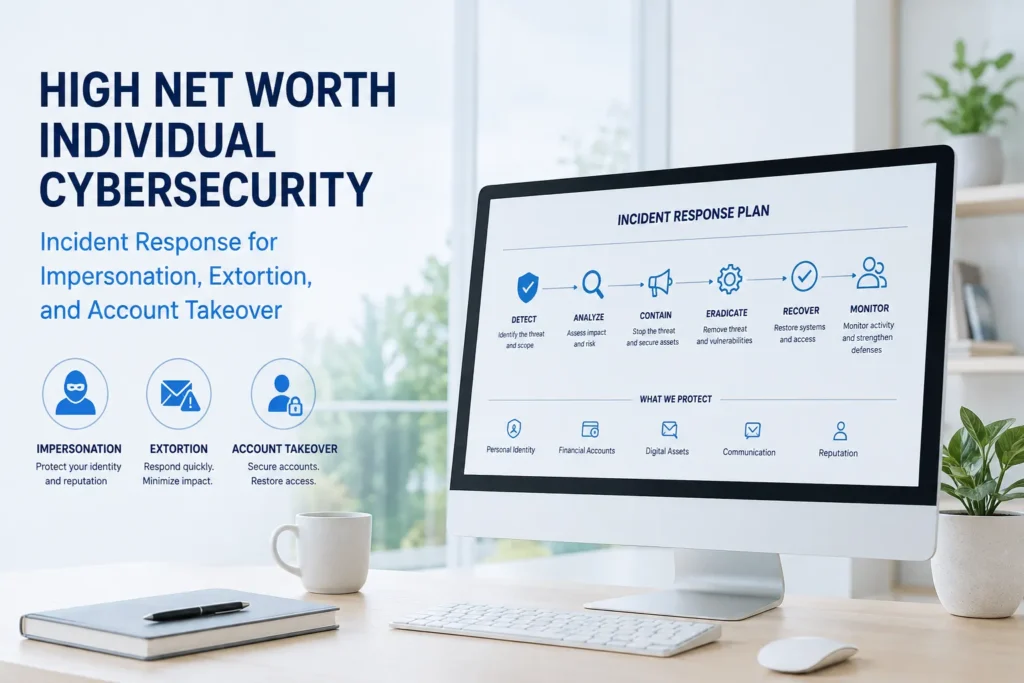
High net worth individual cybersecurity incident response is defined by the first 24 hours, because that window determines how much damage is contained. Impersonation campaigns left unanswered for days, while the victim works out who to call, reach wider audiences and cause more reputational harm. Extortion demands that are mishandled, paid without professional advice, engaged with emotionally, or escalated to law enforcement prematurely when that adds exposure, often end worse than a structured response. Account takeovers not detected promptly let attackers change recovery credentials, exfiltrate sensitive information, and use the compromised account to reach other family members and contacts. On-call response for HNWI clients means a team that engages immediately, assesses the incident type and scope, contains the damage through coordinated technical and advisory action, coordinates with legal counsel as directed, and produces the documentation the client needs without exposing the matter beyond the circle the client designates. It is the response layer of personal cybersecurity for high-net-worth individuals.
Key Takeaways
- Personal cyber incidents are not corporate IT incidents, and the response differs in every respect. The people affected are family members, not employees. The systems are personal devices and accounts, not corporate infrastructure. The legal considerations may include personal privacy, extortion, family, and reputational law rather than corporate breach notification. The documentation standard is confidential and personal. A team that handles corporate breaches all day is not automatically equipped to handle a targeted campaign against a private family with appropriate discretion.
- Impersonation is one of the most common and most underreported incident types targeting HNWIs. Fake social profiles using the principal’s name and photo, spoofed email addresses, and phone numbers used to impersonate the principal to family, advisors, or financial institutions all require structured response to contain and shut down. The damage is primarily reputational and relational: the impersonator messages people in the principal’s network while posing as the principal, damaging relationships and sometimes inducing transactions or disclosures.
- Extortion demands require immediate professional response and careful handling. The common scenarios threaten to publish sensitive personal information, intimate images, or reputationally damaging content unless a financial demand is met. Paying without guidance is almost always counterproductive: payment rarely ends the demand cycle, and it confirms the target will pay, which usually intensifies the campaign. Professional response assesses whether the threatened material actually exists as claimed, whether the actor is credible or bluffing, and what can be done to contain the threat and pursue remedies without making it worse.
- Account takeover in the HNWI context usually targets email, social media, and financial accounts. A compromised email gives an attacker years of correspondence with attorneys, wealth managers, family, and business contacts, a goldmine for social engineering, extortion, and fraud. A compromised social account enables impersonation and reputational attack. A compromised financial account may enable fraudulent transactions. Response means severing access immediately, assessing what was accessed or changed, notifying affected parties, and rebuilding account security to prevent re-entry.
- Evidence preservation is essential from the first moment. The instinct is to delete the threatening messages, shut down the compromised accounts, and move on, understandable, but counterproductive if any legal action is contemplated. Evidence deleted before it is documented cannot be used in proceedings. Alongside containment, the response team’s first priority is documenting the evidence, threatening messages, impersonation account details, extortion demands, and technical indicators, in a form legal counsel can use. The client decides whether to pursue legal action; the team’s job is to preserve the option.
Incident Types and How Each Is Handled
Impersonation campaigns
An impersonation campaign uses the principal’s identity, name, photo, voice, or contact information, to deceive others into believing they are communicating with the principal. The common forms are fake social media profiles, impersonating email accounts, and phone spoofing. Impersonation may be used for financial fraud against the principal’s contacts, for social engineering to extract sensitive information from family members or advisors, for reputational damage by having the impersonator make statements the principal never would, or as a precursor to other attacks.
The response begins with documentation of the impersonating accounts or communications, followed by immediate reporting and takedown requests to the platforms involved. Major social platforms have impersonation reporting processes; response times run from hours to days. While takedown proceeds, the response team notifies the principal’s inner circle, the family, advisors, and business contacts most likely to have been targeted, so they can verify any communications they received purportedly from the principal during the impersonation period. If any transactions or disclosures occurred in response to the impersonation, those are investigated and, where possible, reversed or mitigated.
Extortion and sextortion
Extortion targeting HNWIs typically takes one of three forms: threats to publish private financial or business information the attacker claims to hold; threats to publish intimate images or private content; or threats of physical harm unless a financial demand is met. Sextortion, threatened publication of intimate images, is increasingly common and disproportionately affects family members, particularly younger adults, rather than the principal directly, which is one reason it sits so close to family digital safety. Each form requires professional response for the same reason: the emotional distress makes it hard to assess the threat rationally, and the most instinctive responses, paying immediately, engaging directly with the attacker, or publicizing the threat, are frequently counterproductive.
Professional response to an extortion demand begins with assessment: does the attacker actually possess what they claim, or is the threat a bluff built from public sources? The strategy depends heavily on the answer. If the attacker does not have the content they claim, the appropriate response is very different from a case where the content exists and was obtained through a genuine compromise. Legal counsel is engaged immediately to advise on legal action, law enforcement involvement if appropriate, and any communication with the attacker. The response team manages the technical investigation and any content-removal process while counsel manages the legal strategy.
Account takeover
Account takeover recovery requires acting quickly on multiple fronts at once. The immediate priority is severing the attacker’s access: changing the account password and every linked recovery credential (backup email, phone number, authenticator app) to ones only the legitimate owner controls, reviewing and revoking any authorized applications or devices the attacker may have added, and enabling MFA with a stronger method if it was not already active. These steps must be done in the correct sequence; changing a password without securing the recovery pathways may simply redirect the attacker to the recovery path rather than locking them out.
Following containment, the team assesses what the attacker accessed or changed during the compromise. For an email account, that means reviewing sent messages, forwarding rules, and authorized app connections to understand what was exfiltrated or modified. For a financial account, transaction history and any changes to settings, beneficiaries, or linked accounts. For a social account, messages sent, profile changes, and posted content. The assessment produces a list of affected parties to notify and specific items, fraudulent transactions, sensitive messages sent to contacts, public profile changes, that need remediation, documented to the standard technical forensics work requires if the matter proceeds to legal action. Armour manages this end to end and coordinates with legal counsel as directed by the client.
How On-Call Response Is Structured
On-call cybersecurity for high-net-worth individuals incident response is available 24 hours a day. Initial engagement begins immediately on contact: the client or their designated representative, which may be the family office, the principal’s attorney, or another trusted advisor, reaches the response team and describes the situation. The team runs an initial triage call to understand the incident type, the parties affected, the current state, and any actions already taken. Based on triage, the right personnel are engaged and the response plan is set within the first hour.
Response communication runs over secure channels established during onboarding. Sensitive information about the incident, the affected parties, and the response actions is not transmitted over standard email. Documentation is maintained in the client’s confidential engagement record, outside corporate systems, accessible only to the personnel directly serving the engagement. If legal counsel is to be involved, the client specifies the engagement terms and the response team coordinates with counsel accordingly.
Post-incident, the team runs a review with the principal or family office covering what happened, what was done, what the outcome was, and what changes to the personal security program will reduce the risk of a similar incident. The review is documented at the level of detail the client wants to retain and used to update the incident response playbook. Many incidents reveal gaps in the existing program that, once closed, reduce the likelihood and impact of the next one significantly.
Frequently Asked Questions
Should we involve law enforcement when an incident occurs?
Whether to involve law enforcement is a decision that belongs to the client and their legal counsel, not to the incident response team. Law enforcement involvement has potential benefits, the possibility of identifying and prosecuting the attacker, and real costs, loss of control over the investigation, potential public disclosure of information the client wants to keep private, and the possibility that law enforcement action accelerates or escalates the attacker’s behavior before they can be contained. The response team preserves all options by documenting evidence in a form law enforcement can use if the client chooses to engage them, and by not taking actions that would compromise a future investigation. The recommendation to involve or not involve law enforcement is a legal strategy decision Armour defers to the client’s counsel.
What if the incident involves a family member rather than the principal directly?
Incidents involving family members are within the scope of the HNWI incident response program. A sextortion attack against an adult child, an account takeover targeting a spouse, or an impersonation campaign using a family member’s identity are all situations where the on-call team engages. The response is coordinated with the principal and, where the family member is an adult, with the family member directly. The same confidentiality and discretion standards apply to every family member in the program. For incidents involving minor children, the response is coordinated entirely with the parents and any relevant counsel, with no direct engagement with the child except as directed by the parents.
How do we prepare for incidents before they happen?
The most valuable preparation is the incident response playbook developed as a standard deliverable of the HNWI engagement. It documents the response procedure for each incident type likely to affect the principal, the contact chain for engaging the response team and legal counsel, the communication channels to be used, and the initial steps the principal or family office should take in the first minutes before the response team is fully engaged. Having a playbook means the first moments of an incident, when emotional distress is highest and clear thinking is hardest, are guided by a pre-established plan rather than improvised under pressure. The playbook is tested through the engagement review process and updated as the threat landscape and the family’s circumstances change.
What should we do in the first 15 minutes of a suspected incident?
The most important action in the first 15 minutes is to contact the incident response team and not to take any significant actions before doing so. The second is to preserve evidence: do not delete threatening messages, do not log out of a compromised account before the team can assess it, and do not send public statements or respond to attackers without guidance. The impulse to act immediately is understandable, but the actions most people take instinctively in the first minutes, deleting evidence, paying demands, making public statements, engaging emotionally with attackers, consistently make the situation harder to resolve. The response team’s first job is to assess and provide a structured plan; the client’s first job is to reach the team and hold the line until that plan is in place.
The Bottom Line
When a cyber incident targets you or your family, the outcome is decided less by the sophistication of the attack than by the quality and speed of the response. Impersonation, extortion, and account takeover each reward the same first moves, contact a team that engages immediately, preserve the evidence, and resist the instinct to delete, pay, or go public before there is a plan. The response has to be personal, confidential, and coordinated with your counsel, not run like a corporate breach ticket. Armour’s cybersecurity for high-net-worth individuals practice provides that 24-hour response, and pairs it with the playbook and program review that make the next incident less likely and less damaging.
About the author
David Chernitzky is the CEO and Co-Founder of Armour Cybersecurity, a Toronto-based firm that protects organizations and private clients across North America from advanced cyber threats. He brings more than 25 years of cybersecurity and military cyber intelligence experience, having served as an officer in an elite technology unit before co-founding Armour. Armour’s team of military-intelligence veterans and senior advisors serves 260+ clients across 52+ industries with a 97% client retention rate, and runs a dedicated HNWI practice built around the confidentiality private clients require. Learn more about Armour Cybersecurity.